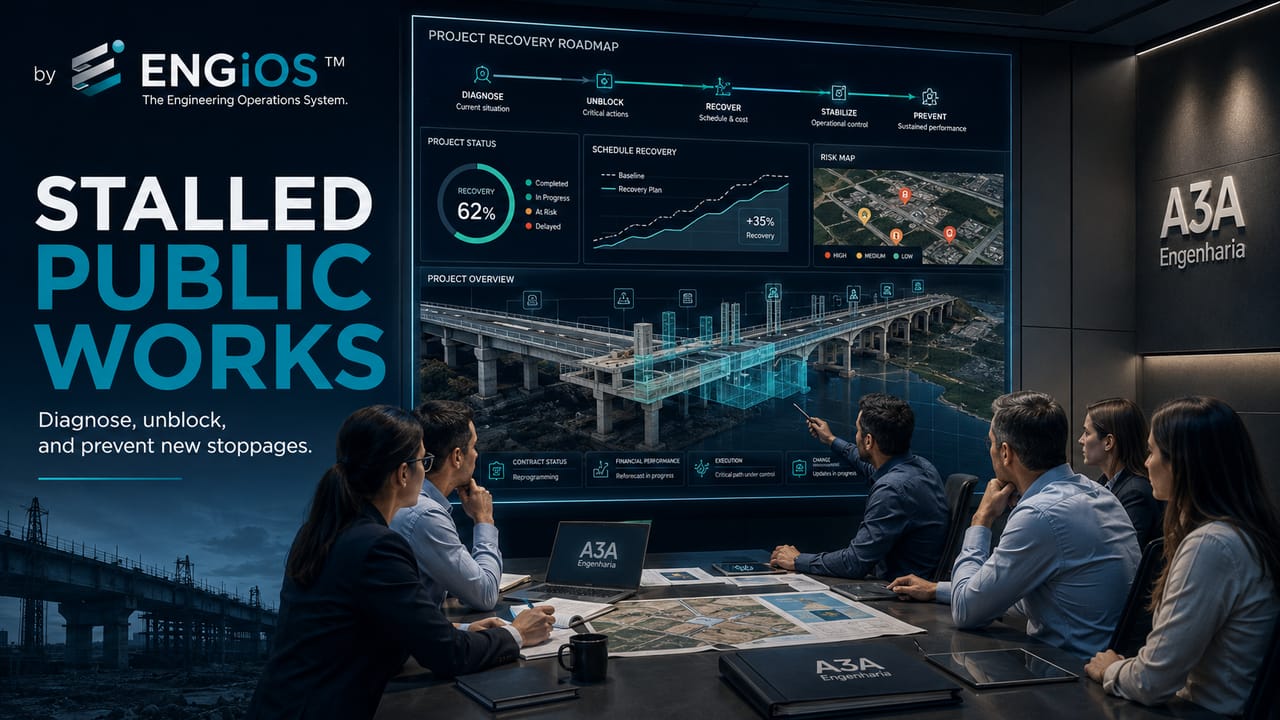
Complete guide to diagnosing, unblocking, and resuming stalled public works through design, budgeting, contractual strategy, oversight, and prevention of another stoppage.
Check it out!
A stalled public work should not be resumed merely because funding became available, a new administration took office, or there is pressure to reopen the site. The correct decision begins with a technical, contractual, financial, and documentary diagnosis capable of answering four questions: what actually exists, why execution stopped, which legal and technical route is viable, and how much it will cost to take the project to a truly operational condition. Without these answers, resumption may simply restart the cycle that produced the first stoppage.
To unblock a public project, the manager must reconstruct the project baseline, survey executed services and deterioration, review designs and budget, identify site and licensing constraints, assess the contract and responsibilities, define the physical-financial balance, choose among continuation, termination, procurement of the remaining scope, or restructuring, and prepare a new execution plan with governance, oversight, and acceptance criteria. To prevent another stoppage, the root causes must be addressed — not merely remobilize a construction contractor.
Why public works become stalled — and why diagnosis must be multidimensional
A stoppage rarely has a single cause. A contract may formally record “lack of funds,” “design problem,” or “termination,” but the final event is usually the result of an earlier chain of failures.
An immature design creates questions; questions lead to late decisions; late decisions shift the schedule; delays pressure costs; costs generate claims; unresolved claims reduce production; lower production affects measurement and cash flow; the contractual relationship deteriorates; eventually, the project stops.
The reverse path can also occur: funding arrives, but the public entity lacks the capacity to procure, oversee, and decide at the required speed. Or the site is not released. Or a permit depends on an unmet condition. Or the budget does not reflect the actual solution.
For this reason, a stalled public work should be analyzed across at least eight dimensions:
- public need and scope;
- physical condition;
- design and engineering;
- budget and remaining scope;
- contract, risks, and responsibilities;
- funding, transfers, and counterpart contributions;
- ownership, expropriation, and licensing;
- governance, oversight, and operational capacity.
The starting point is understanding the national and sector context. Stalled public works in Brazil: updated TCU map and most affected sectors shows the scale of the problem, while Unfinished works by sector explains why education, healthcare, sanitation, and infrastructure do not become stalled through the same mechanisms.
First: confirm whether the project is actually stalled and determine its administrative status
Before formulating a solution, the project’s status must be defined. A “stopped project” may describe very different situations: a formally suspended contract, de facto abandonment, a terminated contract, extremely low production, a court constraint, lack of funds, a completed phase without continuation, or a project with no current contract.
This classification changes the resumption path. A project with an active contract and formal suspension may require removal of the constraint and rescheduling. A project with an expired or terminated contract may require a remaining-scope survey, new procurement, and treatment of responsibilities. A physically completed project with untested systems may not be a case of construction resumption at all, but rather commissioning and operational readiness.
The manager should gather suspension acts, notices, measurements, amendments, work orders, opinions, meeting minutes, communications, transfer-instrument documents, and oversight records. The objective is to reconstruct the decision timeline.
Without this timeline, old problems reappear as if they were new, and the agency risks repeating analyses already performed or contradicting previous decisions.
Perform a technical diagnosis before choosing the resumption strategy
A safe resumption starts by reconstructing the baseline: physical condition, design, remaining scope, risks, contract, and completion path. Mobilizing before this diagnosis increases the likelihood of repeating the problem.
Learn about technical support for oversight and project resumption
The technical diagnosis must come before the political decision to “resume with the current contractor” or “launch a new tender.” It establishes the asset’s actual condition.
The article Technical diagnosis of a stalled public work details this approach. In practice, the diagnosis should verify:
- services actually executed;
- quality and compliance of what was built;
- deterioration during the stoppage;
- services that must be redone;
- stored materials and their condition;
- interferences and changes that occurred on site;
- alignment between the executed work and available designs;
- systems installed but not tested;
- documentation gaps;
- safety, stability, protection, and preservation risks.
The inspection must generate evidence. Unreferenced photographs, spreadsheets without criteria, and generic descriptions are insufficient to build a resumption budget or support accountability.
A survey of executed services and a condition assessment form the new baseline
After a stoppage, the historical contract spreadsheet no longer represents the project by itself. Three realities must be reconciled: what was contracted, what was measured and paid, and what physically exists.
The survey of executed services and condition assessment should identify quantities, condition, compliance, and usability.
This reconciliation is essential to avoid two serious errors: paying again for work already executed or treating as usable something that has lost performance and must be redone.
The assessment also supports dividing the scope into:
- completed and accepted;
- completed with pending items;
- partially executed;
- executed but noncompliant;
- deteriorated;
- not executed;
- required for completion although absent from the original scope.
This classification is what produces the true technical balance of the resumption.
The design must be reviewed for current conditions, not simply republished
A project stalled for months or years may have an outdated design because of changes in standards, physical conditions, technology, use, utilities, interferences, or the agency’s needs.
Before retendering, the Administration should verify whether the design still represents the desired solution and the actual site. The article No detailed design before construction? shows the limits of starting execution with insufficient definitions.
For projects that already presented problems during the first procurement, the risk of simply reusing documents is even greater. If the Terms of Reference, specifications, or design contributed to change orders and conflicts, they should be corrected before the new tender.
Two pieces of content are directly applicable to this review: How to write Terms of Reference for public works that do not turn into change orders and Technical review of Terms of Reference.
Recalculate the actual cost to complete
The remaining value of a terminated contract is not necessarily the cost to complete the project. After a stoppage, there may be deterioration, rework, inflation, mobilization, new requirements, quantity changes, omitted services, and costs associated with preserving what has already been executed.
The manager must build a resumption budget based on current conditions. The baseline should reconcile the reviewed design, physical survey, quantities, cost compositions, reference prices, and execution strategy.
How much does it cost to leave a project stalled for 12 months? helps show that the cost of inaction goes beyond inflation: it includes deterioration, security, demobilization, loss of warranties, administrative costs, and postponement of the public benefit.
When building the new budget, SINAPI, BDI for engineering works and services, and the distinction between overpricing, overbilling, and unfeasible pricing are also relevant.
Separate the cause of the stoppage from the consequences of the stoppage
A project stopped because of an incomplete design may, after several months, also show deterioration, price escalation, and loss of workforce. These new problems are consequences; correcting only them does not eliminate the root cause.
A useful analysis can organize causes into five groups.
Engineering
Incomplete design, incompatibilities, insufficient surveys, incorrect budgeting, ambiguous specifications, or an unfeasible solution.
Contract and market
Unfeasible pricing, an incapable contractor, inadequate risk allocation, insufficient guarantees, conflicts, and unresolved claims.
Institutional
Weak oversight, slow decision-making, changes in management, lack of processes, and insufficient operational capacity.
Financial
Interrupted transfers, unavailable counterpart funding, scheduling incompatible with disbursement, or blocked funds.
External
Licensing, expropriation, court decisions, interferences, utilities, climate events, or supervening events.
The resumption strategy must address the dominant causal group. Otherwise, the new contract inherits the same structural defect.
To structure this decision at public-management scale, the Public Works Management Guide organizes prevention, governance, and investment control, while the 7 Gates of Maturity for Public Engineering Investments Whitepaper formalizes decision and evidence criteria before moving from one stage to another.
Choose among continuation, termination, remaining-scope procurement, or restructuring
After diagnosis, the Administration must choose the completion route. There is no single solution for every project.
Continue the existing contract
This may make sense when the contract remains in force, the contractor retains capability, the constraint can be remedied, and the solution does not require a change incompatible with the original arrangement. In this case, the schedule must be reprogrammed, pending items resolved, and the basis for continuation documented.
Termination and new procurement
This may be necessary when there is serious default, continuation is unfeasible, the relationship has broken down, or the scope must be restructured. Termination requires care to define what was executed, values, materials, guarantees, and responsibilities.
Procurement of the remaining scope
The article Remaining work: how to procure what is left without inheriting the previous contract’s problems addresses the central point: the remaining scope must be technically reconstructed. It is not enough to subtract percentages from the old spreadsheet.
Project restructuring
In some cases, the best solution is to revise the scope, phase delivery, or change the concept before new procurement. This may occur when the public need has changed, the design has become obsolete, or the available budget can no longer support the original solution.
The decision should be recorded with the alternatives evaluated, impacts, risks, and technical basis.
Use a staged resumption protocol
Resumption works better when organized as a process rather than a sequence of emergencies. The 8-step technical protocol for resuming a stalled project can be summarized as a gate logic:
- gather history and documents;
- inspect and diagnose;
- survey executed work and condition;
- review design and scope;
- recalculate budget and remaining scope;
- define the contractual strategy;
- prepare procurement and governance;
- mobilize with an oversight, measurement, and acceptance plan.
The principle matters: no later stage should conceal a critical gap from an earlier one.
The resumption tender must correct what failed the first time
The new procurement must correct the design, tender documents, budget, and criteria that contributed to the previous stoppage. An independent review before retendering is a preventive barrier.
If the project stopped because of poor design quality, a new tender using the same design tends to repeat the problem. If it stopped because the contractor lacked capability, qualification criteria and feasibility analysis deserve review. If it stopped because of scope conflict, the tender documents need clearer criteria and responsibilities.
The cluster covers several selection-phase decisions. Can a reverse auction be used for public works? discusses procurement modality; Open vs. closed bidding mode addresses competitive dynamics; Prequalification for engineering works discusses prior capability screening; and Confidential budget analyzes when access to the estimated budget may be deferred.
When the tender returns a very low price, the Administration must assess feasibility methodically. Bid below 75% and the feasibility due-diligence procedure show how to build a technical decision instead of automatically accepting or excluding bids.
Guarantees can change continuity risk
For more complex works, guarantees should not be treated merely as a percentage in the tender. They are part of the risk strategy.
Law No. 14.133 provides specific mechanisms, including additional guarantees for bids within certain ranges and performance bonds with a step-in clause in legally defined circumstances.
Additional guarantee below 85% explains Article 59, §5. Performance bond with a step-in clause details step-in and the safeguards needed for the guarantee to be operationally useful.
A guarantee, however, does not correct a poor design or replace oversight. It is one layer of protection within a broader system.
The risk matrix must reflect the actual project
Resumption is an ideal moment to rebuild the risk map because the Administration already has evidence of what went wrong.
The risk-allocation matrix should address concrete events: known interferences, areas not yet released, geotechnical conditions, design still to be developed, interfaces with utilities, critical equipment, approvals, and external dependencies.
A known risk should not be hidden in a generic clause. It should be allocated to the party best positioned to control, avoid, or price the event.
Expropriation and licensing must be placed on the critical path
A project may have a design and funding and still be unable to advance. Expropriation and licensing in public works shows why these issues must be treated as schedule and procurement risks.
During resumption, it is necessary to verify whether permits remain valid, conditions have been met, the area is clear, and design changes require new approvals.
A work order should not be used to create the appearance of resumption when the main work front remains blocked by a known constraint.
Funding agreements and Transferegov require engineering and the transfer instrument to be synchronized
When a project is financed through a funding agreement or transfer contract, resumption cannot be handled only within the construction contract. The transfer instrument has its own schedule, work plan, rules, records, and conditions.
The guide Funding agreements in Transferegov for public works shows how basic design, the tender process, the contract, measurements, and monitoring connect within the system.
The counterpart contribution in funding agreements must be rescheduled together with the new timeline. Lack of local cash can stop a project even after federal funding has been unblocked.
Resumption also requires verifying the instrument’s validity, balances, yields, rescheduling, authorizations, and what must be formally updated before new services can be procured or paid.
Parliamentary amendments require the same engineering discipline
Funding originating from a parliamentary amendment does not reduce requirements for design, procurement, oversight, and accountability. Parliamentary amendments for public works distinguishes transfer mechanisms and shows why the budgetary source of funding does not replace technical structuring.
For stalled works, a new amendment may help restore funding, but it should not be used to finance an undefined balance. Diagnosis, scope, and completion budget must be closed first.
Novo PAC: selection and funding do not replace project structuring
Novo PAC also includes resumptions and new large-scale projects. Novo PAC and the structuring of public works projects discusses how to turn selection into an executable project.
For stalled works included in investment programs, the principle remains the same: funding accelerates the solution only when the scope is mature. Otherwise, pressure to execute may accelerate entry into a new contract without resolving old causes.
Structuring studies, design, budget, licenses, governance, and procurement is part of unblocking the project.
The public entity’s operational capacity may be the hidden cause
The cause does not always appear on the construction site. The public entity may simply lack enough staff to decide, oversee, update systems, process measurements, and respond at the speed of execution.
Operational capacity to execute grant-funded public works proposes assessing governance, engineering, procurement, oversight, finance, Transferegov, changes, and acceptance.
If resumption increases the volume of projects without strengthening institutional capacity, the bottleneck merely changes location: it moves from funding to management.
Oversight must be restructured before remobilization
A resumed project usually carries more risk than a new one. There are interfaces between old and new work, responsibility for already executed services, hidden conditions, and a history of conflict.
Oversight must begin with a clear baseline. How to oversee a public work organizes responsibilities, while Evidence-based oversight shows how to connect field activities to auditable records.
Indicators also help. KPIs for oversight and public-works management can guide monitoring of schedule, cost, pending items, RFIs, nonconformities, and decisions.
The oversight team should not discover its own procedures during resumption. Templates, workflows, and criteria need to be ready before the first new progress measurement.
Progress measurement is a technical, financial, and evidentiary control point
Measurement is not merely quantity multiplied by price. It represents the Administration’s assertion that a given service was executed in a condition consistent with the contract.
Public Works Progress Measurement Report shows how evidence, criteria, and acceptance support payments.
During resumptions, measurement must be even more disciplined because there is a risk of overlap between old and new services. The baseline must clearly identify boundaries and remaining quantities.
Changes and claims cannot return to informal handling
Many stoppages mature within a sequence of unresolved changes. During resumption, every change must follow a process with request, analysis, impact assessment, decision, and record.
Technical Analysis of Amendments, Scope Changes, and Claims applies when the Administration needs an independent basis for decision-making.
In suitable contracts, dispute-prevention mechanisms may also help. Dispute Boards in public works explains how boards can follow technical conflicts before they escalate.
The objective is not to eliminate disagreements; it is to prevent unresolved disagreements from blocking execution.
Fear of making decisions can also stall projects
There are situations in which the technical solution is known, but the decision is delayed because the public official perceives a high personal risk in signing it.
The “pen paralysis” phenomenon in public works must be addressed through governance: clear processes, technical analysis, alternatives, a responsibility matrix, opinions, and evidence.
The answer is not to reduce control. It is to increase decision quality and traceability so that the manager can act with a reasoned and defensible basis.
Do not consider resumption complete when the contractor leaves the site
Delivery must be functional. A project may reach 100% physical completion on a spreadsheet and still have systems that are not integrated, pending tests, incomplete documentation, and operations that are not prepared.
The Commissioning Plan for Public Works should define verifications, tests, responsibilities, and approval criteria.
Then, Operational Readiness verifies whether infrastructure, people, documentation, training, and maintenance are available to place the asset into service.
Acceptance under Article 140 of Law No. 14.133 should be treated as a technical gate, not as an automatic final signature.
Auditing final documentation prevents closure with hidden liabilities
As-Built records, manuals, certificates, test reports, ARTs/RRTs, warranties, and the data book are part of the delivered asset. When they are missing, the Administration takes over infrastructure it does not fully understand and that will be harder to maintain, expand, or audit.
Technical Audit of the Data Book and Final Engineering Documentation can verify integrity and consistency before final acceptance.
Document closure also protects future administrations, which will not depend on informal memory to understand decisions made during resumption.
How to prevent the project from stopping again
Resuming is half the problem. The other half is installing barriers against recurrence.
A preventive strategy should include:
- updated technical and financial baseline;
- integrated schedule with real dependencies;
- living risk matrix;
- decision governance;
- design under version control;
- evidence-based oversight;
- measurement with objective criteria;
- indicators and risk meetings;
- formal change control;
- cash-flow and counterpart-funding plan;
- active management of permits and interfaces;
- commissioning and acceptance defined from the outset.
The checklist Is your project heading toward a stoppage? 15 warning signs can be used as a monthly routine for early detection.
A minimum dashboard for the manager
There is no need to begin with dozens of KPIs. A resumption dashboard should answer a few critical questions every week.
| Question | Indicator |
| Are we producing at the planned pace? | actual vs. planned physical progress |
| Does spending track production? | financial vs. physical progress |
| Are decisions blocking work fronts? | number and age of critical pending items |
| Is the design stable? | open RFIs, revisions, and changes |
| Is quality under control? | open and recurring nonconformities |
| Can cash flow support the next milestones? | forecast of disbursement, transfers, and counterpart funding |
| Is the final date still achievable? | critical path and float |
| Is handover being prepared? | tests, data book, training, and pending items |
The dashboard is useful only if one rule is followed: a red indicator must produce an action, an owner, and a deadline. A dashboard without decisions merely digitizes the problem.
A 30-, 60-, and 90-day plan to unblock the project
A resumption can be organized into short horizons to create momentum without sacrificing diagnosis.
0 to 30 days: understand and stabilize
- consolidate history and documents;
- perform inspection and survey;
- identify preservation and safety risks;
- close out the contractual status and transfer-instrument status;
- map the site, permits, and constraints;
- freeze unauthorized interventions;
- produce a list of critical decisions.
31 to 60 days: redesign the completion path
- review design and scope;
- build the completion budget;
- define the contractual strategy;
- reschedule funding and counterpart contributions;
- update the risk matrix;
- define governance and the oversight team;
- prepare documentation for procurement or continuation.
61 to 90 days: procure or remobilize under control
- complete the tender documents or resumption instrument;
- establish the schedule baseline;
- prepare oversight and measurement templates;
- define change control;
- align Transferegov when applicable;
- approve the commissioning and final-documentation plan;
- begin execution only after critical work fronts are released.
The exact timeline varies. The logic matters more: diagnosis, decision, and preparation come before the rush to mobilize.
When engineering consulting makes a difference
Stalled works concentrate high-complexity decisions: what to reuse, what to redo, how much remains, who is responsible, which contract route to use, how to measure the remaining scope, and how to prevent another conflict. Many public administrations have capable professionals but cannot free enough multidisciplinary staff for an extraordinary resumption workload.
Engineering consulting can support independent diagnosis, design review, estimating, planning, tender documents, oversight, change analysis, commissioning, and documentation. Administrative decisions remain with the public agency; specialized support improves the technical basis for those decisions.
The Complete Guide to Engineering Consulting and the whitepaper Engineering Consulting Procurement with Traceability, Governance, and Cost Engineering examine models for structuring this support in greater depth.
Cluster map: where to explore each decision in depth
This guide functions as a hub. To explore a specific issue in depth, use the cluster’s specialized content.
Diagnosis and cause
- Stalled public works in Brazil: updated TCU map
- Unfinished works by sector
- How much does it cost to leave a project stalled for 12 months?
- Technical diagnosis of a stalled project
- 15-warning-sign checklist
Design and Terms of Reference
- No detailed design before construction?
- How to write Terms of Reference that do not turn into change orders
- Technical review of Terms of Reference
- Technical Specifications for Public Works
- Preparatory phase of procurement according to AGU/MGI
Budget and feasibility
- SINAPI: what it is and how to use it
- Bid below 75%
- Additional guarantee below 85%
- Overpricing, overbilling, and unfeasible pricing
- Price diving: artificial discounting, spreadsheet gaming, and change-order strategy
- Public-works budgeting: 18 components for an auditable process
- Reference budgeting and Article 23 of Law 14.133
Procurement and selection
- Can a reverse auction be used for public works?
- Open vs. closed bidding mode
- Prequalification for engineering works and services
- PMI for public projects and works
- Deserted vs. failed tender
- Confidential budget
- What the TCU reviews in the procurement of engineering works and services
- Technical-capability certificates in engineering procurement
Execution, risks, and conflicts
- Pen paralysis
- Performance bonds and step-in
- Dispute Boards in public works
- Contract amendments and change orders
- Technical analysis of amendments according to TCU and AGU
Resumption and handover
- 8-step technical protocol
- Survey of executed services and condition assessment
- Remaining scope
- Operational readiness
- Commissioning plan
- Expropriation and licensing
Funding agreements, amendments, and Novo PAC
- Counterpart contributions in public-works funding agreements
- Parliamentary amendments for public works
- Funding agreements in Transferegov for public works
- Operational capacity to execute grant-funded public works
- Novo PAC and public-works project structuring
Final considerations
Unblocking a public work is not the same as restarting the construction site. It means rebuilding the capability to complete the project. The manager must understand its physical and documentary condition, identify the root cause, review design and budget, define the contractual strategy, secure funding, resolve constraints, prepare oversight, and establish handover criteria.
The safest resumption is the one that creates a new verifiable baseline and closes the gaps that caused the first interruption. Urgency should be directed toward diagnosis and critical decisions, not premature mobilization.
When this process is executed with sufficient governance, evidence, and engineering, the Administration increases the likelihood of converting a stalled asset into infrastructure that is actually delivered — and reduces the chance of returning to the same point a few months later.
Resumption ends only when the infrastructure can be accepted and operated with testing, documentation, and pending items under control. Closing the construction site is not the same as closing the project.
Learn about technical acceptance of engineering works and services
Technical references
[1] BRASIL. Tribunal de Contas da União. Fiscobras 2025 — Relatório consolidado de fiscalização de obras públicas. 2025. Available at: https://portal.tcu.gov.br/publicacoes-institucionais/relatorio-de-fiscalizacao/fiscobras.
[2] BRASIL. Tribunal de Contas da União. Programa Integrado para Retomada de Obras Públicas (Destrava) — acordo de cooperação para retomada de obras paralisadas. 2026. Available at: https://portal.tcu.gov.br/imprensa/noticias/presidente-do-tcu-assina-acordo-para-retomada-de-obras-publicas-paralisadas.
[3] BRASIL. Lei nº 14.133, de 1º de abril de 2021 — Lei de Licitações e Contratos Administrativos. 2021. Available at: https://www.planalto.gov.br/ccivil_03/_ato2019-2022/2021/lei/l14133.htm.
[4] BRASIL. Decreto nº 7.983, de 8 de abril de 2013 — critérios para elaboração do orçamento de referência de obras e serviços de engenharia. 2013. Available at: https://www.planalto.gov.br/ccivil_03/_ato2011-2014/2013/decreto/d7983.htm.
[5] BRASIL. Ministério da Gestão e da Inovação em Serviços Públicos; Ministério da Fazenda; Controladoria-Geral da União. Portaria Conjunta MGI/MF/CGU nº 33, de 30 de agosto de 2023. 2023. Available at: https://www.gov.br/transferegov/pt-br/legislacao/portarias/portaria-conjunta-mgi-mf-cgu-no-33-de-30-de-agosto-de-2023.
[6] TRANSFEREGOV.BR. Módulo de Obras — manuais, tutoriais e fluxo de acompanhamento da execução. 2026. Available at: https://www.gov.br/transferegov/pt-br/manuais/transferegov/obras.
Frequently asked questions
Consolidate the documents and perform a technical diagnosis of the current condition before choosing the contractual solution. It is necessary to know what was executed, what can be reused, which services have deteriorated, what the actual remaining scope is, and what caused the stoppage.
That is not good practice. The remaining scope must be reconstructed from a physical survey, reviewed design, usable services, deterioration, quantities, and current budget. The old spreadsheet is historical evidence, not necessarily the current procurement scope.
When the contract remains in force, the constraint is remediable, the contractor retains capability, and continuation is legally and technically viable. The decision must assess risks, schedule, cost, responsibilities, and the need for changes.
By addressing root causes and creating barriers: mature design, traceable budgeting, a realistic schedule, risk matrix, operational capacity, evidence-based oversight, change management, cash flow, indicators, and a commissioning and acceptance plan.
Physical completion does not guarantee operation. Systems must be tested and integrated, final documentation delivered, operators trained, pending items classified, and performance criteria met. This condition is addressed through operational readiness and commissioning.
Yes. It can support diagnosis, surveys, design review, budgeting, planning, tender review, oversight, claim analysis, commissioning, and document audits. Administrative decisions and statutory powers remain with the public agency.
Additional technical materials
Related services
- Technical Support for Oversight of Engineering Works and Contracts
- Technical Analysis of Amendments, Scope Changes, and Claims in Engineering Contracts
- Technical Review of Tender Documents and Appendices for Engineering Procurement
- Technical Acceptance of Engineering Works and Services
- Technical Audit of the Data Book and Final Engineering Documentation
Core content on this topic
- Technical diagnosis of a stalled project
- How to resume a stalled project: an 8-step technical protocol
- Survey of executed services and condition assessment
- Is your project heading toward a stoppage? 15 warning signs