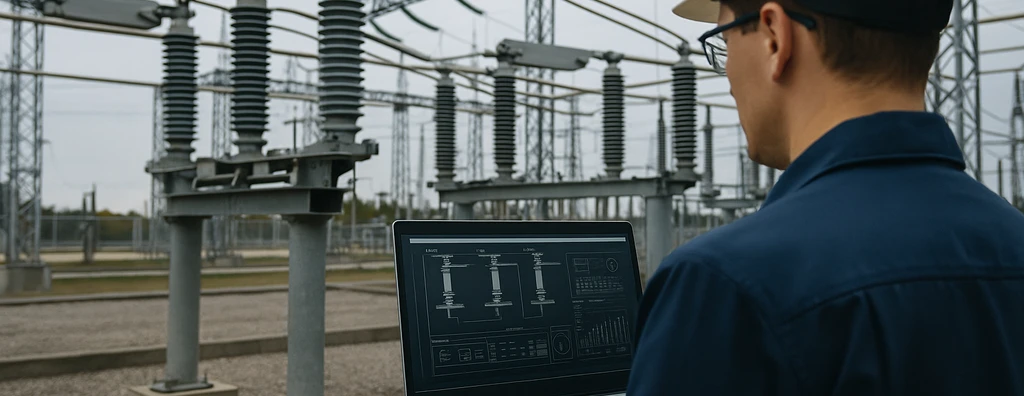
Technical requirements for remote monitoring of disconnect switches in substations, including signaling, interlocking, industrial communications, supervisory integration, operation, and maintenance.
Check it out!
Remote monitoring of disconnect switches in substations is one of the most relevant technological solutions for operational safety and efficiency in maintenance and load-transfer processes in the power sector. In highly critical environments such as substations, strict control of isolating devices is essential to prevent accidental energization, ensure proper isolation, and enable safe technical intervention, especially in remote-support scenarios where automation and remote signaling are essential.
This article details the functional, standards-based, and operational requirements for remote-assistance designs in substations, with emphasis on disconnect-switch monitoring. It addresses safety criteria, automation methodology, interlock specification, associated electrical protection, and operation, diagnosis, maintenance, and supervisory-system integration routines. The objective is to provide a structured guide for robust and compliant designs applicable to critical and multifunctional electrical environments.
Read on!
[elementor-template id=”24446″]
General Principles of Monitoring and Remote Assistance in Substations
Implementing remote assistance in substations enables remote operation and continuous supervision of switching-device status, notably disconnect switches. This solution is based on the following technical principles:
- Position detection: monitoring the open/closed state of each disconnect switch with redundant sensors;
- Remote signaling: transmission of information to a central supervisory system through industrial communication protocols;
- Logical and physical blocking: implementation of automatic interlocks that prevent unauthorized or hazardous switching operations;
- Logging and audit: storage of detailed logs for all operations performed, enabling complete traceability;
- Fault response: immediate detection of functional deviations and generation of real-time alarms for prompt intervention.
These elements improve operational safety, reduce fault-response time, and increase the availability of electrical assets.
Standards Requirements for Isolation and Operational Safety
Compliance with standards requirements is fundamental to safe substation operation. Key technical guidelines include:
- Precautions should be taken to prevent inadvertent or unauthorized operation of isolating devices, especially switches intended for no-load operation;
- Closed switch enclosures, padlocking, or interlocking with devices suitable for operation under load are recommended;
- Isolation should be performed by multipole devices whenever possible, ensuring complete isolation of the supply;
- Warning plates and clear signs should be installed on equipment and facilities indicating energization hazards and conditions for safe access;
- Standards such as ABNT NBR 5410 provide guidance on isolating devices, isolation for maintenance, discharge of stored energy, and warning labels where multiple supplies are present.
These guidelines support remote-assistance designs that improve operational reliability and minimize risk to technical personnel.
Methodology and Architecture for Remote Disconnect-Switch Monitoring
A typical remote-monitoring architecture in substations includes the following technical structure:
- Position sensors: coupled to disconnect switches, providing redundant indication of the status of each isolation point;
- Interface modules: process sensor signals and transmit them to the supervisory system;
- Industrial communication network: implementation of secure industrial protocols, typically based on industrial Ethernet, optical fiber, or redundant links, for data transmission;
- Remote acquisition units: local data concentrators capable of executing blocking, interlocking, and automatic protection logic according to predefined scripts and logic;
- Central supervisory system: responsible for visualization, historical logging, alarm generation, remote commands, and event analysis.
Information flows among sensors, field devices, and the control center should have dual redundancy in critical substations, with alternative communication routes and independent power supplies.
Blocking, Interlocking, and Associated Protection
To prevent accidental energization and ensure safe intervention, technical solutions should include a robust blocking and interlocking system:
- Physical blocking: mechanical or electromechanical locking mechanisms preventing improper manual operation;
- Logical interlocking: automated logic that authorizes switching only when technical conditions such as voltage, equipment position, and external indications are satisfied;
- Local and remote visual indication: clear interfaces on field panels and in the supervisory system to ensure understanding of operational status;
- Protective devices: coordination with protection relays, surge protective devices (SPDs), and integration with grounding bars, as required for command, control, and protection systems.
These measures raise operational safety standards and enable interventions with minimized risk both locally and under remote-assistance operation.
Electrical Infrastructure Supporting Switch Monitoring
The electrical infrastructure supporting disconnect-switch monitoring and remote assistance should be carefully sized:
- Use dedicated circuits segregated from other substation loads;
- Provide redundant power supplies, including UPS systems and battery banks, for continuity in the event of utility failure;
- Provide equipotential grounding bars to protect sensitive electronic equipment against surges and lightning as required by technical standards;
- Incorporate surge protective devices (SPDs), filters, and isolation transformers in automation panels as applicable;
- Use shielded conduits for sensitive cabling and optical fiber on critical links to improve immunity to electromagnetic noise and disturbances.
Compliance with ABNT NBR 5410 and ABNT NBR 5419 requirements is essential to ensure operational continuity and protect personnel and assets during remote or local operation.
Operation, Diagnosis, and Maintenance Routines
The effectiveness of remote-assistance designs depends heavily on standardized operation and diagnosis routines, which should include:
- Remote opening and closing with dual confirmation and automatic logging of each action;
- Periodic testing of sensors, interface modules, and communication circuits;
- Frequent validation of interlocking and blocking logic by simulating faults and extreme operating conditions;
- Automatic issuance of operation reports and fault diagnostics on scheduled cycles;
- Scheduled inspections and preventive maintenance of cabling, connections, power supplies, and protective devices;
- Recurring training of technical teams on system functions, emergency conditions, and safety protocols.
These routines improve system reliability and enable rapid response to anomalies and corrective or predictive maintenance needs.
Integration with Supervisory Systems and Event Auditing
Integration of disconnect-switch monitoring systems with supervisory platforms is essential for centralized management and operational auditing. Key practices include:
- Real-time interfacing: bidirectional communication between field devices and the operations center, with immediate status and event updates;
- Generation and archiving of records: time-stamped logs detailing each manual or remote operation, facilitating traceability for later analysis and regulatory requirements;
- Effective alarm management: alarm programming according to criticality, directing team response toward the highest-risk events;
- Graphical visualization and dashboards: use of mimic diagrams for rapid assessment of operational condition, simplifying decision-making locally or remotely.
This set of operational requirements supports the administrative, technical, and standards compliance of the design.
Conclusion
Implementing remote-assistance designs for disconnect-switch monitoring in substations significantly increases operational safety and efficiency in power operations. By aligning rigorous technical standards such as ABNT NBR 5410 and related documents with automation, supervisory-system integration, and robust electrical infrastructure, it is possible to support electrical continuity, installation integrity, and protection of the personnel involved.
Remote monitoring, combined with well-structured operating routines and advanced blocking and interlocking mechanisms, reduces risk, facilitates diagnosis, and enables predictive and corrective maintenance processes. Successful designs integrate sensors, automation logic, industrial communication, and trained teams within a coherent architecture and according to demanding operating protocols.
Final Considerations
The consolidation of remote-assistance designs for disconnect-switch monitoring reinforces engineering’s role in the safety, reliability, and modernization of the power sector. Follow A3A Engenharia for updates on current technical practices and developments.
Relevant Links (Complementary Technical Materials)
Remote Assistance in Substations
Disconnect-Switch Monitoring in Substations
Telecommunications, Surveillance, and Remote-Assistance Design for Power Distribution Substations