
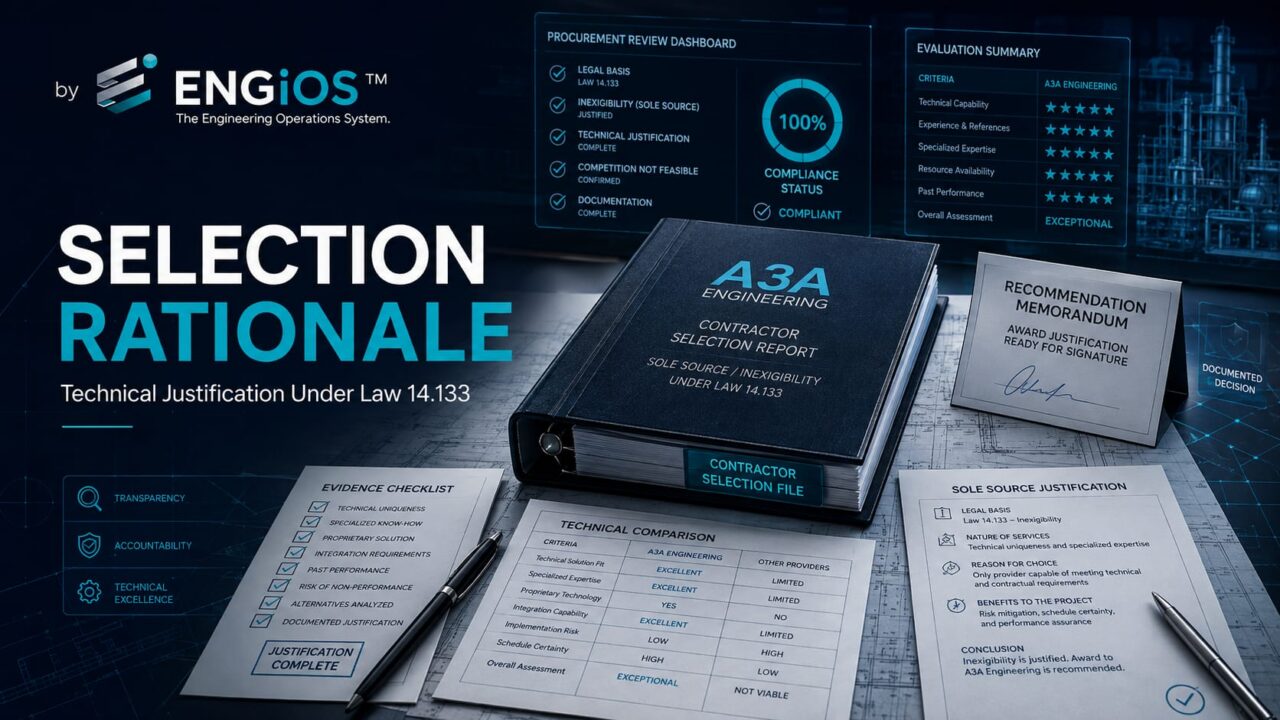
Learn how to substantiate the reason for selecting a contractor in noncompetitive procurement under Brazilian Law 14,133, especially for specialized technical engineering services.
Check it out!
The reason for selecting the contractor is one of the mandatory justifications in the direct-procurement process established by Article 72 of Brazilian Law 14,133/2021. In noncompetitive procurement, it cannot be limited to stating that a given company has experience, tradition, a good reputation, or an acceptable price. The Administration must demonstrate why that professional or company is technically suitable for the specific object and, when procurement is based on Article 74, III, why its recognized expertise is essential and demonstrably appropriate to fully satisfy the need.
This means separating questions that often appear mixed together: why there is no feasible competition, why the service fits the intended legal basis, why that contractor was selected, and why the price is reasonable. These justifications are related, but they are not interchangeable. A robust procurement record builds an evidence chain in which need, object, complexity, differentiated qualifications, relevant experience, team, and previous results converge toward the administrative decision.
In Consulting Engineering services, the reason for selection tends to be especially sensitive because the value of the engagement is linked to intellectual content, applied experience, and the ability to interpret complex problems. The prospective contractor’s résumé or portfolio is only raw material: the Administration must demonstrate the fit between that evidence and the result it needs to obtain.
What Brazilian Law 14,133 Requires Regarding the Reason for Selecting the Contractor
Article 72 structures the direct-procurement process — both noncompetitive procurement and waiver of competitive tendering — and requires, among other elements, the reason for selecting the contractor, the price justification, and evidence of minimum qualification and eligibility. The separation of these statutory items is technically relevant: if the law requires distinct documents, the procurement file should not compress them into a single generic justification.
In practice, the reason for selection answers the question: why is this contractor suitable to satisfy this need, under these conditions and under the legal basis adopted? In noncompetitive procurement under Article 74, III, the answer must directly address the nature of the specialized technical service, recognized expertise, and the demonstration that the work of that professional or company is essential to the object.
The article on Direct Procurement under Brazilian Law 14,133 and the Article 72 process explains the complete structure of the process. Here, the focus is only on item VI: how to build a technically verifiable and defensible reason for selection.
The Reason for Selection Is Not the Price Justification
A recurring mistake is to state that the contractor was selected because it submitted a price compatible with the market. Price compatibility is necessary, but it belongs to item VII of Article 72. By itself, it does not demonstrate why that company was selected.
The distinction can be summarized as follows:
| Issue | Main document or analysis | Question it must answer |
| basis for direct procurement | legal and technical classification | why is competitive tendering not conducted? |
| reason for selection | Art. 72, VI | why is this contractor suitable for the object? |
| price justification | Art. 72, VII and Art. 23 | is the proposed amount reasonable and compatible? |
| qualification | Art. 72, V | does the contractor meet the minimum conditions to contract? |
| recognized expertise | Art. 6, XIX and Art. 74, §3 | what evidence demonstrates differentiated standing and fit? |
A low price does not turn a provider into an essential specialist. Likewise, recognized expertise does not dispense with demonstrating economic reasonableness. The article Price Justification in Noncompetitive Procurement specifically addresses the second issue.
The Reason for Selection Is Also Not Merely Technical Qualification
Eligibility and technical qualification verify whether a company meets the minimum requirements to contract and perform a given object. The reason for selection, especially in noncompetitive procurement, operates at another level: it must show differentiated fit with the specific problem.
A company may hold professional registrations, a technical team, certificates, and sufficient experience to qualify in a competitive tender, but that does not automatically mean its direct procurement is justifiable. The step between “it is technically capable” and “it is the justified choice for this direct procurement” must be documented.
This distinction is important because noncompetitive procurement cannot be built on requirements that multiple economic agents also meet in an objectively comparable manner. When the Administration can establish criteria, receive proposals, and objectively compare capable providers, that strongly indicates feasible competition.
What Changes in Noncompetitive Procurement Under Article 74, III
For specialized technical services of a predominantly intellectual nature, Brazil’s Federal Court of Accounts (TCU) systematizes three core elements: the service must have that specialized and intellectual nature; the contractor must demonstrate recognized expertise; and it must be shown that engaging that professional or company is essential and demonstrably appropriate to fully satisfy the object.
Therefore, the reason for selection cannot begin with the company’s name. It must begin with the Administration’s problem.
A technically consistent sequence is:
- characterize the need and expected results;
- demonstrate why the service requires predominantly intellectual technical work;
- identify the professional attributes that are actually critical to the object;
- map the prospective contractor’s evidence linked to those attributes;
- demonstrate the fit among experience, team, method, and object complexity;
- explain why that fit is relevant to full satisfaction of the engagement;
- keep the economic price justification separate.
This sequence reduces the risk of circular reasoning such as “the company is selected because it has recognized expertise, and it has recognized expertise because it was selected.”
The Selection Must Start From the Object, Not From the Résumé
In weak processes, the object is drafted after the Administration has already decided whom it wants to hire. This reverses the logic of planning and may produce specifications artificially tailored to the prospective supplier’s history.
The technically more defensible flow is the opposite. First, the need, problem, scope, results, risks, and requirements are defined. Then the type of knowledge and experience required is assessed. Only then should the evidence of potential providers be compared against the demand.
In Consulting Engineering, this means avoiding vague descriptions such as “a company with broad engineering experience.” The procurement record should identify which experience matters. Depending on the object, relevant examples may include:
- work on existing assets and brownfield environments;
- experience in multidisciplinary projects;
- coordination of interfaces among disciplines;
- projects in critical and operating facilities;
- management of technical and implementation risks;
- experience in inspection, supervision, or Owner’s Engineering;
- ability to produce verifiable documentation for procurement and acceptance;
- experience with commissioning, QA/QC, testing, or document management;
- knowledge of specific technologies or architectures when genuinely required.
Evidence strengthens the case only when there is a nexus with the object.
How to Assess Previous Performance Without Turning a Certificate Into an Automatic Argument
The reason for selection must demonstrate fit with the object — not merely reputation. Experience, team, and technical production gain value when linked to the specific risks and results of the engagement.
Technical-capacity certificates are important sources of evidence, but they should not operate as a quantitative collection. Ten weakly related certificates may be less relevant than two engagements strongly comparable to the current problem.
The analysis should examine at least four dimensions:
| Dimension | Assessment question |
| technical fit | did the previous work require similar competencies? |
| complexity | are the challenges, interfaces, and risks comparable? |
| role actually performed | did the company perform the relevant intellectual core or only a peripheral activity? |
| result and traceability | are there deliverables, responsibilities, or evidence that make the experience verifiable? |
The article Technical Capacity Certificates in Engineering Tenders goes deeper into assessing compatible experience. For the reason for selection, that analysis must be specifically oriented to direct procurement.
Studies, Education, and Technical Production May Support the Justification
The legal definition of recognized expertise itself allows professional standing to derive from previous performance, studies, experience, publications, organization, equipment, technical team, or other requirements related to the activities.
This means the Administration may build an evidence matrix broader than certificates. Depending on the service, relevant elements may include:
- academic education and specializations consistent with the object;
- professional certifications;
- technical production and publications;
- documented participation in projects of equivalent complexity;
- proprietary methodologies or organizational capability;
- key personnel with directly relevant experience;
- technical infrastructure, tools, and processes when they affect the result;
- history of multidisciplinary work;
- accumulated experience in management, design, inspection, or commissioning.
The central point remains the nexus. A prestigious certification with no material relationship to the object should not carry the same weight as demonstrably relevant experience.
How to Build a Fit Matrix for the Reason for Selection
A good practice is to break the object down into success factors and relate them to the contractor’s evidence. This makes the reasoning auditable and reduces vague adjectives.
| Critical factor of the object | Expected evidence | How to demonstrate fit |
| multidisciplinary scope | projects with multiple coordinated disciplines | identify scope, interfaces, and technical responsibility |
| operating environment | brownfield experience | demonstrate work without improper interruption of the asset |
| high criticality | projects in critical infrastructure | relate risks, availability requirements, and controls used |
| technical management | experience in coordination, inspection, or OE | present role, deliverables, and decisions under responsibility |
| engineering documentation | designs, reports, specifications, data books | demonstrate ability to structure verifiable deliverables |
| technology integration | history with interdependent systems | demonstrate experience with equivalent interfaces |
| acceptance and commissioning | tests, acceptance criteria, QA/QC | show previous deliverables and responsibilities |
The matrix does not need to become an artificial mathematical system. Its function is to demonstrate how the selection derives from observable facts.
Recognized Expertise and the Reason for Selection Are Related, but Not Identical
Recognized expertise characterizes a quality of the professional or company in the relevant field. The reason for selection turns that quality into a contextualized administrative decision.
A company may be recognized in a certain field and still not be the appropriate choice for another object. For example, exceptional experience in industrial electrical design does not automatically prove essentiality for consulting on electronic security, telecommunications, or contract management.
Therefore, the article Recognized Expertise under Brazilian Law 14,133 should be read as the layer that substantiates the provider’s standing. The reason for selection is the next layer: why this body of evidence connects to this procurement.
The Contractor’s Essentiality Must Appear in the Reasoning
Under Article 74, III, it is not enough to identify a service listed by law and find an experienced company. TCU emphasizes the need to demonstrate that the provider’s recognized expertise is essential and demonstrably appropriate to fully satisfy the object.
In practice, that demonstration may involve factors such as:
- high technical risk;
- significant consequences from design errors;
- need for non-standardizable professional judgment;
- need to integrate multiple disciplines;
- accumulated knowledge from comparable situations;
- dependence on experience for decision-making;
- complex interfaces;
- need to develop solutions rather than merely execute prescribed routines.
The argument should not be “we want the best.” It should explain why the specific characteristics of the procurement make differentiated experience relevant to the result.
Impossibility of Competition and the Reason for Selection Must Not Be Confused
In noncompetitive procurement, the reason for selection, impossibility of competition, and price justification are different analyses. Mixing them into one generic justification weakens process traceability.
Impossibility of competition addresses the basis for noncompetitive procurement. The reason for selection addresses the selection of the contractor within that context.
If the Administration can identify multiple capable providers and establish objective criteria to compare proposals, the issue is no longer merely “which one do we prefer?” but “why not conduct a competitive tender?” This is an important warning sign.
The article Impossibility of Competition in Noncompetitive Procurement examines this boundary in greater depth. The reason for selection cannot be used to manufacture impossibility where a comparable competitive market exists.
What Should Not Appear as a Standalone Justification
Some phrases are frequent in administrative proceedings but have low evidentiary density when used alone:
- “a renowned company in the market”;
- “has extensive experience”;
- “has previously provided good services”;
- “is a reference in the sector”;
- “has a highly qualified team”;
- “submitted the most advantageous proposal”;
- “is trusted by the Administration”;
- “knows the agency’s facilities”.
These elements may be part of the reasoning, but they must be converted into verifiable facts. If the company has previously provided services, which ones? What is the fit? What result was produced? What accumulated knowledge is material to the new object? If the team is qualified, which professionals and which experiences will be mobilized?
Previous Contract With the Same Agency: When It Helps and When It Is Not Enough
Previous experience with the same Administration may be relevant, particularly when it demonstrates in-depth knowledge of existing systems, assets, documentation, and interfaces. However, the mere fact that a company was contracted before does not create a right to a new engagement or prove impossibility of competition.
Previous history can serve as evidence when objectively described: scope performed, results, complexity, required technical continuity, knowledge acquired, transition risks, and fit with the new object.
It is also necessary to avoid a dependency cycle in which each past contract automatically becomes the justification for the next. The process must continue to demonstrate need, legal basis, essentiality, and reasonableness of the solution adopted.
The Team That Supported the Selection Requires Careful Treatment
Article 74, §4 establishes a relevant restriction for procurements based on item III: companies or professionals different from those that justified the noncompetitive procurement may not replace them.
This reinforces a practical consequence: if the reason for selection depends on the experience of specific professionals, those names, roles, and responsibilities must be consistently reflected in the process and in execution.
A justification based on a specialist who will not effectively participate in the contract is structurally weak. The Administration should verify who will perform the intellectual activities that supported the selection and how contract governance will preserve that condition.
How the Prospective Contractor Can Organize Its Evidence Without Taking Over the Administration’s Decision
The prospective contractor can organize consistent technical evidence; the legal and administrative reasoning for the selection remains the responsibility of the contracting authority.
Learn about A3A Engenharia’s Consulting Engineering services
An interested company can and should provide information that enables the Administration to properly build the procurement file. This includes portfolio, résumés, certificates, technical-capacity records, publications, organizational description, methodology, proposed team, comparable experience, and pricing documents.
But there is an important institutional boundary: the company provides evidence; the Administration substantiates the selection.
It is not appropriate for the administrative justification simply to be a commercial document written by the prospective contractor and incorporated without critical review. The technical area should compare the evidence against the public need and take responsibility for the reasoning behind the act.
For A3A Engenharia, this means structuring technical qualification dossiers that are useful and auditable: the material should enable the agency to identify experience, technical production, team, methods, results, and fit, without replacing the Administration’s decision-making authority.
A Practical Roadmap for Drafting the Reason for Selection
A justification can be organized into logical blocks.
1. Describe the Object and Its Challenges
Start with what makes the engagement technically relevant: complexity, risks, interfaces, criticality, uncertainties, and expected results.
2. Define the Required Competencies
Explain what knowledge, experience, and capabilities are necessary to address those challenges.
3. Identify the Contractor’s Evidence
Relate experience, studies, publications, team, organization, and other elements that are actually documented.
4. Demonstrate Fit
Do not merely list the evidence: explain how each item addresses the critical factors of the object.
5. Demonstrate Essentiality When the Basis Is Article 74, III
Show why this differentiated experience is relevant to achieving the result and why the selection is not merely a subjective preference.
6. Record the Team Determinative of the Selection
When specific professionals support recognized expertise and essentiality, the procurement record should identify them consistently with the contract.
7. Refer Price and Qualification to Their Own Documents
Avoid turning the reason for selection into a document that tries to justify everything. The procurement becomes more auditable when each requirement has its own analysis.
Example of an Argument Structure for Consulting Engineering
Instead of writing “the company has recognized expertise and extensive experience,” the Administration can develop reasoning similar to the following, adapted to the actual facts of the process:
need: the project has multiple existing systems, incomplete documentation, and a need for multidisciplinary coordination without interrupting operations;
required competency: proven experience in surveys, brownfield design, multidisciplinary coordination, requirements management, risk analysis, and technical support during implementation;
evidence: comparable previous contracts and deliverables, key personnel with documented experience, relevant technical production, and compatible organizational capability;
fit: the demonstrated experience corresponds directly to the risks and deliverables of the object;
essentiality: the quality of the result depends on technical judgment, information integration, and applied experience that cannot be reduced to compliance with a standardized routine.
This model does not replace analysis of the specific case, but it illustrates the difference between an adjective and technical reasoning.
Control Checklist Before Authorization
Before considering the reason for selection complete, it is worth checking:
- is the need clearly documented?
- was the object defined before contractor selection?
- are the service’s critical factors explicit?
- does every experience-related assertion have evidence?
- is the experience relevant, rather than merely numerous?
- are recognized expertise and essentiality demonstrated separately?
- was impossibility of competition addressed in a separate analysis?
- is the price justification in a separate document?
- will the team that supported the selection actually be mobilized?
- does the reasoning allow a third party to understand the decision without relying on implicit information?
When several answers depend on generic phrases, the process is not yet sufficiently mature.
The Reason for Selection as Part of Procurement Governance
A good justification is not only useful for later defense before audit or oversight. It improves the contract itself. By making clear why certain knowledge and professionals matter, the Administration creates references for inspection, change management, and acceptance.
If the selection was based on multidisciplinary coordination experience, that capability should appear in execution. If it depended on a specific team, inspection should verify its participation. If the engagement sought to reduce design risks, the deliverables should show how those risks were addressed.
The reason for selection can therefore serve as a bridge between planning → procurement → execution → verification of results.
Final Considerations
The reason for selecting the contractor is one of the points where the quality of a noncompetitive-procurement record becomes most visible. It should not be a statement of preference, a portfolio summary, or a repetition of the price justification. In specialized technical services, it must demonstrate concrete fit among the need, characteristics of the object, required competencies, contractor evidence, and the essentiality of its work.
The more intellectual and complex the service, the less useful generic language becomes. The decision is strengthened when the Administration can show, in a traceable way, what problem it needs to solve, which capabilities are determinative, and why the evidence presented supports that specific selection.
Technical References
[1] BRASIL. Lei nº 14.133, de 1º de abril de 2021. Lei de Licitações e Contratos Administrativos. Arts. 6º, 23, 72 e 74. Disponível em: https://www.planalto.gov.br/ccivil_03/_ato2019-2022/2021/lei/l14133.htm
[2] TRIBUNAL DE CONTAS DA UNIÃO. Processo de contratação direta. Licitações e Contratos: Orientações e Jurisprudência do TCU. Disponível em: https://licitacoesecontratos.tcu.gov.br/5-10-processo-de-contratacao-direta/
[3] TRIBUNAL DE CONTAS DA UNIÃO. Serviços técnicos especializados de natureza predominantemente intelectual com profissionais ou empresas de notória especialização. Disponível em: https://licitacoesecontratos.tcu.gov.br/5-10-1-3-servicos-tecnicos-especializados-de-natureza-predominantemente-intelectual-com-profissionais-ou-empresas-de-notoria-especializacao-inciso-iii/
Frequently Asked Questions
It is the reasoning required by Article 72, VI, demonstrating why a given professional or company was selected in a direct procurement. It must be based on facts and evidence related to the object.
No. The reason for selection explains why that contractor is suitable; the price justification demonstrates that the amount is reasonable. Brazilian Law 14,133 requires the two elements separately.
Usually not. Certificates are important evidence, but the Administration must demonstrate the fit between the documented experience and the specific characteristics of the object.
Not automatically. The history may be relevant evidence, but the new procurement must again demonstrate need, legal basis, fit, essentiality, and the other applicable requirements.
The decision and its reasoning belong to the Administration. The prospective contractor may provide documents and evidence, but it does not replace the agency’s technical and legal analysis.
Yes. Team experience may be decisive, especially in intellectual services. When specific professionals support noncompetitive procurement under Article 74, III, §4 requires attention to those people’s effective participation in execution.
Supplementary Technical Materials
Main Content on the Topic
- Noncompetitive procurement of engineering services: when is it possible under Brazilian Law 14,133?
- Article 74 of Brazilian Law 14,133: when Consulting Engineering may be contracted through noncompetitive procurement
Related Technical Content
- Recognized Expertise under Brazilian Law 14,133: how to demonstrate it in engineering services
- Direct Procurement under Brazilian Law 14,133: how to structure the Article 72 process
- Price Justification in Noncompetitive Procurement
