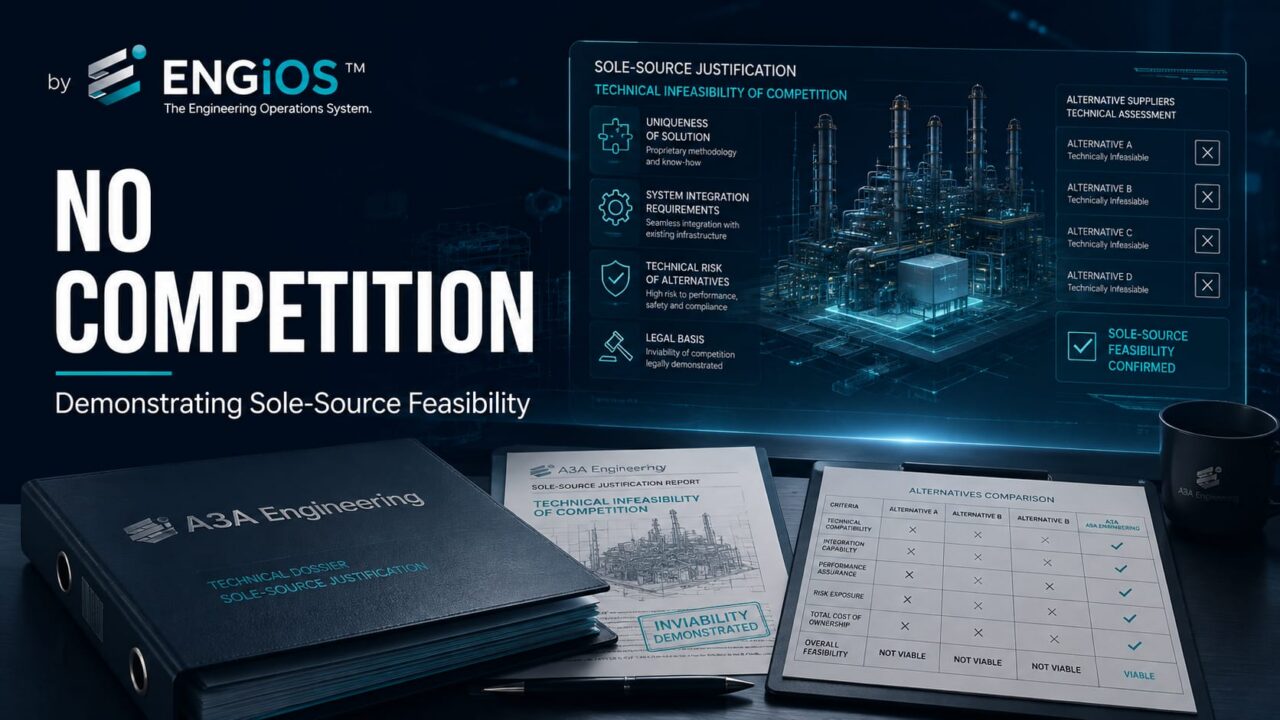
Understand how to demonstrate impossibility of competition in engineering services under Brazilian Law 14,133 by analyzing the object, market, recognized expertise, essentiality and viable alternatives.
Check it out!
The impossibility of competition is the central foundation of noncompetitive procurement under Brazilian law. Article 74 of Law 14,133 begins precisely with this condition: procurement is inexigible when competition is not feasible. In engineering services, this requires much more than stating that the object is complex, that a company has experience or that management prefers a particular provider. The Administration must demonstrate, based on the specific case, why competition does not provide an adequate means of selecting the solution or provider capable of fully satisfying the public need.
For specialized technical services of a predominantly intellectual nature, the analysis must connect the nature of the work, the required specialization, the provider’s evidence and the reason why its work is essential and demonstrably suitable for the object. Law 14,133 no longer requires the former “singularity of the object” as an autonomous requirement; the focus is the impossibility of competition and, under Article 74, III, the specific requirements related to intellectual services and recognized expertise.
What Impossibility of Competition Means
Impossibility of competition must result from analysis of the object and the market. Complexity, reputation or preference for a provider do not replace this demonstration.
Read the Engineering Services Noncompetitive Procurement Hub
Impossibility of competition is not synonymous with the existence of a single supplier. Exclusivity is a clear case of inexigibilidade, but Article 74 contains an illustrative list and reaches other situations in which competition, because of the characteristics of the object or market, does not work as an adequate selection mechanism.
In practical terms, the Administration must answer: is it possible to establish an objective competitive process among alternatives capable of satisfying the need?
If the answer is yes, competitive procurement remains the rule. If the answer is no, the Administration must demonstrate why and identify the legal basis supporting direct procurement.
Complexity of the Object Is Not Enough
Consulting Engineering is a specialized intellectual service, but competitive procurement remains the rule when viable competition exists. Noncompetitive procurement must be demonstrated case by case.
A service may be highly complex and still admit competition. Large projects, multidisciplinary consulting assignments, specialized studies and services with high technical responsibility may have several capable providers and objective evaluation criteria.
In such cases, Law 14,133 provides suitable competitive instruments, such as competitive tendering and technique-and-price or best-technique criteria, when applicable.
AGU Normative Guidance 107/2026 reinforces this logic for Consulting Engineering: these services are specialized technical services of a predominantly intellectual nature and cannot be classified as common engineering services. As a general rule, procurement should occur through competitive tendering, except where noncompetitive procurement is legally justified.
Therefore, being Consulting Engineering does not automatically make the service eligible for inexigibilidade.
When Competition May Be Impracticable in Intellectual Services
In predominantly intellectual technical services, impossibility of competition may arise from a combination of factors that makes traditional competitive comparison inadequate.
The analysis commonly involves:
- the specific nature of the problem;
- the recognized knowledge or experience required;
- demonstrated track record in equivalent situations;
- method, organization or team that is decisive for the outcome;
- technical confidence objectively grounded in evidence;
- need for continuity or integration with prior work, when legally relevant and technically demonstrated;
- risk of losing the intended outcome if the work is performed by a provider without that specialization;
- inability, in the specific case, to reduce selection to sufficiently objective competitive criteria.
None of these factors should be used in isolation as an automatic formula. The process must demonstrate the connection among them.
Article 74, III and the Three Requirements Highlighted by the TCU
For specialized technical services of a predominantly intellectual nature performed by a professional or company with recognized expertise, the Brazilian Federal Court of Accounts (TCU) highlights three requirements:
- the service must be a specialized technical service of a predominantly intellectual nature;
- the contractor must have recognized expertise;
- it must be demonstrated that hiring that professional or company is indispensable to the full satisfaction of the object.
This third element is decisive. It is not enough to prove that the provider is excellent. The Administration must show why that specialization is essential and demonstrably suitable for that specific need.
The article Recognized Expertise Under Brazilian Law 14,133 examines the evidence that may support the second requirement.
Recognized Expertise Is Not a Monopoly on Competence
The Administration does not need to demonstrate that no other professional in the country could perform any similar activity. Such an interpretation would make noncompetitive procurement of intellectual services almost impossible.
At the same time, the mere existence of a renowned company does not eliminate the need to assess the market and feasibility of competition.
The proper reasoning is concrete:
- what is the need;
- what capability is decisive;
- what alternatives exist;
- can they be compared competitively;
- why is a particular specialization essential;
- what evidence supports that conclusion.
Impossibility does not arise from an adjective applied to the contractor. It arises from the relationship among the object, market and selection method.
The Former Singularity of the Object and Law 14,133
Under Law 8,666/1993, discussion of specialized technical services was frequently structured around singularity. Law 14,133 changed this normative architecture.
The TCU states that, for Article 74, III, current law does not require singularity as an autonomous requirement. The analysis focuses on the three elements already mentioned: specialized intellectual nature, recognized expertise and indispensability of that provider’s work for full satisfaction of the object.
This does not mean that specific characteristics of the object have ceased to matter. They remain essential to demonstrate why that specialization is necessary. What changed is the legal structure of the reasoning.
How to Assess the Market Before Concluding That Competition Is Impracticable
Direct procurement should be based on sufficient knowledge of the market. Market research need not become an informal tender, but it must allow the Administration to understand what alternatives exist.
The analysis may include:
- companies and professionals active in the segment;
- comparable prior experience;
- available specializations;
- service methods and delivery models;
- delivery capacity;
- existence of multiple equivalent providers;
- possibility of defining objective evaluation criteria;
- experience of other public entities with similar procurements.
This diagnosis helps distinguish a small market from impossibility of competition. They are different concepts.
When the Existence of Several Providers Points Toward Competitive Tendering
If several providers can meet the object and the Administration can establish objective criteria to compare proposals, there is a strong indication that competition is feasible.
In Consulting Engineering, this may occur when:
- the scope can be standardized;
- deliverables are comparable;
- technical requirements can be defined in advance;
- minimum experience can be addressed during qualification;
- relative quality can be evaluated through technique and price;
- there is no specific element making a particular provider indispensable.
In this scenario, competitive tendering may be the correct instrument.
When Several Providers Do Not Resolve the Analysis by Themselves
On the other hand, the number of companies in the market is not the only relevant fact. There may be many generic providers and few with experience genuinely aligned with the specific problem.
The Administration must assess the degree of equivalence among the alternatives. In intellectual work, nominal capability and effective capability may be very different.
A matrix may help:
| Criterion | Provider A | Provider B | Provider C |
| experience with the specific problem | high | medium | low |
| demonstrated senior team | yes | partial | yes |
| track record in an equivalent environment | yes | no | partial |
| relevant technical production | high | medium | low |
| applicable method | demonstrated | generic | partial |
| integration capability | demonstrated | not demonstrated | demonstrated |
This matrix is not intended to “select a winner” in a tender that does not exist. It is intended to understand whether the alternatives are genuinely equivalent and whether competition is feasible.
Impossibility of Competition and the Rationale for Contractor Selection Are Different Documents
Two justifications are often mixed together:
- why competitive procurement is inexigible;
- why this contractor was selected.
The first addresses impossibility of competition. The second is required by Article 72, VI.
A process may explain very well why a particular professional is excellent and still fail to demonstrate why competition is impossible. It may also demonstrate impossibility in a specific market but select a provider without explaining why that provider is suitable for the object.
Both conclusions must exist and connect to each other.
Impossibility of Competition and Price Justification Are Not the Same Thing Either
Price is another independent dimension. Even when competition is impossible, the Administration must justify the economic reasonableness of the procurement.
The price justification in noncompetitive procurement should compare technically equivalent references and document the criteria used.
This separation produces a much more defensible architecture:
legal classification → selection → price.
Useful Evidence to Demonstrate Impossibility of Competition in Consulting Engineering
Depending on the case, the process may include:
- Preliminary Technical Study (ETP) and market research;
- technical description of the problem;
- criticality and risk analysis;
- justification for the need for specialized expertise;
- provider attestations and technical track record;
- team résumés and experience;
- technical production and publications;
- equivalent prior work;
- performance evaluations;
- demonstration of differentiated method or organization;
- analysis of procurement alternatives;
- independent technical opinion, when appropriate.
The purpose is not to accumulate documents, but to form a coherent evidentiary chain.
The Role of the Preliminary Technical Study (ETP)
The ETP is the appropriate place to show that the Administration assessed the problem, market, alternatives and risks before choosing the procurement model.
The ETP is especially important because it helps demonstrate that noncompetitive procurement was not selected before the need was understood.
A robust ETP may record:
- the problem to be solved;
- expected outcomes;
- solution alternatives;
- market research;
- risks;
- need for specialized knowledge;
- justification for the selected solution;
- conclusion regarding procurement feasibility.
This structure helps avoid the error of writing an object already “tailored” to a provider selected in advance.
How Consulting Engineering Can Support the Contracting Authority
A3A Engenharia can support a public entity on the technical dimension of the decision — requirements, risks, market, equivalence and evidence — without replacing the Administration’s legal and institutional authority over inexigibilidade.
Consulting Engineering can provide technical support so that the public entity understands the need, market and alternatives before deciding on the procurement regime.
This support may involve:
- ETP;
- market research;
- requirements definition;
- risk analysis;
- Terms of Reference structuring;
- matrix of required competencies;
- technical analysis of evidence;
- opinions on equivalence and alignment;
- review of consistency among need, scope and procurement model.
The decision to recognize impossibility of competition and authorize noncompetitive procurement remains with the Administration and its competent bodies.
When A3A Engenharia itself is a potential contractor, it may provide supporting documents regarding its expertise, team, experience, methodology and prices charged, but it should not replace the public entity in motivating its own procurement.
Warning Signs of Poorly Supported Noncompetitive Procurement
Some arguments are insufficient when presented in isolation:
- “the company is a market reference”;
- “the service is complex”;
- “we have worked with it before”;
- “the deadline is short”;
- “the object is strategic”;
- “the technical team trusts the provider”;
- “we found no other provider with the same experience”.
These statements may form part of the context, but they must be converted into evidence and connected to impossibility of competition.
Continuity of Prior Services
Continuity may be technically relevant when a new service depends on accumulated knowledge, models, decisions or information produced in prior work. However, continuity alone should not be treated as automatic authorization for noncompetitive procurement.
The process must assess:
- what knowledge is not easily transferable;
- what cost or risk arises from replacement;
- whether documentation allows transition to another provider;
- whether the new object is a legitimate extension or an independent procurement;
- whether viable competitive alternatives exist.
This analysis avoids turning a prior relationship into artificial exclusivity.
Consulting Engineering: Competitive Tendering or Noncompetitive Procurement?
AGU Normative Guidance 107/2026 provides valuable direction: Consulting Engineering is a specialized technical service of a predominantly intellectual nature. It should not be treated as a common engineering service and, as a rule, competitive procurement occurs through competitive tendering, using the evaluation criteria provided by Law 14,133 as applicable.
Noncompetitive procurement remains possible when its requirements are effectively demonstrated.
The decision can be summarized as follows:
| Situation | Likely route |
| intellectual object, but comparable among several providers | competitive tendering |
| technical quality must be weighted | technique and price / best technique as provided by law |
| competition effectively impossible and Article 74 requirements met | noncompetitive procurement (inexigibilidade) |
| competition feasible, but a statutory Article 75 case applies | direct award by statutory waiver (dispensa) |
How to Document the Conclusion
A sound justification of impossibility should allow a third party to understand the reasoning without depending on the team’s informal knowledge.
The structure may follow:
- public need;
- object and intended outcomes;
- market and identified alternatives;
- criteria that would make competition possible or impossible;
- nature of the required specialization;
- provider evidence;
- demonstration of essentiality and suitability;
- conclusion regarding impossibility;
- connection with the rationale for selection and price justification.
Final Considerations
Impossibility of competition is a technical and legal conclusion built on facts, not a standard phrase used to open a noncompetitive procurement process. In engineering services, demonstrating it requires understanding the problem, market, degree of comparability among providers and importance of intellectual capability to the outcome.
Law 14,133 made this analysis more precise by removing the former singularity requirement as an autonomous condition under Article 74, III and requiring demonstration of a specialized intellectual service, recognized expertise and indispensability of the provider for full satisfaction of the object.
For the contracting authority, the strongest protection is not to begin with the answer “noncompetitive procurement.” The process should begin with the need, investigate alternatives and arrive at the procurement model supported by the evidence.
Technical References
[1] BRAZIL. Law No. 14,133 of April 1, 2021. Public Procurement and Administrative Contracts Law. Available at: https://www.planalto.gov.br/ccivil_03/_ato2019-2022/2021/lei/l14133.htm
[2] BRAZILIAN FEDERAL COURT OF ACCOUNTS (TCU). Public Procurement and Contracts: Noncompetitive Procurement. Available at: https://licitacoesecontratos.tcu.gov.br/5-10-1-inexigibilidade-de-licitacao/
[3] BRAZILIAN FEDERAL COURT OF ACCOUNTS (TCU). Specialized technical services of a predominantly intellectual nature with professionals or companies of recognized expertise. Available at: https://licitacoesecontratos.tcu.gov.br/5-10-1-3-servicos-tecnicos-especializados-de-natureza-predominantemente-intelectual-com-profissionais-ou-empresas-de-notoria-especializacao-inciso-iii/
[4] OFFICE OF THE ATTORNEY GENERAL OF BRAZIL (AGU). Normative Guidance No. 107/2026. Consulting Engineering Services under Law No. 14,133/2021. Available at: https://www.gov.br/agu/pt-br/composicao/cgu/cgu/onsagu
Frequently Asked Questions
It is the situation in which a competitive procurement process is not feasible as a selection mechanism for the specific object. It is the central basis of inexigibilidade under Article 74 of Brazilian Law 14,133.
No. Exclusivity is one case. Law 14,133 also provides for specialized technical services with recognized expertise, accreditation and other situations in which competition may be impracticable.
No. AGU Guidance 107/2026 recognizes Consulting Engineering as a specialized technical service of a predominantly intellectual nature, but competitive procurement remains the general rule whenever competition is feasible.
For Article 74, III, the TCU highlights a specialized technical service of predominantly intellectual nature, recognized expertise and indispensability of the provider. Singularity is no longer an autonomous requirement as it was under the former regime.
Not necessarily, but the existence of several providers is relevant. The Administration must determine whether they are genuinely comparable and whether an objective competitive process can be structured.
Not by itself. The specialization must be connected to the specific need and the Administration must demonstrate why that provider’s work is essential and demonstrably suitable for full satisfaction of the object.
No. The justification for inexigibilidade demonstrates impossibility of competition; the rationale for selection explains why that contractor was chosen. Both must form part of the process.
A3A Engenharia may provide technical evidence regarding experience, team, methodology, technical production and prices charged. Administrative reasoning and the decision on legal classification belong to the contracting public entity.
Complementary Technical Materials
Related Solutions
Related Services
- Preliminary Technical Study (ETP) for Engineering Works and Services
- Technical Planning for Engineering Procurement
- Technical Consulting
- Ongoing Consulting Engineering Services
Main Content on the Topic
- Noncompetitive Procurement of Engineering Services
- Article 74 of Law 14,133 and Consulting Engineering
- Direct Procurement Under Brazilian Law 14,133