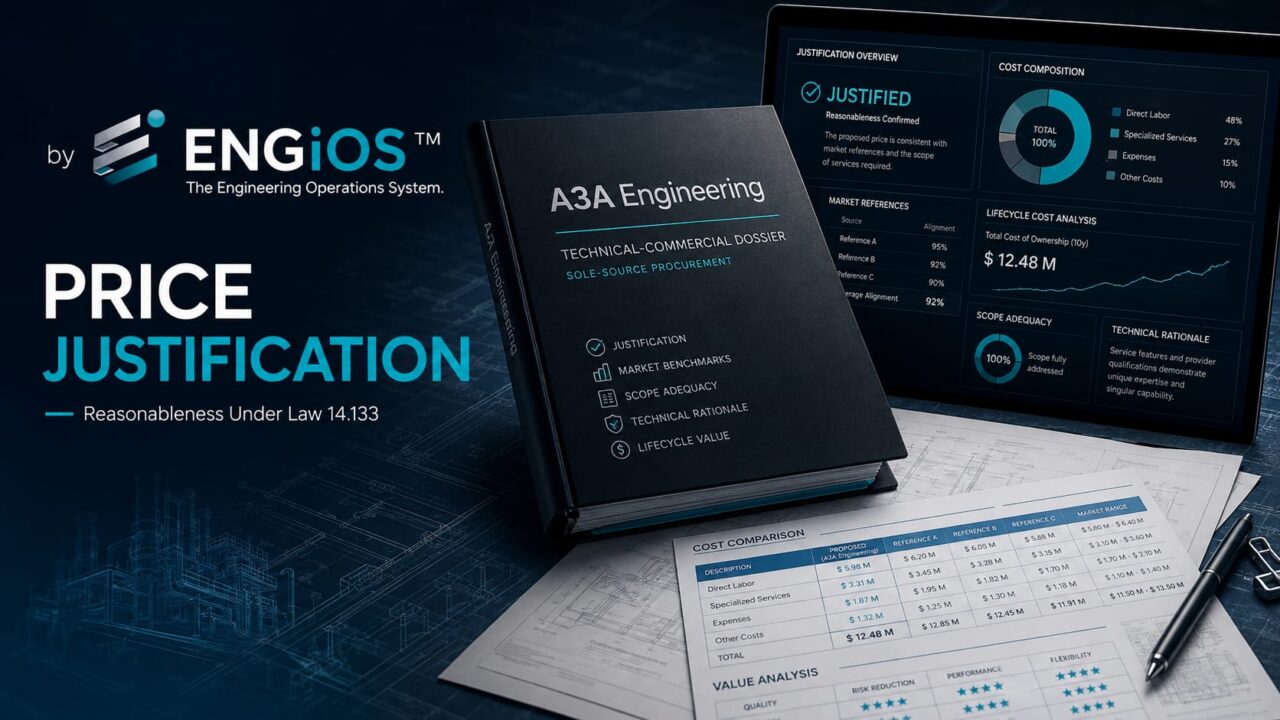
Understand how to demonstrate price reasonableness in noncompetitive engineering procurement by technically normalizing scope, team, HTE, deliverables, mobilization and comparable references.
Check it out!
Price justification in noncompetitive procurement is intended to demonstrate that the contracted amount is reasonable and compatible with reliable references, even when there is no competitive dispute among proposals. It does not replace the demonstration of impossibility of competition and should not be treated as a subsequent formality: price must be analyzed before contracting and in connection with scope, complexity, team, deliverables and actual execution conditions.
In engineering services and Consulting Engineering, the difficulty is greater because contracts with similar names may have very different technical content. Comparing only the total value of two “consulting” contracts without normalizing technical hours, disciplines, responsibilities, mobilization, risks, duration and deliverables may create a false sense of compatibility. A sound price justification turns commercial documents into technical comparables.
What Brazilian Law 14,133 Requires Regarding Price in Direct Procurement
The absence of competition does not eliminate economic control. Price must be demonstrated as reasonable through reliable and technically comparable references.
Learn About Cost Estimating for Engineering Works and Services
Article 72 includes price justification among the documents required for direct procurement. Article 23 provides that the estimated value must be compatible with market prices and, in § 4, establishes a specific route for direct procurements when it is not possible to estimate value using the usual parameters.
In that situation, the prospective contractor must previously demonstrate that its prices are consistent with those charged in similar procurements involving objects of the same nature, through documents from prior contracts, invoices or another reliable means.
Within Brazil’s direct federal public administration, agencies and foundations, Normative Instruction SEGES/ME No. 65/2021 details this procedure. Article 7 permits reliance on prices charged by the prospective contractor for identical objects and, exceptionally, similar objects of the same nature, provided that similarity is technically demonstrated.
The message for management is objective: noncompetitive procurement does not mean unrestricted pricing.
Price Justification Is Not the Same as Impossibility of Competition
These two demonstrations answer different questions.
- Impossibility of competition: why is competitive procurement not feasible in the specific case?
- Price justification: why is the proposed amount reasonable?
A market-compatible price does not make a procurement inexigible. Likewise, recognized expertise does not authorize acceptance of any price.
This distinction is especially important because Normative Instruction SEGES/ME No. 65/2021 provides, within its scope of application, that direct procurement through inexigibilidade is barred if the price justification reveals the possibility of competition.
The economic analysis may therefore also produce information relevant to the legal classification of the procurement.
The Mistake of Requesting Three Quotations Merely to “Check a Box”
Price research should not be reduced to mechanically obtaining three quotations. In a genuine case of inexigibilidade, it may make little sense to request competing proposals for the same object as though a fully comparable market existed.
The problem becomes worse when quotations are obtained from companies with different competencies, scopes or delivery models merely to calculate an average. In that situation, the three numbers do not control price; they only produce a statistic about different objects.
The Administration must seek technically comparable economic evidence.
This may involve:
- prior contracts of the prospective contractor;
- invoices for equivalent services;
- historical proposals that actually resulted in contracts;
- public contracts with similar objects;
- references from professional entities, when applicable and methodologically appropriate;
- compositions of technical hours and professional profiles;
- relevant parametric databases or institutional tables;
- other reliable means, provided their relevance is demonstrated.
In Engineering, Comparability Begins with Scope
In Consulting Engineering, comparing price without normalizing scope, team, HTE, deliverables and responsibility can produce a false economic conclusion.
Before comparing amounts, it is necessary to compare what each amount purchases.
A Consulting Engineering engagement may involve only issuing a technical opinion or may include field surveys, multidisciplinary coordination, modeling, design, procurement planning, technical procurement support, meetings, document management and execution monitoring.
Without normalization, BRL 100 thousand in one contract may be expensive and, in another, insufficient.
Technical Comparability Matrix
A simple matrix helps make the justification auditable:
| Dimension | Intended procurement | Reference A | Reference B |
| object | main scope | equivalent? | equivalent? |
| disciplines | electrical, telecom, security, etc. | which? | which? |
| deliverables | ETP, Terms of Reference, designs, opinions | which? | which? |
| team | profiles and seniority | composition | composition |
| effort | HTE / hours / months | reference | reference |
| mobilization | visits and travel | included? | included? |
| responsibility | design, review, Owner’s Engineering, etc. | level | level |
| schedule | duration and urgency | schedule | schedule |
| risk | criticality / interfaces | comparable? | comparable? |
Price gains meaning only after this normalization.
Lump-Sum Price, Unit Price and HTE
HTE is a useful measurement unit, but it must be accompanied by rules regarding professional profile, productivity, authorization, measurement and included costs.
Different commercial models may be used in specialized technical services. The justification must reflect the actual pricing regime of the procurement.
Lump-Sum Price
It is useful when scope and deliverables are sufficiently defined. Comparison should normalize the number of deliverables, review cycles, visits, meetings, disciplines and responsibilities.
Unit Prices by Deliverable or Activity
They may facilitate comparisons when there is a catalog of deliverables, such as designs, technical opinions, inspections, studies or specific analyses. It is necessary to verify that the unit has equivalent content.
Engineering Technical Hour — HTE
HTE may be a useful unit for on-demand Consulting Engineering contracts, but it does not by itself resolve price justification. One hour of a junior professional is not equivalent to one hour of a senior specialist; moreover, the rate may incorporate corporate structure, management, tools, taxes, professional responsibility and indirect costs.
When HTE is used, the Administration should understand:
- which professional profiles are included in the amount;
- what productivity is implicit;
- how hours are authorized and measured;
- which costs are included;
- which activities are billable;
- how mobilization and direct expenses are treated;
- how annual adjustment occurs, if applicable.
How to Use Prior Contracts of the Prospective Contractor
Comparison with prices previously charged by the same provider is especially relevant when there is no set of technically comparable market proposals.
The method should not be “the contractor charges this amount, therefore the price is correct.” Equivalence must be verified.
Step 1 — Select Relevant References
Select recent contracts of a compatible nature, preferably with documentation that allows scope, unit and conditions to be understood.
Step 2 — Normalize the Objects
Identify differences in:
- quantity;
- schedule;
- execution location;
- mobilization;
- disciplines;
- seniority;
- complexity;
- risk;
- tax regime or relevant commercial conditions.
Step 3 — Explain the Adjustments
When the new price differs from prior references, the process should explain the technical cause. The difference may result from expanded scope, greater complexity, inflation, mobilization needs, a different team or a shorter deadline.
Step 4 — Conclude on Reasonableness
The conclusion should be explicit: which references were considered, what limitations they have and why they support the proposed amount.
Similar Objects Require Demonstration of Similarity
Normative Instruction SEGES/ME No. 65/2021 exceptionally permits use of similar objects when the prospective contractor has not previously sold exactly the intended object. This requires technical demonstration of similarity.
In engineering, the analysis may consider:
- intellectual nature of the service;
- technical discipline;
- complexity level;
- professional responsibility;
- quantity and type of deliverables;
- team composition;
- duration;
- execution environment;
- project criticality;
- interfaces with other contracts.
The mere presence of the word “engineering” in both objects is not sufficient.
How to Address Monetary Adjustment and Date Differences
Historical prices need to be brought to a comparable time basis when there is a relevant difference between dates. The process should state the adjustment criterion used and avoid mixing nominal references from different years as if they were equivalent.
It is also necessary to separate monetary adjustment from an actual scope change. If a prior reference was updated by an index and the new object has more deliverables, these are two different effects and should be shown separately.
Mobilization, Travel and Direct Costs
Engineering services may require visits, surveys, in-person meetings and travel. Comparing fees alone without checking whether direct costs are included can distort the analysis.
A pricing memo should identify, when applicable:
- airfare;
- lodging;
- mileage;
- vehicle rental;
- per diem expenses;
- specific equipment;
- fees and tests;
- reimbursable expenses.
The contracting authority needs to understand the total foreseeable cost and which components depend on prior authorization.
Price Justification in Ongoing Consulting Engineering Services
Ongoing contracts require additional care: total value may depend on the quantity actually demanded over time.
In this model, a sound commercial structure separates:
- reference rate or HTE;
- service catalog or LPU, when applicable;
- authorization mechanism by Service Order;
- monthly allowance, if any;
- mobilization costs;
- price adjustment;
- limits and rules for scope changes.
The price justification should explain how the Administration maintains economic control throughout the contract term, not only at the time of award.
How Price Justification Protects the Contracting Authority
The objective is not only to prevent overpricing. A well-built economic analysis also protects against underpricing incompatible with the scope.
An artificially low price in an intellectual service may result in:
- a team below the planned level;
- insufficient dedication;
- excessive replacement of professionals;
- fewer visits;
- superficial deliverables;
- subsequent scope claims;
- loss of technical quality.
Reasonableness therefore means assessing whether the price is compatible with the expected performance level, not merely whether it is low.
The Role of Consulting Engineering in Price Analysis
Technical comparability analysis turns contracts and invoices into useful economic evidence for administrative decision-making.
The engineering function does not replace procurement or legal review, but it is essential for establishing technical comparability.
Consulting Engineering can support the contracting authority in:
- decomposing scope;
- comparing deliverables;
- estimating effort and team;
- assessing HTE consistency;
- normalizing differences among contracts;
- identifying direct costs;
- assessing productivity;
- technically explaining price differences;
- recording a comparability matrix.
This work improves the quality of the administrative decision because the commercial analysis begins to compare technically normalized objects.
What the Prospective Contractor Can Provide
When A3A Engenharia or any other company is being evaluated for contracting, it may provide documents that help the public entity perform its analysis, such as:
- detailed commercial proposal;
- scope composition;
- prior contracts;
- relevant invoices;
- price build-up memo;
- HTE references;
- team description;
- methodology;
- justifications for differences between prior and current objects.
The conclusion regarding reasonableness, however, belongs to the contracting authority’s administrative process.
Warning Signs of a Weak Price Justification
Some warning signs deserve attention:
- three quotations for different objects;
- documents without scope descriptions;
- invoices with no connection to the intended procurement;
- comparison of total price without adjusting quantity;
- absence of time-based adjustment;
- use of HTE without identifying the professional profile;
- selecting references only because they produce the desired average;
- failure to explain outliers;
- disregarding mobilization and direct expenses;
- a generic conclusion that the price “is at market level”.
How to Document the Conclusion
The justification should allow another professional, months later, to reconstruct the reasoning.
A sound memo contains:
- description of the object and commercial model;
- sources consulted;
- criteria used to select references;
- comparability matrix;
- adjustments made;
- normalized amounts;
- limitations of the references;
- conclusion regarding reasonableness.
This traceability protects the Administration and facilitates audits, review and future procurements.
Relationship with Articles 72 and 74
Price justification is only one part of the process. It must connect with the direct procurement process under Article 72 and, when the case involves inexigibilidade, with the demonstration required by Article 74 of Law 14,133.
A technically consistent process connects:
need → scope → specialization → selection → price → execution → acceptance.
Final Considerations
Justifying price in noncompetitive procurement means demonstrating that the absence of a competitive dispute did not eliminate economic rationality. In engineering services, this requires more than collecting numbers: it requires demonstrating that the compared objects are sufficiently equivalent to support a conclusion.
The strongest price justification combines reliable documents with transparent technical analysis of scope, effort, team, risk and execution conditions. The more intellectual and specific the service, the more important this normalization becomes.
For the contracting authority, this approach reduces the risk of overpricing, underpricing, audit challenges and later scope disputes. For the prospective contractor, it allows transparent presentation of its price without assuming the Administration’s authority to conclude on reasonableness and authorize the procurement.
Technical References
[1] BRAZIL. Law No. 14,133 of April 1, 2021. Public Procurement and Administrative Contracts Law. Available at: https://www.planalto.gov.br/ccivil_03/_ato2019-2022/2021/lei/l14133.htm
[2] BRAZILIAN FEDERAL COURT OF ACCOUNTS (TCU). Public Procurement and Contracts: Guidelines and TCU Case Law. Direct procurement process. Available at: https://licitacoesecontratos.tcu.gov.br/5-10-processo-de-contratacao-direta/
[3] BRAZIL. Secretariat of Management. Normative Instruction SEGES/ME No. 65 of July 7, 2021. Price research. Available at: https://www.gov.br/transferegov/pt-br/legislacao/instrucoes-normativas/instrucao-normativa-seges-me-no-65-de-7-de-julho-de-2021-1
[4] BRAZILIAN FEDERAL COURT OF ACCOUNTS (TCU). Public Procurement and Contracts: definition and execution of the calculation method for the estimated procurement value. Available at: https://licitacoesecontratos.tcu.gov.br/4-3-9-3-definicao-e-execucao-da-forma-de-calculo-do-valor-estimado-da-contratacao/
Frequently Asked Questions
Yes. Article 72 includes price justification among the elements of direct procurement, and Article 23 governs value estimation and the applicable references.
The legislation does not reduce price justification to a mechanical rule of three quotations. Reasonableness must be demonstrated through reliable sources and methods, considering the nature of the object and the applicable regulations.
Yes, under the conditions provided in Article 23, § 4 and, at the federal level, Normative Instruction SEGES/ME No. 65/2021. It is necessary to demonstrate that the objects are identical or sufficiently similar and technically comparable.
Scope, deliverables, disciplines, team, HTE, mobilization, schedule, responsibilities and risks should be normalized before comparing amounts.
No. Price reasonableness and impossibility of competition are different demonstrations. Both must be analyzed when applicable.
Yes, provided the documentation is reliable and comparability of the object is demonstrated under the applicable legal and regulatory basis.
Yes, especially in on-demand services, provided the professional profiles, productivity, included costs, measurement rules and other conditions of the rate are clearly explained.
The conclusion forms part of the contracting authority’s administrative process. The prospective contractor provides evidence and documents; the Administration performs the analysis and gives reasons for its decision.
Complementary Technical Materials
Related Solutions
- Contracts, Scope and Deliverables Management
- Requirements, Evidence and Acceptance Criteria Management
Related Services
- Cost Estimating for Engineering Works and Services
- Technical Planning for Engineering Procurement
- Technical Consulting
- Ongoing Consulting Engineering Services
Main Content on the Topic
- Noncompetitive Procurement of Engineering Services
- Direct Procurement Under Brazilian Law 14,133
- Article 74 of Brazilian Law 14,133 and Consulting Engineering