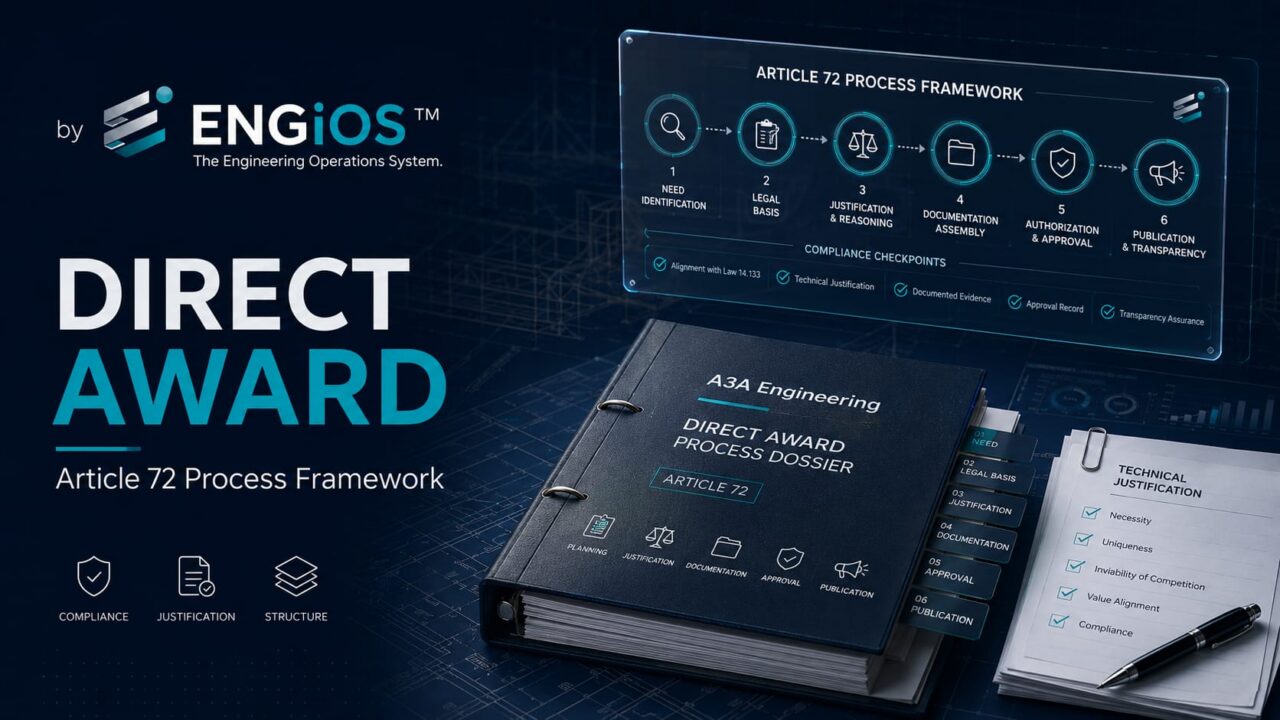
Understand how to structure direct procurement under Brazilian Law 14,133: planning, Article 72 documents, qualification, contractor selection, price justification and authorization.
Check it out!
Direct procurement under Brazilian Law 14,133 does not eliminate planning or reduce procurement to a simple supplier choice. Article 72 requires a formal, documented, and reasoned process applicable to both noncompetitive procurement and waiver of competitive tendering. For the public authority, procurement security depends on demonstrating the need, suitability of the solution, legal basis, price compatibility, contractor qualification, and objective reasons for the selection made.
For engineering works and services, this record is even more important because scope, design, technical requirements, measurement criteria, responsibilities, risks, and deliverables must remain verifiable even when there is no competitive tender. Direct procurement does not mean procurement without engineering; it means procurement without the traditional competitive stage, while preserving the obligation to structure and technically justify the decision.
What Direct Procurement Means Under Brazilian Law 14,133
Brazilian Law 14,133 treats direct procurement as a broad category covering two distinct situations: noncompetitive procurement, governed by Article 74, and waiver of competitive tendering, governed by Article 75. In noncompetitive procurement, competition is infeasible. In a waiver, competition may be feasible, but the law itself authorizes procurement without a tender in specific situations.
This distinction is fundamental because the Article 72 process applies to both routes, but the justification for the legal basis changes completely. In noncompetitive procurement, the Administration must demonstrate why competition is not feasible in the specific case. In a waiver, it must demonstrate that the situation falls within one of the statutory direct-procurement scenarios.
| Element | Noncompetitive procurement | Waiver |
| Main basis | infeasibility of competition | express statutory scenario |
| Central legal basis | Art. 74 | Art. 75 |
| Competition | infeasible | generally feasible, but waived by law |
| Process | Art. 72 | Art. 72 |
| Planning | required | required |
| Price justification | required | required, as applicable |
| Contractor selection | must be reasoned | must be reasoned |
The article What is noncompetitive procurement? explores the conceptual difference between the two forms of direct procurement in greater depth.
Article 72 Turns Direct Procurement Into a Process, Not a Shortcut
Direct procurement does not eliminate planning. Article 72 requires a documentary chain capable of demonstrating need, legal basis, qualification, price, and decision.
Article 72 establishes eight groups of documents that must support the process. They form a logical chain: the Administration identifies the need, defines the solution, estimates the value, verifies budget availability, evaluates the contractor, substantiates the selection, justifies the price, and submits the decision to the competent authority.
Weakness usually arises when those documents formally exist but do not connect. A Preliminary Technical Study may point to one need while the Terms of Reference describes another solution; the reason for selection may rely on expertise that does not appear in qualification records; the price justification may compare technically different objects; or a technical opinion may validate a solution without demonstrating fit with the original problem.
Process consistency requires traceability among need, object, contractor, price, and expected result.
The Eight Elements of Article 72 and What Each One Protects
Demand Formalization Document and Planning Artifacts
The first item includes the Demand Formalization Document (DFD) and, when applicable, the Preliminary Technical Study, risk analysis, Terms of Reference, basic design, or detailed design. The objective is not to produce documents for bureaucracy’s sake, but to record why the Administration needs to procure and which solution satisfies the need.
In engineering, this block should answer questions such as:
- what technical problem must be solved;
- what result is expected;
- what scope will be procured;
- what interfaces exist with systems, designs, or contracts already in force;
- what risks must be controlled;
- what deliverables will be required;
- how measurement, verification, and acceptance will occur.
A well-structured Preliminary Technical Study for engineering works and services is the starting point for this traceability.
Cost Estimate
Item II requires a cost estimate in accordance with Article 23. The fact that procurement is direct does not eliminate the need to assess economic reasonableness. The Administration must know the estimated amount before contracting and understand the parameters used.
For intellectual engineering services, a purely nominal comparison can be misleading. Two contracts called “engineering consulting” may have completely different scopes, responsibilities, team composition, duration, number of deliverables, and risk exposure. The research must compare genuinely compatible objects.
Legal Opinion and Technical Opinions
Item III provides for a legal opinion and technical opinions, when applicable, demonstrating compliance with the required conditions. Technical and legal analyses have complementary functions.
Engineering may demonstrate, for example, that:
- the scope requires a given competency;
- the services are technically specialized;
- the provider’s evidence corresponds to the object;
- the team composition is coherent;
- the compared prices are technically equivalent;
- the execution model is feasible;
- the acceptance criteria are verifiable.
The legal area assesses the legal basis and procedural regularity. One analysis does not replace the other.
Budget Compatibility
Item IV requires demonstrating that available resources are compatible with the commitment to be undertaken. Direct procurement does not authorize a commitment without budget support.
For ongoing or multi-year contracts, the analysis must consider not only the initial installment, but the financial impact of maintaining the contract throughout the expected period.
Minimum Eligibility and Qualification of the Contractor
Item V requires proof that the contractor meets the minimum eligibility and qualification requirements. In engineering services, this may involve professional regularity, company experience, professional experience, technical registrations, and other elements relevant to the object.
In noncompetitive procurement under Article 74, III, this block connects directly to demonstrating recognized expertise and the provider’s demonstrable suitability. The article Recognized Expertise under Brazilian Law 14,133 goes deeper into building that evidence.
Reason for Selecting the Contractor
Item VI requires explaining why that contractor was selected. This point is not the same as the justification for the legal basis.
In a well-documented direct procurement, the Administration should be able to answer:
- Why does this provider satisfy the need?
- What evidence demonstrates its capability?
- What characteristics make it suitable for the object?
- If other possible providers exist, why does direct procurement remain legally admissible?
- Is the selection consistent with the expected results and identified risks?
In noncompetitive procurement based on recognized expertise, the reason for selection must address the essentiality of that professional’s or company’s work to fully satisfying the object.
Price Justification
Item VII requires a price justification. This is one of the process’s greatest exposure points because the absence of competition cannot mean the absence of economic control.
When comparable market references exist, they should be used critically. When market structure or the nature of the object prevents conventional price research, the Law and applicable regulations allow comparison with prices charged by the future contractor for identical or similar objects, supported by reliable documentation.
The central point is to prove reasonableness, not to artificially produce three quotations without real equivalence.
Authorization by the Competent Authority
Item VIII closes the decision chain. The competent authority authorizes procurement based on the completed record. The decision must be supported by coherent and sufficiently reasoned documents to allow subsequent oversight.
Which Planning Documents Are Actually Required
A poorly defined object compromises the entire direct procurement: legal basis, price, provider selection, and inspection all become dependent on a weak baseline.
The phrase “when applicable” in Article 72 does not mean the Administration may simply omit planning. TCU records that direct procurement remains subject to adequate prior planning. The applicability of each artifact depends on the scenario, the entity’s regulations, and the nature of the object.
For engineering, the question should not be “which document can I dispense with?” but “what technical information must I produce to contract safely?”
| Artifact | Function in the process |
| DFD | formalizes the need and demand |
| ETP | assesses the problem, alternatives, and feasibility |
| risk analysis | identifies events that threaten procurement and execution |
| TR | defines the object, requirements, execution, measurement, and acceptance |
| basic design | consolidates the elements needed to define the work or service |
| detailed design | details solutions for execution, when applicable |
For complex intellectual services, an insufficient Terms of Reference may even compromise the noncompetitive-procurement justification: if the object is not clearly characterized, it becomes harder to demonstrate why a given specialization is necessary.
Direct Procurement of Consulting Engineering
In Consulting Engineering, procurement must preserve the intellectual and technical capability that supported the provider’s selection, translating specialization into deliverables, evidence, and acceptance criteria.
Direct procurement of Consulting Engineering requires special care because the object is usually predominantly intellectual. This means experience, method, team, analytical capability, and professional responsibility directly affect the result.
When the scenario is noncompetitive procurement, Article 74 of Brazilian Law 14,133 applied to Consulting Engineering requires a specific demonstration. The mere fact that the service is complex, technical, or intellectual does not automatically make competition infeasible.
The Administration must build a nexus among:
- the nature of the problem;
- the type of service required;
- the demonstrated specialization;
- the provider’s recognized suitability;
- infeasibility of competition in the specific case;
- price reasonableness;
- contract execution capability.
This sequence makes the process technically defensible.
How to Separate Agency Documents From Documents Provided by the Future Contractor
A robust direct procurement cannot transfer to the future contractor responsibility for legally justifying its own engagement. Responsibilities must remain separate.
Documents Produced or Consolidated by the Administration
They typically include:
- DFD;
- ETP and risk analysis, when applicable;
- Terms of Reference, design, or scope;
- classification and basis for direct procurement;
- reason for selection;
- price analysis;
- opinions;
- authorization.
Evidence That May Be Provided by the Future Contractor
It may include:
- technical and commercial proposal;
- résumés and team composition;
- technical-capacity certificates and technical track record;
- ART, CAT, or relevant registrations;
- portfolio and previous experience;
- publications, studies, and technical production;
- work methodology;
- previous contracts or documents supporting price justification;
- qualification documentation.
The Administration uses this evidence to form its own judgment. The boundary is important to protect the independence of the decision.
The Process Must Demonstrate Coherence, Not Merely the Existence of Documents
An Article 72 checklist may be formally complete and still be technically weak. Quality control must verify cross-document coherence.
| Relationship | Control question |
| DFD × ETP | does the solution respond to the need originally recorded? |
| ETP × TR | does the procured object correspond to the selected alternative? |
| TR × qualification | do the required competencies derive from the scope? |
| specialization × selection | does the evidence support the reason for selection? |
| price × scope | do the compared prices correspond to equivalent objects? |
| risks × contract | were the identified risks addressed in the execution model? |
| contract × acceptance | are there objective criteria for verifying delivery? |
This is where Consulting Engineering adds value to the contracting authority: it translates legal and administrative requirements into verifiable technical evidence.
Disclosure and PNCP
Once the process is complete and procurement is authorized, the authorization act or the resulting contract extract must be disclosed in accordance with applicable legal and regulatory requirements. At the federal level, the process also interfaces with Brazil’s National Public Procurement Portal (PNCP) and specific rules for planning and procurement instruments.
Disclosure does not cure a deficient process. It only makes the procurement subject to oversight. Therefore, documentary quality must exist before the decision.
The Risk of Improper Direct Procurement
Article 73 establishes joint liability of the contractor and public agent when improper direct procurement involves intent, fraud, or gross error and causes damage to the public treasury. This reinforces an important message: direct procurement is a legitimate instrument, but it must be used within statutory assumptions and with sufficient documentation.
The risk should not lead managers to avoid every direct procurement. It should lead them to structure the process better.
In complex technical services, insecurity often arises from four failures:
- choosing the legal basis before correctly defining the object;
- generic justifications without evidence;
- price comparisons without demonstrated technical equivalence;
- confusing provider qualification with infeasibility of competition.
How A3A Engenharia Can Support the Process Without Replacing the Administration
A3A Engenharia supports the technical dimension of the process without replacing the Administration’s responsibilities: need, scope, ETP, Terms of Reference, risks, criteria, and technical opinions.
A3A Engenharia may work on the technical dimension of the process, especially when the agency needs to transform an engineering need into a contractible object, verifiable criteria, and coherent technical documentation.
This support may include:
- surveying and characterizing the need;
- ETP and technical studies;
- definition of scope and deliverables;
- preparation or review of Terms of Reference;
- risk analysis;
- structuring technical qualification criteria;
- evaluation of documentation and evidence;
- support for price research and technical comparability analysis;
- technical opinions;
- support for inspection and receipt after contracting.
A3A Engenharia does not replace the Administration’s decision-making, legal, or authorization authority. When A3A itself is the prospective contractor, the agency must build and approve its own justifications for legal basis, selection, and procurement, using technical evidence provided by the company only as documentary support.
Direct Procurement Does Not End at Signature
A technically sound procurement record should prepare execution. The Terms of Reference, contract, and attachments must allow inspection to monitor exactly what justified the engagement.
If the selection was based on a highly specialized team, for example, execution should preserve that capability. If a certain method was essential to the selection, it must appear in the deliverables. If procurement was justified by specific risks, those risks must be monitored.
Direct procurement should follow the same public-investment governance logic:
need → procurement → execution → evidence → receipt → acceptance.
Final Considerations
Article 72 of Brazilian Law 14,133 does not create a simplified version of public procurement. It structures a specific process for situations in which competitive tendering does not occur. Security lies in the quality of the record: a well-characterized need, technically defined object, correct legal basis, qualified contractor, justifiable price, and reasoned decision.
For engineering works and services, the technical dimension is inseparable from the administrative dimension. The more intellectual, multidisciplinary, or critical the object, the greater the need for coherence among documents, evidence, and expected results.
Well-structured direct procurement is not a shortcut. It is an exceptional, documented, and controllable decision built to serve the public interest with technical and legal security.
Technical References
[1] BRASIL. Lei nº 14.133, de 1º de abril de 2021. Lei de Licitações e Contratos Administrativos. Disponível em: https://www.planalto.gov.br/ccivil_03/_ato2019-2022/2021/lei/l14133.htm
[2] TRIBUNAL DE CONTAS DA UNIÃO. Licitações e Contratos: Orientações e Jurisprudência do TCU. 5.10 Processo de contratação direta. Disponível em: https://licitacoesecontratos.tcu.gov.br/5-10-processo-de-contratacao-direta/
[3] BRASIL. Secretaria de Gestão. Instrução Normativa SEGES/ME nº 81, de 25 de novembro de 2022. Termo de Referência. Disponível em: https://www.gov.br/compras/pt-br/acesso-a-informacao/legislacao/instrucoes-normativas/instrucao-normativa-seges-me-no-81-de-25-de-novembro-de-2022
[4] BRASIL. Secretaria de Gestão. Instrução Normativa SEGES/ME nº 65, de 7 de julho de 2021. Pesquisa de preços. Disponível em: https://www.gov.br/transferegov/pt-br/legislacao/instrucoes-normativas/instrucao-normativa-seges-me-no-65-de-7-de-julho-de-2021-1
Frequently Asked Questions
It is procurement conducted without a prior competitive tender in statutory cases of noncompetitive procurement or waiver. Even without a tender, the process must be planned, documented and reasoned under Article 72.
Article 72 provides for the DFD and, when applicable, ETP, risk analysis, Terms of Reference or designs; cost estimate; opinions; budget compatibility; contractor qualification; reason for selection; price justification; and authorization by the competent authority.
No. Direct procurement is the broader category. Noncompetitive procurement is one type and occurs when competition is infeasible; waiver is the other type and derives from the statutory cases in Article 75.
Not automatically. The applicability of each artifact depends on the scenario, object and applicable regulations. Planning remains necessary, and at the federal level there are specific rules on ETP and Terms of Reference.
Yes. The Administration must demonstrate price reasonableness. The comparison method depends on the nature of the object and available references, observing Article 23 and applicable regulations.
The reason for selection is the Administration’s responsibility. The future contractor may provide evidence of capability, experience and prices charged, but does not replace administrative reasoning.
Yes. Article 72 itself governs the direct-procurement process covering both situations.
It can technically support need characterization, ETP, scope, Terms of Reference, risk analysis, price comparability and technical opinions, while preserving the Administration’s decision-making and legal responsibilities.
Supplementary Technical Materials
Related Solutions
- Contract, Scope and Deliverables Management
- Requirements, Evidence and Acceptance Criteria Management
Related Services
- Technical Planning for Engineering Procurement
- Preliminary Technical Study (ETP) for Engineering Works and Services
- Terms of Reference for Engineering Works and Services
- Technical Review of Terms of Reference
Main Content on the Topic
- Noncompetitive procurement of engineering services
- Article 74 of Brazilian Law 14,133 and Consulting Engineering
- What is noncompetitive procurement?