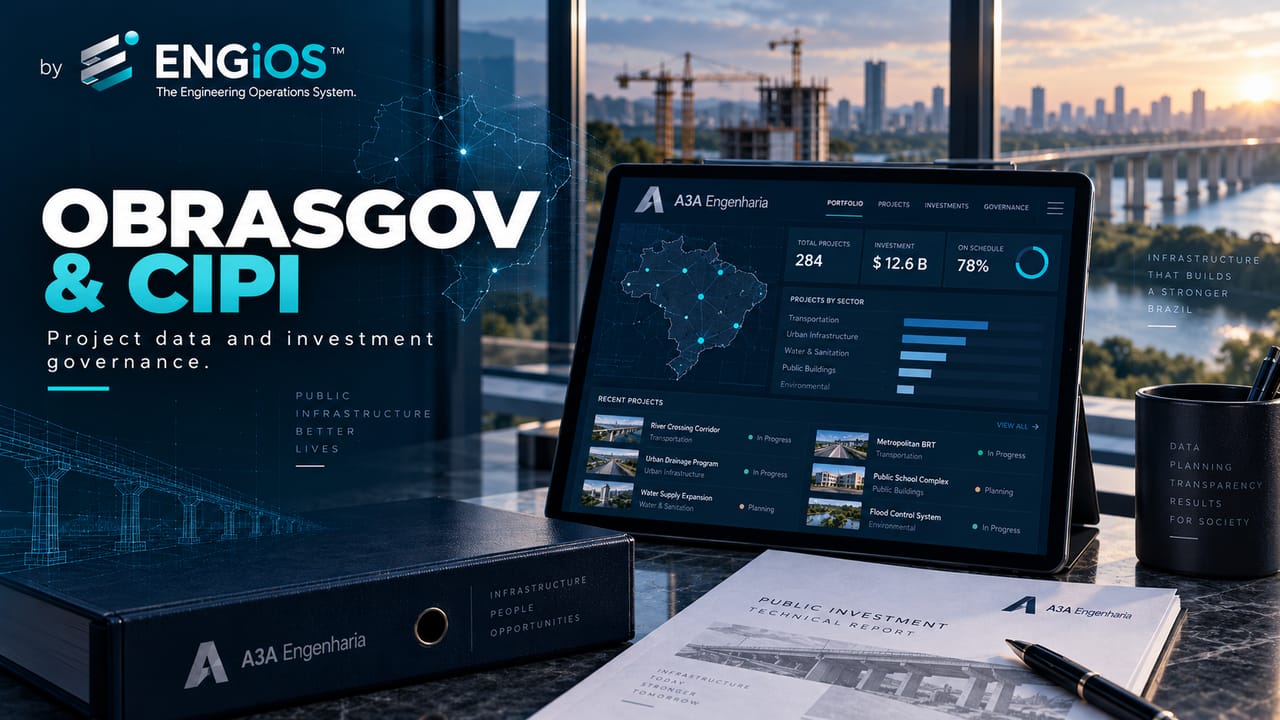
Understand what Obrasgov and CIPI are, when registration applies, which project information must be governed, and how to integrate design, estimate, contract, execution, and transparency.
Check it out!
Obrasgov.br is the federal platform that operates the Integrated Investment Project Registry — CIPI, a centralized record of information on infrastructure investment projects. Within the scope defined by Decree No. 10,496/2020, CIPI brings together data on studies, designs, and works funded by Brazil’s Fiscal and Social Security Budgets within the federal Executive Branch, enabling monitoring of location, status, resources, and investment progress. Other public entities and branches may use the platform for investments funded with their own resources subject to the accession conditions established by regulation.
In practice, Obrasgov and CIPI are not two competing registries. CIPI is the registry created by decree; Obrasgov.br is the platform through which that registry is operated. The naming and user-experience changes sought to bring the system closer to the language of public works management while preserving its role of integrating investment-project information and strengthening governance and transparency.
For public-sector engineering, the registry should not be treated as an administrative task disconnected from the project. Recorded information needs to reflect the actual investment: scope, location, stage, responsible party, funding source, schedule, status, and other data required by the system. If the Basic Design, estimate, transfer instrument, and Obrasgov describe different investments, the inconsistency affects governance, monitoring, control, and transparency.
For this reason, the best way to work with Obrasgov is to integrate it into the investment structuring journey, from studies and solution definition through procurement, execution, and closeout. The system is most useful when it receives reliable data produced by mature technical processes rather than when it is populated merely to satisfy a formal step.
Obrasgov.br and CIPI: what is the difference?
Decree No. 10,496/2020 established the Integrated Investment Project Registry — CIPI to centralize information on infrastructure investment projects. Subsequently, regulation and system evolution moved CIPI operations to the platform known as Obrasgov.br.
The distinction can therefore be summarized as follows:
| Term | Function |
| CIPI | integrated public registry of infrastructure investment projects |
| Obrasgov.br | technology platform that operates CIPI and provides management, consultation, and transparency tools |
| Obrasgov Dashboard | visualization and consultation layer for investment information |
| Public Access | public environment for consulting available data |
This distinction helps interpret older and current documents. Historical references may mention only CIPI, more recent references may use Obrasgov.br, and technology addresses may still contain the CIPI acronym. The institutional object, however, remains connected to the integrated investment-project registry.
The official portal states that the platform seeks to strengthen governance of federal infrastructure investments, provide visibility into project status, geolocate investments, and facilitate integration with monitoring, control, and inspection systems.
What is the legal basis for Obrasgov and CIPI?
The primary legal basis is Decree No. 10,496 of September 28, 2020, which established CIPI. The decree was later amended, including by Decree No. 10,899/2021 and Decree No. 11,272/2022, which expanded permitted uses and consolidated operation through the Obrasgov.br platform.
SEGES/ME Ordinance No. 25,405/2020 regulates the registry and details concepts, responsibilities, registration methods, and updating obligations. The ordinance was later amended, including by MGI-SEGES Ordinance No. 4,322/2023 and, more recently, SEGES/MGI Ordinance No. 10,874 of December 3, 2025.
For those structuring procurement or monitoring investments, this chronology matters. Copying an internal procedure based only on the initial 2020 version may ignore subsequent changes in concepts and workflows. Official Obrasgov documentation should be treated as a living operational source and consulted together with consolidated legislation.
The official manual available in 2026 brings this framework together and guides users on access, profiles, registration, and use of the platform.
When is registration in Obrasgov mandatory?
According to the official portal, registration is mandatory for studies, Basic Designs, Detailed Designs, works, and other interventions funded by the Fiscal and Social Security Budgets within the federal Executive Branch, subject to the specific rules of Decree No. 10,496/2020 and Ordinance No. 25,405/2020.
It is important to avoid an incorrect generalization. The fact that Obrasgov is a national transparency platform does not mean that every municipal project funded exclusively with local resources is automatically required to use the system. The decree allows states, the Federal District, municipalities, and bodies of the federal Legislative and Judiciary branches to use CIPI for projects funded with their own resources under accession rules.
On the other hand, transfer instruments and federal programs may create registration, integration, or updating obligations in federal systems under their specific regulations. Projects funded through federal transfers therefore also need to be analyzed in light of the transfer instrument, program, Transferegov, and rules applicable to the funding source.
O artigo sobre Transferegov agreements for public works addresses this other layer of the process. Obrasgov and Transferegov may interact, but they perform distinct functions and should not be treated as synonyms.
What types of intervention can be registered?
Obrasgov is not limited to works already under physical execution. Official documentation covers information relating to studies, Basic Designs, Detailed Designs, works, and other interventions that form part of infrastructure investment projects.
This is consistent with the maturation logic of a public investment. Before a construction site exists, resources may already be committed to studies, surveys, designs, and preparation. If the system only began monitoring the investment once physical construction started, an important part of governance would remain outside the registry.
For the engineering team, this reinforces the need to establish stable project identifiers early. The name used in the Preliminary Technical Study, Basic Design, estimate, transfer instrument, and Obrasgov should represent the same scope or clearly explain its relationship to phases and subprojects.
What should be ready before registering the investment
The system may accept registration at different stages, but registration quality depends on the quality of source information. Before entering data, the organization should at least be able to answer:
- what the investment is and which public problem it seeks to address;
- where it is located;
- which public body or entity is responsible for the investment;
- what the funding source and financing structure are;
- what stage the investment is in;
- which studies and designs already exist;
- which values and schedule milestones are valid on the registration date;
- who will be responsible for updating the data;
- which source systems already contain equivalent information.
These answers do not all need to be final for the investment to exist, but uncertainties need to be recognized. Recording a still-preliminary value, a merely aspirational date, or an unapproved solution as “final” creates false precision and reduces the management quality of the registry.
A structuring of Novo PAC projects illustrates why funding selection does not mean an investment is ready for procurement. The registry should follow the actual evolution of project maturity.
How to organize Obrasgov data within engineering governance
If the Obrasgov registry diverges from the design, estimate, or contract, the problem is usually not the form itself: it lies in governance of the information sources. Mapping processes, responsible parties, and source systems should come before automating updates.
The better model is not to create a parallel spreadsheet solely to “feed CIPI.” The organization should maintain a source of truth for investment data and map which fields are published or synchronized to each system.
A governance structure can separate five information families:
| Family | Examples | Preferred technical source |
| Identification | code, name, scope, location | master investment registry |
| Planning | phase, milestones, schedule, responsible parties | PMO / project planning |
| Technical | studies, Basic Design, Detailed Design, physical status | document management system / engineering team |
| Financial | estimate, commitments, funding, disbursements | budget and financial systems |
| Contractual | procurement, contract, execution, measurement | contract management |
Obrasgov works best when these information families are coordinated. A material design change may affect schedule and value; contract termination may change physical status; a new transfer instrument may alter the funding composition. The update should reflect the event first in the source system and then in dependent systems.
Obrasgov does not replace Basic Design, the Preliminary Technical Study, or Terms of Reference
Registration does not replace technical maturity. An investment identified as ready for procurement needs a sufficiently structured need, solution, design, estimate, and risk basis. Preparing the Preliminary Technical Study and Basic Design creates the reliable foundation that will later be reflected in monitoring systems.
Preliminary Technical Study for Construction and Engineering Services
The system records and organizes information about the investment; it does not produce the engineering required to procure the works.
An investment may be correctly registered and still lack a sufficiently mature Basic Design. Likewise, a technically mature design may exist while the registry is outdated. The two controls need to operate in parallel and remain aligned.
O Basic Design under Law 14.133 according to the TCU remains the document that defines and sizes the scope with the level of maturity required for the applicable procurement regime. The Terms of Reference for public works organize execution, management, measurement, and acceptance criteria.
Obrasgov should reflect these decisions and enable monitoring. Treating it as a substitute for engineering documents produces a registry that may appear complete but lacks sufficient technical basis.
Relationship between Obrasgov and Transferegov
This is a recurring question because many federal infrastructure investments involve transfer instruments.
Transferegov.br is the platform used to manage federal transfers and partnerships through several instruments. Obrasgov.br organizes registration and monitoring of infrastructure investment projects. The systems are integrated and may share data, but they perform distinct roles.
A public-works agreement may contain a work plan, targets, disbursement schedule, documents, and accountability records in Transferegov, while the investment also has registration and monitoring information in Obrasgov. The manager should understand which system is the source of each data item and avoid contradictory records.
Official Obrasgov documentation describes integration with Transferegov, Siafi, Comprasnet, and proprietary works-management systems. For organizations with their own automated systems, regulation provides for web-services integration in certain contexts.
This architecture reinforces an important principle: the sustainable solution is not to manually enter the same information in multiple places, but to organize data governance and integrations when the investment portfolio justifies it.
Systems integration and interoperability
Public bodies with extensive investment portfolios should not treat Obrasgov as a permanently manual activity. The platform itself provides interoperability documentation and web services for systems integration.
Before developing integration, however, governance problems that technology cannot fix need to be resolved:
- define a unique investment identifier;
- establish which system is the source of truth for each field;
- standardize project statuses and phases;
- define events that trigger updates;
- handle duplicate and conflicting records;
- record the date and source of the information;
- define responsibility for correcting exceptions.
Without these rules, an API merely automates inconsistencies. With governance established, integration reduces rework and increases update frequency.
Para organizações em processo de transformação digital, o Engineering Process Diagnosis and Optimization can map the current workflow, data sources, redundancies, and control points before any automation.
Data quality: the main risk in the registry
The usefulness of a monitoring system is limited by the quality of the data recorded. A populated field is not necessarily reliable information.
Common problems in public-works portfolios include different names for the same investment, inaccurate geolocation, outdated dates, values from different phases compared as though they were equivalent, physical status without uniform criteria, and records that remain active after a change in strategy.
A data-quality policy should define at least:
- completeness: mandatory and critical fields are populated;
- validity: the reported value has a recognized source;
- currency: the information corresponds to the current period;
- consistency: the data do not contradict official systems and documents;
- uniqueness: the same investment has not been duplicated;
- traceability: the source and person responsible for the update can be identified.
These criteria bring the registry closer to the logic of an engineering information system. The information ceases to be merely “portal data” and becomes management evidence.
How to connect Obrasgov to the project lifecycle
Portfolios with dozens of investments need baseline, milestone, cost, and exception control. Project Controls helps organize information at the source and reduce dependence on manual consolidations to update external platforms.
The registry should evolve together with the investment. A milestone-based control model can connect engineering events with data updates.
| Milestone | Typical change | Information to review |
| ETP approval | preferred solution defined | scope, stage, estimates |
| Basic Design completion | scope and cost gain maturity | value, schedule, documents |
| tender publication | procurement strategy defined | status, procurement references |
| contract signature | contractor and schedule confirmed | contract data and schedule |
| notice to proceed | physical execution begins | status and start date |
| material measurements | physical and financial progress | percentage, values, and milestones |
| contract amendment or design revision | baseline changes | schedule, value, and related justifications |
| acceptance | execution closes | status, date, result |
The table does not replace the system manual because fields and rules may change. It functions as a governance model: each important investment event should trigger a review of updates in monitoring systems.
Obrasgov and BIM in public works
The Obrasgov portal maintains an area dedicated to BIM in public works, reference designs, and an object library. This does not mean every CIPI registration requires BIM, but it demonstrates the convergence between investment governance and structured engineering-information management.
O artigo BIM in Public Works: why standardize requirements before procurement, contracting, and inspection addresses this connection. BIM models, CDEs, and information requirements can improve project-data quality, but they need to be integrated into the institutional process to create value.
An organization with well-implemented BIM can extract part of the information used by management systems from the design environment. Even so, budget, contractual, and institutional data usually come from other sources. The challenge remains multidisciplinary.
How Obrasgov supports transparency and control
The centralized registry makes it possible to view investments beyond the individual administrative file. Managers can analyze the portfolio, location, stage, and resources; oversight bodies can cross-check data; and citizens can consult publicly available information.
This portfolio view creates incentives for better standardization. If each unit uses different concepts for “in progress,” “stopped,” “completed,” or “under design,” consolidation loses meaning. Central systems push organizations to define comparable taxonomies and criteria.
The transparency gain does not eliminate the need for context. A delay may result from design, permitting, procurement, execution, funding, or an administrative decision. The data identify the condition; technical governance needs to explain the cause, risk, and corrective action.
Essa é uma ponte natural com a public-works risk management and with technical monitoring of the portfolio.
Recurring errors when using Obrasgov
Registering only to meet a deadline
When registration is not integrated into the management routine, information becomes outdated quickly. The system then shows a historical snapshot rather than the current state of the investment.
Creating a duplicate investment record
Changes in name, department, funding source, or contract may lead users to register the same investment again. The investment identifier should survive administrative changes when the underlying scope remains the same.
Confusing the investment, contract, and construction work
An investment project may involve more than one contract, study, design package, and execution phase. Structuring the registry as a mirror of a single contract can fragment the overall view of the investment.
Updating the value without recording a baseline change
Values may evolve from a preliminary estimate to a reference estimate and then to the contracted value. Comparing these figures requires knowing the stage and date. Replacing one with another without governance erases the decision history.
Reporting physical progress without a method
Execution percentage should come from a consistent criterion, preferably linked to measurement, schedule, or a defined physical breakdown. “80% complete” based only on visual perception is difficult to audit.
Separating the registry from inspection
Inspection produces field data that should inform the investment status. If those updating the system do not receive inspection information, delays and contradictions emerge.
How to audit an investment record before treating the data as reliable
An audit can be performed in layers.
Identity
Confirm code, name, location, scope, and responsible public body. Check for duplicates and the relationship with earlier phases.
Technical maturity
Compare the declared stage against the actual existence of the Preliminary Technical Study, designs, estimate, permits, and other necessary documents. An investment classified as ready for procurement should have compatible evidence.
Financial consistency
Compare registry values with the estimate, budget commitments, transfer instruments, and contracts. Differences should be explainable by stage or base date.
Schedule consistency
Compare planned and actual dates against the current schedule. Identify fields not updated after extensions or suspensions.
Physical consistency
Compare status and progress with measurements, inspection reports, photographs, and field evidence.
Governance
Verify who performs updates, how frequently, from which source, and which workflow corrects inconsistencies.
This audit turns the registry into a management tool rather than merely a transparency obligation.
When specialized support is needed
Organizations with a small number of investments and experienced staff may manage the registry internally. The need for specialized support increases when there is a large portfolio, legacy systems, dispersed data, stalled works, multiple transfer instruments, or low confidence in the current database.
Objective warning signs include:
- frequent discrepancies between Obrasgov and internal reports;
- investments with no assigned person responsible for updates;
- duplicates and inconsistent names;
- difficulty reconciling the registered value with the current estimate;
- outdated physical status;
- projects identified as mature without sufficient documentation;
- need to integrate an internal system with Obrasgov;
- portfolio without uniform classification criteria.
In these cases, support should begin with the process and the data. Automating before cleaning and governing the database tends to perpetuate the problems.
What to procure to structure Obrasgov and CIPI governance
A technical support service should not have only “Obrasgov data entry” as its scope. That scope is narrow and encourages operational dependency. A more robust objective is to structure information governance for the investment portfolio and treat the registry as one of its outputs.
The scope may include:
- diagnosis of current planning and monitoring processes;
- inventory of investments and removal of duplicates;
- data-source matrix;
- definition of a unique identifier;
- taxonomy of phases and statuses;
- quality and update criteria;
- reconciliation with designs, estimates, and contracts;
- definition of responsibilities by field and event;
- Obrasgov update procedure;
- integration specification where applicable;
- internal dashboard for exceptions and pending items;
- team training;
- periodic data-quality audits.
Measurement should be linked to verifiable deliverables: a cleansed database, governance matrix, approved procedure, integration rules, inconsistency reports, and training evidence. The focus should remain on institutional autonomy and information reliability.
O Engineering Risk Management can complement this work when the portfolio needs to prioritize interventions, critical risks, and corrective actions, while Project Management and Project Controls structures schedule, costs, and baseline control.
Final considerations
Obrasgov.br and CIPI should be understood as part of the infrastructure for governance of public infrastructure investments. CIPI is the integrated registry; Obrasgov is the platform that operates it and expands access, monitoring, and transparency.
The value of the system depends less on the act of registration and more on the reliability of what is registered. Design, estimate, contract, execution, and inspection need to feed a coherent information chain. When data are treated as a by-product of engineering management, the registry helps provide portfolio visibility, monitor risks, and support accountability. When treated as isolated data entry, the system simply receives inconsistencies that already existed in the process.
For the Administration, the objective should be simple: ensure that every published piece of information about an investment can be traced to a valid technical or administrative source, a reference date, and a person responsible for updating it. This discipline transforms Obrasgov from a formal obligation into an effective governance instrument.
When the database contains stalled works, divergent values, duplicates, or outdated statuses, the priority is to cleanse the portfolio and define risks and responsible parties. The objective is to make management data usable before expanding transparency or integration.
Technical references
[1] BRASIL. Decreto nº 10.496, de 28 de setembro de 2020. Establishes the Integrated Investment Project Registry — CIPI. Disponível em: [https://www.planalto.gov.br/ccivil_03/_ato2019-2022/2020/decreto/d10496.htm](https://www.planalto.gov.br/ccivil_03/_ato2019-2022/2020/decreto/d10496.htm).
[2] MINISTÉRIO DA GESTÃO E DA INOVAÇÃO EM SERVIÇOS PÚBLICOS. Portaria SEGES/ME nº 25.405, de 23 de dezembro de 2020. Regulates CIPI. Disponível em: [https://www.gov.br/transferegov/pt-br/legislacao/portarias/portaria-seges-me-no-25-405-de-23-de-dezembro-de-2020](https://www.gov.br/transferegov/pt-br/legislacao/portarias/portaria-seges-me-no-25-405-de-23-de-dezembro-de-2020).
[3] MINISTÉRIO DA GESTÃO E DA INOVAÇÃO EM SERVIÇOS PÚBLICOS. Portaria SEGES/MGI nº 10.874, de 3 de dezembro de 2025. Amends CIPI regulation. Disponível em: [https://www.gov.br/transferegov/pt-br/legislacao/portarias/portaria-seges-mgi-no-10-874-de-3-de-dezembro-de-2025](https://www.gov.br/transferegov/pt-br/legislacao/portarias/portaria-seges-mgi-no-10-874-de-3-de-dezembro-de-2025).
[4] MINISTÉRIO DA GESTÃO E DA INOVAÇÃO EM SERVIÇOS PÚBLICOS. About Obrasgov.br. Disponível em: [https://www.gov.br/obrasgov/pt-br/sobre-obrasgov.br/sobre-o-obrasgov.br](https://www.gov.br/obrasgov/pt-br/sobre-obrasgov.br/sobre-o-obrasgov.br).
[5] MINISTÉRIO DA GESTÃO E DA INOVAÇÃO EM SERVIÇOS PÚBLICOS. Obrasgov.br Manual — version available in 2026. Disponível em: [https://www.gov.br/obrasgov/pt-br/sobre-obrasgov.br/documentacao-do-obrasgov.br/manual-do-obrasgov.br/manual-do-obrasgov.pdf](https://www.gov.br/obrasgov/pt-br/sobre-obrasgov.br/documentacao-do-obrasgov.br/manual-do-obrasgov.br/manual-do-obrasgov.pdf).
Frequently asked questions
Obrasgov.br is the platform that operates the Integrated Investment Project Registry — CIPI and provides tools for registering, monitoring, consulting, and increasing transparency of infrastructure investment projects.
CIPI is the registry established by Decree 10,496/2020; Obrasgov.br is the technology platform that operates that registry. In practice, the names appear together because Obrasgov is CIPI’s current user interface.
Within the federal Executive Branch, regulation makes registration mandatory for interventions covered by CIPI, including studies, designs, and works funded through the Fiscal and Social Security Budgets. Other public entities may use the platform for investments funded with their own resources according to accession rules and specific regulations.
Yes. States, the Federal District, and municipalities may use CIPI/Obrasgov to monitor infrastructure investments funded with their own resources subject to the applicable accession conditions. Projects funded with federal resources must also comply with the rules of the program and transfer instrument.
Transferegov manages federal transfers and partnerships; Obrasgov organizes the registration and monitoring of infrastructure investment projects. The systems may be integrated and share data, but they perform different functions.
No. The system records investment information but does not replace the Preliminary Technical Study, preliminary design, Basic Design, Detailed Design, estimate, Terms of Reference, or other technical documents required to procure and execute the works.
Updates should follow the deadlines and events defined in regulation and the current manual. Internally, it is advisable to link review to milestones such as design approval, procurement, contract award, start of works, measurements, amendments, stoppages, and acceptance.
Yes. The platform provides interoperability documentation and web services. Before integrating, the organization should define sources of truth, identifiers, data-quality rules, and update events so that inconsistent data are not automated.
Complementary technical materials
Related services
- Engineering Process Diagnosis and Optimization
- Preliminary Technical Study (ETP) for Construction and Engineering Services
- Engineering Basic Design
- Project Management: Schedule, Costs, and Earned Value
- Engineering Risk Management
Main content on the topic
- Transferegov Agreements for Public Works
- Novo PAC and Public-Works Project Structuring
- Basic Design under Law 14.133 according to the TCU