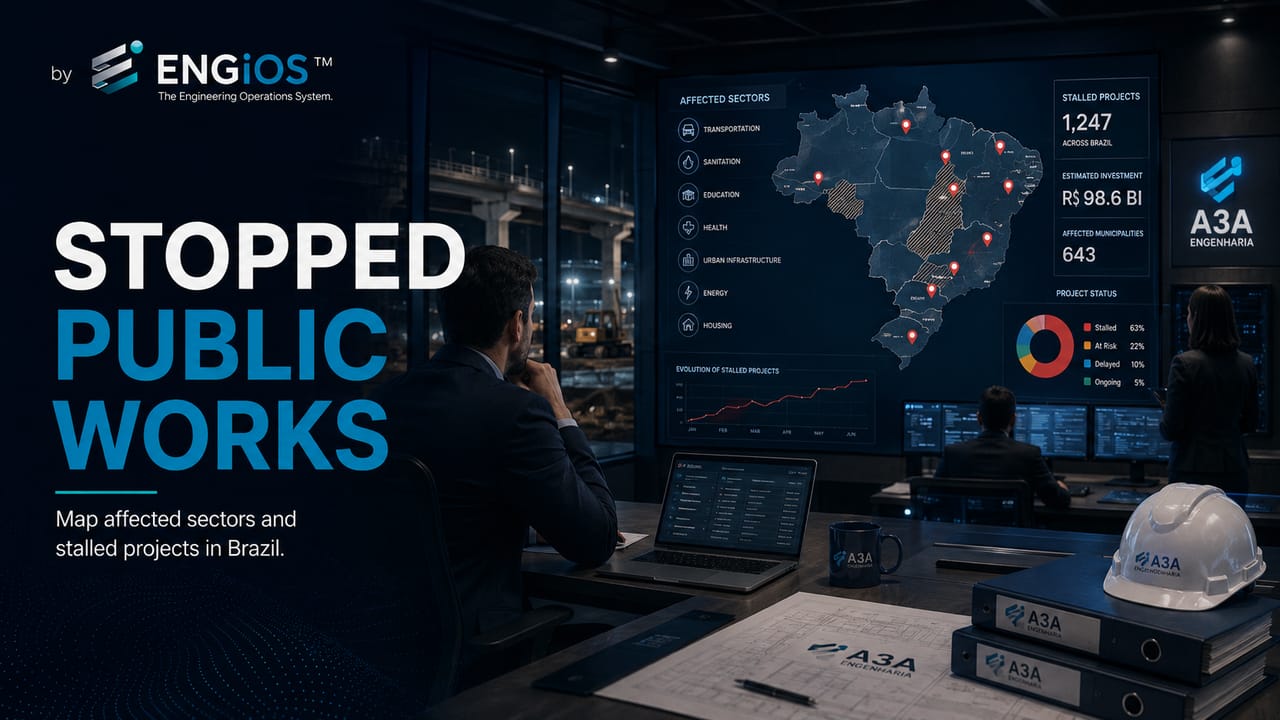
Updated map of stalled public works in Brazil based on TCU data: quantities, most affected sectors, critical states, causes, and how to prioritize resumption.
Check it out!
Stalled public works in Brazil remain one of the country’s largest infrastructure and public-policy liabilities. The Federal Court of Accounts (TCU) series shows the worsening of the problem within the portfolio then monitored: 38.5% of works were stalled in 2022, 41% in 2023, 52% in April 2024, and 50.7% in April 2025, when 11,469 of 22,621 mapped projects were not progressing normally. In July and August 2026, the TCU updated the classification criteria and cleaned up the Stalled Public Works Dashboard, more clearly separating stalled, canceled, and completed works. This methodological change prevents the 2026 snapshot from being treated as a simple percentage continuation of the previous series and makes it even more important to distinguish the reference date, monitored universe, and classification criterion.
These figures should not be read as a simple delay statistic. A stalled project represents immobilized public capital, an asset subject to deterioration, an unmet public need, the risk of projects and permits expiring, higher resumption costs, and often a new procurement cycle. Proper interpretation of the TCU map requires separating the number of works, financial value, project nature, physical stage, cause of stoppage, and institutional capacity to resume. The same stoppage rate may conceal very different situations: a nearly completed daycare center that was abandoned, a primary healthcare unit blocked by land issues, a sanitation project without a mature detailed design, or a road project whose contract became economically unfeasible.
For this reason, the national diagnosis becomes useful to public managers only when converted into engineering questions: which works should be resumed first, which require a condition survey, which designs should be reviewed, which contracts can still be remedied, which remaining scopes require a new procurement process, and which projects no longer make technical, economic, or operational sense.
What the TCU’s latest data actually show
The update published by the TCU in July 2025, with data consolidated through April of that year, is the most precise national reference located for quantifying the portfolio. The dashboard mapped 22,621 projects financed with federal funds and classified 11,469 as stalled. This means that, at that cut-off date, slightly more than one out of every two projects was not progressing normally.
The financial dimension is also substantial. Follow-up materials from the Court itself pointed to tens of billions of reais in planned investments linked to stalled works and amounts already disbursed into assets that had not yet fully delivered the intended public service. The problem, therefore, is not limited to the amount required to complete what remains. There is also the economic cost of keeping already-invested resources from generating benefits, in addition to physical deterioration and the need for rework.
In 2026, a change occurred that was more significant than a simple update in quantities. In Ata 27/2026-Plenário, dated July 15, the TCU recorded the update of the Stalled Public Works Dashboard criteria, including the distinction between stalled and canceled works. In Ata 30/2026-Plenário, dated August 5, the Court presented a new extraction with data referring to April 2026 and highlighted, among other results, 3,737 works classified as canceled and 6,141 as completed. The portfolio therefore underwent data cleansing and status reclassification.
There is an important methodological difference between saying that the TCU released new consolidated national figures and saying that, in 2026, the Court reiterated the scale of the problem. As of the date of this analysis, the detailed and publicly documented quantitative baseline located remains the one with a cut-off in April 2025. In technical content, this distinction avoids mixing publication date, data reference date, and later update statements.
For public managers, the practical consequence is straightforward: the national dashboard should guide prioritization and benchmarking, but a decision about a specific project requires its own baseline, updated in the field and reconciled against the documentation.
Education and healthcare account for most stalled works
According to the TCU, education and healthcare accounted for 8,053 stalled works as of April 2025, equivalent to approximately 70% of the national total. This helps explain why unfinished public works have a disproportionately large social impact.
An unfinished school or daycare center is not merely an incomplete real-estate asset. It represents seats that were not made available, the need to travel to other facilities, continued use of temporary structures, and lost service capacity. In healthcare, an unfinished primary care unit, hospital, laboratory, or specialized facility directly affects access to care and may leave the population dependent on more distant or overloaded facilities.
In June 2026, the TCU’s own communications reinforced this priority. The Destrava II Program began concentrating efforts precisely on education and healthcare. At the time, the Ministry of Health reported having identified 5,600 works without continuity in its area, with approximately 65% still awaiting resumption. The Ministry of Education reported finding 5,600 stalled works in the current administration, of which 3,700 had been resumed and more than 700 completed, leaving around 1,800 still inactive.
These sector-specific figures should not be mechanically added to the national dashboard because they may use different universes, cut-off dates, and classification criteria. Their analytical value lies in confirming the same conclusion through different sources: healthcare and education form the largest and most socially sensitive core of the stalled-works backlog.
Why education and healthcare projects have specific risks
Projects in these sectors combine several characteristics that increase the sensitivity of resumption:
- strong dependence on intergovernmental transfers and funding agreements;
- a large number of small and medium-sized municipal projects;
- the need to coordinate architecture, building systems, and operational requirements;
- equipment and systems that may change during long stoppage periods;
- health, accessibility, fire-protection, and licensing requirements;
- the need for staffing, operating budgets, and maintenance after physical delivery;
- the risk that a standardized design does not fully match the actual site or facility conditions.
In many cases, the physical works are only part of the problem. A facility may be nearly complete and still not be ready to enter operation. This is why the operational readiness of a public facility must be assessed separately from the percentage of physical completion.
Maranhão, Bahia, Pará, and Minas Gerais are among the states with the largest backlog
In the July 2025 release, the TCU highlighted Maranhão, Bahia, Pará, and Minas Gerais. Together, these four states accounted for nearly four thousand unfinished works within the monitored universe.
This does not mean that all projects share the same cause of stoppage or that responsibility lies exclusively with state governments. The dashboard includes works financed with federal funds and executed under different institutional arrangements. The same state may contain directly federal, state, municipal, grant-funded, or sector-program projects.
For territorial analysis, three views are more useful than a raw ranking:
- absolute number of stalled works;
- percentage of stalled works relative to the local portfolio;
- value and functional relevance of the affected projects.
A state with many small municipal works may rank first by count without necessarily concentrating the greatest financial value. Another may have fewer projects but of much larger scale and higher economic impact. Resumption prioritization should combine these dimensions.
Institutional capacity must also be considered. Smaller municipalities may struggle to review designs, update budgets, conduct a new tender, oversee contracts, and structure resumption documentation. The bottleneck therefore becomes not only financial but also one of engineering and governance.
The most concerning figure: recent projects also stop
The TCU highlighted that the problem is not limited to old contracts. Of the 5,505 works started between April 2024 and April 2025, approximately 1,200 were already stalled at the analyzed cut-off, around 22% of the total.
This indicator is particularly relevant because it weakens the explanation that the backlog is merely a legacy of older procurement models, Law 8.666, or historical crises. A significant share of newly started works also quickly becomes stalled.
When a recent project stops after only a few months, the investigation should begin before the construction site. Recurring technical hypotheses include:
- insufficiently mature basic design;
- inconsistent quantities;
- a reference budget that does not represent actual market conditions;
- lack of site release;
- incomplete permits and authorizations;
- unrecorded interferences;
- a schedule incompatible with the construction method or logistics;
- award of an economically unfeasible bid;
- poor risk allocation;
- insufficient contractor capability;
- payment or counterpart-funding flows incompatible with execution;
- oversight governance unable to respond quickly to deviations.
The article Why projects stop before they even begin goes deeper into the portion of risk that originates during studies, design, and procurement. The data on recent works show that addressing only the old backlog does not stop the flow of new stoppages.
A stalled project is not a single technical category
The national dashboard must transform thousands of different records into comparable categories. This is essential for portfolio management. However, when deciding the future of a specific project, the generic classification “stalled” is insufficient.
A project may be inactive because the contract was terminated, the contractor abandoned the site, a court issued an order, funding was unavailable, there was an environmental constraint, expropriation was pending, the design was defective, a change order was required, measurement was disputed, the company became insolvent, or because several of these factors occurred together.
The consequence is that there is no resumption protocol based solely on the declared cause. Before remobilizing, the public manager must establish the asset’s current condition and reconstruct the contractual and physical baseline.
Five questions the dashboard cannot answer on its own
For each project, the decision requires answers to at least five questions:
- What was actually executed? The financial percentage paid does not necessarily equal the percentage of valid physical completion.
- What remains technically usable? Executed elements may have deteriorated or become incompatible with an updated design.
- What remains to be executed? The remaining scope must be measured from the current condition, not merely by subtracting the original budget.
- What was the root cause of the stoppage? Resuming without removing the original constraint leads to another stoppage.
- What is the appropriate contractual route? Continuation, remediation, termination, calling a runner-up for the remaining scope, or a new tender depend on the specific situation and the decision of the competent public authority.
The technical protocol for resuming a stalled public work organizes these questions into an operational sequence of diagnosis, decision, and remobilization.
The reported physical completion percentage can be misleading
One of the most dangerous distortions in managing stalled works is to treat “80% complete” as synonymous with “20% remaining.” This arithmetic logic is rarely sufficient.
Imagine a building with the structure and walls completed, systems partially installed, equipment stored for years, a leaking roof, and incomplete As-Built documentation. The financial report may indicate 80% progress, but the portion that is actually reusable may be lower. Part of what was executed may require inspection, testing, correction, or replacement.
Resumption must distinguish at least four metrics:
| Metric | What it represents | Risk if used alone |
| Measured percentage | services recognized in progress certificates | may include items whose current condition has not been validated |
| Paid percentage | cumulative disbursement | does not prove quality or usability |
| Apparent physical percentage | visually executed volume | may hide defects and untested systems |
| Technically usable percentage | portion that can be incorporated into the final solution | requires inspection, documentation, and acceptance criteria |
This is why the survey of executed services and condition assessment is one of the most important documents before defining the remaining scope.
The cause of stoppage should be treated as a system problem
A project usually does not stop because of one isolated event. Even when there is an obvious trigger — contractor abandonment, nonpayment, or a court decision — it is necessary to investigate why the contractual system failed to absorb the problem before reaching a complete interruption.
A robust cause analysis separates the event, immediate cause, contributing cause, and systemic cause. For example:
- event: the contractor reduces crews and abandons the site;
- immediate cause: insufficient cash flow;
- contributing cause: a bid margin incompatible with actual productivity;
- systemic cause: insufficient feasibility analysis and an inadequate risk matrix.
Or:
- event: work is halted because the specified foundations cannot be executed;
- immediate cause: geotechnical conditions differ from those assumed;
- contributing cause: insufficient subsurface investigation;
- systemic cause: a basic design was tendered without the survey needed to size the solution.
The advantage of this approach is that it avoids “solving” only the event. Replacing the contractor without correcting the design, budget, or site-release problem may reproduce exactly the same failure.
Design, budget, and site conditions form the critical triangle of resumption
Three elements recur in stalled works: technical definition of the scope, the economic baseline, and the effective availability of the work front.
Design
The design must represent actual conditions and be mature enough to define what will be procured. In a stalled project, the original design may be outdated because standards have changed, materials have been discontinued, interferences have been discovered, or the building itself has changed during the stoppage.
When resumption requires a new procurement process, repeating the old package without review tends to transfer the same defects into the new contract. The article No detailed design before construction? What Law 14.133 requires before work begins details the relationship between basic design, detailed design, and the start of execution.
Budget
The budget for the remaining scope must reflect the current solution. Simply applying monetary escalation to the original bill of quantities is not enough. Quantities change, mobilization must be repeated, temporary works reappear, repairs enter the scope, productivity may fall in a brownfield environment, and the costs of testing, documentation, and commissioning may become more significant.
Price research for engineering works and services and detailed budget composition should be rebuilt using current bases and explicit assumptions.
Site and released work front
Expropriation, easements, environmental licensing, interferences, and physical access are production conditions. If the contractor does not receive an effectively released work front, the schedule becomes fictitious.
The allocation of expropriation and licensing risks must be addressed before procurement, not after the site has already been mobilized.
How to prioritize a portfolio of dozens or hundreds of stalled works
A portfolio of stalled works should not be treated merely as a list of problematic contracts. Technical Due Diligence organizes physical condition, documentation, risks, cost to complete, and priorities so that the backlog can be converted into executable decisions.
Structure a technical diagnosis of the stalled-works portfolio
The TCU dashboard helps visualize the national problem, but each public entity must build its own prioritization. Resuming the project with the highest physical completion rate first is not always the best decision. A project that is 90% complete may require substantial additional investment to produce any benefit, while another at 60% may be placed into operation quickly and serve a larger population.
A prioritization matrix should combine at least:
- social relevance and population benefited;
- urgency of the public policy;
- technically usable percentage;
- estimated cost to complete;
- time to enter operation;
- risk of deterioration if the project remains stalled;
- availability of design documents and permits;
- land status;
- complexity of a new procurement process;
- legal and contractual risk;
- availability of budget funding;
- future capacity for operation and maintenance.
The decision may be organized into action categories:
- immediate resumption, when scope, funding, and work front are mature;
- conditional resumption, when solvable pending issues remain before mobilization;
- reformulation, when design, scope, or purpose must be revised;
- new procurement of the remaining scope, when the previous contract cannot continue and the remaining object is defined;
- justified discontinuation, when resumption is no longer technically, economically, or socially rational.
The last option is frequently overlooked. Responsible portfolio management does not mean completing every project at any cost. It means demonstrating which decision produces the greatest public benefit considering the project’s current condition.
The remaining scope is not the financial balance of the previous contract
New mobilization must start from a reconstructed budget for the actual remaining scope. Quantities, repairs, mobilization, productivity, testing, and documentation must reflect the project’s current condition, not merely the historical spreadsheet.
When the previous contract ends, it is common to treat the difference between the contracted amount and the amount paid as the “remaining project balance.” Technically, this is insufficient.
The remaining scope is the current set of services, corrections, completions, tests, documentation, and deliverables required to produce the final result. It must be reconstructed from the actual survey and design review.
This means it may include:
- services originally planned but not yet executed;
- services executed but rejected or deteriorated;
- repairs resulting from exposure during the stoppage;
- new code and standards upgrades;
- removal and reinstatement needed to access existing elements;
- updates to systems and equipment;
- new testing and commissioning;
- final documentation and As-Built records;
- mobilization and demobilization of the new contractor.
The article Remaining work: how to procure what is left without inheriting the previous contract’s problems examines this reconstruction of the scope in greater depth.
Resuming without commissioning may simply replace a stalled project with an asset that does not work
Institutional pressure usually focuses on physically completing the project. This is understandable, but it creates another risk: declaring the project complete without demonstrating that the systems operate in an integrated manner, that requirements have been met, and that the team is ready to take over the asset.
Especially in hospitals, schools, administrative buildings, sanitation, energy, electronic security, and critical facilities, handover must include tests and evidence.
A commissioning plan for public works should organize:
- verifiable requirements;
- inspections and tests by system;
- integrated tests;
- pass/fail criteria;
- resolution of punch-list items;
- documentation of results;
- training;
- handover of manuals and As-Built records;
- transition to operations.
Resumption only delivers public value when the project stops being a “construction work” and begins operating as a school, healthcare facility, water-supply system, road, urban facility, or operational infrastructure.
The cost of leaving a project stalled continues to grow even without physical progress
A stalled project continues to generate economic costs. Some are visible and others do not immediately appear in the budget.
Direct and indirect costs include:
- site security and preservation;
- weather-related deterioration;
- vandalism and theft;
- corrosion and loss of stored equipment;
- expiration of warranties;
- updates to designs and permits;
- new mobilization;
- increases in material and labor prices;
- the need to redo work;
- administrative and legal costs;
- unavailability of the planned public service;
- maintenance of temporary solutions.
The amount disbursed before the stoppage also has an opportunity cost. Resources invested in a structure that delivers no service could be financing another functioning asset. The longer the interruption, the greater the risk that the original economic rationale of the project no longer reflects reality.
For this reason, the resumption decision should be accompanied by a new economic analysis rather than merely an update of the contractual balance.
Stalled works require portfolio governance, not only construction-site oversight
The TCU has been treating the issue as a problem of coordination and backlog management, not merely as the sum of individual contracts. Acórdão 2.134/2023-Plenário directed the Office of the Chief of Staff to prepare a management plan for the federal public-works portfolio, including strategy, guidelines, prioritization, targets, and indicators.
This approach is essential. Construction oversight operates at the project level. An administration with dozens or hundreds of interrupted projects also needs portfolio governance.
At portfolio level, there should be:
- a single project registry;
- standardized status classification;
- periodic updates of cost to complete;
- recorded root cause;
- technical, legal, budgetary, and social risk;
- an institutional owner for the next action;
- a formal decision on the project’s disposition;
- resumption milestones;
- indicators for time to enter operation.
The Project, Program, and Portfolio Governance solution applies precisely when an organization needs to move beyond isolated cases and structure common criteria for decision-making, prioritization, and monitoring.
The new phase of Destrava reinforces the need for coordinated solutions
On June 11, 2026, the TCU participated in the signing of the cooperation agreement that marked a new phase of the Integrated Program for the Resumption of Public Works, Destrava II. The initiative brings together oversight bodies, the justice system, and the federal government and seeks solutions for projects interrupted by judicial or administrative decisions, prioritizing education and healthcare.
The interinstitutional composition recognizes that certain stoppages cannot be resolved by a single agency. There are situations in which engineering, budget, contract, oversight, court decisions, public assets, and public policy overlap.
For local public managers, however, institutional coordination does not replace technical documentation. The more parties involved in the decision, the greater the need for traceability:
- what is the current physical condition;
- what amounts were measured and paid;
- what pending items remain;
- which design will be adopted;
- how much completion will cost;
- what risks were identified;
- which alternative was chosen and why;
- who assumes each responsibility;
- what conditions must be satisfied before remobilization.
Without this foundation, an attempt to unblock the contract may simply shift the conflict to the next stage.
What a municipality should do when it identifies a stalled project in its portfolio
For a municipal government, autonomous public entity, or state agency, the first move should not be to publish a new tender. It should be to stabilize the information baseline.
An initial sequence may follow this order:
- preserve the site, documents, and evidence;
- gather the contract, designs, budget, measurements, payments, amendments, orders, and communications;
- perform a physical survey of what exists;
- assess quality and condition;
- reconcile execution, measurement, and payment;
- identify the cause of the interruption and any unresolved issues;
- review designs, quantities, and current requirements;
- estimate the cost of the remaining scope;
- verify permits, land ownership, and interferences;
- compare resumption alternatives;
- define the contractual strategy with the competent departments;
- structure the new technical package and acceptance criteria.
The purpose of this sequence is to prevent political urgency to resume from replacing sound engineering preparation.
Which documents form the minimum diagnostic baseline
There is no single list valid for every project, but the analysis normally begins with four document sets.
Design baseline
- preliminary studies;
- basic design;
- detailed design and revisions;
- technical specifications;
- design calculations;
- surveys and geotechnical investigations;
- approvals and permits;
- partial As-Built documentation, when available.
Contractual baseline
- tender documents and appendices;
- contract;
- winning bid;
- contract bill of quantities;
- schedule;
- risk matrix;
- bonds and guarantees;
- contract amendments;
- work and suspension orders.
Execution baseline
- site diary;
- inspection reports;
- progress measurement reports;
- photographic records;
- tests and certificates;
- NCRs and outstanding items;
- submittals and approvals;
- inventory of materials and equipment.
Financial and administrative baseline
- payments made;
- remaining budget appropriation;
- funding source;
- counterpart contributions;
- grant agreement or transfer instrument;
- sanction proceedings;
- legal opinions and relevant administrative decisions.
Missing documentation should not be filled with assumptions. It should be recorded as a gap and addressed in the investigation plan.
How Engineering Consulting can support a portfolio of stalled works
When resumption involves design review, budgeting, procurement, oversight, testing, and acceptance, Owner’s Engineering acts as an integrating layer across disciplines while preserving the owner’s perspective.
The role of Engineering Consulting is not to replace the authority of the public manager or decide legal matters that belong to the Administration. Its value lies in producing an independent, comparable, and traceable technical basis for decision-making.
For a portfolio of stalled works, support can be organized in layers.
Portfolio screening
The first layer classifies projects by materiality, urgency, maturity, risk, and potential for resumption. The objective is to avoid mobilizing full teams for every project at the same time.
Due diligence and condition survey
For priority projects, the team reconstructs the current situation: documents, field conditions, measurements, contracts, risks, and gaps. Technical Engineering Due Diligence is appropriate when the Administration needs to transform dispersed information into a diagnosis and action plan.
Design and budget review
After the existing condition is understood, scope, design, quantities, and cost to complete are reviewed. When necessary, the technical package is updated to enable a new procurement process.
Procurement strategy and oversight
Engineering defines technical criteria, measurement requirements, evidence, and acceptance criteria to reduce the risk of repeating previous causes. Technical Support for Oversight of Engineering Works and Contracts can support implementation without removing the public inspector’s statutory responsibilities.
Commissioning and handover
Finally, completion must be demonstrated through tests, documentation, training, and acceptance, closing the transition from resumed construction to a functioning asset.
A practical readiness model for resumption
Before authorizing remobilization, the project can be classified by readiness level.
| Level | Status | Recommended decision |
| 0 — unknown | documentation and physical condition not reconciled | diagnose before procuring |
| 1 — diagnosed | cause and current condition known | define solution alternative |
| 2 — technically defined | design and remaining scope updated | consolidate budget and risks |
| 3 — ready for procurement | scope, budget, site, and permits sufficient | prepare procurement |
| 4 — ready for mobilization | contract, work front, and governance ready | begin execution |
| 5 — ready for handover | testing, documentation, and operations planned | complete and place into service |
This model avoids the most common leap: moving directly from “stalled project” to “new tender.” Between these extremes lies a sequence of technical maturation.
How to prevent resumption from becoming a second stoppage
Structured oversight reduces the likelihood of a second stoppage because it creates traceability for progress, pending items, decisions, measurements, and acceptance criteria during renewed execution.
Structure technical support for oversight of project resumption
A second stoppage is usually more expensive than the first because it occurs on an already deteriorated asset and after a new institutional mobilization. For this reason, the resumption stage should be more rigorous than a standard procurement process.
Before restarting, it is advisable to verify:
- design consistency with current conditions;
- a budget aligned with the remaining scope;
- a feasible execution methodology;
- an effectively available work area;
- valid permits;
- clearly allocated responsibilities;
- a schedule compatible with procurement lead times and constraints;
- the contractor’s financial and operational capacity;
- objective measurement criteria;
- a decision process for RFIs, changes, and nonconformities;
- a testing and acceptance plan;
- availability of staff and operating budget after handover.
A mature resumption process changes the question from “when does the project restart?” to “what conditions must be satisfied so it can restart and not stop again?”
The national map should guide prevention, not only recovery
The greatest lesson from the TCU figures is that the country cannot treat stalled public works merely as a backlog to be cleared. As long as new projects quickly become stalled, the backlog is replenished.
A resumption policy must go hand in hand with a prevention policy. This involves improving the quality of studies, increasing design maturity, structuring realistic budgets, analyzing feasibility, releasing work fronts before mobilization, allocating risks, and strengthening oversight.
Within the procurement cycle, three controls are especially relevant:
- technical review of the Terms of Reference before publication;
- technical analysis of bids, including feasibility due diligence;
- cost and measurement control to distinguish overpricing, overbilling, and unfeasible pricing.
Prevention does not eliminate all external events, but it substantially reduces the number of stoppages caused by problems that could have been identified before procurement.
Indicators that should accompany the number of stalled public works
Counting projects is necessary but insufficient to measure the effectiveness of a resumption policy. A more mature management system also tracks flow and outcome indicators.
Useful indicators include:
- total number of stalled works;
- total planned portfolio value;
- resources already invested;
- updated cost to complete;
- average duration of stoppage;
- percentage of projects with completed diagnosis;
- percentage with updated design;
- percentage with confirmed funding source;
- number of projects resumed during the period;
- number of projects that became stalled again;
- average time from resumption decision to mobilization;
- average time from resumption to entry into operation;
- public benefit actually delivered.
The “resumed” indicator alone can create a false sense of success. A project remobilized for a few months and then interrupted again is not a solution. The final indicator should be an asset completed, accepted, and operating.
Final considerations
The TCU map reveals a structural backlog. In the consolidation with an April 2025 cut-off, 11,469 of 22,621 works financed with federal resources were stalled. Education and healthcare accounted for 70% of cases. In June 2026, the Court was still describing the problem as roughly 22,000 monitored works and 11,000 stalled works, while strengthening the Destrava Program and interinstitutional coordination.
The most important interpretation, however, is not statistical. The country must prevent the management of stalled public works from being reduced to finding funding and remobilizing a site. Sustainable resumption requires technical diagnosis, reconstruction of the remaining scope, updated design and budget, treatment of the root cause, contractual definition, structured oversight, commissioning, and preparation for operations.
For public managers responsible for a significant portfolio of interrupted projects, the most efficient approach is to transform the list of works into a portfolio of decisions: which should be resumed, which need reformulation, which require new procurement, and which no longer justify continuation. Engineering provides the objective basis for making that decision defensible, prioritized, and executable.
Technical references
[1] BRASIL. Tribunal de Contas da União. Metade das obras financiadas com recursos federais estão paradas. Brasília, 30 jul. 2025. Data from the Stalled Public Works Dashboard with an April 2025 cut-off. Available at: [https://portal.tcu.gov.br/imprensa/noticias/metade-das-obras-financiadas-com-recursos-federais-estao-paradas](https://portal.tcu.gov.br/imprensa/noticias/metade-das-obras-financiadas-com-recursos-federais-estao-paradas)
[2] BRASIL. Tribunal de Contas da União. Presidente do TCU assina acordo para retomada de obras públicas paralisadas. Brasília, 11 jun. 2026. Available at: [https://portal.tcu.gov.br/imprensa/noticias/presidente-do-tcu-assina-acordo-para-retomada-de-obras-publicas-paralisadas](https://portal.tcu.gov.br/imprensa/noticias/presidente-do-tcu-assina-acordo-para-retomada-de-obras-publicas-paralisadas)
[3] BRASIL. Lei nº 14.133, de 1º de abril de 2021. Lei de Licitações e Contratos Administrativos. Brasília, DF. Available at: [https://www.planalto.gov.br/ccivil_03/_ato2019-2022/2021/lei/l14133.htm](https://www.planalto.gov.br/ccivil_03/_ato2019-2022/2021/lei/l14133.htm)
[4] CÂMARA BRASILEIRA DA INDÚSTRIA DA CONSTRUÇÃO. Obras públicas paralisadas no Brasil: diagnóstico, propostas e a nova Lei de Licitações. Brasília, 2023. Available at: [https://cbic.org.br/obras-publicas-paralisadas-no-brasil-diagnostico-propostas-e-a-nova-lei-de-licitacoes/](https://cbic.org.br/obras-publicas-paralisadas-no-brasil-diagnostico-propostas-e-a-nova-lei-de-licitacoes/)
Frequently asked questions
In the latest clearly published national quantitative consolidation by the TCU, with an April 2025 cut-off, 22,621 works financed with federal resources were mapped and 11,469 were stalled, equivalent to 50.7%. In June 2026, the TCU again referred to approximately 22,000 monitored works and 11,000 still stalled.
Education and healthcare account for the largest share. At the April 2025 cut-off, the two sectors totaled 8,053 unfinished works, about 70% of the stoppages monitored by the TCU.
In the TCU’s July 2025 release, Maranhão, Bahia, Pará, and Minas Gerais were highlighted and together totaled nearly four thousand unfinished works. The ranking should also be interpreted in light of portfolio size, value, and project type.
No. Before choosing the contractual route, the Administration must understand the physical and documentary condition of the project, identify the cause of the stoppage, define the remaining scope, update the design and budget, and assess the legally available alternatives.
Not necessarily. It is necessary to distinguish measured percentage, paid percentage, apparent physical percentage, and technically usable percentage. Deterioration, rejected services, and untested systems may reduce the portion that can actually be reused.
A structured diagnosis is normally required, combining a field survey, condition assessment, reconciliation of measurements and payments, document review, root-cause analysis, and a pending-items map. The document name may vary depending on the scope.
Because problems involving design maturity, budgeting, site release, licensing, feasibility, contractor capability, and governance continue to occur. The TCU reported that around 22% of the works started between April 2024 and April 2025 were already stalled at the analyzed cut-off.
It is an interinstitutional initiative aimed at finding solutions to resume interrupted public works. In June 2026, a new phase, Destrava II, was formalized with participation from the TCU, CNJ, the federal government, oversight bodies, and other institutions, prioritizing education and healthcare.
Prioritization should combine social benefit, urgency, technically usable percentage, cost to complete, time to operation, deterioration risk, design maturity, permits, land status, funding source, and contractual complexity.
Technical Due Diligence and Owner’s Engineering are appropriate structures for organizing diagnosis, risks, priorities, scope review, and resumption governance. Depending on the case, cadastral surveys, budgeting, Terms of Reference review, and technical support for oversight may also be necessary.
Additional technical materials
Related solutions
- Project, Program, and Portfolio Management
- Contract, Scope, and Deliverables Management
- Requirements, Evidence, and Acceptance Criteria Management
- Document Governance and Document Management System
Related services
- Technical Engineering Due Diligence
- Owner’s Engineering
- Technical Support for Oversight of Engineering Works and Contracts
- Budgeting for Engineering Works and Services
- Technical Review of Terms of Reference for Engineering Works and Services
Core content on this topic
- How to resume a stalled public work: an 8-step technical protocol
- Survey of executed services and condition assessment
- Remaining work: how to procure what is left
- Expropriation and licensing in public works
Related technical content
- Why projects stop before they even begin
- Operational readiness in public works
- Commissioning plan for public works
- Technical review of Terms of Reference
- Feasibility due diligence
- Overpricing, overbilling, and unfeasible pricing
- Complete Guide to Procurement and Contracts for Engineering Works and Services
- Owner’s Engineering: executive framework for procurement, governance, and acceptance
