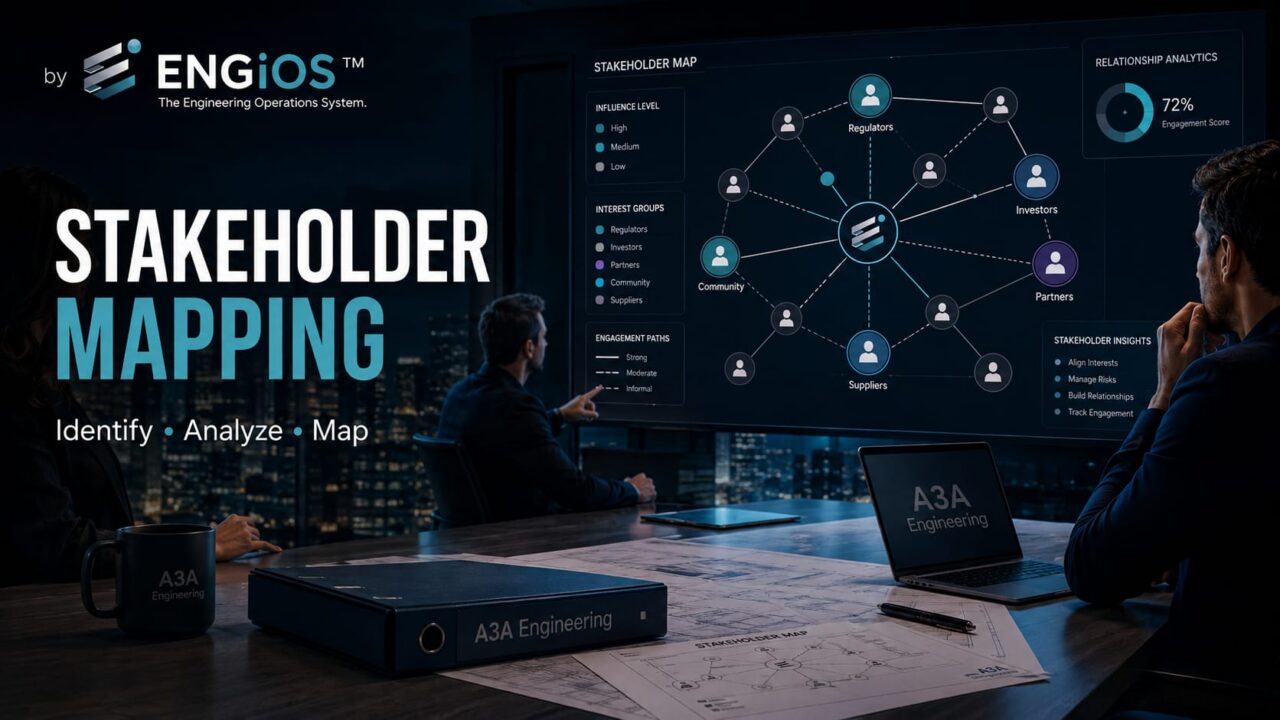
Learn how to perform stakeholder mapping in projects: identification, relationships, influence, impact, mapping, review and integration with communication and governance.
Check it out!
Stakeholder mapping is the structured process of identifying the interested parties in a project, understanding how each one relates to objectives, decisions, deliverables and impacts, analyzing influence, interest, legitimacy, dependencies and current position, and representing these relationships in a useful way to guide engagement, communication and governance.
A stakeholder map is not just a list of names or a quadrant chart. It needs to help the team answer concrete questions: who can change a decision? who provides a critical requirement? who will be affected by the solution? who can block an approval? who needs to participate before a given milestone? and how do these relationships change throughout the project lifecycle?
In engineering projects, the value of mapping lies in making visible relationships that are normally dispersed across organization charts, contracts, minutes, technical documents, interfaces, permits and the team’s tacit knowledge. When done well, the map reduces the likelihood of discovering important stakeholders only after rework, conflict, delay, late change or rejection of a deliverable has already occurred.
What is stakeholder mapping
Stakeholder mapping turns stakeholder identification into a representation that helps the team understand relationships, influence, dependencies and management priorities. It is one of the practices that support stakeholder management in projects, but it has its own purpose: to make the project’s relationship system visible.
The key point is that a stakeholder does not exist in isolation. An operations area may influence requirements; a supplier may depend on an inspection approval; a utility may condition an energization milestone; a sponsor may decide investment exceptions; a community may experience impacts and influence legitimacy. The map helps visualize these connections before they become coordination problems.
Three artifacts are often confused:
| Artifact | Main question | Typical use |
| Stakeholder register | Who are the interested parties and what information do we need to maintain about them? | Controlled source of data and history |
| Stakeholder map | How do these parties relate to each other and to the project? | Visualization of relationships, dependencies and influence |
| Stakeholder matrix | Who requires greater attention priority according to defined criteria? | Classification and prioritization |
The map therefore does not replace the register or the matrix. It connects information and context.
Why map stakeholders in engineering projects
Engineering projects are sociotechnical systems. In addition to the physical or digital solution, there are contracts, approvals, operations, regulatory requirements, interfaces, field constraints, economic interests, responsibilities and decisions distributed across different organizations.
A team may produce a technically correct design and still face resistance because operations was not involved. It may mobilize construction and discover that a utility needed to approve an intervention. It may purchase equipment and later realize that maintenance had an unrecorded access and spares requirement. It may deliver a system and have acceptance delayed because the person responsible for validating operations never participated in testing.
Mapping helps anticipate these situations by connecting stakeholders to:
- objectives and expected benefits;
- requirements and acceptance criteria;
- work packages and deliverables;
- decisions and authority levels;
- technical and contractual interfaces;
- risks, assumptions and constraints;
- external licenses and approvals;
- schedule milestones;
- operations, maintenance and transition;
- social, institutional or environmental impacts.
The logic is close to interface management in engineering projects: a relevant interface needs an owner, information, timing and a closure mechanism. Stakeholder mapping extends this view to the human and organizational relationships that support those interfaces.
When the map should be prepared
The first map should be prepared early, but it does not need to wait until all information is available. During initiation, it serves as a structured hypothesis of the project environment. As scope, contracts, solution and governance mature, the map should mature as well.
Especially important review points include:
- project charter approval;
- definition of the governance structure;
- requirements consolidation;
- issue of procurement packages;
- entry of new suppliers;
- significant scope changes;
- start of mobilization or implementation;
- licenses, authorizations and external interfaces;
- FAT, SAT, commissioning and integrated tests;
- preparation for acceptance and handover;
- change of sponsor, manager or authority;
- occurrence of relevant conflict or resistance.
A map created only at the beginning and never reviewed quickly becomes a historical record rather than a management tool.
How to identify stakeholders before building the map
The most common mistake is starting with the drawing. Before choosing quadrants, circles or connections, the team needs to identify broadly enough who participates, influences or receives impacts.
Start with governance and procurement documents
The project charter, business case, organization chart, contracts, terms of reference, responsibility matrix, project plan and initial meeting minutes reveal formal actors. They indicate the sponsor, client, managers, package owners, authorities and known suppliers.
The RACI Matrix is useful for identifying responsible, accountable, consulted and informed roles by activity, but it should not be confused with a stakeholder map. RACI shows responsibility for the work; the map shows relationships, interest, influence and impact.
Walk through the WBS and deliverables
Each WBS package should generate questions:
- Who provides data or requirements?
- Who performs the work?
- Who verifies or approves?
- Who depends on the deliverable?
- Who receives impact from the solution?
- Who will operate or maintain it later?
- Who can interrupt or condition the activity?
- Who must provide access, a license, a resource or a decision?
This walkthrough identifies stakeholders that do not appear in project organization charts.
Analyze technical and organizational interfaces
Interfaces among disciplines, companies, systems, areas and phases are recurring sources of forgotten stakeholders. An electrical decision may affect automation, civil, operations and safety. A layout change may affect maintenance, logistics and accessibility. A new integration may involve IT, OT, cybersecurity, a supplier and a user.
Consider the lifecycle beyond implementation
The most important stakeholder for a decision is not always the one present in the current phase. Operations, maintenance, facilities, safety, procurement and asset management often live with the consequences for years. Mapping them early prevents engineering problems from being transferred to operations.
Look for parties without formal representation
Indirect users, shift teams, communities, future service providers and support areas may not have a permanent representative. The absence of a name in the organization chart does not eliminate the impact. Governance needs to define how these perspectives will be represented.
What information to gather for mapping
The map should be visually simple, but building it depends on structured information. The stakeholder register serves as the data source.
Useful fields include:
| Information | Purpose |
| Stakeholder or group | Identify the interested party |
| Organization and area | Understand context and links |
| Project role | Relate the party to deliverables and decisions |
| Interest | Understand objectives, needs and concerns |
| Influence | Assess the ability to affect a decision or result |
| Impact received | Assess how much the project may affect the party |
| Formal authority | Distinguish influence from decision power |
| Critical knowledge | Identify technical or operational dependency |
| Current position | Support, neutrality, resistance or lack of awareness |
| Main relationships | Show alliances, dependencies and influence channels |
| Relationship owner | Assign ownership to management |
| Critical timing | Link the stakeholder to a milestone, phase or decision |
| Last review | Control how current the analysis is |
Not all information should appear in the drawing. Sensitive assessments, commercial interests, conflicts or informal relationships may require restricted access. The public map used in an executive meeting may differ from the management team’s working artifact.
How to analyze relationships among stakeholders
The stakeholder map should produce management decisions. If the drawing does not change who participates, when they participate, what information flows or how a risk is treated, it has become documentation only.
The distinguishing feature of a map is its relationships. Two parties with similar influence may require completely different strategies depending on how they relate to other parties and to the project itself.
Authority relationships
They show who decides, approves, vetoes, authorizes or escalates. In complex projects, authority is often distributed: one person approves budget, another validates technically and a third authorizes an operational intervention.
Contractual relationships
Owner, contractor, subcontractor, supplier, integrator and inspection have formal obligations that should not be replaced by informal relationships. The map should make these dependencies understandable without erasing the contractual structure.
Technical relationships
One discipline provides data to another; a supplier holds proprietary information; an automation team depends on signals from another system; a utility needs to validate a study. These relationships can define critical decision paths.
Informal influence relationships
Not all influence comes from a job title. A recognized specialist, key user or community leader may change acceptance and behavior without formal authority. The map helps recognize this reality without turning it into a personal judgment.
Impact relationships
It is also necessary to map who receives consequences. A stakeholder with low power may experience high impact. Ignoring that party simply because they do not make decisions can create operational, reputational, regulatory or social risks.
Methods for building a stakeholder map
There is no single correct format. The method depends on the question the team needs to answer.
Radial map
Places the project or undertaking at the center and distributes stakeholders around it, usually by proximity, group or relationship. It is useful for an overview and identification workshops.
It can separate, for example:
- governance and sponsor;
- client and operations;
- project team;
- suppliers and contractors;
- authorities and regulators;
- users and communities.
Its strength is simplicity. Its limitation is that it does not show priority or multiple relationships well when there are many actors.
Network map
Represents stakeholders as nodes and relationships as connections. It is better for projects with multiple organizations, consortia, supply chains or strong interface dependencies.
Connections may represent:
- decision;
- information;
- contract;
- technical dependency;
- approval;
- influence;
- impact.
To avoid an unreadable diagram, each version of the map should be limited to a specific purpose.
Layered map
Organizes stakeholders into layers of proximity to the project. For example: decision core, direct participants, operational interfaces and external environment. It is useful for executive communication.
Power-interest matrix
It is often called a map, although technically it is a prioritization matrix. It positions stakeholders according to two criteria and is explored in depth in the specific Stakeholder Matrix article. The important point here is that quadrants simplify reality and should not replace analysis of impact, legitimacy, urgency and dependencies.
How to assess influence without confusing it with job title
Influence is the ability to affect decisions, resources, requirements, pace, acceptance or results. It can come from several sources:
- formal authority;
- budget control;
- ownership of a mandatory requirement;
- contractual power;
- scarce technical knowledge;
- control of access or licensing;
- ability to mobilize other people;
- responsibility for operations or acceptance;
- institutional or social legitimacy;
- critical project dependency.
A director may have great authority and little day-to-day involvement. An operator may have low formal authority and critical knowledge to validate the solution. A utility may be outside the organization and still control an essential milestone. The map needs to capture these differences.
How to represent interest and impact
Interest measures how much the stakeholder cares about the project or a specific decision. Impact measures how much they may be affected. The two are not the same.
A community may experience high impact and have low formal influence. A corporate area may have high influence and little interest in details. A maintenance team may face high long-term impact even though it participates little during conception.
This distinction avoids a classic mistake: prioritizing only those with power and forgetting those who will receive the effects of the decision.
How to map support, neutrality and resistance
A stakeholder’s position should not be treated as a personal label. The objective is to understand evidence and causes.
Resistance may result from:
- an unmet requirement;
- real impact without mitigation;
- operational risk;
- loss of autonomy;
- priority conflict;
- insufficient information;
- a history of unfulfilled commitments;
- contractual disagreement;
- a legitimate interest different from the project objective.
The record should describe observable behavior and known reasons, not adjectives. This makes it possible to define an appropriate management response.
How to use the map to define the engagement strategy
The map creates value only when it changes management decisions. After visualizing relationships and priorities, the team should convert the analysis into strategy.
For each relevant stakeholder or group, define:
- what relationship outcome is required;
- what decision, requirement or impact is at stake;
- what level of participation is appropriate;
- who should lead the relationship;
- what information is required;
- what channel and timing make sense;
- what feedback is expected;
- how to demonstrate that the interaction produced a result.
The strategy may vary among informing, consulting, involving, collaborating, negotiating, mobilizing or escalating. The choice depends on the issue, not only on the person.
How to connect the map to the communication plan
The map indicates who needs attention and why. The communication plan translates that into flows of information and interaction.
A good connection between the two avoids generic meeting plans. Instead of simply defining a “weekly meeting,” the project starts to define:
| Element | Example |
| Audience | Operations and maintenance |
| Objective | Validate operability requirement |
| Content | Alternatives, impacts and required decision |
| Channel | Technical workshop |
| Timing | Before design freeze |
| Owner | Engineering lead |
| Feedback | Closed comments and recorded decision |
| Evidence | Minutes, updated requirement and approval |
The satellite article on the Project Communication Plan expands this structure without turning the stakeholder map into a message calendar.
How to connect stakeholders to requirements and changes
Forgotten stakeholders often reappear as late requirements, uncoordinated interfaces, conflicts or approval delays. Mapping needs to communicate with the technical and contractual structure of the project.
Stakeholders are among the main sources of requirements and changes. Mapping should be connected to requirements management in engineering.
When a new interested party appears, ask:
- does the party introduce a requirement not yet recorded?
- does it have an acceptance criterion?
- does it change an assumption or constraint?
- does it affect an existing interface?
- does it change risk or priority?
- does it require a formal decision?
The relationship does not automatically authorize a scope change. Any modification must follow the applicable control process.
How to connect the map to risk management
A stakeholder may be a source of risk, a response owner, an affected party or a mitigation agent. Therefore, the map and project risk management should be connected.
Examples:
- approval delay by an external authority;
- unavailability of a supplier specialist;
- operations resistance to an intervention window;
- change of sponsor;
- conflict between contracts;
- lack of a representative with authority to decide.
The map helps reveal the relational dimension of these risks and define actions before they occur.
Example of mapping in a modernization project
Consider modernization of an operating industrial facility.
The team initially identifies:
- sponsor;
- project manager;
- Owner’s Engineering;
- operations;
- maintenance;
- occupational safety;
- IT/OT;
- implementation contractor;
- critical system supplier;
- utility;
- inspection;
- affected users.
The map shows that operations receives high impact and holds essential knowledge; the utility has external authority over a milestone; the supplier controls technical data without which integration cannot advance; the sponsor decides investment exceptions; maintenance influences access and lifecycle requirements.
This analysis changes the project plan. Workshops with operations are brought forward; utility approvals are included in the schedule; the supplier receives submittals with need dates; maintenance participates in the review before freeze; and the sponsor receives decisions prepared with alternatives and impacts.
The value of the map is not in the final drawing. It is in the actions it produces.
Common mistakes in stakeholder mapping
Mapping only senior positions
This ignores users, specialists, operations and directly affected parties.
Using an organization chart as if it were the map
An organization chart shows formal structure, not influence, dependencies, impact or project relationships.
Creating the map once
Stakeholders, contracts and interests change. The map needs to follow the project’s evolution.
Exposing sensitive assessments
Maps may contain sensitive information. Access governance and professional language are mandatory.
Confusing priority with human importance
Classifying management attention does not mean assigning value to people. The objective is to direct management resources according to context and risk.
Mapping without generating action
If the map does not change communication, engagement, schedule, risk or decisions, it has become only an illustration.
Checklist for reviewing a stakeholder map
Before considering the map useful, verify that:
- the main objectives and deliverables were considered;
- contracts and governance were reviewed;
- operations and maintenance are represented;
- external interfaces were identified;
- stakeholders without formal representation were assessed;
- authority and dependency relationships are clear;
- impact received was analyzed, not just influence;
- sensitive assessments have appropriate access;
- each priority stakeholder has a relationship owner;
- the map is connected to communication, risk, requirements and decisions;
- there is a review trigger or periodicity;
- the current version represents the actual project phase.
When to seek Consulting Engineering support
In complex projects, the value of Consulting Engineering lies in turning dispersed relationships into verifiable governance: owners, criteria, information, milestones and traceable decisions.
Mapping tends to require structured support when the project involves many organizations, contracts, technical interfaces, continuous operations, external authorities, communities, significant changes or high-impact decisions.
In Engineering Project Management, the consultant’s role is not to replace the sponsor or responsible parties. It is to structure the decision environment: identify critical relationships, organize information, integrate stakeholders with requirements, interfaces, risks and schedule, and maintain enough traceability for decisions to occur at the right time.
In Owner’s Engineering models, this view also helps the owner coordinate designers, suppliers, contractors and operations without losing control over scope, criteria and responsibilities.
Final considerations
Stakeholder mapping is a management practice for understanding the project’s relationship system and converting that understanding into concrete actions. A good map is not the most visually sophisticated one; it is the one that makes visible the decisions, influences, dependencies and impacts the team needs to manage.
Identification should start from objectives, deliverables, documents, contracts and interfaces. Analysis needs to distinguish authority, influence, interest and impact. And the result should feed engagement, communication, requirements, risks, schedule and governance.
When treated as a living artifact, the stakeholder map stops being a static figure and becomes an instrument for coordination and anticipation of problems in engineering projects.
Technical references
[1] INTERNATIONAL ORGANIZATION FOR STANDARDIZATION. ISO 21502:2020 — Project, programme and portfolio management — Guidance on project management. Geneva: ISO, 2020. Available at: https://www.iso.org/standard/74947.html
[2] PROJECT MANAGEMENT INSTITUTE. A Guide to the Project Management Body of Knowledge (PMBOK® Guide). 8th ed. Newtown Square: PMI, 2025. Available at: https://www.pmi.org/standards/pmbok
[3] PROJECT MANAGEMENT INSTITUTE. Stakeholder management. Newtown Square: PMI. Available at: https://www.pmi.org/learning/library/stakeholder-management-task-project-success-7736
Frequently asked questions
It is the process of identifying interested parties, analyzing their relationship with the project and representing influence, interest, impact, dependencies and connections in a useful way to guide engagement, communication and decisions.
The map emphasizes relationships, connections and context among interested parties. The matrix classifies and prioritizes stakeholders according to selected criteria such as influence and interest. Both can be used together.
Start by identifying stakeholders from objectives, contracts, the WBS, interfaces and impacts. Record essential information, analyze relationships and influence, choose a suitable representation and connect the result to engagement and communication actions.
At the beginning and during phase transitions, scope changes, supplier onboarding, governance changes, new risks, licensing, implementation milestones, commissioning, acceptance or whenever stakeholder influence and impact change.
No. RACI assigns responsibilities for activities and deliverables. The stakeholder map analyzes relationships, interest, influence and impact. The same person may have a specific role in RACI and a different position on the map.
In addition to the sponsor, client and team, operations, maintenance, suppliers, contractors, inspection, authorities, utilities, users, support areas and other parties affected by decisions and deliverables should be assessed.
No. Power and interest are useful, but complex projects also require assessment of impact received, legitimacy, urgency, critical knowledge, dependencies, current position and the ability to influence other parties.
The main result is better management decisions: involving the right party at the right time, anticipating conflicts and dependencies, adjusting communication, reducing late changes and protecting requirements and acceptance criteria.
Complementary technical materials
Related solutions
Related services
Main content on the topic
- Stakeholder Management in Projects
- RACI Matrix in Engineering Projects
- Interface Management in Engineering Projects