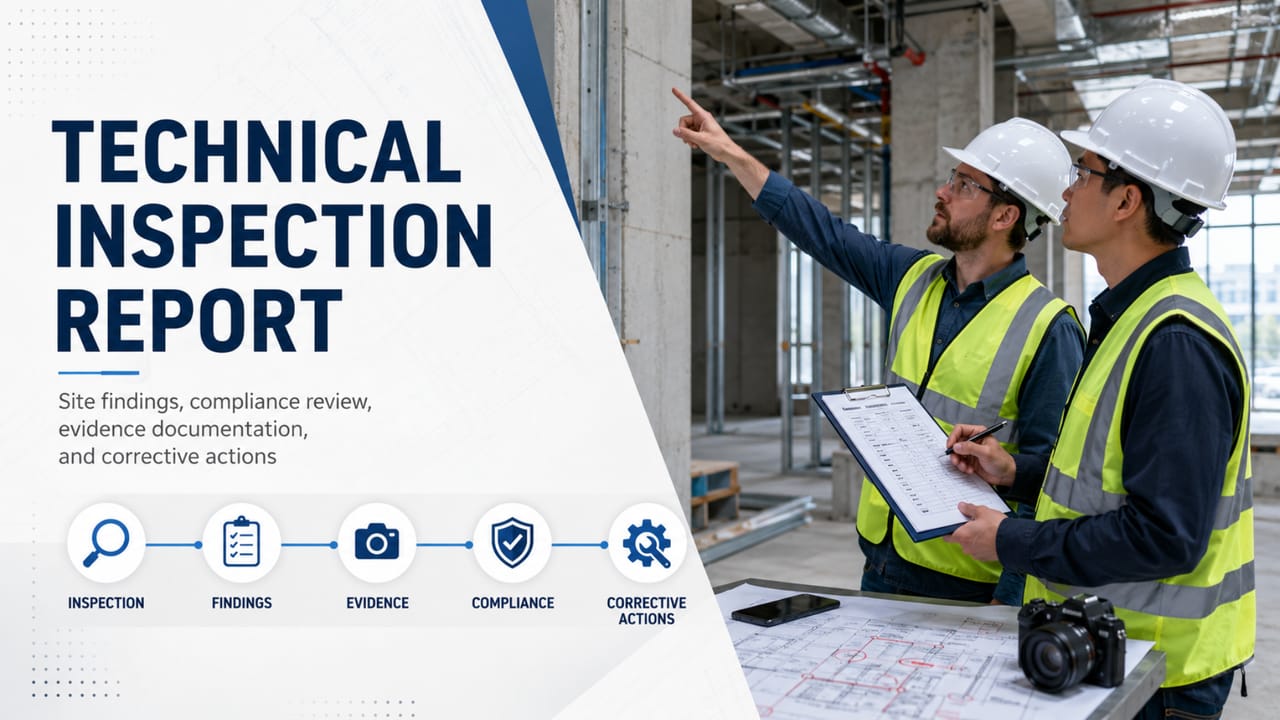
Learn how to structure an engineering technical inspection report with evidence, construction daily logs, measurements, outstanding items, recommendations, acceptance, and handover.
Check it out!
The engineering technical inspection report is one of the main traceability instruments used in the execution of construction works, technical services, deployments, and critical systems. It records what was verified, which evidence was collected, which outstanding items were identified, which measurements were evaluated, and which technical recommendations were issued to the client.
An inspection report should not be merely a narrative record of a site visit. It should organize technical information in a verifiable manner, connecting scope, execution, documentation, quality, measurements, outstanding items, risks, commissioning, acceptance, and handover.
This topic is directly connected to Technical Inspection of Construction Works and Engineering Services, ao Measurement Statement in Engineering Consulting, à Engineering Outstanding Items Matrix e ao Provisional and Final Acceptance in Engineering.
What is a technical inspection report
The technical inspection report is the document that records the analysis of technical execution over a given period, visit, stage, work front, or contractual milestone.
It can be used to monitor construction works, engineering services, installations, commissioning, system deployment, delivery acceptance, outstanding-item analysis, and validation of measurements.
The good report should answer:
- what was inspected;
- which scope or contract was considered;
- which documents served as references;
- which activities were verified;
- which evidence was recorded;
- which deviations were identified;
- which outstanding items remain open;
- which measurements were analyzed;
- which risks or impacts were observed;
- which technical recommendations were issued.
Without this level of organization, the report becomes merely a descriptive record with limited value for technical control and decision-making.
An inspection report is not merely a construction daily log
The construction daily log records events, activities, team presence, field conditions, occurrences, and chronological execution information. It is important, but it does not replace the technical inspection report.
The inspection report technically interprets the records, analyzes compliance, identifies deviations, associates evidence, organizes outstanding items, and recommends actions.
| Document | Main function |
| Construction daily log | Record facts and activities over time |
| Construction report | Consolidate information on progress and execution |
| Inspection report | Technically assess scope, quality, evidence, outstanding items, and measurements |
| Measurement statement | Record executed services and measured deliverables |
| Outstanding items matrix | Control open items, responsible parties, deadlines, and evidence |
The construction daily log can feed the inspection report, but the report must add technical analysis.
When to prepare an inspection report
The report can be prepared at different points during the contract.
In simple projects, it may be issued per visit or stage. In complex contracts, it may be issued periodically and linked to milestones, measurements, tests, commissioning, acceptance, or handover.
Typical situations include technical inspection visits, weekly or monthly monitoring, measurement validation, recording of technical deviations, outstanding-item analysis, verification of corrections, commissioning support, technical-acceptance support, provisional acceptance, final acceptance, and contract closeout.
The frequency should be compatible with the criticality of the scope and the technical risk of the contract.
Recommended report structure
The report structure should be clear, traceable, and proportional to the complexity of the execution.
Recommended fields include contract identification, inspection period or date, location or work front, participants, reference documents, inspected scope, verified activities, collected evidence, deviations, open outstanding items, analyzed measurements, risks, recommendations, parties responsible for corrective actions, deadlines, and technical conclusion.
This structure allows the report to be used as a management document, not merely as a visit record.
Evidence in the inspection report
Evidence is the basis of the report.
They may include photographs, videos, checklists, certificates, test reports, commissioning records, measurement statements, meeting minutes, revised drawings, training records, outstanding-item lists, and delivery documents.
Evidence must be linked to the technical finding. Attaching photographs without context is not enough. Each piece of evidence should indicate what it proves, which requirement it relates to, and which technical decision it supports.
In contracts requiring traceability, the report should make it possible to reconstruct the history: what was observed, when it was observed, which evidence was collected, who received the finding, and what action was taken.
Relationship with construction measurement and measurement statements
Construction or service measurements should be technically verified before acceptance.
The inspection report can support this validation by recording whether the measured services were executed, whether they are consistent with the scope, whether sufficient evidence exists, and whether outstanding items affect the measurement.
The measurement statement registra o que foi medido. The relatório de fiscalização pode sustentar tecnicamente essa medição, apontando conformidade, restrições, ressalvas ou inconsistências.
This relationship reduces the risk of payment without sufficient technical evidence.
Relationship with the outstanding items matrix
During inspection, technical outstanding items should be recorded in a structured manner.
The outstanding items matrix consolidates these items, indicating classification, responsible party, deadline, required evidence, and closeout condition.
The relatório de fiscalização pode abrir novas pendências, atualizar pendências existentes ou registrar a baixa de itens corrigidos.
For this purpose, each outstanding item should be described objectively, with technical impact, evidence, and recommendation. Generic outstanding items make correction, validation, and closeout more difficult.
Relationship with acceptance criteria
The relatório de fiscalização deve dialogar com os acceptance criteria defined for the contract.
If the criteria require testing, documentation, as-built records, training, performance, or integration, the report should record whether these requirements were met, remain pending, or could not be verified.
Sem acceptance criteria, o relatório tende a registrar percepções. Com critérios claros, ele registra avaliação técnica objetiva.
Relationship with commissioning
In critical systems, the inspection report can support commissioning by recording readiness, test execution, integration outstanding items, configuration inconsistencies, missing documents, and evidence of operation.
The commissioning of critical systems depende de registros consistentes. The relatório de fiscalização pode indicar se a instalação está pronta para testes, se há pré-requisitos pendentes e se as evidências de validação foram entregues.
Relationship with acceptance and handover
The relatório de fiscalização também apoia o technical acceptance, o recebimento provisório e o recebimento definitivo.
The technical acceptance valida se a entrega atende ao escopo, aos requisitos, às evidências e às condições de operação previstas. The provisional and final acceptance formalizes stages for submission, verification, and acceptance of the delivery.
The relatório de fiscalização contribui para essa decisão ao registrar histórico de execução, pendências, evidências e recomendações.
Technical recommendations in the report
An inspection report should go beyond identifying problems.
It should indicate technical recommendations proportional to the identified impact. These recommendations may involve corrections, additional documentation, retesting, scope adjustment, stronger evidence, rescheduling of activities, opening a formal technical inquiry, or withholding acceptance.
Examples include correcting an outstanding item before a new measurement, completing as-built documentation, repeating a test after a configuration adjustment, not recommending final acceptance while a blocking item remains open, accepting with reservations only when a deadline and responsible party are defined, or requesting additional evidence before acceptance.
Risks of weak inspection reports
Weak inspection reports can compromise the entire technical control of the contract.
Risks include insufficient evidence, difficulty proving deviations, measurement without technical validation, outstanding items without responsible parties, premature acceptance, final acceptance without documentary support, supplier disputes, difficulty invoking warranties, loss of technical history, and poor-quality decision-making.
For this reason, the report must be objective, technical, and traceable.
Como a A3The estrutura relatórios de fiscalização
The A3The estrutura relatórios de fiscalização como instrumentos de governança técnica, com foco em escopo, evidências, medições, pendências, riscos, recomendações e aceite.
This work may be integrated with:
- Technical Inspection of Construction Works and Engineering Services;
- Technical Procurement;
- Ongoing Engineering Consulting Services;
- Owner’s Engineering;
- EPCM;
- Technical Due Diligence.
The objetivo é apoiar o contratante com documentação técnica verificável, reduzindo subjetividade na medição, no aceite e no encerramento contratual.
Recommended complementary content
Para aprofundar fiscalização, medição, pendências e technical acceptance, consulte também:
- Technical Inspection of Construction Works and Engineering Services;
- Measurement Statement in Engineering Consulting;
- Engineering Outstanding Items Matrix;
- Engineering Acceptance Criteria;
- Technical Acceptance in Engineering Projects;
- Provisional and Final Acceptance in Engineering.
Conclusion
The relatório de fiscalização técnica é uma peça central para controlar obras e serviços de engenharia com rastreabilidade.
It should record evidence, outstanding items, measurements, deviations, risks, recommendations, and conditions for acceptance or handover. When well structured, it reduces subjectivity, improves decision-making, and protects the client during execution and technical closeout.
Em engenharia, fiscalizar bem exige documentar bem. The relatório transforma observações de campo em evidência técnica para gestão contratual.
Talk to our Engineering Department
If your organization needs to structure technical inspection reports, control outstanding items, validate measurements, monitor commissioning, or support technical acceptance and handover, contact A3A’s Engineering Department.
The A3The apoia empresas privadas, indústrias, órgãos públicos e instituições na fiscalização e documentação técnica de obras e serviços de engenharia com método, evidências e rastreabilidade documental.
Technical references
[1] A3The Consulting Engineering. Complete Guide to Engineering Consulting. Disponível em: https://a3aengenharia.com.br/conteudo/guias-tecnicos/guia-completo-sobre-engenharia-consultiva/.
[2] A3The Consulting Engineering. Procurement of Engineering Consulting with Traceability, Governance, and Cost Engineering. Disponível em: https://a3aengenharia.com.br/conteudo/whitepapers/contratacao-engenharia-consultiva-governanca-rastreabilidade/.
[3] PMI. PMBOK Guide.
[4] AACE International. Recommended Practices for Cost Engineering.
Frequently asked questions
It is the document that records the technical analysis of execution, including inspected scope, evidence, outstanding items, measurements, deviations, risks, and recommendations.
Não. The diário de obra registra eventos cronológicos. The relatório de fiscalização analisa tecnicamente conformidade, evidências, pendências, medições e recomendações.
Contract, period, inspected scope, reference documents, verified activities, evidence, outstanding items, measurements, risks, recommendations, responsible parties, and technical conclusion.
It records whether measured services were executed according to scope and whether there is sufficient evidence to validate the measurement or accept it with reservations.
The relatório fornece histórico, evidências, pendências e recomendações que ajudam a decidir se a entrega pode ser aceita, aceita com ressalvas ou rejeitada tecnicamente.