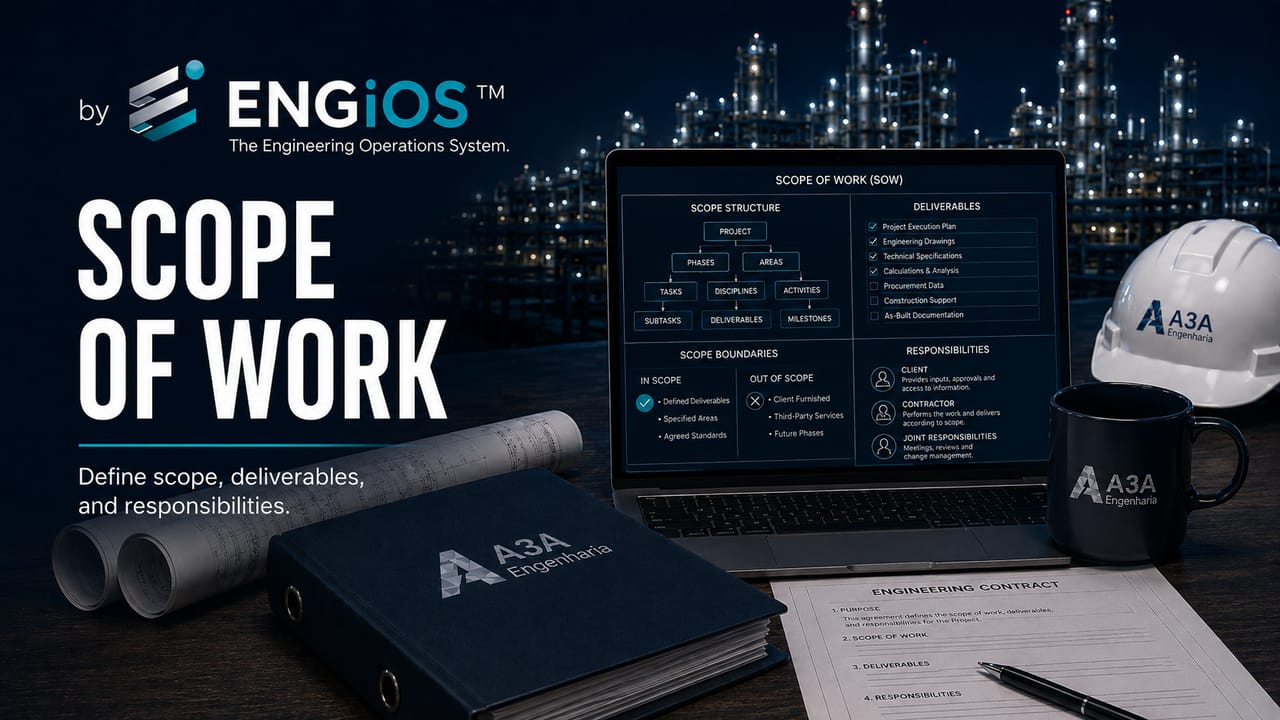
Understand Scope of Work and SOW in engineering: how to define work scope, deliverables, exclusions, assumptions, interfaces, measurement, and acceptance criteria in contracts.
Check it out!
Scope of Work is the structured definition of the work to be performed under an engineering contract or package, establishing boundaries, deliverables, responsibilities, requirements, interfaces, and completion criteria. In many business environments, the acronym SOW is used for Statement of Work, the document containing the formal description of the work; within it, the scope of work is the core that defines what will be done. In industrial, EPC/EPCM, and Consulting Engineering projects, this definition must be precise enough to procure, measure, control changes, and accept deliverables without turning the document into an excessive prescription of how the supplier must work.
A good SOW reduces ambiguity before procurement. It explains the objective, describes expected products and services, makes inclusions and exclusions explicit, records assumptions and constraints, identifies third-party interfaces, establishes input data, and defines how each deliverable will be verified and accepted. It also creates the reference against which scope changes, claims, measurements, and responsibilities can be analyzed during execution.
In the Brazilian context, SOW should not automatically be treated as synonymous with a Term of Reference. The Term of Reference has its own role, especially in public procurement and under Law 14,133. The SOW discussed here is the work-definition instrument used in private, industrial, EPC, EPCM, supply, and technical-service contracts. The documents may share elements, but they belong to different governance contexts.
What is Scope of Work and what does SOW mean
Scope of Work literally means the scope of the work. It describes the boundary of the contracted work: which tasks, products, services, and outcomes are part of the supplier’s obligation and which are not.
Statement of Work is a broader expression. NASA’s historical guidance defines the SOW as a description of the tasks, products, and services to be procured and emphasizes that the requirement should be expressed completely, clearly, and precisely without specifying more than necessary. In engineering contracts, that logic remains valid: the document should state what must be delivered, under what conditions, and with which performance and acceptance criteria.
In business practice, the two terms are often mixed. For governance, it is better to establish an explicit convention:
- Statement of Work — SOW: contractual or pre-contractual document that organizes the work;
- Scope of Work: section or core that defines the extent and boundaries of the work;
- WBS: hierarchical decomposition of the total project scope;
- Work Package: lowest manageable WBS level for estimating and controlling cost, effort, duration, and resources.
This distinction prevents a generic phrase called “scope” from being used as a substitute for the entire procurement package.
Why an SOW is critical in engineering projects
Scope ambiguity becomes cost during execution. When the contract does not clearly define the obligation, questions arise such as:
- who provides the input data?
- who performs the field survey?
- how many review cycles are included?
- who coordinates interfaces?
- must the supplier issue calculations or drawings only?
- is As-Built documentation included in the scope?
- are testing and commissioning included?
- is training a contractual obligation?
- must manufacturer documentation be delivered?
- what constitutes completion and acceptance?
If these answers only appear after award, negotiation no longer takes place in a competitive environment and instead occurs under schedule pressure, mobilization, and technical dependency.
The SOW in the procurement chain
The SOW should be created before the request for proposals and remain traceable through acceptance.
The RFP in Engineering uses scope as one of the bases for requesting comparable proposals. The TBE — Technical Bid Evaluation verifies how each bidder meets the technical requirements. If the SOW is vague, both stages lose quality.
SOW is not just a list of activities
Listing verbs such as “design, install, test, and deliver” does not define sufficient scope.
A contract needs to connect an activity to a verifiable product. For example:
Weak: prepare detailed telecommunications design.
More structured: develop detailed telecommunications design for the defined systems, including drawings, diagrams, lists, construction details, calculations, specifications, interfaces, and cable matrix, submitting the documents to the review workflow and incorporating comments until issuance approved for construction.
The second wording still needs specific requirements, but it already indicates content, deliverables, and the completion process.
Recommended structure for an engineering SOW
The SOW should transform a need into a verifiable obligation. Scope without deliverables, interfaces, and acceptance criteria remains open to interpretation even when it spans many pages.
Structure the procurement with Technical Engineering Consulting
There is no single table of contents applicable to every contract. The structure needs to reflect the object, contract model, engineering maturity, and measurement method. Rather than treating each component as an isolated list, it is more useful to view the SOW as a definition chain: context and requirements establish the basis; scope, deliverables, and interfaces translate that basis into work; measurement and acceptance demonstrate completion.
| SOW element | Technical function | Expected evidence |
|---|---|---|
| Objective and context | Explain why the work exists, in which project, and under what conditions. | Description of the problem, project phase, existing systems, and reference documents. |
| Included scope | Define activities and obligations covered by price and schedule. | Verifiable verbs associated with concrete results. |
| Deliverables | Turn work into identifiable physical, documentary, or digital products. | Drawings, narratives, models, reports, calculations, test records, Data Book, As-Built, or acceptance documentation. |
| Exclusions and boundaries | Make explicit boundaries that could reasonably be interpreted as included. | List of exclusions and identification of the alternate responsible party when the item remains necessary to the project. |
| Assumptions and constraints | Record conditions used to form price, schedule, and solution, and limits that constrain execution. | Verifiable assumptions, operating windows, standards, safety requirements, interoperability, and access conditions. |
| Interfaces | Define dependencies among contractor, owner, and third parties. | Owner of each interface, input, output, deadline, and handoff condition. |
| Measurement | Establish how progress will be recognized for control and payment. | Milestones, units, or criteria associated with verifiable progress. |
| Acceptance | Define the objective completion condition. | Requirements met, tests approved, documentation accepted, open items addressed, and corresponding formalization. |
Recommendation from ABNT NBR ISO 21502:2021: scope management should start from the approved scope, reflect requirements and acceptance criteria, and maintain traceability through delivery confirmation. The standard also recommends that only formally approved work be incorporated into the project. Applied to the SOW, this means defining from procurement not only “what to do,” but how the result will be verified and under what condition it can be considered accepted.
When multiple packages meet, Interface Management in Engineering Projects complements the SOW by making handoffs and responsible parties between contracts explicit.
Included and excluded scope
The boundary must be explicit.
Consider a contract for detailed electronic-security design. It may include:
- field survey;
- review of the basic design;
- sizing;
- drawings and diagrams;
- specifications;
- material lists;
- network integration;
- coordination meetings;
- reviews through approval.
The following may be excluded if that is the strategy:
- equipment supply;
- installation;
- software licensing;
- civil works;
- factory testing;
- construction support;
- As-Built prepared by the installation contractor.
Excluding an item does not mean it is unnecessary. It means it is outside that package and needs another responsible party.
Poorly defined exclusions create contract gaps
If the designer excludes the survey and the contractor assumes existing documents are reliable, no one verifies the actual condition.
If the integrator excludes electrical infrastructure and the electrical contractor excludes rack power supply, the gap only appears during implementation.
Therefore, exclusions should be analyzed horizontally across contracts, not only within each SOW.
Assumptions need to be verifiable and manageable
A proposal assumption can materially change cost.
Example:
“It is assumed that all existing drawings are up to date.”
If this condition is not true, there will be impacts on surveys, design, and schedule. The SOW should state who validates the information and what happens if the assumption fails.
Critical assumptions may become contractual conditions or change triggers.
Constraints need to appear before the proposal
A constraint discovered after award may invalidate the proposed solution.
Examples:
- work only during a night window;
- classified area;
- equipment must fit in an existing rack;
- the system cannot be shut down;
- use of a specific protocol;
- cloud use prohibited;
- deadline imposed by the annual outage.
If the constraint changes resources, technology, or planning, it belongs in the procurement package.
Deliverables must be identifiable
“Complete documentation” is a weak expression because each company may interpret it differently.
A deliverable register or contractual master list may contain:
| Code | Deliverable | Format | Revision | Responsible party | Acceptance criterion |
| DOC-001 | Design Narrative | PDF/DOCX | AFC | Contractor | comments closed |
| DWG-001 | Layout Drawing | DWG/PDF | AFC | Contractor | approved technical revision |
| REP-001 | Test Report | Final | Contractor | results within limits |
Actual coding depends on project document governance.
SOW and Requirements Management
The SOW should not disorderly repeat every specification.
The Requirements Management helps structure what the product or service must satisfy. The SOW defines who will perform the work required to produce and demonstrate compliance.
A useful relationship is:
Requirement → work → deliverable → verification → acceptance.
If a requirement has no associated work, it may not be implemented. If work does not lead to a required requirement or product, it may be waste or excessive scope.
SOW and WBS
The Work Breakdown Structure decomposes total project scope into deliverable-oriented components.
The PMI Lexicon defines WBS as the hierarchical decomposition of the total scope of work to be carried out to achieve objectives and create deliverables. The SOW may be the source for the contractual WBS or may be structured using an already defined WBS.
The 100% rule is an important reference: decomposition should cover the required work without duplication.
SOW and Work Package
O Work Package in Engineering Projects is the unit at the lowest WBS level where cost, effort, duration, and resources can be estimated and managed.
The SOW establishes the overall or contractual obligation; work packages make it possible to decompose that obligation into controllable units.
SOW and Technical Requisition
The Technical Requisition in Engineering organizes the technical package sent to the market.
It may include or reference:
- SOW;
- specifications;
- datasheets;
- drawings;
- lists;
- TBE criteria;
- document requirements;
- technical instructions.
The SOW is one part of procurement, not the entire package.
SOW and RFP
The RFP requests a proposal and defines how the bidder should respond.
The SOW defines the work to be contracted.
Mixing both in a single unstructured text makes reviews and future changes difficult. A good practice is to keep the document architecture clear: tender instructions in one document, technical obligation in another, or in a clearly identified section.
SOW and Term of Reference
O Term of Reference in Engineering has its own purpose and strong application in public procurement processes.
The SOW in this article is directed at work management in private, industrial, and international contracts. In both cases there are common themes — scope, deliverables, acceptance criteria — but the legal and procedural framework should not be mixed.
SOW and technical specification
The specification describes technical requirements for the product, system, or service. The SOW describes the contractor’s work.
Example:
Specification: the switch shall have redundant power supplies and support a specified protocol.
SOW: the contractor shall supply, install, configure, integrate, and test the switches in accordance with Specification X.
Separating “what the product must be” from “what the contractor must do” improves change control.
Performance-based SOW
Whenever possible, the owner should specify outcomes and criteria rather than unnecessarily controlling the supplier’s method.
A performance-based work statement approach seeks to describe results and performance levels while leaving room for the contractor to define execution methods.
This does not mean eliminating engineering requirements. Interfaces, standards, safety, compatibility, and mandatory criteria remain necessary.
The balance is to avoid prescribing the method when the objective can be defined through a verifiable result.
When prescribing the method is necessary
There are situations in which the method is part of the obligation:
- a standard requires a specific procedure;
- the existing system requires a defined protocol;
- inspection depends on an accredited method;
- safety requires a defined sequence;
- the client requires a specific corporate tool;
- integration depends on a fixed standard.
The prescription should be justified by need, not habit.
Interfaces: where SOWs fail most often
Many SOWs describe each supplier’s internal work well but poorly define the point where one package depends on another. This is where the most expensive questions arise: who provides the data? who makes the connection? who releases access? who integrates? who tests the overall system? An interface without an owner may remain invisible until commissioning.
| Interface | Question the SOW should answer | Handoff evidence |
|---|---|---|
| Engineering ↔ supplier | Who provides data, drawings, and battery limits, and at which revision? | Transmittal, approved datasheet, interface drawing, or ICD. |
| Civil ↔ electromechanical | Who designs and executes foundations, inserts, anchors, and openings? | Coordinated drawing, inspection, and work-front release. |
| Power ↔ automation/telecom | Who provides power supply, grounding, protection, and connection point? | Diagram, identification, electrical test, and energization record. |
| Network ↔ system | Who provides IP, VLAN, ports, rules, and validates communication? | Addressing matrix, configuration, and end-to-end test. |
| Construction ↔ commissioning | What condition makes the system ready for testing? | Readiness checklist, documentation, punch list, and formal release. |
| Contractor ↔ owner | Which approvals, access, or information are the owner’s obligation? | Required date, responsible party, and record of availability. |
The Interface Management in Engineering Projects addresses this control in depth. In the SOW, the objective is to ensure that each material dependency has identifiable input, output, owner, deadline, and acceptance condition.
Responsibility matrix in the SOW
The RACI Matrix can complement the SOW when several parties participate in the same deliverable.
However, RACI does not replace a scope clause. “Responsible” identifies a role, but the technical obligation still needs to be described.
Owner-provided data and items
List the information and resources the client will provide:
- existing drawings;
- BIM models;
- licenses;
- credentials;
- area access;
- temporary power;
- existing equipment;
- databases;
- process information;
- shutdown windows.
Also define the date and condition of provision when this affects schedule.
Contractor Furnished and Owner Furnished
In international contracts, it is common to separate owner-furnished and contractor-furnished items.
Owner-furnished equipment may still require the contractor to perform:
- receipt;
- inspection;
- storage;
- installation;
- configuration;
- integration;
- testing.
“Client-provided equipment” does not automatically resolve the associated responsibilities.
Measurement criteria
Measurement should follow a verifiable result, not a subjective perception of progress. In engineering contracts, the measurement milestone needs to indicate which state of the product is being recognized: issuance, approval, physical delivery, testing, commissioning, or acceptance.
| Possible milestone | What it proves | Contractual caution |
|---|---|---|
| Document issued | The deliverable was submitted to the review workflow. | Does not equal approval. |
| Document approved | Applicable comments and requirements were addressed. | Define the document status accepted by the contract. |
| Equipment delivered | The supply reached the specified location or condition. | Physical receipt does not replace inspection or testing. |
| Installation completed | The component was installed in accordance with the scope. | Testing, configuration, and documentation may still be pending. |
| Test approved | The functional or performance requirement was verified. | Record procedure, result, and any outstanding items. |
| System commissioned | Integration and performance were demonstrated at the specified level. | Define boundaries and readiness criteria. |
| Data Book / final documentation accepted | Execution evidence was consolidated and approved. | Do not leave all documentary value to a single milestone without intermediate governance. |
This logic avoids measuring 100% of an activity when tests, As-Built, or essential records are still pending. The Data Book in Engineering shows why documentation needs to be produced during execution, not merely organized at closeout.
Acceptance criteria
Acceptance needs to be designed into the SOW. A well-written acceptance criterion combines the requirement, verification method, evidence, and authority to accept. This prevents completion from depending on generic phrases such as “service satisfactorily performed.”
Recommendation from ABNT NBR ISO 21502:2021: requirements and acceptance criteria should be associated with scope definition, and delivery confirmation should verify and validate requirements and quality standards before transfer. In contractual terms, this reinforces that acceptance needs to be designed together with the scope, not improvised at the end.
In practice, acceptance may depend on compliance with requirements, document approval, test results, closure of blocking items, As-Built, backups, training, and manufacturer documentation. The Technical Acceptance Certificate in Engineering Projects covers the formalization of this stage in greater depth.
“Delivered” is not the same as “accepted”
Completed installation does not mean the contract has been accepted. Documentation, tests, As-Built, backups, and closure of open items may be contractual deliverables just as mandatory as physical work.
The supplier may have submitted a document or installed a system. This constitutes physical or documentary delivery, but not necessarily acceptance.
Acceptance depends on the defined criteria and verification by the owner.
This difference should appear in the SOW to avoid the interpretation that a submission protocol automatically closes the obligation.
Reviews and comments
In engineering services, the SOW should provide for the review cycle.
Important questions:
- how many cycles are expected?
- do comments resulting from contractor error count as additional scope?
- is a client requirement change a scope change?
- what is each party’s response time?
- how are conflicting comments resolved?
It is not advisable to limit responsibility for correcting technical errors to “two revisions.” The number of commercial review cycles and the obligation to correct nonconformity need to be handled consistently.
Scope baseline
After award, the SOW and referenced documents form part of the baseline against which changes are assessed.
The baseline should have a clear version, date, and document hierarchy.
Without this, a new presentation or email may be interpreted as a contractual change without formal analysis.
Scope change management
A change should be compared against the baseline.
A process may assess:
- new or changed requirement;
- origin of the change;
- technical impact;
- cost impact;
- schedule impact;
- affected interfaces;
- decision by the competent authority;
- document updates.
The service of Technical Analysis of Contract Amendments, Scope Changes, and Claims applies when the contractual boundary needs to be technically demonstrated.
What should not be treated as a change
Error correction, rework due to nonconformity, or fulfillment of an already defined obligation should not automatically be classified as additional scope.
Likewise, the owner should not require genuinely new work under the generic justification that it “is part of the solution.”
The analysis needs to return to the contractual text, requirements, and evidence.
How to write work requirements
A useful structure is:
Responsible party + action verb + object + condition/reference + expected evidence.
Example:
The Contractor shall perform certification tests on the installed optical links in accordance with the criteria defined in the applicable specification and deliver the native instrument files and a consolidated report for each link.
The sentence identifies action and evidence.
Avoid vague verbs
Terms such as support, collaborate, monitor, and assist may be necessary, but they need boundaries.
“Support commissioning” could mean two hours of meetings or weeks in the field.
Define:
- activity;
- duration or event;
- location;
- quantity;
- deliverable;
- completion condition.
Quantities and volume assumptions
If price depends on quantity, the SOW should record the basis:
- number of sites;
- points;
- equipment;
- documents;
- meetings;
- visits;
- hours;
- km of network;
- interfaces.
When the quantity is estimated, define a mechanism for variation.
SOW in lump-sum contracts
Lump-sum pricing requires especially mature scope because the contractor assumes responsibility for the defined whole.
Ambiguities may generate price contingency or later disputes.
The owner should ensure that reference documents do not contradict one another.
SOW in unit-price contracts
The unit of measurement needs to be clearly defined.
Example: a “network point” may include only termination or the entire set comprising patch panel, cable, outlet, identification, certification, and documentation.
The composition of the unit should be explicit.
SOW in hourly or technical-hour-equivalent contracts
Hourly Consulting Engineering contracts need to define the type of service, authorization mechanism, outputs, and governance.
A technical hour does not replace scope. It defines the commercial unit of consumption, while each Work Order can detail the objective, deliverables, responsible parties, schedule, and hour limit.
SOW in EPC and EPCM
In EPC, the boundary among engineering, procurement, construction, testing, and delivery needs to be consistent with the contract’s overall responsibilities.
In EPCM, the management contractor may coordinate packages without assuming supply or construction. The SOW should clearly separate management, review, inspection, contract administration, and the responsibilities of executing contractors.
SOW for Consulting Engineering
Professional services need clear outputs without reducing consulting to mere document production.
Examples of deliverables:
- assessment;
- alternatives study;
- technical opinion;
- independent review;
- master plan;
- design;
- TBE;
- technical monitoring;
- inspection report;
- commissioning report;
- decision record.
The value lies in technical content and professional responsibility, not merely the number of pages.
SOW document control
The document should have:
- code;
- revision;
- status;
- approvers;
- date;
- reference list;
- change history.
Changes during tendering need to be communicated to all bidders through the same governance channel.
Document hierarchy
Contracts may contain SOWs, specifications, drawings, proposals, clarifications, and appendices.
The hierarchy or order-of-precedence rule needs to be defined in the contract. Without it, two conflicting requirements may remain equally valid and generate disputes.
SOW completeness audit
Before issuing an RFP, review whether there is an answer to:
- what will be done?
- where?
- by whom?
- which inputs will be provided?
- which deliverables will be produced?
- what is excluded?
- which interfaces exist?
- which standards apply?
- which quantities form the pricing basis?
- what is the schedule and operating window?
- how will it be measured?
- how will it be verified?
- how will it be accepted?
- how will changes be handled?
If these questions do not have answers, proposals tend to contain different assumptions across suppliers.
Failure example: “complete” design without a deliverables list
A contractor may interpret complete design as drawings and a narrative. The owner may also expect calculations, details, material lists, specifications, BIM model, interface matrix, and As-Built.
The word “complete” does not resolve the difference.
The deliverables list makes the obligation observable.
Failure example: installation without closeout documentation
An integrator installs all equipment and declares 100% physical completion. The contract, however, also requires tests, photographic reports, configuration files, backups, As-Built, and a formal acceptance request.
If the SOW structured these deliverables, management can distinguish completed installation from accepted contract.
Failure example: third-party interface
One supplier delivers the panel; another provides power; a third integrates automation. If no one has the obligation to perform end-to-end testing, the system may remain without overall validation.
The SOW should assign system integration and testing to a responsible party.
SOW and claims risk
A better SOW does not eliminate legitimate changes, but it improves the evidence used to distinguish:
- original scope;
- detail required to fulfill the original scope;
- error or rework;
- unforeseen condition;
- new request;
- requirement change;
- quantity change;
- interface change.
This classification is central to contract administration.
SOW checklist before procurement
Check:
- clear objective;
- sufficient context;
- included scope;
- exclusions;
- assumptions;
- constraints;
- traceable requirements;
- identified deliverables;
- assigned interfaces;
- owner-furnished items;
- baseline quantities;
- standards and references;
- schedule and milestones;
- measurement;
- verification;
- acceptance;
- final documentation;
- change control;
- document hierarchy;
- review and approval.
The checklist does not replace multidisciplinary review.
When Consulting Engineering adds value
The Technical Engineering Consulting can turn a generic business need into a contractable technical package.
The work may involve:
- needs assessment;
- requirements definition;
- SOW structuring;
- interface review;
- deliverables definition;
- TBE criteria;
- measurement and acceptance criteria;
- RFP/RFQ;
- technical bid equalization;
- negotiation support;
- change management during execution.
Owner’s Engineering can also review an SOW produced by EPC contractors or designers to protect the owner’s lifecycle objectives.
Final considerations
Scope of Work is one of the main tools for preventing ambiguity in engineering contracts. It defines the work boundary and connects requirements to activities, deliverables, interfaces, measurement, and acceptance. When these relationships are clear before tendering, suppliers price on more comparable bases and the owner reduces the space for gaps and contradictory interpretations.
The SOW should not be confused with the entire RFP, the technical specification, or the Term of Reference. Each document has its own function. It should also not be a generic list of verbs: it needs to turn the owner’s intent into verifiable obligations and manage the points where different contracts meet.
Scope quality appears throughout the lifecycle. It improves TBE, enables a consistent WBS, supports work packages, provides the basis for measurement, organizes change control, and defines what must happen for a deliverable to be effectively accepted. In complex projects, writing the SOW is part of procurement engineering — not an administrative activity performed after technical design.
Before tendering, reviewing the SOW, interfaces, and measurement criteria costs far less than negotiating scope gaps after schedule, supplier, and mobilization are already committed.
Technical references
[5] ASSOCIAÇÃO BRASILEIRA DE NORMAS TÉCNICAS. ABNT NBR ISO 21502:2021 — Gerenciamento de projetos, programas e portfólios — Orientação sobre gerenciamento de projetos. Rio de Janeiro: ABNT, 2021. Disponível em: https://www.abntcatalogo.com.br/
[1] NASA. Statements of Work Handbook — NHB 5600.2. Washington, DC: National Aeronautics and Space Administration. Disponível em: https://ntrs.nasa.gov/api/citations/19750015297/downloads/19750015297.pdf
[2] NASA. Guidance for Writing Work Statements — NPG 5600.2B. Washington, DC: National Aeronautics and Space Administration. Disponível em: https://www.hq.nasa.gov/office/procurement/newreq1.htm
[3] PROJECT MANAGEMENT INSTITUTE. PMI Lexicon of Project Management Terms. Version 5.0. Newtown Square: PMI, 2026. Disponível em: https://www.pmi.org/-/media/pmi/documents/registered/pdf/pmbok-standards/pmi-lexicon-pm-terms.pdf
[4] PROJECT MANAGEMENT INSTITUTE. The Standard for Project Management and A Guide to the Project Management Body of Knowledge (PMBOK® Guide). 8. ed. Newtown Square: PMI, 2025. Disponível em: https://www.pmi.org/standards/pmbok
Frequently asked questions
It is the definition of the extent and boundaries of the contracted work, including activities, deliverables, interfaces, assumptions, exclusions, and completion criteria.
The acronym SOW is formally and commonly used for Statement of Work. Scope of Work is the core definition of the work and may be a section of that document. Companies also use the terms interchangeably, so the convention should be made explicit.
They may contain similar elements, but the Term of Reference has its own framework, especially in public procurement. The SOW is widely used in private, industrial, and international contracts to define the work.
Objective, included scope, exclusions, assumptions, constraints, deliverables, interfaces, applicable requirements, quantities, schedule, measurement, verification, and acceptance criteria.
The specification defines requirements for the product, system, or service. The SOW defines the work the contractor must perform to deliver and demonstrate compliance.
No. The SOW describes the contracted work. The WBS hierarchically decomposes scope into manageable components and work packages.
It forms part of the contractual baseline. A new request can be compared with the original scope, assumptions, exclusions, and interfaces to determine whether a real change exists.
Not necessarily. Delivery indicates physical or documentary availability; acceptance requires contractual verification and completion criteria to have been satisfied.
Additional technical resources
Related solutions
- Contract, Scope, and Deliverables Management
- Project, Program, and Portfolio Governance
- Process, Workflow, and Technical Approval Management
- Engineering PMO Implementation and Structuring
- Engineering Document Management: DMS, EDMS, revisions, and traceability
Related services
- Technical Engineering Consulting
- Owner’s Engineering
- Engineering Project Management
- Technical Analysis of Contract Amendments, Scope Changes, and Claims
- Technical Acceptance of Engineering Works and Services
- Technical Audit of Data Book and Final Engineering Documentation
Core content on the topic
- RFP in Engineering: scope, requirements, and selection criteria
- Technical Requisition in Engineering
- TBE — Technical Bid Evaluation
- Work Package in Engineering Projects
- Contractual Scope in Engineering
- Engineering Procurement Strategy
Related technical content
- Term of Reference in Engineering
- Requirements Management in Engineering
- Interface Management in Engineering Projects
- RACI Matrix in Engineering Projects
- Data Book in Engineering
- Complete Guide to Consulting Engineering
- Engineering Management: guide to processes, governance, and performance
- Owner’s Engineering: executive framework for procurement, governance, and acceptance
- Technical Handover Framework for Works and Systems