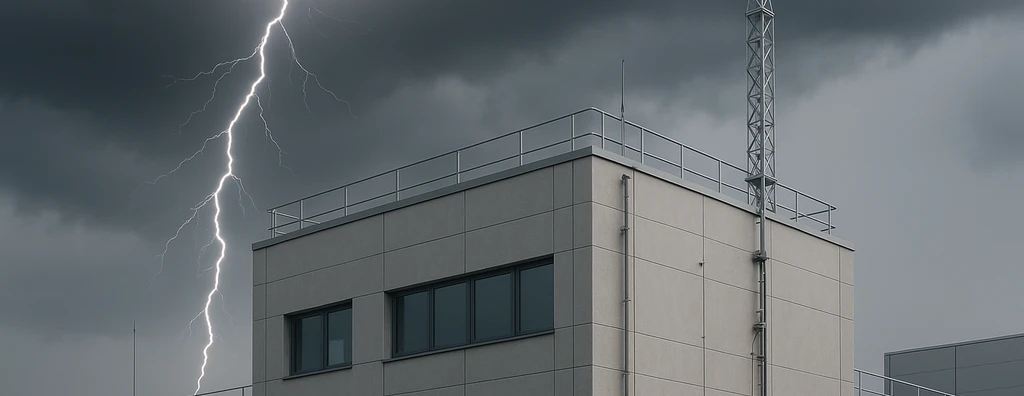
Understand how lightning protection zones are defined, segmented, and applied in engineering projects to control electromagnetic impacts and reduce risk.
Check it out!
Protection against lightning discharges is essential in electrical engineering projects, especially for the integrity of critical installations, sensitive electronic systems, and the operational safety of buildings. The intensity of atmospheric phenomena, combined with the growing technological density of environments, makes it indispensable to adopt rigorous criteria for mitigating the risks associated with lightning. Segmenting spaces into protection zones aims to control the impact of the electromagnetic environment generated by discharges and guide the project toward high standards of robustness and regulatory compliance.
In this article, the definitions, segmentation logic, and guidelines for the use of lightning protection zones are detailed, based on the technical standards of electrical engineering. The goal is to provide a comprehensive understanding of the concept and its correct application in projects, from risk analysis to the implementation of electromagnetic protection and grounding measures.
Check it out!
[elementor-template id=”24446″]
Technical Definition of Lightning Protection Zones
A lightning protection zone, or LPZ (Lightning Protection Zone), is the concept used to delimit and characterize regions in which the electromagnetic environment caused by lightning is defined. According to the applicable standards, the boundary of an LPZ does not necessarily correspond to physical barriers such as walls or ceilings; it may be established based on functional, electromagnetic, or construction criteria.
Dividing an environment into zones makes it possible to quantify and mitigate risks, establishing for each zone the appropriate protection, grounding, and shielding measures against surges caused by lightning discharges (LEMP – Lightning Electromagnetic Pulse).
Zone Classification: Internal and External Segmentation
The segmentation of lightning protection zones is divided into external zones (exposed to the environment) and internal zones (protected by construction elements and/or protection systems). Each category has subdivisions and specific characteristics:
External Zones
- LPZ 0: Zone in which there is no attenuation of the electromagnetic field of the lightning discharge. Internal systems may be subject to the full or a significant portion of surge currents. It is subdivided into:
- LPZ 0A: Region where there is a direct threat both from the lightning discharge and from the electromagnetic field generated by it. Internal systems in this zone may be subject to the full surge current.
- LPZ 0B: Area protected against direct lightning discharges, but still subject to the full electromagnetic field of the discharge. Partial surge currents may affect systems in this zone.
Internal Zones
- Zones protected against direct lightning discharges: These are internal environments in which the impact of electromagnetic fields and surge currents has been substantially reduced by shielding, grounding, physical barriers, protection devices, and other construction measures.
The transition between zones occurs according to the level of residual exposure to the field induced by lightning and the functionality of the implemented protection elements.
Criteria for Delimiting and Using Protection Zones
The determination of protection zones follows a technical analysis based on:
- Calculated risk of lightning incidence at the site;
- Building topology and segmentation of areas in relation to critical systems and infrastructure;
- Characterization of internal systems regarding sensitivity to surges and electromagnetic disturbances;
- Density of architectural shielding and effectiveness of artificially established barriers;
- Effectiveness of the grounding system and equipotential bonding connections in each zone.
The proper use of zone segmentation stands out by enabling the selective and optimized application of surge protection devices, shielding, and equipotential bonding measures, adjusting investment and protection level according to the degree of risk and criticality of each protected environment or system.
Shielding, Equipotential Bonding, and Complementary Measures by Zone
For each defined LPZ, specific technical solutions are recommended to help mitigate the effects of lightning on internal systems:
- Spatial shielding: It can be implemented through metallic meshes in structural elements such as reinforced concrete bars, frames, and metallic supports. This shielding reduces the electromagnetic field coupled to internal areas.
- Grounding subsystem: It is based on the efficient conduction and dissipation of discharge current into the ground, preventing the accumulation of dangerous potential.
- Equipotential bonding connections: They interconnect conductive elements, promoting electrical potential uniformity and reducing dangerous voltage gradients.
- Surge protection devices (SPDs): They should be strategically installed at the transition between zones, protecting circuits and equipment from transient phenomena.
The grading of barriers and the redundancy of measures are determined by the level of exposure and sensitivity of the protected environment or equipment.
Integration of Zones with Protection Systems and Risk Management
The correct definition of protection zones must be integrated with the external Lightning Protection System (LPS), as well as with risk management and maintenance policies. The zones determine the need for:
- Adoption of progressive protection measures as environments become more internalized;
- Implementation of continuous monitoring systems for the integrity of barriers and equipotential bonding connections;
- Periodic updating of the risk analysis in the presence of structural, technological, or layout changes;
- Training of those responsible for maintenance regarding the importance of zones for the overall safety of the installation.
This systemic process ensures a robust response to incidents and sustains the functionality of critical systems even under extreme disturbances.
The segmentation of environments into lightning protection zones is an essential element in projects that seek to increase operational resilience, structural integrity, and regulatory compliance of installations. A proper understanding of electrically defined limits, the systematic application of shielding, grounding, and SPD protection measures, and the constant review of zone boundaries as risk evolves are mandatory steps for critical environments. In summary, the disciplined and technically grounded use of zone logic allows assets, electronic systems, and people to be effectively safeguarded against the effects of lightning discharges, consolidating best practices in electrical engineering and the protection of sensitive infrastructure.
