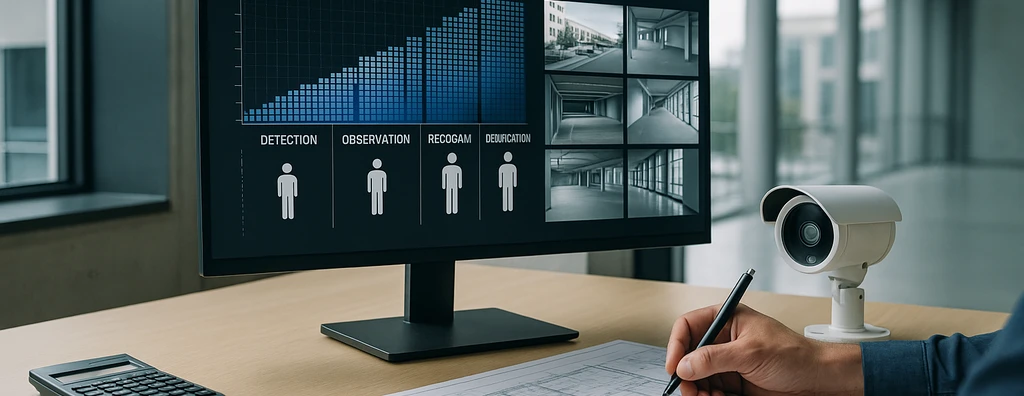
Pixel density and DORI requirements (Detection, Observation, Recognition, and Identification) play a central role in the sizing, specification, and performance evaluation of professional video surveillance systems. Correct analysis of these parameters determines not only the suitability of image capture and transmission devices, but also compliance with operational requirements imposed by specific technical standards, such as […]
Check it out!
Pixel density and DORI requirements (Detection, Observation, Recognition, and Identification) play a central role in the sizing, specification, and performance evaluation of professional video surveillance systems. Correct analysis of these parameters determines not only the suitability of image capture and transmission devices, but also compliance with operational requirements imposed by specific technical standards, such as ABNT NBR IEC 62676, directly impacting surveillance effectiveness, forensic analysis precision, and the integration of advanced video analytics capabilities.
This article details the concepts of pixel density, calculation methodology, design factors, and operational requirements under the DORI model, explaining their practical implications for designers, integrators, and owners of electronic security systems. Normative recommendations, evaluation criteria, performance parameters, and best practices for integrating these requirements into CCTV/IP architectures of any scale will be presented.
Read on!
[elementor-template id=”24446″]
Definition of Pixel Density
ABNT NBR IEC 62676, composed of several parts, establishes minimum performance requirements, functionalities, and compliance criteria for video surveillance systems used in security applications. Among its main objectives are:
- Standardization of operational and functional levels for VSS (Video Surveillance Systems).
- Establishment of parameters for transmission, storage, visualization, and analysis of images.
- Definition of criteria for evaluating the performance of cameras, monitors, and related devices according to the system’s purpose.
The concept of pixel density emerges as a critical analysis tool, serving as the basis for measuring the level of detail recorded in the monitored area of interest. It is the designer’s responsibility to specify, through a standardized methodology, the minimum width in pixels of the image of a given object or region, directly relating it to the demands of the surveillance process (for example: presence detection, facial recognition, vehicle license plate reading).
Fundamental Concepts of DORI Criteria
The DORI model, universally adopted and referenced in ABNT NBR IEC 62676-4, defines the following functional levels for analyzing the performance of video surveillance systems:
- Detection: The system’s ability to indicate the presence of an object or individual in a given scene or monitored area.
- Observation: The ability to distinguish movements, actions, and interactions of individuals or objects within the scene.
- Recognition: Allows the observer to distinguish whether an individual is or is not known, based on prior analysis or a visual database.
- Identification: Enables the clear and unambiguous identification of an individual, including facial features, clothing, biometric elements, or critical details.
Each of these levels requires a specific pixel density distributed across the width of the object of interest (for example, human faces). Typically, no fewer than 40 pixels across the width of the face are recommended to ensure suitability for the identification function, and this number may increase as environmental factors or precision requirements grow. These parameters must always be verified under the most adverse conditions of the intended scenario, ensuring system resilience and performance.
Technical Procedure for Sizing
Pixel density sizing must be performed during the design phase of the video surveillance system. The following are considered:
- Native resolution of the camera’s image sensor (e.g., 1080p, 4K UHD).
- Real field of view (FOV) defined by the selected lens and camera positioning.
- Dimensions of the monitored area and effective distance between the object and the camera.
The practical equation for determining pixel density per meter is:
pixel_density_per_meter = image_width_in_pixels / physical_width_of_captured_area_in_metersFor DORI requirements, the width (in pixels) of the critical object — for example, the human face — is assessed by approximating the average proportion, relating:
- The ratio of required pixels according to the desired DORI level;
- The typical size of the object to be identified (example: average width of a human head);
- Expected results according to the installed camera’s resolution and FOV.
It is recommended to use technical support tables and simulators to validate calculations across different camera models and optical configurations. These resources assist in comparative analysis between equipment alternatives and adjustments of angles and distances in the project layout.
Factors Affecting the Effectiveness of Pixel Density
Pixel density cannot be analyzed in isolation; it must be considered in synergy with:
- Effective camera resolution: High-resolution equipment provides greater operational margin, but may exhibit reduced sensitivity in low-light conditions.
- Lens quality and aperture: Determines coverage angle, depth of field, and the ability to adapt to different lighting scenarios.
- Positioning and installation height: Impact the visible useful area and the severity of obstructions or optical distortions.
- Environmental conditions and lighting: Higher-resolution cameras may require advanced sensors and algorithms to optimize performance in nighttime scenarios or under high dynamic contrast.
Practical example:
For monitoring critical access points where the objective is positive identification of individuals even under adverse lighting conditions, it is recommended to use cameras with advanced sensors, adjustable-aperture lenses, and installation at angles that minimize shadows and reflections.
Standards indicate that each video surveillance structure must be customized, and it is the technical team’s responsibility to conduct field tests to confirm the designed parameters. The main aspects to be evaluated include:
- Effective sensor performance under varying conditions of motion, contrast, and lighting.
- Verification of video stream fidelity during transmission and storage.
- Focus, angle, and digital zoom adjustments for alignment with the calculated pixel density.
For functions such as automatic license plate recognition (LPR) or people counting, dedicated installation of cameras with optimized pixel density and field of view is recommended, calibrated to the specific application in compliance with applicable technical standards.
Correct camera positioning and careful configuration provide greater efficiency in analysis both by human operators and by video analytics algorithms, improving the accuracy of detection, recognition, and identification.
The correct application of DORI requirements faces inherent challenges from the operational environment, such as:
- Variable lighting conditions, including nighttime scenes or areas with intense backlighting.
- Movement of objects and people, requiring dynamic adjustments to focus and exposure.
- Physical space limitations hindering ideal camera positioning and homogeneous coverage of the critical area.
Mitigation measures include:
- Use of cameras with high sensitivity and dynamic image processing capabilities.
- Modular designs with multiple cameras overlapping critical areas, ensuring redundancy.
- Adoption of wide dynamic range (WDR) technologies and dedicated infrastructures for supplemental lighting.
System optimization must maintain a balance between operational results, implementation costs, and maintenance requirements, aiming for maximum surveillance process efficiency and compliance with regulatory requirements.
Correct application of DORI requirements implies systemic integration with the other components of the electronic security project, encompassing:
- Network infrastructure for lossless high-resolution video transmission with minimal latency.
- Storage systems configured for high availability and adequate retention of critical images.
- Intelligent video analytics modules (embedded or server-based) calibrated based on the actual pixel density per target or region.
- Monitor and workstation selection compatible with the resolutions used in the system, avoiding degradation in the final display.
The synergy between technical specification, standardization, and operational validation processes contributes to a robust, scalable system capable of meeting monitoring objectives with technical rigor.
Parameters must be defined in the executive design, using:
- Pixel density calculation spreadsheets for each camera position.
- Field of view (FOV) simulators for predictive coverage analysis.
- Normative checklists ensuring compliance with the applicable parts of ABNT NBR IEC 62676, covering transmission requirements, performance analysis, and network architecture.
Acceptance tests must replicate the scenario’s critical conditions, with daytime and nighttime simulations, variations in distances and objects, and rigorous inspection of the image quality and pixel density achieved, both on local monitors and remotely.
The implementation of continuous technical audit processes and periodic review of parameters ensures sustained performance and adherence to operational requirements throughout the system’s life cycle.
Pixel density and the correct adoption of DORI levels directly affect the system’s ability to provide robust, conclusive, and legally admissible forensic evidence, as well as the effectiveness of real-time monitoring operations. Images obtained in compliance with normative parameters increase the likelihood of positive target identification, minimizing recognition failures or false positives in automated video analysis processes.
Engineering decision-making must also consider:
- The balance between required level of detail and infrastructure costs.
- The compatibility between video system specifications and other security subsystems (access control, alarms, automation).
- Scalability and architectural flexibility for future technology upgrades and changes in operational requirements.
Final Considerations
The correct understanding and application of pixel density concepts and DORI requirements, as established by technical standards such as ABNT NBR IEC 62676, constitute indispensable elements for the design, evaluation, and maintenance of professional video surveillance systems. Rigor in quantifying and validating these parameters ensures not only compliance with regulatory requirements, but above all the robustness, longevity, and operational effectiveness of the systems, optimizing resources and mitigating risks associated with monitoring critical environments.
Engineering professionals and electronic security system integrators are advised to systematically adopt formal calculation methodologies, conduct practical field tests, and keep abreast of relevant normative and technological advances. In this way, it is possible to guarantee superior levels of performance in monitoring, forensic analysis, and operational response, contributing substantially to asset security and the integrity of individuals.