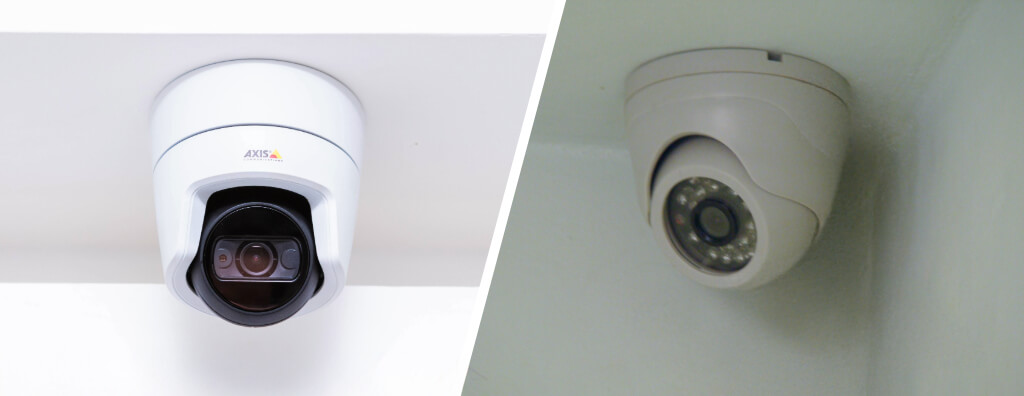
Surveillance cameras are essential components of security infrastructure. This article compares IP and analog cameras across resolution, intelligent capabilities, scalability, costs, installation, and infrastructure requirements.
Check it out!
Surveillance cameras are essential components of the security infrastructure of homes, businesses, and public spaces. With growing demand for monitoring and protection solutions, selecting an appropriate surveillance system is critical to achieving effective security.
In this context, understanding the differences between IP cameras and analog cameras is essential to the decision-making process.
In this article, we compare IP cameras and analog cameras, highlighting the main aspects that can help determine which system is more appropriate for specific security requirements.
We will examine video resolution, intelligent capabilities, scalability, costs, ease of installation, and infrastructure requirements, providing a broad view of the advantages and limitations of each technology.
Read on!
[elementor-template id=”24446″]
How the Systems Work
Before comparing the cameras themselves, it is useful to understand how each system operates:
Analog Video Surveillance System
An Analog Video Surveillance System, also known as CFTV (Circuito Fechado de Televisão), uses coaxial cables and DVRs to transmit and store video data.
Analog cameras, which are the input devices in this system, capture images and convert them into analog electrical signals.
The analog video signal is transmitted over coaxial cables to a DVR (Digital Video Recorder). In this process, the DVR converts the analog signal into digital format so recordings can be stored and viewed later.
IP Video Surveillance System
An IP Video Surveillance System uses the Network Infrastructure to transmit and receive data.
IP Cameras, also referred to as Network Cameras, capture images using high-quality image sensors and convert them into digital video signals.
These data can be transmitted through either wired or wireless connections, depending on the specific characteristics of the camera model.
Digital video data can be sent to an NVR (Network Video Recorder) or a VMS (Video Management System) for storage and management. These systems provide a broad range of capabilities, including recording archives, recording schedules, search functions, and more.
In addition, this type of camera supports advanced capabilities such as video analytics, edge storage, and remote monitoring. IP cameras can also be integrated with other security systems, such as alarms and access control systems, creating a more integrated security architecture.
Video Resolution
Video resolution is one of the main factors to consider when comparing IP cameras and analog cameras.
Resolution plays a fundamental role in captured-image quality by determining how much detail can be seen in recordings. In this context, it is useful to compare the video resolutions offered by each technology:
IP Cameras are known for high video resolution, producing sharper and more detailed images. They can provide a range of resolutions from HD (1280×720) through Full HD (1920×1080 pixels), 2K (2560×1440 pixels), and even 4K (3840×2160 pixels). These higher resolutions support clearer identification of objects, faces, and other critical details, including at greater distances.
The ability of IP cameras to provide advanced resolutions is one reason they are frequently selected for demanding surveillance projects where image detail is important for security and decision-making.
Analog Cameras generally provide more limited resolutions than IP cameras. Although they can offer SD (640×480 pixels) and even HD (1280×720 pixels), they typically do not reach the image quality available from high-resolution IP cameras.
Because of their lower resolution, analog cameras may not provide images as detailed or sharp as IP cameras. This can affect identification of people and objects over long distances or across large areas, making effective monitoring more difficult in high-traffic environments.
Scalability and Flexibility
Analog surveillance systems rely on dedicated coaxial cables to transmit video signals to the Digital Video Recorder (DVR).
Expanding these systems, whether by adding new cameras or relocating existing cameras, can be labor-intensive and costly because new cabling may be required and, in some cases, the DVR must be replaced by a model with more channels.
By contrast, digital systems offer a more scalable and flexible approach. With IP cameras, expanding the surveillance system is direct and practical. Adding new cameras to the network can often be accomplished by connecting the camera to existing network infrastructure.
Using existing network infrastructure is one of the major advantages of IP cameras. This integration simplifies adding cameras in remote locations where network infrastructure is already available.
IP cameras can also communicate easily with other surveillance devices on the network, enabling a more comprehensive and interconnected monitoring system.
The flexibility of IP cameras also allows them to be relocated as needed. If the monitored area changes, the IP camera can be reconnected at another network point. Configuration is performed through the camera’s web interface, making the process relatively simple and agile.
The scalability of IP cameras is complemented by centralized management systems such as VMS (Video Management System).
A VMS enables control and monitoring of multiple cameras from a centralized location, making management of larger surveillance systems more efficient. This centralization also facilitates simultaneous viewing of multiple cameras and supports rapid response to security events.
Investment
IP Cameras: IP cameras generally require a higher initial investment because of their advanced technology and integrated capabilities. However, return on investment (ROI) and long-term benefits should also be considered. Key technical aspects related to investment in IP cameras include:
Existing Network Infrastructure: Reusing existing network infrastructure such as Ethernet cabling and switches reduces the need to invest in additional cabling and dedicated infrastructure.
Ease of Installation: Plug-and-play installation of IP cameras can reduce labor and installation time compared with the complexities of installing analog cameras with coaxial cabling.
Simplified Remote Access: Real-time remote access provided by IP cameras can reduce the need for frequent physical visits for checks and certain maintenance activities.
Lower Maintenance Requirements: IP cameras may require less maintenance over time depending on the equipment and installation conditions.
Analog Cameras: Although analog cameras may have a lower initial investment, additional costs associated with the infrastructure and equipment required for the surveillance system must be considered. Key technical aspects include:
Coaxial Cabling Infrastructure: Installing dedicated coaxial cables for each analog camera can increase investment costs compared with IP cameras that may use existing Ethernet infrastructure.
DVR and Storage: Analog cameras require a DVR (Digital Video Recorder) to process and store video. DVR cost must be considered, particularly in systems with many cameras.
Frequent Maintenance: Analog systems may require more frequent maintenance, especially in harsh environments, which can affect ROI.
More Complex Remote Access: More complex configuration for remote access to analog cameras can add configuration and technical-support costs.
Conclusion
The choice between IP cameras and analog cameras depends on the specific surveillance needs and requirements of each application. If the objective is high-resolution imaging, advanced intelligent capabilities, and better adaptability to future technologies, IP cameras are generally the more appropriate option. Ease of installation, simplified remote access, and integration with existing IT networks can provide additional long-term benefits.
On the other hand, if budget is limited and surveillance requirements are less demanding in terms of resolution and advanced capabilities, analog cameras may be a more economical alternative. However, analog systems may face obsolescence sooner and can require additional infrastructure costs as surveillance systems expand.
In conclusion, the specific surveillance requirements of each environment and the long-term return on investment should be evaluated carefully when choosing between IP and analog cameras. In many modern surveillance applications, the higher initial investment in IP cameras can be offset by their advanced capabilities, scalability, and integration benefits.