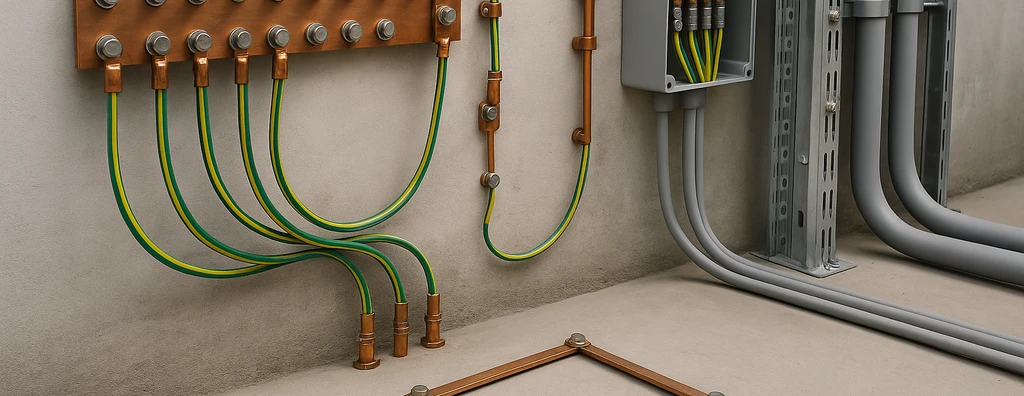
Grounding and potential equalization are essential pillars in electrical engineering to ensure the safe, reliable, and technically robust operation of residential, commercial, and industrial installations. The correct dimensioning of these systems is directly related to mitigating risks arising from lightning strikes, insulation failures, circulation of leakage currents, and electromagnetic interference. Challenges such as the integration […]
Check it out!
Grounding and potential equalization are essential pillars in electrical engineering to ensure the safe, reliable, and technically robust operation of residential, commercial, and industrial installations. The correct dimensioning of these systems is directly related to mitigating risks arising from lightning strikes, insulation failures, circulation of leakage currents, and electromagnetic interference. Challenges such as the integration between subsystems, the minimization of potential gradients, and normative adaptation to complex construction arrangements impose increasingly rigid and specialized technical demands.
In this article, the design principles, main applicable standards, execution methods, and best practices for grounding and potential equalization systems will be detailed. The objective is to present a comprehensive reference for electrical engineers, designers, and maintenance managers, enabling the application of solutions aligned with the highest standard of national engineering.
Check it out!
[elementor-template id=”24446″]
Technical Principles of Grounding and Equipotentialization
Proper grounding and equipotentialization are based on the formation of a combined system, obligatorily including two main subsystems:
- Grounding subsystem: Its premise is the efficient dispersion of lightning discharge currents, faults, and other disturbances to the ground, complying with, among others, ABNT NBR 5419-3 and ABNT NBR 5410.
- Equipotentialization mesh: Reduces potential differences between accessible conductive parts, minimizing magnetic fields and promoting operational safety.
These subsystems must act in an interconnected and synergistic manner, minimizing surface voltages and enabling internal and functional protection of the equipment, as explained in Brazilian standards and principles established in corresponding international standards.
Architecture of the Grounding System
The grounding subsystem can adopt multiple architectures, with the following configurations being the most relevant:
- Ring-shaped grounding mesh: Usually installed around buildings, it provides low grounding impedance and favors perimeter equipotentialization.
- Natural electrode: This applies to the use of concrete reinforcement of the foundations, enhancing the structural integration with the electrotechnical function.
Both approaches must be interconnected to ensure uniformity in the reference potential. Possible internal modules, such as localized secondary meshes, can be incorporated to reinforce protection and minimize local potential variations.
Descriptive textual diagram of a multidimensional grounding system:
- Main grounding network surrounding the perimeter of the building.
- Interconnection of the foundation reinforcements as natural electrodes.
- Internal modules composing relevant meshes under panels, Main Low Voltage Switchboards (QGBT), and critical technical rooms.
Equipotentialization and Reduction of Potential Differences
Equipotentialization consists of the electrical interconnection of conductive elements to minimize potential differences. This process is essential to eliminate dangerous gradients and increase the effectiveness of protection systems against lightning strikes and surges.
Fundamental Characteristics
- Execution of equipotentialization conductors in parallel, installed in the same paths as the main electrical cables.
- Use of reinforced concrete ducts, continuous metallic conduits, and duly equipotentialized cable trays.
- Interconnection between grounding subsystems of different areas, including for cases of multifunctional buildings or complex industrial plants.
Simplified implementation flow
- Mapping of existing conductive structures.
- Definition of the main and secondary equipotentialization points.
- Selection of conductors, dimensioned according to the current regime and normative constraints.
- Physical execution of the connections, with inspection of the electrical contact and compliance with ABNT NBR 5410, ABNT NBR 5419-4, and related standards.
Functional and Protective Grounding
Grounding can be classified according to its main purpose:
- Protective grounding: Intended to protect people and equipment against electrical shocks and dangerous voltages. Requires strict adherence to ABNT NBR 5410, including maximum resistance values.
- Functional grounding: Relates to the stabilization of electrical references and the correct operation of sensitive electronic circuits.
- Combined grounding: Integrates protection and operation functions, being usual in complex systems, ensuring functionality and safety simultaneously.
The correct dimensioning, execution, and maintenance of grounded subsystems contribute to the robustness and longevity of the electrical installation.
Applicable Norms and Standards
Every grounding and equipotentialization project must be based on the main Brazilian technical standards, which establish minimum requirements for safety, performance, and systemic integration:
- ABNT NBR 5410: Defines the guidelines for low voltage electrical installations, including grounding criteria, protection against shocks, and dimensioning of equipotentialization conductors.
- ABNT NBR 5419: Establishes the requirements and methods for protection against lightning strikes, approaching protection zones, detailing grounding meshes, structural connections, and performance tests.
Specifically, NBR 5419-3 deals with the grounding subsystem, while NBR 5419-4 details general principles and equipotentialization architecture, addressing recommendations for functional, protective, and mixed systems.
Design and Execution Methods
The grounding and equipotentialization project must include:
- Analysis of the physical structure and geological conditions of the soil.
- Definition of the types and quantities of electrodes (rods, strips, meshes, and reinforcements).
- Determination and dimensioning of the equipotentialization conductors, considering the fault current regime and distances.
- Study regarding the integration between natural and artificial electrodes.
Example of execution flowchart:
- Planning and elaboration of the detailed executive project.
- Execution of the trenches, installation of electrodes and bare copper strips.
- Connection of the meshes to the foundation reinforcement.
- Interconnections with electrical panels, QGBT, cable trays, and relevant metallic structures.
- Grounding resistance and commissioning tests.
Best Practices for Maintenance and Monitoring
Continuous maintenance of grounding and equipotentialization systems is essential to preserve performance and safety. The adoption of the following practices is recommended:
- Periodic inspections of electrical connections, identifying possible points of corrosion, loosening, or oxidation.
- Performing resistance tests on the grounding system at regular intervals.
- Documentary record of all interventions, adjustments, and measurements made.
- Use of specific products and connectors for each type of connection, respecting the electrochemical compatibility of the metals.
Mitigation of Electromagnetic Interference and Noise
The correct equipotentialization of metallic structures and cable pathways is essential for mitigating electromagnetic interference (EMI) and unwanted inductions in sensitive electrical and electronic systems.
- Equipotentialization meshes must be dimensioned and connected in order to reduce ground loops and prevent circulating currents.
- Compliance with ABNT NBR 5410 and the integration between the grounding of main and functional systems results in significant EMI attenuation.
- Equipotentialized metallic trays and ducts act as preferential paths for the flow of stray currents and, simultaneously, as a physical barrier against coupled fields.
The adoption of advanced equipotentialization practices results in more robust installations that are less susceptible to intermittent failures and degradation of electronic equipment.
Solutions for Industrial Plants and Complex Buildings
In industrial environments and multifunctional buildings, potential equalization and grounding must consider multiple subsystems, integrating:
- Perimeter protection networks.
- Internal meshes under raised technical floors and electrical panels.
- Horizontal and vertical interconnection between floors and sectors, using main and secondary equipotential bars.
- Equipotentialization pathways that accompany critical cable trays.
Additionally, the use of redundant conductors and continuous monitoring systems is recommended, especially in zones subject to the presence of explosive atmospheres or mission-critical equipment.
Integration of Grounding Systems with SPDA
The integration between the grounding systems and the Lightning Protection System (SPDA) is mandatory according to ABNT NBR 5419:
- The meshes and electrodes of the SPDA must be interconnected to the electrical installation’s grounding subsystem, ensuring a common reference and efficient flow of impulsive currents.
- Structural equipotentialization becomes even more relevant to protect internal circuits and automation systems against transient overvoltages.
At the interconnection points, the electrical contact must be ensured by robust mechanical means, resistant to corrosion and aging.
Testing, Assays, and Acceptance Criteria
After execution, the system must undergo rigorous testing:
- Measurement of the global grounding resistance, meeting the limits established by technical standards.
- Verification of the electrical continuity of all equipotentialization conductors.
- Integrity tests of the connections and visual inspection of all physical accesses to the meshes.
Only after compliance with the tests is it possible to release the installation for full operation.
Recommendations for Technical Documentation
All grounding and equipotentialization projects and installations must be accompanied by detailed technical documentation, including:
- Descriptive memorial of the implemented system.
- Floor plans and single-line diagrams.
- Photographic records of the execution processes and main connections.
- Results of resistance and continuity tests.
These records are fundamental to support maintenance, future updates, and accountability to regulatory agencies.
Conclusion
The correct design and execution of grounding and potential equalization systems represent a critical investment in the safety, reliability, and performance of electrotechnical installations. National technical standards, especially ABNT NBR 5410 and ABNT NBR 5419, constitute the foundation for conducting projects aligned with the best practices of the electrical segment. It is observed that the integration between the grounding subsystems, structural meshes, and equipotentialization decisively reduces risks arising from failures, transient surges, and interference, promoting an electromagnetically balanced and safe environment.
For engineering professionals, a detailed understanding of these practices is fundamental not only for normative compliance but also to enable solutions with high operational robustness and longevity of critical infrastructures.
Final Considerations
As highlighted, well-designed and implemented grounding and equipotentialization systems are essential for modern installations, protecting assets, equipment, and lives, while ensuring functional and operational integrity in adverse environments. We thank you for reading this article in detail and invite you to continuously reflect on the technical and normative innovations in the sector. Follow A3A Engenharia de Sistemas on our social networks to keep up with exclusive content, success stories, and the most relevant trends in electrical engineering and systems integration.