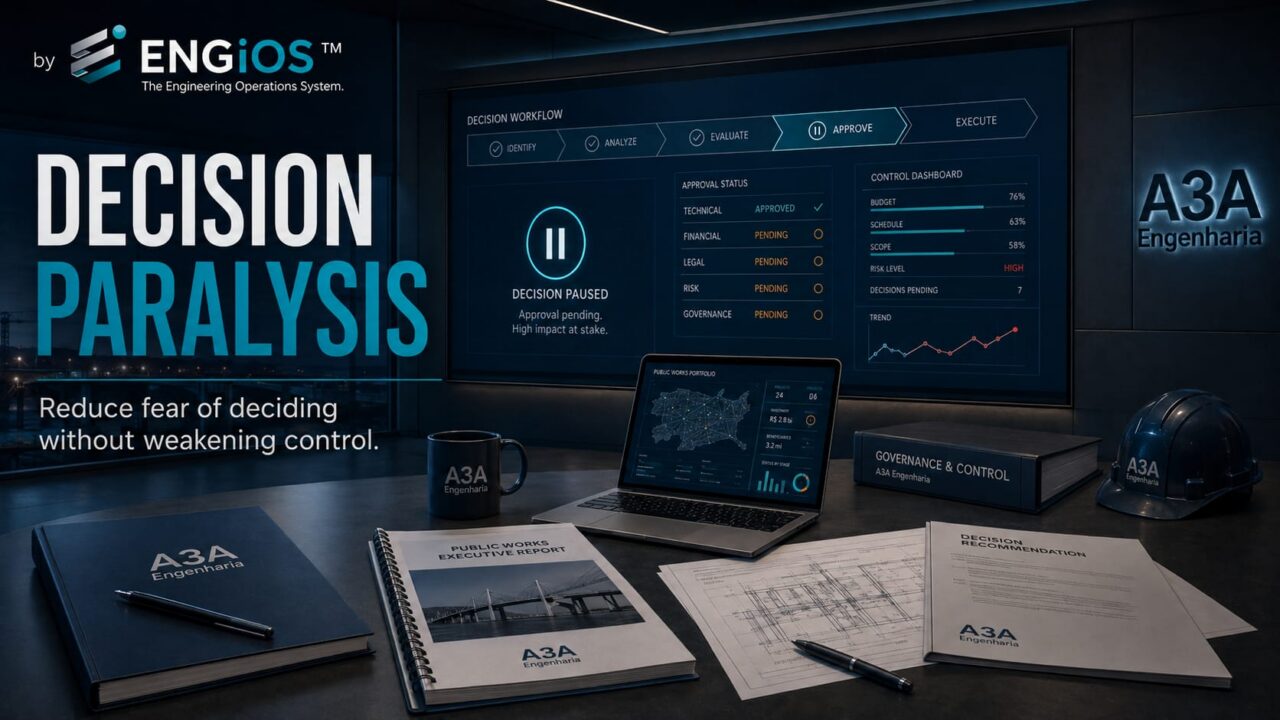
Understand decision paralysis (“apagão das canetas”) in Brazilian public works, why managers stop deciding and how governance, evidence and technical support reduce decision bottlenecks.
Check it out!
The Brazilian expression “apagão das canetas” describes decision paralysis caused by the fear that a technically defensible administrative decision may later be treated as irregular or personally attributable to the public official. In public works, it appears when managers and teams avoid deciding on changes, measurements, economic-financial rebalancing, technical solutions, restarts or closeouts even when the absence of a decision increases damage to the project.
The problem is not solved by weakening oversight. It is solved by improving decision quality, traceability, clarity of responsibilities and available technical capacity. LINDB and Decree No. 9,830/2019 reinforce that decisions must consider practical consequences, real difficulties and concrete circumstances; personal liability requires intent or gross error.
What is “apagão das canetas” in public works?
The expression describes a management phenomenon: the competent authority remains formally able to decide but postpones the substantive decision due to fear of liability, disagreement among departments, lack of documentation or absence of objective criteria.
In public works, not deciding is rarely neutral. A stalled project suffers physical deterioration, unproductive mobilization, loss of warranties, discontinuity of teams, price increases and loss of accumulated knowledge. The article on how much it costs to leave a public project stalled for 12 months shows why decision delay must also be treated as an economic variable.
The main triggers are:
- significant technical uncertainty;
- fear of personal liability;
- disagreement among engineering, legal, financial and oversight functions;
- insufficient documentation;
- diffuse responsibilities;
- incomplete designs;
- conflicts with the contractor without timely treatment.
What LINDB changes in the analysis of public decisions
Law No. 13,655/2018 incorporated into LINDB provisions aimed at legal certainty and efficiency. Art. 20 requires consideration of practical consequences. Art. 22 requires real obstacles, difficulties and concrete circumstances to be considered. Art. 28 provides for personal liability in cases of intent or gross error.
Decree No. 9,830/2019 defines gross error as a manifest, evident and inexcusable error committed with gross negligence, and states that the mere causal link between conduct and damage does not, by itself, imply personal liability.
This does not create immunity. Weak decisions, without due diligence or evidence, remain exposed. The difference is recognizing that a technically supported decision does not have to be infallible.
Not deciding also creates risk
When a change request remains unanswered for months, the schedule keeps running, the contractor may demobilize teams and work fronts remain blocked. When a disputed measurement is not analyzed, the risks of conflict and financial interruption increase.
In a stalled project, postponing the choice between restart, termination or reprocurement may be more costly than any available alternative. Decision omission therefore has its own cost and risk.
Decisions most exposed to paralysis
Contract amendments
Amendments generate concern because they change the original conditions of the procurement. The answer is not to avoid them at any cost, but to demonstrate cause, necessity, responsibility, quantitative basis, impact and legal framing. See also contract amendments in public works and engineering services.
Economic-financial rebalancing
Rebalancing requests require separating ordinary variation, acts of the Administration, extraordinary events and risks already allocated under the contract. Without causal and cost analysis, the process becomes a dispute of narratives.
Measurements
Measurement must be supported by verifiable quantities, records, tests and evidence. A measurement certificate reduces subjectivity and decision risk.
Design changes
Engineering changes must distinguish technical need, cause, responsibility, schedule and cost impact and the appropriate contractual instrument.
Restarting a public project
A restart requires a new physical and documentary baseline. A technical diagnosis of a stalled project and a survey of completed services and condition report reduce uncertainty before the decision.
How to turn a decision into an auditable decision
An auditable decision allows a third party to later reconstruct the reasoning used with the information available at the time.
A robust process should record:
- triggering event;
- contractual basis;
- evidence;
- technical analysis;
- schedule impact;
- cost impact;
- risk matrix;
- alternatives;
- recommendation;
- decision and follow-up.
The structure does not eliminate challenges, but it changes the quality of the debate: instead of asking only who signed, the analysis shifts to whether the reasoning was consistent.
How to break decision paralysis without weakening oversight
Critical project decisions need to reach the authority with facts, alternatives, risks and consequences technically organized.
The main change is to replace the personal decision model with a structured institutional decision model. The manager remains responsible within the manager’s authority but receives a process supported by alternatives, risks and evidence.
Five mechanisms help:
- escalation criteria;
- internal deadline for critical decisions;
- decision technical memorandum;
- record of assumptions and uncertainties;
- independent technical support.
Consulting Engineering can produce design, schedule, budget, interface, risk, measurement and evidence analyses without replacing the public official’s decision-making authority.
The role of evidence-based inspection
Effective inspection transforms field records into usable information for measurement, schedule, conformity and change decisions.
Evidence-based inspection organizes execution so that every conclusion can be traced to verifiable records.
A nonconformity should indicate the violated requirement, location, date, evidence, impact and responsible party. A time extension should demonstrate the period, affected activity, critical path, responsibility and net impact.
The better the evidence, the less room there is for decisions based only on perception or pressure.
How to structure decisions on changes and claims
The workflow should record the event, preserve evidence, verify the contract, analyze causality, quantify impact, assess alternatives and formalize the decision with follow-up actions.
The difference between contract manager and contract inspector must also be clear: inspection verifies and records; management consolidates and coordinates contractual treatment; the competent authority decides when the act requires its authority.
A legal opinion does not replace an engineering decision
Legal counsel evaluates legal framing and compliance. Defining construction method, quantities, schedule impact, performance and solution belongs to the technical sphere. Likewise, a technical opinion does not replace the administrative authority required to authorize the act.
| Function | Main question |
| Engineering | Does the solution work and what is the technical impact? |
| Planning | What is the effect on the schedule? |
| Cost engineering | What is the economic impact? |
| Inspection | Is the fact proven? |
| Contract management | How does the event affect obligations? |
| Legal | Is the solution legally permissible? |
| Authority | Which alternative best serves the public interest? |
Signs that fear of deciding already threatens the project
- critical RFIs without answers;
- amendments under review for a period incompatible with the schedule;
- services executed without formalization;
- measurements accumulating in dispute;
- successive meeting minutes repeating the same problem;
- contractor reducing pace because of uncertainty;
- decisions repeatedly forwarded among departments;
- claims growing faster than they are analyzed.
The checklist of warning signs of project stoppage helps recognize this stage.
Consulting Engineering as decision infrastructure
In complex projects, Consulting Engineering can function as a support layer for the Administration through diagnosis, design review, planning, budgeting, schedule analysis, measurement verification, claim analysis, risk management, technical memoranda and inspection support.
Its role is not to replace the manager or inspector, but to improve the quality of the information that reaches them.
Checklist for a technically defensible decision
- problem defined objectively;
- sufficient contemporaneous evidence;
- contract documents identified;
- risk matrix consulted;
- cause and responsibility analyzed;
- cost and schedule impacts quantified;
- alternatives considered;
- consequences of not deciding assessed;
- explicit technical recommendation;
- clear decision-making authority;
- defined follow-up.
How to apply a decision matrix to sensitive project issues
One of the most effective ways to reduce decision risk is to turn complex choices into an explicit comparison of alternatives. This is especially useful when no solution is perfect and all alternatives carry some residual cost, schedule or risk.
The matrix should not replace technical judgment. It organizes criteria and makes visible why one alternative was preferred. For an engineering change, for example, the assessment may consider safety, performance compliance, schedule impact, CAPEX, OPEX, ease of implementation, interference risk and reversibility.
| Criterion | Decision question | Expected evidence |
|---|---|---|
| Safety | Does the alternative introduce a new risk? | Technical analysis, JSA, standards and requirements |
| Performance | Is the functional requirement still met? | Design memorandum, calculation, specification and test |
| Schedule | What is the impact on the critical path? | Schedule and sequencing analysis |
| Cost | What is the verifiable incremental cost? | Quantities, cost compositions and quotations |
| Contractual risk | Who assumed the event under the contract? | Risk matrix and clauses |
| Operation | Does the solution create a future liability? | Maintenance, service-life and operational analysis |
When the criteria are defined before the choice, the rationale ceases to be a justification constructed after the fact. It becomes the consequence of a verifiable decision-making process.
Provisional decision, final decision and contingency control
Some project events do not allow weeks of waiting for a final solution. An interference blocking excavation, a safety condition, a failure in a temporary system or a critical incompatibility may require an immediate decision to protect people, assets or continuity.
In these cases, governance should distinguish a provisional decision from a final decision. The provisional solution needs limited scope, a deadline, a responsible party, a closure condition and a clear record that it does not replace final contractual analysis.
This distinction reduces two opposite risks: stopping a work front for an unnecessary period or turning an emergency workaround into a permanent change without analysis.
When a provisional decision is reasonable
- there is a risk to safety or asset integrity;
- inaction causes progressive damage;
- a work front must be released without compromising the final solution;
- the measure is reversible or has controlled risk;
- there is a defined deadline for final analysis.
The provisional decision should be accompanied by a contemporaneous technical record and a formal action in the management system. Without this, the exception tends to become permanent.
The value of analyzing practical consequences
The requirement to consider practical consequences does not mean always choosing the cheapest or fastest alternative. It means recognizing that an administrative decision has real effects on the project, budget, operation, users and contracts.
In a stoppage, for example, declaring an act void or interrupting a work front may be legally justified, but the decision must consider protection of what has already been executed, demobilization, preservation of equipment, continuity of essential services and a transition plan.
Likewise, maintaining a problematic contract merely to avoid termination cost can increase the damage. Proper analysis compares scenarios, not only the immediate cost of a measure.
Continuation scenario
It should consider the contractor’s actual capacity, productivity, recovery plan, technical punch items, financial health where relevant, impact of claims and ability to complete the scope.
Contract correction scenario
It should assess whether a permissible change in design, schedule, quantities or method can restore viability without transforming the object or improperly transferring risks.
Termination and restart scenario
It should include an inventory of completed work, condition, remaining services, warranties, documentation, demobilization costs, new procurement and the time until effective restart.
The article on how to restart a stalled public project goes deeper into this protocol.
How to handle disagreement among technical opinions
Decision paralysis also appears when specialists disagree. A designer recommends one solution, inspection disagrees, the contractor presents a third alternative and legal counsel identifies risks in each path.
Disagreement is not necessarily a sign of a poor process. In complex engineering, legitimate alternatives may exist. The problem arises when the organization has no method for deciding among them.
A good practice is to require each position to explicitly state:
- assumptions used;
- requirements met;
- residual risks;
- schedule and cost impacts;
- data supporting the conclusion;
- conditions that would cause the recommendation to change.
This allows opinions to be compared by their basis rather than by the authority of the person who issued them.
How the risk matrix reduces decision paralysis
The risk allocation matrix is one of the most useful documents when an unforeseen event occurs. If the risk was clearly identified and allocated, the discussion of responsibility tends to be more objective.
A poorly prepared matrix, on the other hand, can increase uncertainty. Generic expressions such as “all project risks belong to the contractor” rarely resolve complex events involving design, interferences, expropriation, licensing, physical conditions or changes ordered by the Administration.
To work as a decision instrument, the matrix should describe the event, allocation, treatment mechanism, expected effect and, where applicable, responsibility for prevention or mitigation.
The role of the competent authority: deciding does not mean producing all the analysis
Another frequent mistake is confusing responsibility for the decision with an obligation to master every discipline involved. The competent authority does not need to replace the engineer, planner, cost engineer, inspector and legal counsel. It needs to verify that the process is sufficiently supported and exercise the authority assigned to it.
This separation is essential to avoid two extremes: an authority that decides without technical support and an authority that refuses to decide because it does not possess specialized knowledge of every detail.
The engineering process should convert technical complexity into decision information: problem, evidence, alternatives, impacts, risks and recommendation.
How to create a decision trail for future audits
A mature decision trail is not a folder of accumulated PDFs. It is a coherent sequence of records that makes it possible to understand how the event evolved.
For relevant events, the Administration should be able to answer:
- when the event arose;
- who identified it;
- which requirement was affected;
- which contemporaneous records exist;
- when the contractor communicated the impact;
- which alternatives were studied;
- who recommended each alternative;
- when the authority decided;
- how the schedule and budget were updated;
- which effects were observed afterward.
This trail is particularly important for claims, amendments, delays and rebalancing because review often occurs long after the event.
Construction meetings need to produce decisions, not just minutes
Lengthy minutes do not compensate for lack of governance. A weekly meeting that repeats the same punch items for ten weeks is documenting paralysis, not resolving it.
A governance agenda should separate information, pending issues and decisions. Each critical item needs a responsible party, deadline, escalation level and schedule consequence.
| Status | Treatment |
|---|---|
| Information | Record without decision action |
| Technical pending item | Responsible party and deadline for analysis |
| Decision required | Alternatives and competent authority |
| Critical blocker | Immediate escalation and critical-path impact |
Meeting discipline is simple but has an enormous effect on project response time.
How to measure the quality of the decision-making process
Decision governance can also be monitored through indicators. The objective is not to turn every decision into a KPI, but to identify accumulating risk before the project stops.
Useful indicators include:
- average RFI response time;
- average age of pending decisions;
- number of overdue decisions;
- value of claims awaiting analysis;
- critical-path days affected by Administration pending items;
- number of changes executed before formalization;
- percentage of nonconformities with overdue treatment;
- time between event identification and formal recording.
These indicators connect to the model of KPIs for public-works inspection and management.
A practical ten-step decision protocol
- Define the problem. Write the decision question in one objective sentence.
- Preserve the facts. Gather contemporaneous evidence and identify gaps.
- Check the requirements. Consult the contract, design, specifications, standards and risk matrix.
- Identify the cause. Separate technical, contractual and administrative causes.
- Build alternatives. Do not send the authority only a problem without options.
- Quantify. Estimate cost, schedule, performance and risks for each alternative.
- Obtain the necessary inputs. Engineering, planning, cost engineering, legal and other functions as applicable.
- Compare consequences. Include the scenario of not deciding.
- Formalize the decision. Record rationale, conditions, responsible party and deadline.
- Monitor. Verify whether the decision produced the expected effect and update the baseline.
This protocol turns the act of signing into the final stage of a chain of work, not an individual gamble by the manager.
Final considerations
Decision paralysis is a legal-certainty problem, but also an engineering and governance problem. It appears when the organization demands a high-consequence decision without providing information, criteria, responsibilities and evidence compatible with project complexity.
The answer is not to eliminate oversight. It is to transform weak decisions into structured, traceable and technically supported decisions. In public works, due diligence means deciding with engineering: a reliable baseline, contemporaneous records, causal analysis, quantification, risk matrix, alternatives, rationale and follow-up.
Project Controls integrates schedule, costs, risks and interfaces to reduce decision backlogs.
Technical references
[1] BRAZIL. Law No. 13,655, of April 25, 2018. 2018. Available at: https://www.planalto.gov.br/ccivil_03/_ato2015-2018/2018/lei/l13655.htm.
[2] BRAZIL. Decree No. 9,830, of June 10, 2019. 2019. Available at: https://www.planalto.gov.br/ccivil_03/_ato2019-2022/2019/decreto/d9830.htm.
[3] BRAZIL. Law No. 14,133, of April 1, 2021. 2021. Available at: https://www.planalto.gov.br/ccivil_03/_ato2019-2022/2021/lei/l14133.htm.
[4] FEDERAL COURT OF ACCOUNTS — TCU. Oversight needs to be closer to managers. 2026. Available at: https://portal.tcu.gov.br/imprensa/noticias/o-controle-precisa-estar-mais-perto-dos-gestores-diz-presidente-do-tcu.
Frequently asked questions
It is paralysis or excessive postponement of administrative decisions caused by fear of liability, poor-quality technical support, diffuse responsibilities or uncertainty about future oversight.
No. It provides for personal liability in cases of intent or gross error and requires consideration of practical consequences and concrete circumstances.
Yes. Failure to decide can increase delays, costs, conflicts, physical deterioration and the risk of stoppage.
Through clear governance, evidence, analysis of alternatives, a risk matrix, quantification of impacts and technical support proportional to complexity.
No. A consultant can analyze and recommend, but administrative decision-making authority remains with the public official.
Complementary technical materials
Main content on the topic
- How to inspect a public works project
- Evidence-based inspection in public works
- Contract manager vs. contract inspector under Law 14,133
Related services
- Engineering Technical Consulting
- Technical Support for Public-Works and Contract Inspection
- Project Management