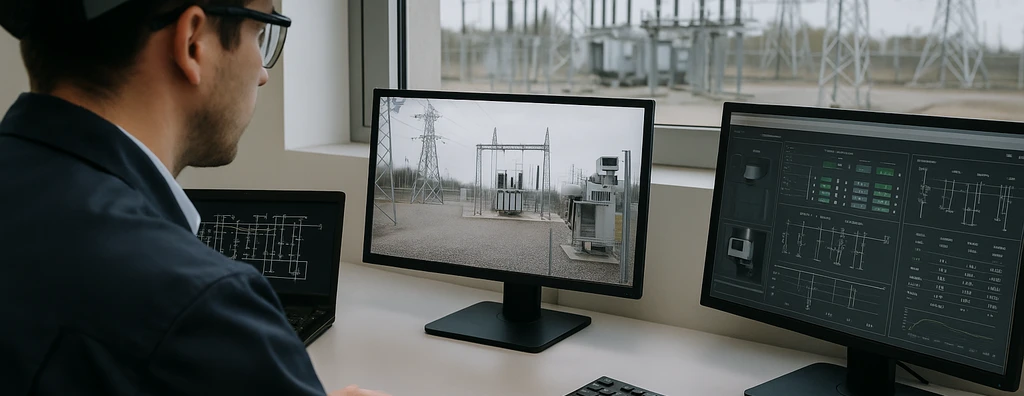
The adoption of remote monitoring systems in electrical substations has advanced as a response to the growing demand for remote control, automation, supervision, security monitoring, and improved operational reliability. This trend imposes engineering challenges spanning electrical robustness, IT system integration, specific regulatory requirements, risk management, and cybersecurity constraints. Proper dimensioning and interoperability between electronic supervision, […]
Check it out!
The adoption of remote monitoring systems in electrical substations has advanced as a response to the growing demand for remote control, automation, supervision, security monitoring, and improved operational reliability. This trend imposes engineering challenges spanning electrical robustness, IT system integration, specific regulatory requirements, risk management, and cybersecurity constraints. Proper dimensioning and interoperability between electronic supervision, video surveillance, data communications, electrical protection, and remote control subsystems are fundamental to ensuring the availability of industrial processes and the resilience of the critical infrastructures involved.
This article addresses in depth the technical challenges in substation remote monitoring projects, the application of key regulatory frameworks, and engineering solutions focused on integration, safety, electrical reliability, contingency planning, and operational management of remotely monitored systems. The objective is to provide a solid technical foundation for design, operations, and maintenance professionals, as well as to support the preparation of technical proposals and institutional documentation.
Check it out!
[elementor-template id=”24446″]
Remote monitoring in substations encompasses the implementation of technical infrastructures and operational protocols that enable monitoring, remote control, and maintenance without the need for continuous on-site operator presence. Systems of this type are composed of multiple device layers: sensors, actuators, protective equipment, video surveillance systems, communication media, servers, and management interfaces.
- Remote Supervision: Enables real-time visualization of electrical data, equipment status, alarms, and environmental video for rapid decision-making.
- Remote Control: Enables remote actuation of disconnectors, circuit breakers, and other devices essential to the operation and safety of the substation.
- Security Monitoring: Involves the integration of video surveillance systems, intrusion detection, and access control in compliance with regulatory requirements.
The technical benefits manifest in greater operational availability, reduced failure response times, improved asset and personnel security, and optimized human resource utilization. These advantages are enabled by a robust architecture of automation, industrial telecommunications, and electronic security, in compliance with regulatory rigor and controlled operational procedures.
The development and implementation of remote monitoring systems must comply with a set of national and international technical standards that ensure the interoperability, safety, and performance of the installed systems. Key standards include:
- ABNT NBR IEC 62676 (Video surveillance systems for use in security applications): Defines minimum performance requirements, video transmission recommendations, reliability, interoperability, and functional aspects for video surveillance systems in critical environments such as substations.
- ABNT NBR 5410 (Low-voltage electrical installations): Establishes criteria for power supply, disconnection, electrical protection, circuit division, emergency shutdown, and maintainability — all essential for the electrical infrastructure supporting remote monitoring.
- Industrial Communication and Supervision Protocols: The NBR IEC 60870 standard characterizes the protocols for automation, control, and supervision in electrical systems, ensuring interoperability and security in information exchange between devices and control centers.
Complementary standards cover aspects of grounding, power continuity (backup sources), identification, functional testing, mandatory visual inspections, and corrective/preventive maintenance — all sustaining the integrity of the implemented solutions.
One of the primary challenges lies in integrating the automation, video surveillance, access control, and data communications subsystems. Interoperability is mandatory and spans both hardware and software protocols, strongly determined by the cited standards and by the specific operational requirements of substations.
Key aspects of system integration:
- Unified Management: Consolidation of network node management, including switches, routers, workstations, video transmission devices, servers, and automation and security systems.
- Infrastructure Monitoring: Solutions capable of monitoring network conditions, device failures, video transmission quality, and critical events — enabling proactive actions to ensure operational efficiency.
- Latency Reduction and QoS Optimization: Network architectures must prioritize critical traffic (control, supervision, and video) to minimize delays and ensure continuous availability of remotely monitored systems.
These requirements impose the adoption of modular architectures, extensive use of VLANs for logical segmentation, link and equipment redundancy mechanisms, and SNMP-, NetFlow-, and other industrial protocol-based network management tools.
Secure, redundant, and efficient transmission of critical data is an essential requirement. In substations, transporting supervision signals, control commands, and video streams requires:
- Use of Standardized Protocols: TCP/IP-based protocols for remote supervision (such as IEC 60870-5-104), proprietary video surveillance protocols, and secure encapsulation mechanisms.
- Network Topology Redundancy: Hierarchical topologies with redundant links, Hot Standby Router Protocol (HSRP), Gateway Load Balancing Protocol (GLBP), EtherChannel, Spanning Tree Protocol (STP/RSTP).
- Quality of Service (QoS): Implementation of priority queuing, latency reduction strategies, and bandwidth management to guarantee availability for the most critical traffic flows.
ABNT NBR IEC 62676 details specific requirements for video transmission, including minimum expected performance, fault management, availability monitoring, and the requirement for immediate corrective actions in response to detected failures in transmission or network infrastructure.
Electronic security in substations with remote monitoring is grounded in principles of reliability, resistance to sabotage, and regulatory compliance. Key points include:
- Standardized Video Surveillance: Structured by the ABNT NBR IEC 62676 series, requiring minimum performance, multi-vendor interoperability, and remote monitoring plans.
- Logical and Physical Access Control: Management of access to critical areas with multi-factor authentication for remote operators and event records, combining physical devices and digital systems.
- Alarm and Event Management: Integrated intrusion detection, alarm, door status alerts, perimeter monitoring, and environmental analysis systems, synchronized with centralized supervision platforms.
The management of security events and access must be supported by auditable records, integration with automation systems, and rapid incident response mechanisms — promoting high resilience and operational traceability.
The base electrical design for substation remote monitoring requires attention to several regulatory factors:
- Emergency Shutdown: Providing quickly operable and clearly identified devices for immediate circuit de-energization in critical situations.
- Disconnection and Protection: Independent circuit disconnection capability, protection devices against electrical shock and thermal effects, regular inspection, and clear component identification.
- Accessibility and Maintainability: Component placement ensuring easy access for inspection, maintenance, and safe operation by qualified professionals.
- Secure and Redundant Power Supply: For security services (video surveillance, access control, automation), reliable and redundant sources with specific autonomy are required to maintain operation during main supply interruptions.
Mandatory visual inspection procedures, periodic functional testing, corrective maintenance, and adoption of emergency plans complement the regulatory requirements — fundamental to ensuring the availability and performance of remotely monitored systems.
Operational continuity in substations depends on the redundancy architecture implemented in the electrical, automation, and communication systems. Recommended technical structures include:
- Communication Redundancy: Alternative links (fiber optic, radio, redundant WANs), use of fast recovery protocols such as Hot Standby Router Protocol, Spanning Tree Protocol (STP/RSTP), and gateway load balancing.
- Power Redundancy: Dual sources, generator sets, dimensioned UPS systems with automatic switchover, according to the criticality of the systems.
- Operational Contingency Plans: Detailed procedures for failure response, acting from the monitoring layer through protection systems to remote control restoration actions.
Detailed risk analysis and prioritization of critical data, power, and monitoring routes in the project design ensure the resilience required in mission-critical environments such as utility and industrial electrical substations.
Cybersecurity is a central aspect of remote monitoring, as failures or attacks can compromise the operational integrity and physical security of the installations. Key technical requirements include:
- Network Segmentation and VLANs: Logical separation of functional domains (control, supervision, video, access) with rigorous flow and privilege controls.
- Authentication, Encryption, and VPN: Implementation of multi-factor authentication, site-to-site VPN tunnels, and secure remote access for operators and technicians, in accordance with high-security enterprise architecture guidelines.
- Firewalls and Permission Policies: Access restrictions, control list policies, and continuous monitoring of unauthorized access attempts.
- Centralized Log Management: Recording and analysis of network events, incidents, and failures for rapid detection and response to threats.
Proper management of these layers is essential to meeting the requirements for data availability, confidentiality, and integrity, in compliance with best practices for protecting critical industrial networks.
Maintainability and reliability of installed systems stem directly from the application of technical routines prescribed in ABNT NBR 5410 and in specific electronic security and automation standards. Key points include:
- Periodic Visual Inspection: Regular assessment of the physical integrity of components, protection against shock and thermal effects, connections, identification, and accessibility.
- Functional Testing: Regular operational tests of systems, verifying actuation of protection devices, disconnection, performance of redundant power sources, and video and data transmission.
- Corrective Maintenance: Detection, notification, and immediate correction of identified anomalies, safe de-energization of critical circuits, and re-energization only after safety and performance parameters have been re-established.
These routines, complemented by technical staff training, ensure rapid response to operational deviations — maintaining high levels of availability, security, and operational traceability in environments subject to remote monitoring.
Remote monitoring projects must consider the scalability of systems in accordance with operational growth or future topological changes in substations. Key technical elements include:
- Scalable and Modular Topologies: Allow progressive integration of new devices, circuit expansion, and addition of automation elements without interrupting primary services.
- Resource Rightsizing: Continuous assessment of workload on communication, bandwidth, processing, storage, and power capacity resources.
- Software Modularity and Protocols: Adoption of interoperable protocols and service-oriented infrastructure (Service Oriented Architecture — SOA) to facilitate function orchestration, integration of new systems, and controlled technology updates.
This approach enables rapid response to business demands and technology adoptions, and ensures long-term operational sustainability for substations under intensive remote monitoring regimes.
Remote monitoring systems in electrical substations represent an advanced convergence point between electrical engineering, industrial data networks, and electronic security — requiring strict compliance with technical standards, precise system integration, robust resilience strategies, and comprehensive contingency plans. The demands for maintainability, availability, and security — both physical and logical — call for design and operational solutions grounded in recognized protocols, redundant architecture, proven inspection and maintenance practices, and effective cybersecurity policies. Thinking systemically and prospectively, aligning technical specifications with architectural flexibility, is essential to ensuring the success of projects and the safe operational continuity of substations in the current context of digital transformation in the power sector.
Thank you for reading this technical article on remote monitoring in electrical substations. To explore further topics such as systems integration, technical standards, and engineering solutions for critical environments, follow A3A Engineering Systems on social media and stay tuned for our upcoming professional publications.
