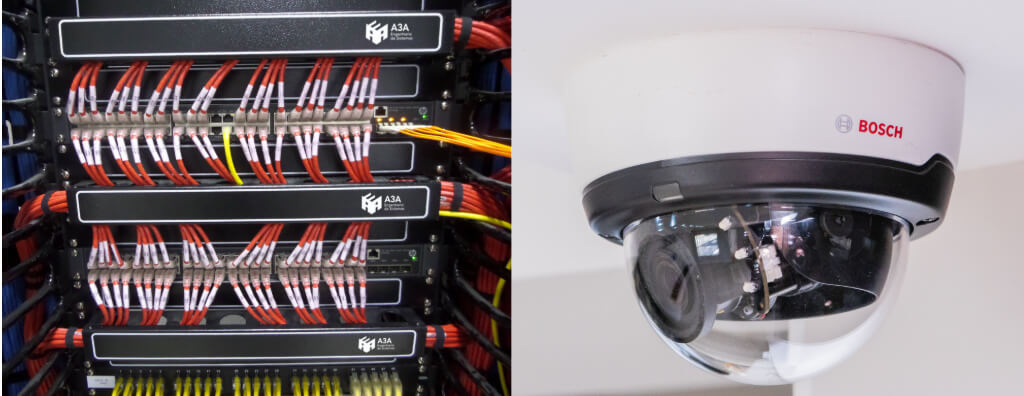
Cat5e vs. Cat6 for IP CCTV: real differences, Gigabit Ethernet, PoE, bitrate, MPTL, shielding, certification, cost, and selection criteria for new projects or retrofits.
Check it out!
The choice between Cat5e and Cat6 for IP CCTV should not be based on camera resolution alone. A 4K camera does not “require Cat6” by definition, just as a Full HD camera does not automatically make Cat5e sufficient. The correct criterion considers Ethernet application, link length, PoE, certification margin, environment, future expansion, project standardization, and lifecycle cost.
On horizontal links up to 100 m, Cat5e and Cat6 can operate Gigabit Ethernet when the channel is correctly designed, installed, and certified. Cat6 provides higher transmission performance and greater crosstalk margin, with 250 MHz specified frequency versus 100 MHz for Cat5e. In new corporate, industrial, and institutional projects, this margin often supports choosing Cat6, but the decision should come from the design rather than a simplistic megapixel rule.
What Really Changes Between Cat5e and Cat6
Cat5e and Cat6 belong to the balanced twisted-pair cabling family, but they have different performance requirements. Category is a classification of the component and link, not a direct measure of the bitrate generated by a camera.
| Criterion | Cat5e | Cat6 |
| Specified frequency | up to 100 MHz | up to 250 MHz |
| 1000BASE-T | supported on a compliant channel | supported on a compliant channel |
| 10GBASE-T | not the typical design application | may be supported under distances/conditions defined by the standard, but Cat6A is the reference for 10 Gb/s at 100 m |
| Crosstalk margin | lower | higher |
| Typical diameter | lower | geralmente higher |
| Material cost | lower | higher |
| Uso em novos projetos de higher ciclo de vida | possible, depending on requirements | often preferable |
The table should not be interpreted as “Cat6 is always better.” In a retrofit, for example, an existing Cat5e link that certifies, supports the application, and has remaining service life may remain technically valid. Replacing it unnecessarily can be wasteful. In a new installation with strong dependence on PoE and future expansion, the analysis tends to favor higher categories.
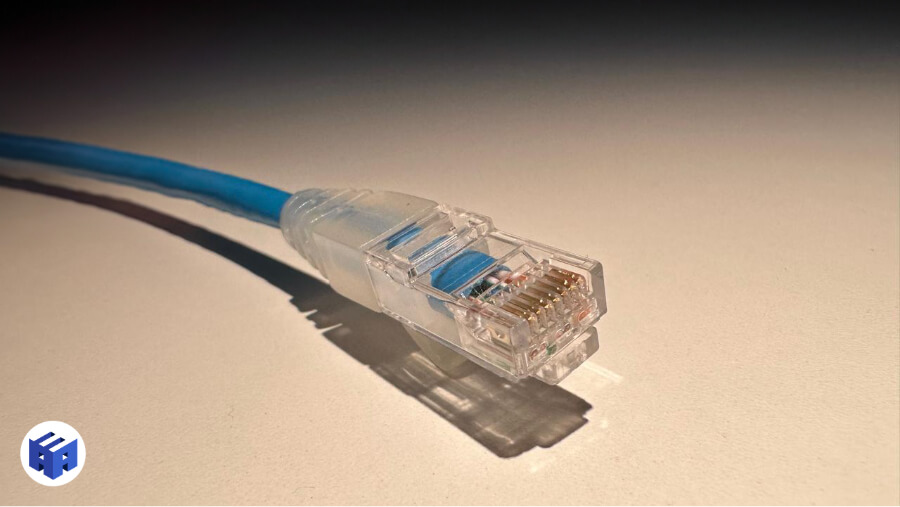
A3A Engenharia collection — twisted-pair cable used in network infrastructure.
Megapixels Do Not Determine Cable Category
A camera’s bitrate results from compression, scene content, and configuration. Cabling category should be defined by the Ethernet application, environment, PoE, certification, and lifecycle — not by a megapixel rule.
A common mistake is to associate camera resolution directly with category: “Full HD uses Cat5e; 4K uses Cat6.” This relationship is technically weak because video is compressed before transmission. Bitrate depends on resolution, frame rate, codec, compression profile, scene complexity, lighting, noise level, VBR/CBR/MBR, and manufacturer settings.
Two 4K cameras can generate very different bitrates. Likewise, a Full HD camera in a complex scene can generate more traffic than a 4K camera using efficient compression in a stable scene.
The camera link commonly operates at 100 Mb/s or 1 Gb/s, capacities far above the average bitrate of a single video stream. The bottleneck tends to appear at aggregation points: multiple cameras converge on access switches, uplinks, the backbone, recording servers, and storage.
Does Cat5e Support a 4K Camera?
From an Ethernet perspective, a compliant Cat5e link can support Gigabit Ethernet. Because a single 4K video stream typically uses only a fraction of that capacity, a 4K camera does not invalidate Cat5e.
The better question is whether Cat5e makes sense in new infrastructure expected to remain in service for many years. The answer depends on the scenario. Cable savings should be compared with the total cost of pathways, labor, connectors, certification, racks, mobilization, and eventual future replacement.
In many projects, cable represents only part of the installed cost. Saving a small amount on the component while reducing performance margin or standardization may not be rational. In other cases, especially retrofits with installed and certified Cat5e, reusing the existing asset may be technically and economically sound.
Why Cat6 Is Often Preferred in New CCTV Projects
Cat6 provides greater transmission margin and lower susceptibility to crosstalk than Cat5e under the conditions defined by the standards. This matters because real installations add variables: cable bundles, PoE, temperature, bends, connectors, patch cords, proximity to power, and future changes.
The advantage is not “transmitting 4K video because it has more MHz.” The advantage is delivering a link with greater margin and technical lifecycle, especially when the infrastructure may also serve other devices, Wi-Fi, access control, IoT, or future cameras.
Cat6 Does Not Eliminate the Need for Design
Specifying Cat6 and installing it poorly still produces a poor system. Excessive untwisting, incompatible connectors, improper bend radius, cable crushing, overly tight bundles, inferior patch cords, or incorrect certification can compromise the link.
A channel must be treated as a system. Cat6 cable with a Cat5e patch panel, unsuitable patch cord, or poor termination does not become Cat6 because of the label on the cable box.
Cat6 and 10 Gigabit Ethernet: Avoid Oversimplification
Cat6 can support 10GBASE-T under limited conditions and distances, but Cat6A is the category normally used when the design requirement is 10 Gb/s over a 100 m channel. Using “10 Gb/s” as a generic justification for Cat6 in CCTV is inappropriate.
At the camera, individual traffic rarely requires 10 Gb/s. The need for 10 Gb/s is more likely to arise in aggregated uplinks and backbones, where optical fiber or higher-capacity core interfaces are often more appropriate.
PoE Changes the Cat5e vs. Cat6 Analysis
In IP CCTV, the cable carries data and often power. Power over Ethernet (PoE) introduces current into the pairs, resistive losses, and heating. The greater the power and number of energized cables in a bundle, the more important it becomes to consider resistance, temperature, bundling, conductor gauge, and installation conditions.
Category alone does not determine thermal performance. Two Cat6 cables can have different physical constructions. The design should consider manufacturer specifications, conductor material, diameter, operating temperature, PoE application, and installation conditions.
CCA — copper-clad aluminum — cables should not be treated as equivalent to cables with copper conductors specified for the system. In addition to compliance concerns, the higher electrical resistance is particularly undesirable in PoE applications.
Switch PoE Budget Is Independent of Cable Category
Another mistake is assuming that using Cat6 automatically solves power problems. The switch must have a sufficient total PoE power budget for the connected devices.
A port may support a given power class while the switch power supply cannot provide that power on all ports simultaneously. The design must verify maximum consumption for cameras, heaters, IR, PTZ, illuminators, and accessories.
When redundant power supplies are used, it is also necessary to verify whether capacity remains sufficient under degraded conditions, such as with only one active supply.
MPTL for IP Cameras
Cameras are fixed devices for which MPTL — Modular Plug Terminated Link may make sense, eliminating the telecommunications outlet and patch cord at the device. This can reduce connection points and facilitate installation in compact enclosures.
MPTL does not simply mean “crimping an RJ45 onto horizontal cable.” The field plug must be appropriate for the cable, category, construction, shielding, and application. The link must be tested using a certification configuration compatible with MPTL.
Cat5e vs. Cat6 for Outdoor Cameras
For cameras on facades, rooftops, yards, or poles, category is no longer the only issue. The design should consider:
- exposure to temperature and humidity;
- UV protection where applicable;
- transition between indoor and outdoor areas;
- conducted and induced surges;
- interface with the LPS;
- potential differences;
- enclosures and connectors suitable for the environment;
- use of fiber when links run between structures or are exposed to significant electrical risk.
A standard indoor Cat6 cable does not become suitable for every outdoor environment simply because it is a higher category.
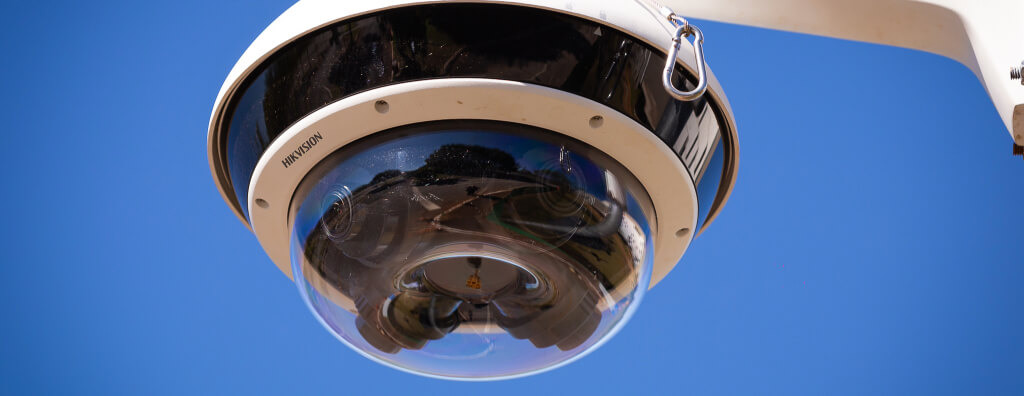
A3A Engenharia collection — multisensor camera used in video-surveillance systems.
Shielding: Cat6 Does Not Mean Shielded Cable
Cat6 can be manufactured as U/UTP or shielded cable. Cat5e can as well. Category and shielding are different attributes.
The choice of F/UTP, U/FTP, or S/FTP should be based on the electromagnetic environment and equipotential-bonding strategy. Poorly designed shielding can increase cost and complexity without proportional benefit.
In industrial environments or near strong interference sources, shielded cabling may be appropriate. Under more severe conditions or between separate areas, optical fiber may be preferable because it eliminates the metallic medium.
What Happens When the System Has Many Cameras
Camera count primarily affects aggregation. Each access link carries the traffic of its connected camera; the switch uplink carries the sum of many cameras.
Consider a switch with dozens of cameras. Even if each generates only a few megabits per second, the total can consume a significant portion of a 1 Gb/s uplink. Add live viewing, recording, secondary streams, failover, synchronization, and administrative traffic, and the margin decreases.
The design should model at least:
- average bitrate;
- configured maximum bitrate;
- concurrency;
- primary and secondary traffic;
- recording and live view;
- uplinks and redundancy;
- future growth.
The solution may be a 10 Gb/s uplink, multiple uplinks, link aggregation, or an optical backbone. Replacing Cat5e with Cat6 at the camera alone does not increase the capacity of an existing uplink.
Video Analytics and the Network
Embedded analytics can generate metadata with relatively small traffic impact compared with video. Server-side analytics may require additional streams or forwarding to specific servers. The effect depends on the manufacturer’s architecture and the VMS.
It is not correct to state generically that facial recognition or license plate recognition “exceeds Cat5e.” It is necessary to map which streams traverse which links and where processing occurs.
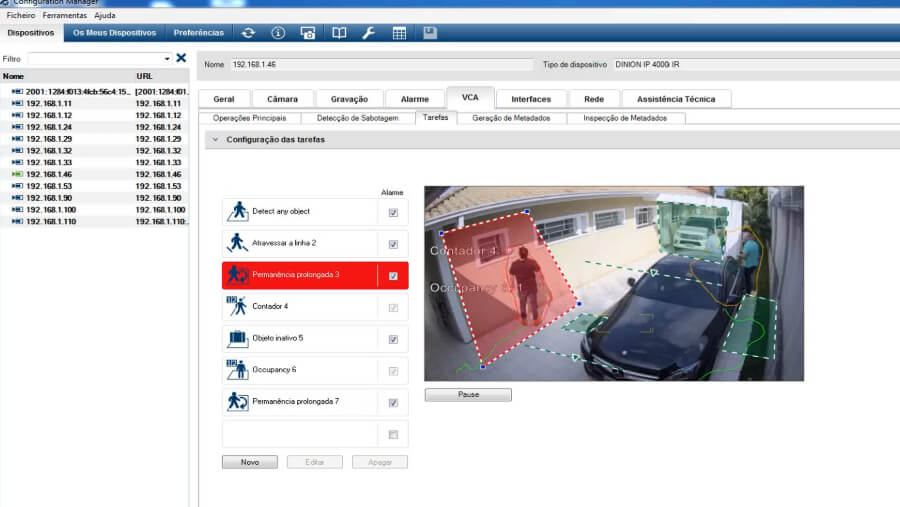
A3A Engenharia collection — proof of concept for video analytics.
Technical Comparison for New Projects
| Situation | Cat5e | Cat6 | Engineering note |
| Retrofit with certified existing link | may remain | replacement possible | evaluate remaining life and actual need |
| New corporate installation | possible | generally preferable | consider lifecycle and standardization |
| High-density PoE | requires thermal analysis | requires thermal analysis | category does not replace cable sizing/selection |
| Industrial environment | may be unsuitable depending on environment | may be suitable depending on construction | evaluate MICE, shielding, and fiber |
| Single 4K camera | may support | may support | resolution does not define category |
| Aggregated backbone | generally not the main criterion | generally not the main criterion | evaluate fiber and uplink capacity |
Certification: How to Demonstrate Link Compliance
A working camera does not prove category or link margin. Certification turns the installed infrastructure into verifiable and traceable technical evidence.
Acceptance should not be limited to “the camera displays video.” The permanent link must be certified according to the applicable category and test configuration.
Parameters such as wire map, length, insertion loss, NEXT, PSNEXT, ACR-N, ACR-F, return loss, and other applicable measurements help demonstrate the physical compliance of the link.
Reports should be traceable to the outlet identifier, instrument, adapter, and test date. The certifier’s native file is stronger evidence than an isolated PDF when the objective is auditing and reprocessing results.
Cable Certification Is Not CCTV Commissioning
A link can certify while the camera still has configuration, PoE, multicast, VMS, firmware, licensing, or storage problems. Likewise, a camera can work on a link that does not meet the specified category.
Complete acceptance should therefore separate:
- cabling certification;
- active-network validation;
- functional camera tests;
- recording and recovery validation;
- integration and alarm tests;
- final documentation and As-Built.
Cost: Compare the Installed System, Not Just the Cable Box
The price difference between Cat5e and Cat6 should be compared with the total infrastructure cost. In a new installation, cable trays, conduits, cable pulling, connectors, patch panels, racks, certification, design, inspection, and mobilization can represent a significant portion of the investment.
If choosing Cat5e causes premature replacement, the initial savings can disappear. If the facility already has high-quality, certified Cat5e, replacing it without a requirement may be equally uneconomical.
The decision should be based on lifecycle, not catalog labels.
Procurement: How to Avoid False Technical Equivalence
When procuring cabling, “Cat6” is not a sufficient specification. The technical package should define construction, performance, conductor, fire-reaction, environmental, shielding where applicable, connectivity compatibility, and certification requirements.
CCA products should not be accepted as equivalent to the copper cables specified in the design. Likewise, mixing components from different categories without analysis can reduce channel performance.
Technical proposal review should verify datasheets, certificates, offered models, manufacturer documentation, and any deviations before installation.
When Cat6A Enters the Discussion
Cat6A becomes relevant when the design requires 10GBASE-T over 100 m, greater margin for certain applications, high density, or long-lifecycle standardization. In CCTV, it may be adopted as part of a converged-infrastructure strategy even if the individual camera operates at 1 Gb/s or less.
On the other hand, specifying Cat6A merely because “it is better” can increase cable diameter, pathway occupancy, cost, and installation difficulty. The decision should be consistent with the architecture.
Practical Decision Criteria
For a new installation, answer in sequence:
- what Ethernet application is required today and over the design horizon?
- which devices will use PoE and what is the maximum power?
- what are the link lengths and topology?
- what are the MICE environment and electromagnetic exposure?
- will there be outdoor cameras or interconnections between structures?
- will the infrastructure be shared with other systems?
- what is the expected lifecycle?
- what certification and warranty requirements will apply?
If the objective is only to verify whether a current camera “works,” Cat5e may be sufficient in many cases. If the objective is to build long-term corporate infrastructure, the decision should incorporate margin, expansion, and replacement cost.
Common Errors When Comparing Cat5e and Cat6 for CCTV
- choosing category only by camera resolution;
- stating that Cat5e does not support a 4K camera;
- stating that Cat6 eliminates network latency;
- confusing cable MHz with video bitrate;
- ignoring PoE and heating;
- using CCA because it is cheaper;
- assuming Cat6 is automatically shielded;
- forgetting that the bottleneck may be in the uplink or storage;
- accepting the system simply because video is present;
- failing to certify links;
- ignoring fiber in backbones and outdoor areas.
Sizing Example: Where Cat5e or Cat6 Actually Matter
Consider a building with 96 cameras distributed across four PoE switches. If each camera is configured with a maximum bitrate of 12 Mb/s, the individual link remains far below 1 Gb/s. The point of attention is aggregation: 24 cameras can represent up to 288 Mb/s per switch from the primary stream alone, before adding secondary streams, overhead, viewing, failover, or growth.
In this scenario, changing the access cable from Cat5e to Cat6 does not turn a 1 Gb/s uplink into 10 Gb/s and does not by itself reduce network utilization. Category affects the physical margin of the link; aggregate capacity depends on active interfaces and architecture. If strong growth is expected, adopting 10 Gb/s optical uplinks and correctly sized access links may be more relevant than using cable category as a substitute for network design.
On the other hand, in a new installation, the incremental investment in Cat6 may be small compared with the total cost of cable installation, pathways, racks, certification, and mobilization. In that case, greater electrical margin and lifecycle may justify Cat6 even if the current camera operates at 100 Mb/s. The correct decision connects performance and economics over the service life.
Certification Margin and Installation Quality
Two links that receive a PASS result are not necessarily equivalent in margin. The certifier report shows how close each parameter is to the applicable limit. Infrastructure with consistently small margins deserves investigation, especially when failure patterns are concentrated by team, pathway, material lot, or cabinet.
Margin should not be used to invent a requirement above the standard after installation, but it is useful quality-control information. Excessive untwisting, unsuitable connectors, compressed cables, or aggressive bends can reduce performance before causing an absolute failure. In PoE and long-lifecycle applications, preserving installation quality is as important as choosing the correct category.
- compare results by rack, installer, and lot;
- investigate links with margins abnormally lower than the group;
- confirm the correct test-limit configuration;
- verify certifier calibration and adapters;
- preserve native files for auditing and reprocessing;
- link the test identifier to the physical outlet and As-Built.
Retrofit: When Keeping Cat5e Is the Best Decision
In existing buildings, the Cat5e vs. Cat6 discussion should begin with diagnosis of the installed asset. If Cat5e links use copper conductors, are within length limits, have suitable connectivity, certify for the application, and support the required PoE, wholesale replacement may not provide benefits proportional to cost and operational disruption.
The strategy can be selective: keep suitable links, correct failed points, replace deteriorated sections, and reserve Cat6 or Cat6A for new expansions. This approach requires good infrastructure administration so different cabling generations are not confused during operation and maintenance.
In a retrofit where Cat5e includes CCA cables, missing certification, degraded connectors, unsuitable routes, or higher PoE requirements, replacement may make sense for reasons far beyond bandwidth. The diagnosis should record existing conditions and turn modernization into an engineering decision rather than a technology preference.
Inspection and Acceptance in CCTV Contracts
When a contract specifies Cat6, inspection must verify that the delivered system actually preserves that category. Checking the cable marking alone is not enough. Patch panels, connectors, patch cords, MPTL plugs, installation procedures, and test configuration must be compatible with the requirement.
Receiving materials before installation reduces the risk of installing nonconforming components and discovering the deviation only during final certification. Datasheets, labels, product codes, lots, and compliance documentation should be checked against the approved proposal. Substitutions need an equivalence review before entering the installation.
At closeout, inspection should cross-check installed quantities, physical identification, test results, As-Built, and inventory. This protects the owner from a recurring problem: having certification reports that cannot be unambiguously related to the actual links in the building.
Final Considerations
Cat5e can be technically sufficient for many IP CCTV links, including high-resolution cameras, when the Ethernet application, length, and certification meet the requirements. Cat6, however, is often a more robust choice for new installations because of its greater performance margin and better alignment with longer lifecycles.
The decision should not be reduced to “4K = Cat6.” The design must connect cabling, PoE, switches, uplinks, fiber, storage, environment, and future expansion. This avoids both undersizing and oversizing without real benefit.
The Cat5e vs. Cat6 decision should consider lifecycle cost, PoE, environment, and expansion. In new installations, designing the complete system avoids apparent savings that later become premature retrofit costs.
Technical References
[1] ASSOCIAÇÃO BRASILEIRA DE NORMAS TÉCNICAS. ABNT NBR 14565 — Structured cabling for commercial buildings. Available at: https://www.abntcatalogo.com.br/
[2] ASSOCIAÇÃO BRASILEIRA DE NORMAS TÉCNICAS. ABNT NBR 16869 — Structured cabling. Available at: https://www.abntcatalogo.com.br/
[3] IEEE. IEEE 802.3 Ethernet Working Group. Available at: https://www.ieee802.org/3/
[4] INTERNATIONAL ORGANIZATION FOR STANDARDIZATION; INTERNATIONAL ELECTROTECHNICAL COMMISSION. ISO/IEC 11801 — Generic cabling. Available at: https://www.iso.org/
[5] ASSOCIAÇÃO BRASILEIRA DE NORMAS TÉCNICAS. ABNT Catalog — Brazilian cabling and telecommunications standards. Available at: https://www.abntcatalogo.com.br/
Frequently Asked Questions
It can. Camera resolution alone does not define cable category; stream bitrate is normally far below the capacity of a compliant Cat5e Gigabit Ethernet link.
Not universally. Cat6 is often preferable in new installations because of greater margin and lifecycle, but the requirement should be defined by the design.
No. Latency can result from congestion, switches, uplinks, processing, VMS, storage, and other factors. Cable category is only one layer.
No. Cat6 can be U/UTP or use different shielded constructions. Category and shielding are distinct characteristics.
It should not be treated as equivalent to the specified copper cable. Its higher electrical resistance is especially problematic for PoE applications.
Cat6 can support 10GBASE-T under limited conditions and distances; for 10 Gb/s over 100 m, Cat6A is the usual design reference.
It is a link terminated directly in a modular plug appropriate for the horizontal cable, useful for fixed devices. It is not simply crimping a generic plug.
Yes, when the design requires link compliance. Seeing video from the camera does not replace certification of the physical medium.
Additional Technical Materials
Related Solutions
- Video Surveillance: IP CCTV, VMS, Analytics, and Operations
- Structured Cabling: Design, Implementation, Certification, and Management
