
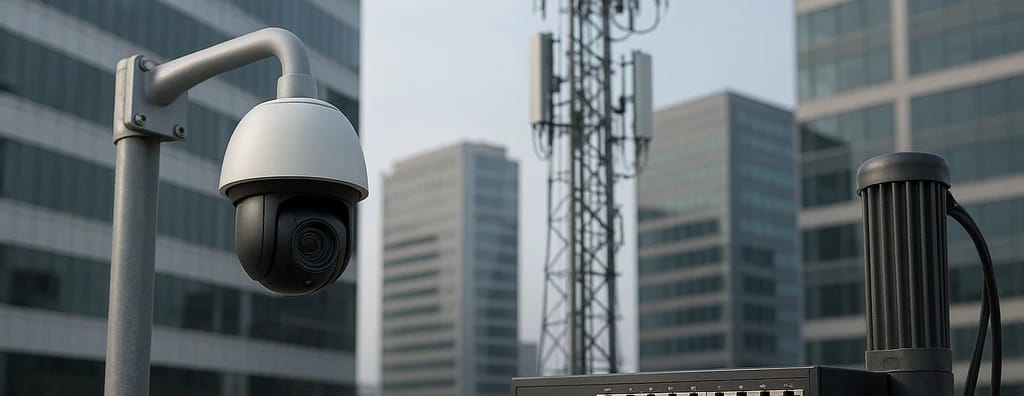
The evolution of smart cities requires rigorous integration among electronic surveillance systems, data communication networks, and critical electrical infrastructure. The need to monitor, control, and analyze urban events in real time, combined with the exponential growth of sensors, IP cameras, IoT devices, and security applications, creates complex challenges in interoperability, operational resilience, and standards compliance. […]
Check it out!
The evolution of smart cities requires rigorous integration among electronic surveillance systems, data communication networks, and critical electrical infrastructure. The need to monitor, control, and analyze urban events in real time, combined with the exponential growth of sensors, IP cameras, IoT devices, and security applications, creates complex challenges in interoperability, operational resilience, and standards compliance. Modern solutions must provide flexible architectures, simultaneous support for multiple technological domains, and information-security assurance in dynamic and exposed environments.
This article explores in depth the integration of surveillance systems, data communications, and electrical infrastructure according to the technical requirements of smart cities, addressing architectures, protocols, standards requirements, cybersecurity, power supply, event management, video analytics, automation, interoperability challenges, and recommended practices for highly complex urban projects.
Read on!
[elementor-template id=”24446″]
Integrated Systems Architecture in Smart Cities
The design of smart cities depends on an integrated architectural approach among video surveillance systems, access control, alarms, environmental sensors, communication networks, and electrical infrastructure. Critical elements of this architecture include:
- Multilevel Interconnection: IP video surveillance systems, access-control modules, and alarm platforms communicate over a converged network, enabling coordinated and centralized response actions.
- Standard Interfaces: Adoption of open APIs and compliance with interoperability standards, such as ONVIF for network video, enables integration among different manufacturers.
- Scaling Strategy: Modular and expandable topologies with the logical capacity to incorporate new nodes and devices without requiring major redesigns.
- Centralized Management: Video management systems (VMS) and urban SCADA platforms centralize monitoring, event analysis, and device administration at scale.
Effective integration among these elements results in comprehensive and resilient solutions capable of supporting critical reliability and performance requirements.
Data Communication Infrastructure in Urban Environments
The secure and efficient transmission of urban information is supported by communication networks that combine wired and wireless technologies. Key aspects for smart-city projects include:
- Network Standards: The use of Ethernet-based local area networks (LAN), IP protocols (IPv4/IPv6), and IEEE 802.11 standards (WLAN) facilitates real-time transport of video, voice, and data.
- Hybrid Topologies: Adoption of mesh networks, metropolitan optical fiber, point-to-point (PtP), and point-to-multipoint (PtMP) links provides redundancy and operational flexibility.
- Security and Authentication: Implementation of methods such as WPA/WPA2 for WLAN networks, centralized authentication, data encryption, and robust filtering policies mitigates interception and unauthorized-access risks.
- Quality of Service (QoS) Protocols: Video traffic management requires prioritization and bandwidth reservation, especially for critical security applications.
- Event Management and SNMP: Protocols such as Simple Network Management Protocol (SNMP) enable real-time health monitoring of distributed network assets.
Careful selection of technologies and protocols, aligned with multilayer security measures, is essential to ensure availability and performance of integrated systems.
Integration of Video Surveillance, Alarm, and Access-Control Systems
Integration among video surveillance, intrusion detection, and physical access-control systems forms the core of security in smart cities. This integration is enabled by:
- Management Platforms: Video management software (VMS) capable of monitoring IP cameras, alarm sensors, and access-control actuators through a unified interface.
- Event-driven Architecture: Capture and association of heterogeneous events — for example, an alarm activation linked to a pop-up notification and priority recording from a nearby camera.
- Compatibility and Interoperability: Application of integration standards, such as ONVIF recommendations, ensuring that devices from different manufacturers can provide consistent and synergistic information.
- Audit and Logging: All relevant events must be logged with timestamps, event details, source identification, and the ability to support subsequent audits, in accordance with operational security practices.
This creates an ecosystem in which incident response is automated, minimizing latency and increasing the efficiency of urban operations.
Video Management and Analytics in Urban Environments
Video analytics is a fundamental element in optimizing operational resources, predictive security, and decision-making in urban environments. Technologies used include:
- Distributed Video Analytics: Event processing may occur at the edge through intelligent cameras, in hybrid solutions, or in the cloud, depending on the use case and latency constraints.
- Efficient Search and Monitoring: Algorithms for motion detection, license plate recognition, identification of behavioral patterns, and forensic search accelerate investigations and incident response.
- Privacy and Regulation: Implementation of mechanisms for anonymizing visual data and complying with local and international privacy regulations.
The use of open and scalable platforms is recommended to enable continuous updates and integration with new visual-analysis capabilities.
Electrical Infrastructure and Energy Resilience for Urban Security Systems
Electrical infrastructure is an essential pillar supporting critical surveillance, control, and data-communication systems in smart cities. Standards and design considerations include:
- Standards Compliance: Strictly follow the requirements of ABNT NBR 5410 for low-voltage installations, including reliability requirements, division of the installation into appropriate circuits, and use of certified devices.
- Redundant Power and Backup Sources: For security services, power sources with adequate capacity, stability, and reliability are essential. Redundant power supplies and backup-energy systems such as UPS units and generator sets ensure continuous operation.
- Protection Against Surges and Lightning: Surge protective devices (DPS), equipotential bonding of metallic enclosures, and physical separation between power and signal lines help prevent damage to sensitive equipment.
- Electromagnetic Compatibility (EMC): Adoption of filters, shielding, and appropriate layouts to prevent radio-frequency interference and ensure stable operation of critical equipment.
These measures enable uninterrupted operation of integrated systems even during electrical disturbances and failures in the public distribution network.
Cybersecurity and Operational Security in Integrated Urban Platforms
Cybersecurity is a non-negotiable aspect of systems integration in smart cities. Exposure to attacks, sabotage, or unauthorized access requires the adoption of robust strategies:
- User and Account Management: Centralized management of authentication, granular permissions, and continuous audit processes.
- Software Maintenance and Updates: Policies for periodic updates of firmware, security applications, and critical patches.
- Traffic Filtering and Segmentation: Use of firewalls, VLANs, and packet filtering to limit attack surfaces.
- Integrity Monitoring and Alarms: Tools for real-time monitoring of security devices, automatically notifying operators of any anomaly or compromise.
- Physical Protection of Assets: Ensuring critical equipment is installed in protected locations with physical access control and operational redundancy.
These measures provide resilience against increasingly sophisticated threats and ensure compliance with regulatory requirements and international best practices.
Technical Standards and Interoperability in Multi-Vendor Environments
To enable transparent communication and efficient device management in multi-vendor environments, the following are essential:
- Compliance with Standards and Protocols: Adherence to established technical standards for each segment, prioritizing the most stringent requirements when standards overlap.
- Interoperability Standards: Rigorous implementation of standardized protocols such as ONVIF for network video, IEEE 802.11 for wireless communications, and ABNT standards for electrical installations.
- Integrated Documentation and Audit: Detailed recording of configuration changes, manual operations, and critical events, always with consistent timestamps.
These practices maximize interoperability and systemic operational consistency in urban projects, reducing the risk of technical incompatibility.
Considerations for Expansion, Scalability, and Technological Evolution
Scalability is a determining factor in the sustainability of smart-city systems. Population-growth projections, increasing numbers of connected devices, and demands for new services require:
- Modular Designs: Physical and logical infrastructure designed to add new modules or subsystems without interruptions.
- Upgrade Capability: Open and scalable platforms that allow integration with future detection, analysis, and communication applications and devices.
- Hybrid Solutions: Ability to combine on-premises, cloud, and edge-computing architectures to optimize resources and operational flexibility.
A modular approach and provision for continuous technological upgrades are essential to avoid obsolescence and ensure long-term return on investment.
Conclusion
The integration of surveillance systems, data networks, and electrical infrastructure in smart cities involves stringent interoperability, reliability, and security requirements. Simultaneous compliance with technical standards, rigorous cybersecurity strategies, centralized management, and automation of operational events forms the foundation for resilient and scalable solutions. A modular and open architecture combined with systematic maintenance, technological updating, and environmental-protection practices is indispensable to the longevity and operational efficiency of the cities of the future.
The adoption of standardized protocols, robust management platforms, and electrical infrastructure compatible with critical services enables not only real-time monitoring but also the development of predictive analytics, ensuring higher levels of public safety, mobility, and urban quality of life.
In summary, engineering decisions for smart cities must be based on rigorous technical criteria, coordination among domains, and long-term planning, with the objective of sustainability, flexibility, and comprehensive response to complex urban scenarios.
Final Considerations
Building smart cities with full integration of surveillance, data, and communication systems presents multidisciplinary challenges and requires a highly technical approach, as detailed in this article. Thank you for reading and for trusting A3A Engenharia as a reference in advanced solutions for urban infrastructure and critical systems. Follow A3A Engenharia de Sistemas on social media for more technical content, updates, and industry trends.
