Understand TCO in integrated electronic-security projects, including CAPEX, OPEX, licensing, integration, maintenance, cybersecurity, compliance, and lifecycle costs.
Check it out!
TCO in electronic-security projects (Total Cost of Ownership) is one of the most relevant factors when investing in an integrated electronic security system. Understanding it is essential for guiding technical, financial, and operational decisions throughout the lifecycle of systems such as video surveillance, access control, alarms, communication networks, and integrated interfaces. Proper TCO assessment allows managers, engineers, and designers to understand the factors that directly and indirectly influence both initial investment and recurring expenditures on operation, maintenance, and technology upgrades. Maximizing return on investment and operational efficiency is directly associated with mastering TCO calculation methodologies, especially when considering the standards requirements present in structured physical- and logical-security projects.
In this article, the following are analyzed in a structured manner: the technical foundations of TCO in electronic-security systems; methodologies for proper estimation; the critical factors that most affect cost throughout the lifecycle; practical examples of recurring-cost breakdowns; and recommendations for systemic TCO management based on applicable national and international standards such as ABNT NBR IEC 62676 for video-surveillance systems and other sector references. This content provides technical support for informed decisions in designs, technical proposals, and electronic-security asset-management strategies.
Read on!
[elementor-template id=”24446″]
Foundations of Total Cost of Ownership (TCO) Applied to Electronic Security
The concept of Total Cost of Ownership goes beyond the boundaries of initial investment (CAPEX), encompassing detailed assessment of all costs involved throughout the lifecycle of the electronic security system. This includes direct and indirect expenses, integration costs between different platforms, operation, maintenance, technology-upgrade expenses, and aspects related to obsolescence and component disposal.
In systems involving multidisciplinary designs such as electrical installations, telecommunications networks, and integration of surveillance, access-control, alarm, and fire-detection systems, each subsystem has its own characteristics and standards requirements, including those described in ABNT NBR IEC 62676, NBR 5410, and NBR 14565 among others. TCO analysis therefore includes elements such as:
- Physical infrastructure: structured cabling, electrical-power devices, communication networks, racks, and mounting hardware;
- Active and passive equipment: cameras, sensors, controllers, VMS, switches, power supplies, and PoE (Power over Ethernet) systems;
- Software licensing: management platforms, analytics systems, integration modules, and per-channel licenses;
- Integration and interoperability costs: interfaces with other systems such as video surveillance, access control, and intrusion; adaptation to different vendors; standards compliance; and customization;
- Implementation services: engineering, installation, commissioning, training, and documentation preparation;
- Operation, maintenance, and support: firmware updates, technical-support contracts, continuing training, and spare-parts costs;
- Responsible disposal and upgrading: costs related to planned obsolescence, environmentally responsible disposal, and replacement with new technologies.
A rigorous TCO assessment helps identify critical points for cost optimization, risk reduction, and improved system efficiency, directly affecting the longevity and sustainability of investments. This requires strong engineering expertise to align the design with the client’s technical and budgetary needs.
Including an economic-feasibility study in the design helps ensure that each stage of the solution is compatible with available investment capacity without sacrificing performance or security. In that context, design engineering can represent a small share of total lifecycle cost while enabling significant economic gains through a deeper technical TCO analysis.
Methodology for Estimating TCO in Electronic-Security Projects
The methodology for calculating TCO in electronic-security projects should adopt a systems approach, structuring the process into sequential stages involving survey, categorization, and analysis of all cost components. The following blocks should be detailed:
- Functional-Scope Mapping
- Define the overall system architecture: scope of video surveillance, access control, alarms, and integrations;
- Identify standards-based and functional requirements according to ABNT NBR IEC 62676;
- Capital Expenditure (CAPEX) Survey
- Active and passive equipment such as cameras, servers, controllers, and power supplies;
- Electrical and logical infrastructure such as cables, conduits, distribution panels, and switches;
- Software licenses, VMS platforms, and integration modules;
- Detailed-design development, installation services, commissioning, and initial training;
- Operating Expenditure (OPEX) Survey
- Preventive and corrective maintenance;
- Technical-support contracts and firmware/software updates;
- Energy consumption of devices and auxiliary systems such as UPS, cooling, and PoE systems;
- Standards updates, periodic training, and personnel refresher-training costs;
- Integration and Management Costs
- Interconnection among different systems such as video surveillance, access control, intrusion, building automation, and industrial automation;
- Compliance requirements for multiple interfaces and technical-compatibility analysis;
- Integrated monitoring and adjustment of recording, date/time, and alarm-restoration parameters;
- Lifecycle and Obsolescence Analysis
- Projection of technology-upgrade, component-replacement, and environmentally responsible disposal costs;
- Periodic evaluation of system effectiveness against new regulatory requirements and technological advances;
By adopting this methodology, the technical manager gains better support for decision-making and can develop technical-financial decision matrices oriented toward the best cost-performance relationship over the planned period.
Structuring TCO Components in Video Surveillance, Access Control, and Integrated Systems
In electronic-security projects, TCO costs should be decomposed by subsystem. Detailed understanding of each component is essential to ensure compliance, performance, and high budget predictability.
1. IP Video Surveillance
- Core equipment: compatible IP network cameras, video servers, VMS systems, NVRs and storage, and PoE power devices;
- Infrastructure: structured cabling, patch panels, outlets, managed switches, electrical protection devices, and UPS systems;
- Licensing and software: VMS, analytics, integration, and remote monitoring;
- Integration services: configuration of recording parameters, event management, and interfaces with automation, access control, and alarms;
- Operating costs: maintenance, periodic updates, integrity analysis, and replacement of cameras and critical components;
2. Access Control
- Controllers and readers: authentication devices, biometrics, RFID readers, and proximity cards;
- Electrical infrastructure: power supplies, batteries, backup devices, and redundancy;
- Licensing: access-management platforms and integration modules for building and industrial systems;
- Associated services: parameterization, access-rule programming, and operator training;
- Recurring costs: updates, credential-record revalidation, authentication-device maintenance, and technical support;
3. Integration with Third-Party Systems
- Interfaces with building automation, industrial systems, environmental sensors, and fire systems;
- Development costs for custom integrations, open protocols such as ONVIF, BACnet, and Modbus, and standards compliance;
- Consolidated monitoring, response to integrated events, and automation of multi-platform logical responses;
When structuring the budget and planning for an integrated electronic security system, a comprehensive view of these components is fundamental to avoiding cost overruns caused by compatibility failures, lack of integration, or accelerated obsolescence.
Main TCO Variation Factors in Electronic-Security Projects
TCO in electronic-security projects can vary significantly due to technical, operational, and contextual factors. The main determinants include:
- System topology and scope: distributed, multisite systems or systems with redundancy requirements can significantly increase infrastructure and synchronization costs;
- Technologies used: IP-based systems using PoE can rationalize physical and power infrastructure, while legacy analog solutions tend to involve higher maintenance costs and lower scalability;
- Update and maintenance management policy: lack of planning for systematic updates to firmware, licenses, and equipment increases corrective costs and reduces system longevity;
- Degree of integration and automation: systems integrated with building or industrial automation require greater investment in development, interoperability, and customization, affecting both CAPEX and OPEX;
- Standards compliance and compliance governance: meeting ABNT NBR IEC 62676 requirements and international standards may require additional costs for documentation, audits, and interface validation;
- Physical and logical security policy: investment in physical-protection measures, network segmentation, and logical access controls adds implementation and maintenance costs but improves system effectiveness and performance;
- Obsolescence and planned lifecycle: failing to consider component lifecycles can lead to premature replacements that were not included in the initial budget, materially affecting TCO.
Accordingly, proper identification and mitigation of these factors should be part of any planning and monitoring strategy for complex electronic-security projects.
Technical Standards and Their Influence on TCO Composition
Electronic-security projects, whether focused on video surveillance, access control, or systems integration, are subject to national and international technical standards. ABNT NBR IEC 62676, for example, defines criteria for the structure and performance of video-surveillance systems. These requirements directly affect TCO by requiring:
- Implementation of recording, search, playback, and alarm acknowledgement/restoration functions;
- Detailed logging of parameter changes, events, and date/time markings, increasing the complexity of administrative and logging systems;
- Interoperability among platforms from different manufacturers, requiring greater investment in integration and compliance testing;
- Comprehensive protection of components and interfaces to ensure system integrity and prevent unauthorized access;
- Redundancy, fault-detection, and protection strategies against physical and logical violations;
In addition, requirements for ongoing software and firmware updates, user-account management, IP-address filtering, and advanced authentication mechanisms such as IEEE 802.1X increase both initial investment and maintenance costs. Technical compliance not only supports full system operation but also adds value to the investment by reducing operational and legal risks and improving security at interfaces with third-party systems.
Practical Study: Breakdown of TCO Components in an IP Video-Surveillance Project
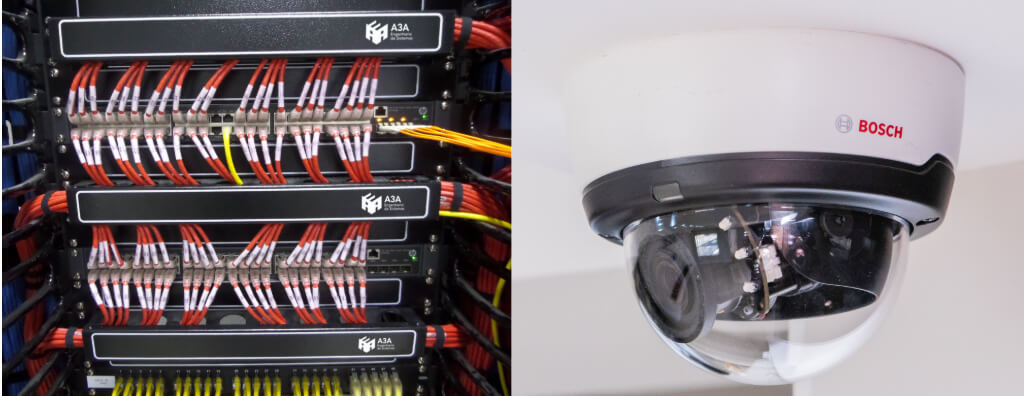
Technical Portfolio – A3A Engenharia
To illustrate application of the TCO concept in real electronic-security projects, consider an IP video-surveillance system designed for perimeter and internal-area protection, with architecture based on ABNT NBR IEC 62676 and using PoE devices and centralized management.
Logical and Physical Infrastructure
- Sizing of PoE switches for centralized power, reducing auxiliary cabling. This can simplify installation, improve electrical-backup implementation, and reduce infrastructure complexity.
- Rack installation, electrical protection, and redundant-storage accommodation for image recording, according to standards requirements and operational-continuity practices.
License Costs
- Investment in VMS platforms, including per-channel licenses, analytics systems, and native access-control integration. Planning should account for update and expansion costs as the system grows.
Maintenance Expenses
- Ongoing firmware updates and device-integrity verification, together with planned replacement of cameras and critical components, should be included in the maintenance strategy.
- Periodic operator training, supporting proper operation, rapid incident response, and high system availability.
- Development and maintenance of integration interfaces between heterogeneous systems such as video surveillance, access control, and building automation, addressing interoperability and applicable requirements of ABNT NBR IEC 62676.
LGPD, Cybersecurity, and Network-Security Costs
- LGPD compliance: investments in privacy, anonymization, and sensitive-data management should be considered, with clear policies for retention and disposal of images and records.
- Cybersecurity: costs should include device hardening, network segmentation, firewalls, multifactor authentication, encryption of data in transit and at rest, and intrusion-monitoring solutions such as IDS/IPS.
- Network security: planning should include periodic audits, password updates, VPN use, restricted remote access, and continuous log monitoring to improve resilience against attacks and data leakage.
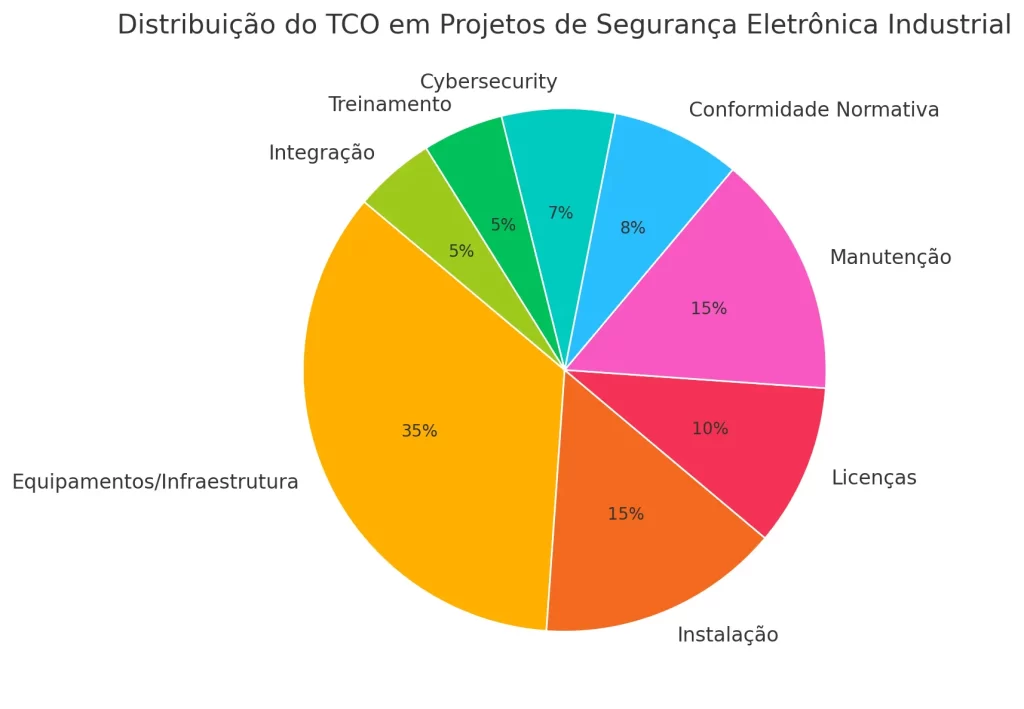
Summary:
Breaking down the TCO of an IP video-surveillance project shows that effective cost management depends on standards-based practices, training, careful attention to LGPD, and cybersecurity. These elements support compliance and performance while reducing operational and legal risks and extending the longevity and sustainability of electronic-security systems.
TCO Management: Technical Recommendations for Optimization and Sustainability
To improve efficiency and financial sustainability in electronic-security projects, the following TCO-management practices are recommended:
- Detailed design documentation: perform field surveys and complete detailed designs to minimize sizing errors and unforeseen costs;
- Careful selection of suppliers and technologies: prioritize systems compatible with open standards, robust protocols, and native integration, reducing customization costs and supporting evolutionary upgrades;
- Lifecycle management: develop technology-upgrade plans, proactive component replacement, and continuing team training;
- Continuous monitoring of cost indicators: implement TCO tracking tools with periodic metrics comparing actual and planned expenditures;
- Predictive-maintenance policy: replace purely corrective models with strategies based on predictive diagnostics to improve value and system longevity;
- Adoption of centralized-power solutions: use PoE where technically appropriate, reducing dedicated electrical-infrastructure costs and optimizing overall system energy consumption;
- Compliance and audit procedures: maintain ongoing standards compliance by reviewing documentation and logical and physical access policies and performing regular technical audits;
These recommendations improve stability, reliability, and budget predictability, supporting strategic TCO management in medium- and large-scale electronic-security systems.
Conclusion
Advanced understanding and effective management of Total Cost of Ownership in electronic-security projects are essential for organizations seeking high standards of security, operational performance, and financial sustainability. Rigorous TCO analysis based on technical standards such as ABNT NBR IEC 62676 supports risk anticipation, intelligent investment planning, and mitigation of hidden costs associated with operation, maintenance, upgrades, and compliance of integrated systems. Proper balance between CAPEX and OPEX, together with lifecycle, interoperability, and technology-upgrade assessment, contributes to greater robustness and longevity of the security environment while supporting increasingly demanding standards and operational requirements. TCO therefore becomes an essential tool for engineers, managers, and decision-makers seeking to optimize resources and align technology, security, and efficiency.
Final Considerations
Based on the technical discussion and recommendations presented, Total Cost of Ownership analysis should be an intrinsic part of the planning, implementation, and management of any electronic-security project. Follow A3A Engenharia for ongoing technical content on security, technology, and applied engineering.
See also:
Total Cost of Ownership of a Video-Surveillance System
Cybersecurity in Video-Surveillance Systems
Main Applications of Video Analytics
Frequently Asked Questions
1. What Is TCO and Why Should It Be Considered in IP Video-Surveillance Projects?
TCO (Total Cost of Ownership) includes all direct and indirect system costs: acquisition, implementation, maintenance, training, licensing, security, upgrades, and integration. A rigorous TCO assessment helps optimize investment, prevent hidden costs, and improve system longevity and efficiency.
2. Which Costs Are Commonly Overlooked in the TCO of Video-Surveillance Systems?
Software licensing, preventive maintenance, security updates, team training, replacement of obsolete equipment, integration with other systems, and LGPD compliance are frequently underestimated.
3. How Does LGPD Affect Video-Surveillance Projects?
LGPD requires images and data collected by video-surveillance systems to be handled securely, with retention, disposal, and restricted-access policies and appropriate treatment of data-subject rights. The design should provide for anonymization, access control, audit logging, and compliance documentation.
4. How Can a Video-Surveillance Design Support LGPD Compliance?
In addition to access restrictions, operators should be trained, processes documented, audit records maintained, and solutions such as anonymization in sensitive areas adopted to support ongoing compliance.
5. Which Cybersecurity Practices Are Essential for Protecting Video-Surveillance Systems?
Regular firmware updates, strong passwords, network segmentation, firewalls, data encryption, multifactor authentication, access monitoring, audits, and periodic penetration testing are important system-security practices.
6. What Is the Impact of Underinvesting in Cybersecurity for Video-Surveillance Systems?
Insufficient security measures can result in unauthorized access, image manipulation, data leakage, or even system outages caused by attacks, with financial losses and legal risks.
7. Why Is Network Security So Important in IP Video-Surveillance Projects?
Network-connected video-surveillance systems can be targeted by attacks that lead to unauthorized access, image compromise, or leakage of sensitive data. A secure network protects system integrity, information privacy, and organizational reputation.
8. How Can IP Video Surveillance Be Integrated with Access Control and Building Automation?
Effective integration depends on open standards such as ONVIF, compatible software, and unified security and update policies across interconnected systems.
9. Can an Economic-Feasibility Study Reduce Final Project Cost?
Yes. A technical and economic feasibility study identifies tailored solutions, avoids unnecessary expenditure, reduces risks, and guides selection of equipment and technologies according to budget, improving return on investment (ROI).
10. How Should Maintenance and Upgrades Be Planned for Long-Term Compliance and Performance?
Include software-update routines, security-policy reviews, scheduled equipment replacement, continuing training, and regular integrity testing. Document all actions for management and audit purposes.
11. How Does Monitoring Automation Affect TCO and Security?
Automation using video analytics and intelligent alarms can reduce operating costs, improve efficiency and incident-response time, and reduce the need for manual intervention.
12. Why Is It Important to Document System Processes and Configurations?
Detailed documentation facilitates maintenance, audits, upgrades, knowledge transfer, and compliance with technical standards and LGPD.
13. Which Measures Improve the Service Life and Performance of Video-Surveillance Systems?
Selecting suitable components, ensuring proper installation, protecting the environment through racks and stable power, using preventive-maintenance agreements, and periodically updating systems improve reliability and longevity.
14. Which Technology Trends Should Be Considered in IP Video-Surveillance Projects?
Trends such as artificial intelligence for video analysis, integration with IoT systems, high-resolution cameras, cloud storage, and embedded cybersecurity are changing the efficiency and scope of video-surveillance systems.
15. What Should Be Considered When Selecting an Engineering Company for an Electronic-Security Design?
Selection should consider proven experience in similar projects, knowledge of applicable technical standards, ability to provide integrated and tailored solutions, demonstrated attention to LGPD and cybersecurity, qualified technical support, and a disciplined TCO approach to support economic feasibility and operational efficiency.
