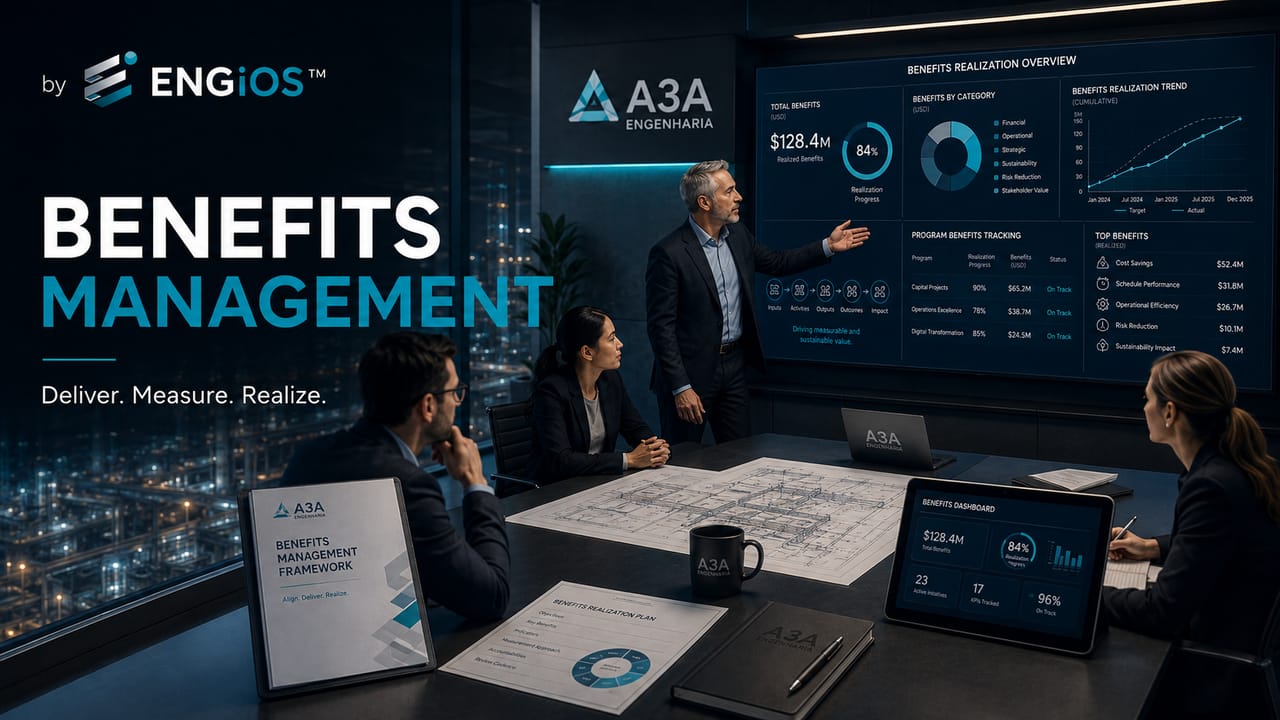
Benefits management applied to engineering projects and programs: business case, outputs, outcomes, Benefits Realization Management, owners, metrics, handover, and assurance.
Check it out!
Benefits management in engineering projects and programs is the discipline that identifies, structures, monitors, and verifies the benefits that justify an investment or transformation. Its focus is not only on completing scope, schedule, and cost, but on demonstrating whether the deliverables produced generated the expected outcomes for the organization and its operations.
In this context, “benefits” does not refer to employee compensation or benefits. It refers to Benefits Realization Management: managing the chain that connects strategy, business case, projects, deliverables, operational changes, outcomes, and realized value.
This distinction is especially important in Engineering. A project may deliver a substation, an automation modernization, new telecommunications infrastructure, or an industrial expansion in accordance with the contracted scope and still fail to produce the availability, capacity, risk reduction, efficiency, or performance that justified the CAPEX. Therefore, benefits realization needs to begin before execution and continue after handover.
Deliverables, outcomes, and benefits are not the same thing
Traditional project management tends to concentrate attention on deliverables and milestones. For investment governance, however, three levels need to be separated.
| Level | Question | Engineering example |
| Deliverable / output | what did the project produce? | new electrical system installed and commissioned |
| Outcome | what changed after delivery? | increased capacity and fewer interruptions |
| Benefit | what measurable advantage was created? | higher availability, protected revenue, or reduced losses |
ABNT NBR ISO 21503:2024 differentiates deliverable, outcome, and benefit and positions benefits realization as a central element of program management. This logic is also useful for individual projects whenever the investment is approved based on an expected performance change.
The error occurs when the organization ends the assessment at the first level. “We delivered the project” does not automatically answer “did the investment fulfill its purpose?”.
Completed delivery is not the same as realized benefit. Governance needs to preserve the connection between the asset delivered, the expected operational change, and the value that justified the investment.
The business case should make clear why the project exists
Benefits management begins in the business case. Before defining indicators, it is necessary to understand which need, opportunity, risk, or obligation justified the project.
A coherent decision chain can be represented by:
need → objectives → alternatives → investment → deliverables → outcomes → benefits
The business case should make it possible to relate the investment to this logic. When that relationship is weak, the project may maintain a technically correct scope and still lose connection with the strategy that originated it.
CAPEX Management in Engineering Projects deepens this relationship between definition, investment, risk, and decision. Benefits management closes the loop by verifying what happened after the capital was committed and the asset entered operation.
Benefits need to be defined before they can be measured
Expressions such as “improve reliability,” “increase productivity,” or “modernize infrastructure” are useful objectives, but still insufficient for benefits management. The intention must be translated into a verifiable condition.
A well-structured benefit should clarify, as applicable:
- which change is expected;
- who receives or perceives the benefit;
- how it will be measured;
- what the baseline is;
- what the target and tolerance are;
- when the benefit may begin to occur;
- which deliverables and conditions enable it;
- who is accountable for its realization;
- which risks may prevent or reduce the benefit.
The level of formalization should be proportional to the project. In a significant CAPEX program, benefits may have their own records, owners, baseline, target, and realization calendar. In smaller projects, a simple matrix may be sufficient, provided traceability is preserved.
The benefits chain shows how Engineering creates value
One of the most useful tools is to represent the logic between deliverables and benefits. The objective is not to create a decorative diagram, but to make explicit the dependencies required for value to be realized.
Simplified example:
new power system → available electrical capacity → elimination of an operational constraint → increased production → economic benefit
In another project:
new security system → better coverage and detection → reduced response time → reduced operational and asset exposure
This chain helps prevent improper attribution of benefits. A project may enable a capability, but final realization may depend on training, process change, hiring people, systems integration, or operational adoption.
Not every benefit belongs to the project manager
One reason benefits are lost after implementation is the absence of clear ownership. The project manager is responsible for delivery, but does not necessarily control all conditions required for the benefit to be realized after transition.
It is useful to separate roles such as:
| Role | Primary responsibility |
| Sponsor | preserve strategic alignment and remove executive impediments |
| Project/program manager | coordinate deliverables and transition conditions |
| Benefit owner | be accountable for benefit realization and monitoring |
| Operations / business | incorporate the new capability into the real process |
| PMO / EPMO | standardize method, consolidate information, and monitor the portfolio |
| Governance | decide in response to variances, changes, or loss of justification |
In programs, ABNT NBR ISO 21503 gives explicit importance to benefits realization and to the roles of sponsor and program manager. The specific structure may vary, but accountability should not disappear when the project closes.
A baseline is essential to prove improvement
A benefit cannot be demonstrated merely by comparing a perception of “before and after.” Whenever possible, the organization needs to record a baseline before implementation.
For infrastructure modernization, the baseline may include:
- current downtime;
- number of failures;
- energy consumption;
- installed and utilized capacity;
- response time;
- maintenance cost;
- production losses;
- incidents or nonconformities;
- execution time for a given process.
The target should use the same definition and data source. Otherwise, the organization risks comparing indicators calculated in different ways.
Project indicators do not replace benefit indicators
SPI, CPI, physical progress, contractual milestones, and forecast are essential for governing execution. By themselves, they do not demonstrate whether the investment generated value.
| Execution indicator | Benefit indicator |
| Engineering progress | reduction in failures after implementation |
| schedule compliance | increase in available capacity |
| actual cost | reduction in operating cost |
| package delivery | increase in availability |
| commissioning completed | sustained performance in operation |
Project Controls should provide a robust view of execution performance. Benefits management begins where this information is no longer sufficient to answer whether the desired change actually occurred.
The benefits realization plan follows the project lifecycle
Benefits management should not be an activity created at closeout. It needs to evolve throughout the lifecycle.
1. Concept: identify potential benefits and their relationship to the need. 2. Business case: define expected benefits, assumptions, and alternative value. 3. Planning: assign owners, indicators, baseline, targets, and dependencies. 4. Engineering and procurement: verify that solution decisions preserve expected benefits. 5. Execution: monitor changes that may reduce or alter benefits. 6. Commissioning and handover: confirm technical and operational readiness for realization. 7. Operations: measure realization, sustainability, and unforeseen effects. 8. Post-project evaluation: compare outcomes with the business case and incorporate learning.
Guidance from the UK Infrastructure and Projects Authority treats benefits management as a structured activity throughout major projects and connects it to the business case and assurance process.
Scope changes also need to assess their impact on benefits
In complex projects, change is inevitable. The problem is approving a change based only on cost and schedule while ignoring the effect on the benefit that justified the investment.
A change may:
- reduce a benefit;
- delay its realization;
- transfer the benefit to another stage;
- create an additional benefit;
- eliminate the need for a component;
- make the business case inadequate.
Engineering Change Management should incorporate this analysis whenever the change affects a requirement, capability, or expected outcome.
In programs, benefits justify coordinated management
Benefits management is particularly important in Engineering Program Management. A program should exist because coordination among components produces outcomes and benefits that would be more difficult to obtain if each project operated in isolation.
This means that benefits may depend on several components.
For example, a plant modernization program may simultaneously require:
- electrical reinforcement;
- automation;
- industrial networks;
- supervisory system upgrades;
- physical modifications;
- operator training.
No single project produces the complete result. The benefit appears when the capabilities are integrated and used.
The portfolio uses benefits to prioritize investments
At portfolio level, benefits help compare initiatives competing for capital and resources. The analysis does not need to reduce every project to a single financial metric, but it should make expected value and its relationship to strategic objectives explicit.
Project Portfolio Management can use expected benefits, risks, capacity, urgency, compliance, and return to support selection and prioritization.
It is also important to avoid double counting: two projects should not each claim the full value of the same benefit when both only contribute to a single outcome change.
Stage-gates should verify whether the benefit remains valid
A stage-gate should not assess only whether phase documents were produced. For relevant investments, governance needs to verify whether the justification remains consistent.
Useful questions include:
- is the benefit still needed?
- do the business-case assumptions remain valid?
- does the selected solution still enable the expected outcome?
- have cost or schedule changes altered the value relationship?
- is operations prepared to absorb the change?
- are metrics and accountable owners defined to measure realization?
Stage-gates in engineering projects create more value when they operate as investment decisions rather than documentary checkpoints.
Commissioning and handover are the bridge to benefits realization
Many benefits can only be captured when the asset is technically ready and the organization is operationally prepared. Therefore, commissioning and handover are part of the benefits chain.
Physical completion does not guarantee:
- operator training;
- updated procedures;
- available documentation;
- structured spare-parts and maintenance arrangements;
- integration with corporate systems;
- performance stability;
- ability to measure post-implementation indicators.
Benefits management should define which readiness conditions must exist before operations assumes accountability for realization.
Handover transfers the asset; it should not erase accountability for the benefit. Owners, metrics, and the measurement horizon need to remain defined after project closeout.
See how programs coordinate benefits that depend on multiple projects →
Benefits assurance: reviewing whether the organization is prepared to capture value
The Infrastructure and Projects Authority maintains specific guidance for benefits assurance in major projects. The logic is also relevant outside the public sector: an independent review can verify whether benefits are defined, measurable, assigned to accountable owners, and connected to implementation and operational conditions.
This review does not replace project management. It acts as an independent challenge to identify gaps before the investment advances to a point where value realization becomes more difficult or costly.
Project, Program, and Portfolio Governance can incorporate assurance reviews at decision points.
Common mistakes in benefits management
Among the most recurring mistakes are:
- defining benefits only after project approval;
- confusing delivery with benefit;
- using indicators without a baseline;
- assigning all benefits to the project manager;
- ending measurement at handover;
- keeping benefits vague or impossible to verify;
- failing to update the business case after relevant changes;
- counting the same benefit across multiple initiatives;
- ignoring operational conditions required for realization;
- measuring only financial benefits when there are technical, regulatory, or risk objectives.
The common pattern is losing the cause-and-effect chain between the investment and the outcome that should justify its continuation.
When benefits management adds the most value
The discipline is especially useful in programs, significant CAPEX projects, organizational transformations, infrastructure modernizations, and initiatives where the outcome depends on operational adoption after delivery.
It is also important when:
- the business case contains benefits relevant to approval;
- multiple projects contribute to the same outcome;
- benefits will be realized months or years after implementation;
- operations assumes important responsibilities after handover;
- there is a need to demonstrate return, risk reduction, or capacity gain;
- governance needs to decide whether the investment remains justified.
In low-complexity environments, the method may be simple. The central requirement is to preserve a traceable line between need, deliverable, outcome, and benefit.
Mature projects do not end at delivery
Benefits management completes the logic of Engineering Management. Engineering develops and delivers capabilities; governance needs to demonstrate whether those capabilities produced the expected outcome.
The final question is no longer only “was the project completed?” and becomes: was the asset incorporated into operations, did it produce the intended change, and did it realize the value that justified the investment?
When this question remains visible from business case through operations, decisions on scope, CAPEX, procurement, commissioning, and change are evaluated by their effect on the final outcome — not only by compliance with the initial plan.
Technical references
[1] INFRASTRUCTURE AND PROJECTS AUTHORITY. Guide for effective benefits management in major projects. London: Cabinet Office, 2017.
[2] INFRASTRUCTURE AND PROJECTS AUTHORITY. Assurance of benefits realisation in major projects. London: Cabinet Office, 2021.
[3] INTERNATIONAL ORGANIZATION FOR STANDARDIZATION. ISO 21503:2022 — Project, programme and portfolio management — Guidance on programme management. Geneva: ISO, 2022.
[4] INTERNATIONAL ORGANIZATION FOR STANDARDIZATION. ISO 21500:2021 — Project, programme and portfolio management — Context and concepts. Geneva: ISO, 2021.
Frequently asked questions
It is the discipline that identifies, plans, monitors, and verifies the benefits that justify a project or program, connecting technical deliverables to outcomes and value realized in operations.
A deliverable is the product produced by the project; an outcome is the change generated through use of that deliverable; a benefit is the measurable advantage created by that change for the organization or its stakeholders.
It depends on governance. The project manager coordinates deliverables, but benefits occurring after transition usually need clearly defined benefit owners, sponsors, and operational owners.
Preferably in the business case and early phases. They should be refined during planning and reassessed whenever relevant changes alter cost, schedule, scope, or expected outcomes.
Not necessarily. The project may close after delivery and handover, while benefits measurement continues under the responsibility of operations, the program, PMO, or defined governance.
It is a structured and ideally independent review of the project’s or program’s ability to realize expected benefits, verifying definition, metrics, ownership, dependencies, and readiness for value realization.
Complementary technical materials
Related solutions
- Project, Program, and Portfolio Governance
- Engineering PMO Implementation and Structuring
- Requirements, Evidence, and Acceptance Criteria Management
Related engineering services
- Engineering Project Management
- Project Management and Project Controls
- Owner’s Engineering
- Technical Engineering Consulting
Related technical content
- Engineering Program Management
- CAPEX Management in Engineering Projects
- Project Portfolio Management
- Stage-gate in engineering projects
- Project Controls: planning and control of engineering projects
- Engineering Change Management in Engineering Projects
- Technical Handover in Engineering
Guides, frameworks, and references
- Engineering Management: processes, governance, projects, and performance
- Project Management: complete guide for engineering, governance, and control
- Commissioning: complete guide to planning, testing, acceptance, and handover
- Technical Handover Framework for Works and Systems
- Owner’s Engineering: executive framework for contracting, governance, and acceptance