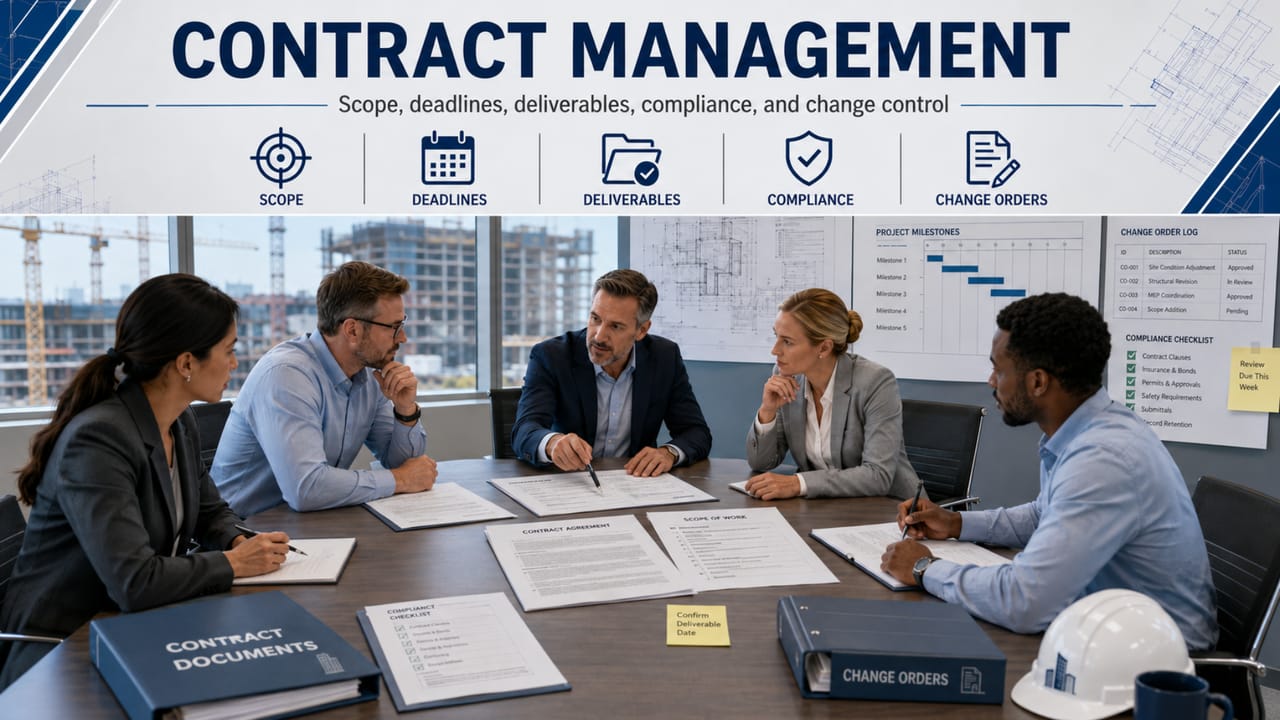
How to structure engineering contract inspection around obligations, records, measurements, changes, risks, claims, payments, and acceptance.
Check it out!
Engineering contract inspection is the contract-performance monitoring system used to verify obligations, record events, control communications, support measurements and payments, manage changes, monitor risks, instruct decisions, and preserve evidence through closeout. In construction and engineering service contracts, it connects field reality to the administrative process.
The function is not limited to technical inspection of the work. While field inspection verifies execution, quality, materials, testing, and physical progress, contract inspection must ensure that this evidence is converted into formal decisions consistent with the contract, risk matrix, measurement criteria, deadlines, responsibilities, and the public authority’s procedures.
Brazilian Law No. 14,133/2021 requires performance to be monitored and inspected by representatives of the public authority and allows third-party support to provide them with technical assistance. At the federal level, Decree No. 11,246/2022 — updated in 2026 — details the functions of contract managers and inspectors, separating management coordination from technical, administrative, and sector-specific inspection. Other public entities must observe their own applicable regulations.
Mature contract inspection produces a verifiable history of what happened, why a given decision was made, which document supported a measurement, which risk materialized, how a change was analyzed, who approved a given action, and which conditions allowed acceptance. Without this traceability, the contract may progress physically while its governance remains weak.
Contract inspection is different from construction inspection
The two concepts complement one another, but they are not equivalent.
Technical construction inspection primarily observes execution compliance: services, materials, quality, inspections, testing, progress, measurements, and open items. Contract inspection broadens the focus to obligations, records, formal communication, payments, changes, risks, guarantees, schedules, responsibilities, sanctions, acceptance, and closeout.
| Dimension | Technical construction inspection | Contract inspection |
| main reference | design, specifications, ITP, and technical criteria | contract, bidding documents, Terms of Reference, proposal, risk matrix, and management model |
| focus | physical and technical compliance | fulfillment of obligations and execution governance |
| evidence | inspections, tests, measurements, photos, and NCRs | records, communications, reports, decisions, and administrative process |
| changes | verifies technical impact | instructs change, responsibility, cost, and schedule |
| payment | validates execution and compliance | consolidates requirements for payment authorization |
| closeout | supports technical acceptance | coordinates documentation and closeout acts |
The article on Public Works Inspection examines the technical field layer in greater depth. Here, the focus is governance of the engineering contract.
The contract management model should exist before execution
Well-inspected contracts turn clauses into verifiable controls: obligation, responsible party, evidence, deadline, and treatment of deviations. Without this, the document exists, but governance does not.
Contract inspection should not be improvised after the notice to proceed. The management model needs to be structured during the preparatory phase and reflected in the procurement documents.
The TCU describes the management model as the definition of how performance will be monitored and inspected by the organization. This involves actors, responsibilities, communication, records, measurement, payment, acceptance, and decision workflows.
A consistent model may define:
- responsible contract manager and inspectors;
- substitutes;
- limits of authority;
- formal communication channels;
- meeting frequency;
- mandatory records;
- submittal and RFI workflows;
- measurement process;
- treatment of nonconformities;
- change management;
- risk management;
- verification of guarantees and qualification requirements;
- claim management;
- acceptance procedures;
- closeout and archiving of the contract history.
Without these rules, each occurrence tends to be treated ad hoc, increasing the risk of inconsistent decisions.
Contract manager and inspectors: roles need to be explicit
Brazilian Law No. 14,133/2021 requires monitoring and inspection by designated agents. At the federal level, Decree No. 11,246/2022 details the functions of the contract manager and technical, administrative, and sector-specific inspectors.
Under the federal framework, the contract manager coordinates inspection activities and the preparatory acts related to payment, changes, economic rebalancing, sanctions, extensions, and termination. The technical inspector monitors performance from the perspective of the scope and records technical occurrences. The administrative inspector monitors administrative aspects defined in the applicable management model.
In a complex project, there may be multiple disciplines, locations, and packages. The division of functions needs to reflect actual complexity, avoiding both overlap and areas without a responsible party.
The decisive point is not the role title, but clarity about:
- who observes and records;
- who performs the technical analysis;
- who consolidates evidence;
- who decides within their authority;
- who escalates matters that exceed that authority;
- who instructs the necessary administrative acts.
Management history: the contract needs institutional memory
At the federal level, Decree No. 11,246/2022 requires the management history to contain formal performance records such as notices to proceed, occurrences, changes, and extensions. This logic is essential in any well-governed engineering contract.
A robust history may include:
- notice to proceed and mobilization;
- meeting minutes;
- construction diary and reports;
- formal communications;
- submittals and approvals;
- RFIs and responses;
- inspection records;
- nonconformities;
- measurements;
- updated schedules;
- risk register;
- change requests;
- technical opinions;
- contract amendments;
- claims;
- administrative decisions;
- testing and commissioning;
- acceptance records;
- final documentation.
Contract memory is not only for future audits. It reduces ambiguity during execution itself and improves decision quality.
Formal communication protects governance
Engineering contracts generate a large volume of daily interaction. Not every conversation needs to become formal correspondence, but matters that change obligations, interpretation, schedule, scope, requirements, or responsibility need to be formalized through the designated channel.
Informal decisions create two problems. First, the team may execute something without knowing whether there was authority to order the change. Second, months later it may be impossible to reconstruct the context that justified a cost, schedule effect, or modification.
A communication protocol may distinguish:
- contractual correspondence;
- technical RFI;
- design or material submittal;
- event notification;
- change request;
- coordination meeting;
- risk record;
- nonconformity communication;
- formal instruction;
- escalation for higher-level decision.
Traceability between communication, response, and effect on the baseline matters more than document volume.
Contractual obligations need to become verifiable controls
A lengthy contract is not necessarily a controlled contract. Inspection needs to turn relevant clauses into monitorable items.
An obligations matrix may contain:
| Obligation | Responsible party | Evidence | Frequency / deadline | Status |
| maintain responsible technical professional | contractor | ART/RRT/TRT and employment/contractual link | start and changes | controlled |
| update schedule | contractor | approved file and report | monthly | controlled |
| submit quality documentation | contractor | ITP, certificates, and reports | by stage | controlled |
| maintain guarantee | contractor | valid policy | as required by contract | controlled |
| meet milestones | contractor | measurement and schedule | by milestone | controlled |
| provide As-Built | contractor | revised documentation | closeout | controlled |
The value of the matrix lies in preventing peripheral obligations from disappearing under execution pressure.
Measurement, payment verification, and payment require an evidence trail
Payment should not begin with the invoice. Before it, the public authority needs to verify whether the contractual requirements for measurement and payment verification have been met.
In engineering contracts, the trail may include:
- measurement records;
- executed quantities;
- field records;
- technical compliance;
- completed milestones;
- mandatory documentation;
- applicable retainage;
- deductions or disallowances;
- inspection validation;
- measurement acceptance;
- tax and administrative documentation.
The Public Works Estimate provides the economic baseline, but inspection needs to maintain consistency among the contracted item, unit, quantity, progress, and payment criterion.
A disallowance needs to be technically justified and documentarily traceable. Likewise, approval of a measurement should identify the evidence supporting the conclusion that the service is payable.
Contract schedule, time, and milestones
Contract time should not be monitored only through the final date. Project Controls connects milestones, critical path, trends, changes, and forecasts to demonstrate impact before schedule loss becomes consolidated.
Contract inspection should distinguish the management schedule from the contractual schedule. The former may contain operational detail; the latter embodies commitments, milestones, and dates relevant to the contract.
When a delay occurs, it is necessary to understand:
- affected activity;
- cause;
- responsibility;
- impact on the critical path;
- effect on milestones;
- recovery measures;
- associated risks;
- any need for a contractual decision.
Not every deviation requires a contract amendment, and not every extension of time automatically results from an observed delay. The analysis should consider the contract, risk matrix, cause, and evidence.
Project Controls helps distinguish perceived delay from demonstrated impact on the baseline.
Risk management during contract execution
Brazilian Law No. 14,133/2021 requires continuous and permanent risk-management and preventive-control practices. This means that risk should not disappear from the process after bidding.
The register needs to be updated with execution events: productivity, supplies, permits, interfaces, changes, disputes, quality, safety, documentation, and testing.
The article on Risk Management in Public Works distinguishes risk management from the contractual risk matrix and shows how to connect risk to an owner, action, contingency, cost, and schedule.
In contract inspection, materialized risks should migrate into an occurrence, decision, or change workflow. Keeping an event that has already occurred as an “open risk” without addressing its effects weakens governance.
Changes need to be controlled before they become contract amendments
A change executed before analysis of scope, responsibility, cost, and schedule reduces the public authority’s decision-making power and creates fertile ground for claims that are difficult to reconstruct later.
Technical Analysis of Contract Amendments, Scope Changes, and Claims
One of the most critical inspection functions is to prevent changes from being incorporated informally and formalized only afterward.
The change workflow should answer:
- what changed?
- why did it change?
- who requested it?
- does an existing contractual obligation already apply?
- was the condition addressed in the risk matrix?
- is there an alternative that does not require a contract change?
- what is the technical impact?
- what is the cost impact?
- what is the schedule impact?
- which documents need revision?
- which authority needs to decide?
Technical Analysis of Contract Amendments, Scope Changes, and Claims makes it possible to address changes based on engineering, chronology, and evidence before administrative formalization.
Contract amendments should not be used to correct absent governance
A contract amendment is a legitimate legal instrument when the applicable conditions and justifications are present. The problem arises when it becomes a routine mechanism to regularize informal decisions, planning failures, or changes executed without control.
Mature governance seeks to identify the need for change before cost and schedule are committed. This allows alternatives to be compared, responsibilities assessed, and the public authority’s decision-making power preserved.
The history needs to separate:
- triggering event;
- date of awareness;
- associated communications;
- technical analysis;
- demonstrated impact;
- contractual classification;
- decision;
- baseline revision.
This chronology is essential in future discussions of responsibility and economic-financial balance.
Claims need to be analyzed by cause, entitlement, causation, and quantification
A claim should not be accepted or rejected solely on the amount requested or a perception of fairness. The analysis needs to verify contractual basis and evidence.
A technical framework can separate:
- event: what occurred;
- cause: why it occurred;
- responsibility: to whom the contract and risk matrix allocate the event;
- causation: how the event produced impact;
- impact: demonstrated cost, schedule, or productivity effect;
- mitigation: what was done to reduce effects;
- documentation: contemporaneous records supporting the narrative;
- quantification: calculation supporting the amount or extension requested.
Without this decomposition, the discussion tends to become argumentative rather than evidentiary.
Economic-financial rebalancing and the risk matrix
The risk matrix is not merely a bidding file. During execution, it needs to be consulted when events materialize and when questions of responsibility and economic-financial balance arise.
The risk matrix helps define the initial economic-financial balance in relation to supervening events. Contract inspection therefore needs to know the approved allocation and use it in occurrence analysis.
Not every cost increase creates entitlement to rebalancing. It is necessary to verify who assumed the risk, what exceptions exist, which event occurred, and whether the impact was demonstrated.
It is also important to distinguish rebalancing from index-based price adjustment, labor-cost repricing when applicable, quantitative or qualitative changes, and compensation resulting from a change initiated by the public authority. Each mechanism has a different legal basis and treatment.
Sanctions require due process and evidence, not field reaction
Inspection identifies facts and produces records. The application of sanctions depends on the competent procedure, the right of defense, and the applicable legal and regulatory rules.
The technical role is to document precisely:
- the obligation breached;
- the occurrence;
- notifications;
- deadlines granted;
- the contractor’s response;
- evidence;
- effects on the contract;
- recurrence when relevant.
The article on Administrative Sanctions under Law 14,133 examines the accountability process in greater depth. In inspection, the priority is to preserve evidence and refer the facts to the competent authority.
Guarantees, insurance, and qualification conditions also need monitoring
Some obligations remain relevant throughout execution. Expired guarantees, lapsed insurance, or unmonitored administrative conditions may create contractual risk even while physical construction progresses.
The inspection model may establish controls for:
- contractual guarantee;
- performance bond when applicable;
- technical responsibility;
- regularity requirements for payment;
- authorizations and permits;
- labor and social-security documentation when relevant;
- specific conditions established in the bidding documents or contract.
The frequency should be proportional to risk and the applicable requirements.
Management meetings need to end with traceable decisions
Periodic meetings should not be merely progress updates. A good contract meeting organizes matters that require action.
The agenda may include:
- progress and milestones;
- critical risks;
- open changes;
- claims;
- pending RFIs;
- overdue submittals;
- nonconformities;
- required decisions;
- documentation;
- testing and acceptance;
- actions, responsible parties, and deadlines.
Minutes should record the decision, responsible party, and deadline. A matter repeated over several meetings without an owner and action is a symptom of weak governance.
Contract inspection and Project Controls
Project Controls provides information on schedule, costs, progress, trends, and forecast. Contract inspection uses this information to support decisions and verify alignment with the baseline.
Integration is especially useful in contracts with multiple packages or interfaces. A supplier delay may affect another contractor’s critical activity; a design change may generate a cost trend; a late decision may consume float and produce contractual impact.
Without an integrated view, each contract may appear locally controlled while the overall project loses performance.
Provisional and final acceptance close different stages
Acceptance needs to follow contractual and legal rules. Brazilian Law No. 14,133/2021 distinguishes provisional and final acceptance for works and services, and the management model should define responsible parties, deadlines, and methods.
Provisional acceptance verifies compliance with the requirements applicable to the delivery stage. Final acceptance requires assessment of contractual compliance according to the allocation of responsibilities defined by the public entity.
At the federal level, Decree No. 11,246/2022, under the wording in force during 2026, assigns provisional acceptance to the competent inspectors and final acceptance to the contract manager, sector manager, or designated committee, as applicable.
Technical Acceptance of Engineering Works and Services can support this decision through inspections, documentation, punch lists, As-Built documentation, Data Books, and technical opinions.
Contract closeout should preserve the investment’s institutional memory
Closeout is not merely paying the final measurement. Before closure, the public authority needs to verify whether delivery obligations were fulfilled.
Depending on the contract, required items may include:
- As-Built documentation;
- Data Book;
- manuals;
- guarantees;
- certificates;
- test reports;
- commissioning documentation;
- training;
- permits;
- closed open items;
- asset inventory;
- acceptance certificates;
- record updates;
- records required for operations.
Documentation open items may compromise operations, maintenance, and future accountability even when physical execution has ended.
Useful indicators for contract inspection
Indicators should signal trends and the need for decisions.
| Indicator | Possible interpretation |
| pending communications | backlogged decisions or interfaces |
| RFI aging | information gaps |
| open changes | cost and schedule exposure |
| claims under review | financial and contractual risk |
| returned measurements | weak evidence or process |
| overdue actions | low governance effectiveness |
| guarantees nearing expiration | administrative risk |
| overdue contractual milestones | schedule exposure |
| pending closeout documentation | acceptance risk |
| critical risks without treatment | high residual exposure |
The objective is not to create a presentation dashboard; it is to direct attention and action.
Common mistakes in engineering contract inspection
Some mistakes appear repeatedly in complex contracts:
- starting inspection without a management model;
- failing to distinguish the roles of contract manager and inspectors;
- accepting informal communication as a decision;
- failing to maintain a management history;
- approving measurements without an evidence trail;
- executing a change before analyzing impact and responsibility;
- handling claims without chronology and causation;
- ignoring the risk matrix when analyzing events;
- leaving guarantees and administrative obligations uncontrolled;
- confusing observed delay with automatic entitlement to an extension of time;
- using field pressure instead of formal process;
- leaving closeout documentation until the end;
- failing to integrate risks, Project Controls, and technical inspection.
A practical contract inspection workflow
An objective system may follow this sequence:
- formally designate the contract manager and inspectors;
- consolidate the contractual baseline;
- turn critical obligations into controls;
- define the communication protocol;
- structure the management history;
- integrate technical inspection with contractual decisions;
- control measurement, documentation, and payment;
- monitor schedules, milestones, and risks;
- record occurrences and escalate decisions;
- control changes before execution;
- analyze claims by cause, responsibility, causation, and impact;
- monitor guarantees and administrative obligations;
- prepare provisional and final acceptance;
- consolidate documentation and close out the contract with traceability.
The system’s sophistication should be proportional to complexity. The principle, however, is universal: every relevant obligation needs a responsible party, evidence, deadline, and defined treatment.
Final considerations
Engineering contract inspection is governance applied to execution. It turns field facts into records, records into analyses, and analyses into formal decisions consistent with the contract.
Brazilian Law No. 14,133/2021 establishes the obligation to monitor and inspect performance. The TCU structures execution around the management model, technical and administrative inspection, acceptance, and records. At the federal level, Decree No. 11,246/2022 details the division of functions and was updated during 2026, reinforcing the need for clear roles and history.
When measurement, schedule, risk, change, communication, claims, and acceptance are treated as connected processes, the public authority reduces informal decisions and improves evidence quality. The result is a more controllable contract, a more traceable project, and better conditions for protecting public investment through final acceptance.
Closing out an engineering contract requires demonstrating that the asset, documentation, and open items have reached a condition compatible with acceptance. Technical acceptance turns this decision into verifiable evidence.
Technical references
[1] BRAZIL. Law No. 14,133, of April 1, 2021. Public Procurement and Administrative Contracts Law. Available at: [https://www.planalto.gov.br/ccivil_03/_ato2019-2022/2021/lei/l14133.htm](https://www.planalto.gov.br/ccivil_03/_ato2019-2022/2021/lei/l14133.htm)
[2] BRAZIL. Decree No. 11,246, of October 27, 2022. Regulates the activities of contract managers and inspectors within the direct, autonomous-agency, and foundational federal public administration, as amended. Available at: [https://www.planalto.gov.br/ccivil_03/_ato2019-2022/2022/decreto/d11246.htm](https://www.planalto.gov.br/ccivil_03/_ato2019-2022/2022/decreto/d11246.htm)
[3] BRAZILIAN FEDERAL COURT OF ACCOUNTS. Procurement and Contracts: TCU Guidance and Case Law. Section 4.3.6 — Contract management model. Available at: [https://licitacoesecontratos.tcu.gov.br/4-3-6-modelo-de-gestao-do-contrato/](https://licitacoesecontratos.tcu.gov.br/4-3-6-modelo-de-gestao-do-contrato/)
[4] BRAZILIAN FEDERAL COURT OF ACCOUNTS. Procurement and Contracts: TCU Guidance and Case Law. Section 6.1 — Contract execution. Available at: [https://licitacoesecontratos.tcu.gov.br/6-1-execucao-do-contrato/](https://licitacoesecontratos.tcu.gov.br/6-1-execucao-do-contrato/)
[5] BRAZILIAN FEDERAL COURT OF ACCOUNTS. Procurement and Contracts: TCU Guidance and Case Law. Section 6.1.6 — Contract management and final acceptance. Available at: [https://licitacoesecontratos.tcu.gov.br/6-1-6-gestao-do-contrato-e-recebimento-definitivo-2/](https://licitacoesecontratos.tcu.gov.br/6-1-6-gestao-do-contrato-e-recebimento-definitivo-2/)
[6] ALMEIDA, Carlos Wellington Leite de. Contract inspection under Law 14,133/2021: governance and results in administrative contract execution. Revista do TCU, v. 150, 2023. Available at: [https://revista.tcu.gov.br/ojs/index.php/RTCU/article/view/1814](https://revista.tcu.gov.br/ojs/index.php/RTCU/article/view/1814)
Frequently asked questions
Inspection monitors specific dimensions of execution and records occurrences. Management coordinates inspection activities and the acts required for payment, changes, economic rebalancing, sanctions, extensions, acceptance, and closeout, according to applicable regulations.
No. Construction inspection focuses on the technical and physical compliance of execution. Contract inspection broadens the focus to obligations, communications, measurements, changes, risks, guarantees, claims, and administrative acts.
Law 14,133 permits third parties to be retained to assist and support the inspector with relevant information, without transferring the inspector’s own exclusive duties to the third party.
Notices to proceed, occurrences, communications, changes, extensions, measurements, risks, decisions, inspection records, and other documents required to reconstruct execution and the actions taken.
The analysis should verify the event, cause, responsibility, risk allocation, causation, demonstrated impact, mitigation, and contemporaneous documentation, in addition to the applicable legal framework.
Inspection produces and validates evidence about execution and compliance. The management model should establish how this evidence supports measurement, payment verification, and payment under the contract rules.
The Decree directly regulates the direct, autonomous-agency, and foundational federal public administration. States, the Federal District, and municipalities must observe their own regulations, without prejudice to the general rules of Law 14,133 and the specific application cases established in the Decree itself.
Additional technical materials
Related services
- Technical Support for Engineering Works and Contract Inspection
- Technical Analysis of Contract Amendments, Scope Changes, and Claims in Engineering Contracts
- Project Management: Schedule, Costs, and Earned Value (Project Controls)
- Engineering Risk Management
- Technical Acceptance of Engineering Works and Services
Core content on this topic
- Capital Projects in Public Works: structuring public investments from need to operations
- Public Works Inspection: controlling quality, progress, measurements, and evidence
- Risk Management in Public Works: integrating planning, contract, and execution
Related technical content
- Scope Execution Model under Law 14,133: structuring workflows, schedules, notices to proceed, measurement, and responsibilities in engineering procurement
- Administrative Sanctions under Law 14,133: violations, penalties, and accountability procedures in engineering procurement and contracts
- Public Works Management: preventing stoppages, protecting investment, and reducing management risk