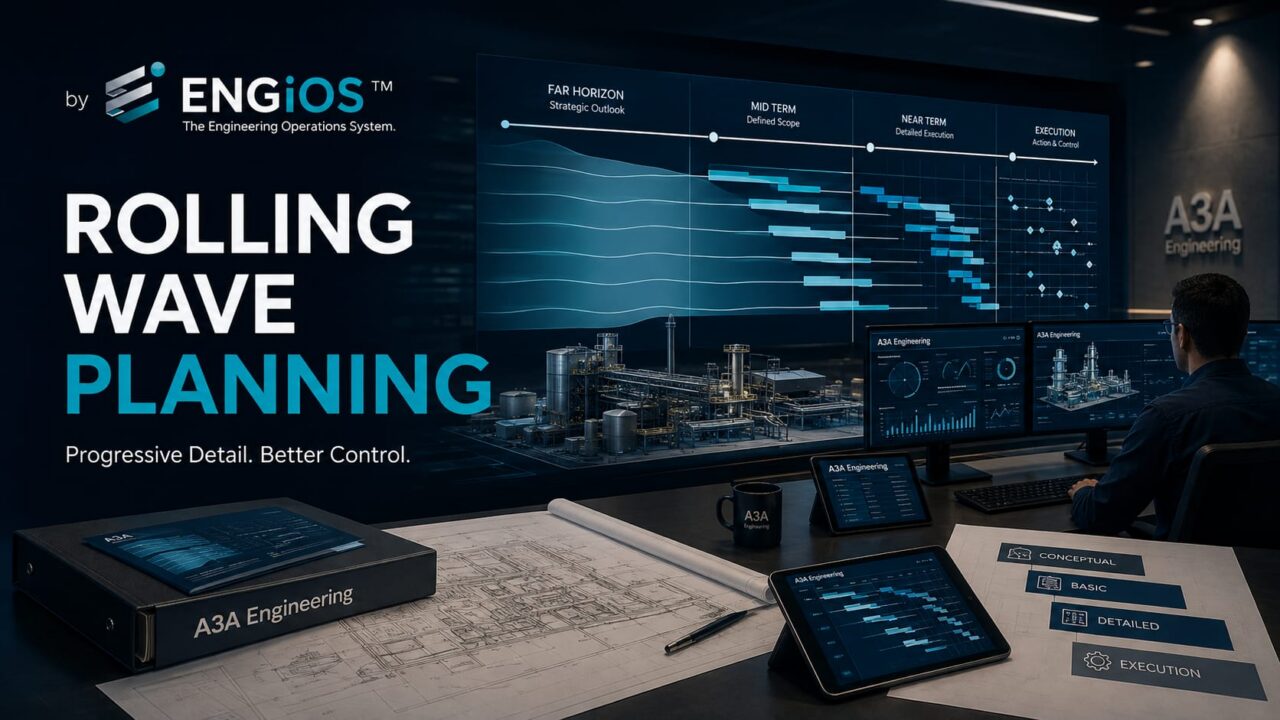
Learn how to apply Rolling Wave Planning in engineering projects, structuring progressive planning, planning packages, schedules, lookahead, FEL, PMO and Owner’s Engineering.
Check it out!
Project planning does not require every activity to be detailed with the same level of precision from day one. In engineering projects, attempting to define a distant horizon in minute detail while requirements, interfaces, suppliers or field conditions are still maturing can create a false sense of control. Rolling Wave Planning solves this problem by detailing near-term work while keeping future work at a more aggregated level until sufficient information exists to plan it with quality.
The technique does not eliminate the master schedule, baseline or project milestones. On the contrary, it creates discipline for evolving the level of detail without losing the integrated view of the project. The entire horizon remains planned; what changes is the granularity used in each period.
For engineering, this logic is especially relevant in FEL, brownfield projects, multidisciplinary development, procurement and implementation because the information needed to plan the future emerges progressively. The key is to distinguish legitimate uncertainty from lack of planning and establish clear rules for turning planning packages into detailed activities before they enter the execution horizon.
What is Rolling Wave Planning?
Rolling Wave Planning is a progressive-planning technique in which short-term activities are decomposed in greater detail while more distant work remains represented at an aggregated level.
The Project Management Institute’s Practice Standard for Scheduling describes the technique as a way to detail near-term activities — for example, the next weeks or months — while keeping future periods as planning packages until enough information exists for detailed planning.
The logic starts from a simple observation: the team tends to know more about what is near than about what will happen many months ahead.
This does not mean ignoring the future. It means representing it with the level of precision that current maturity allows.
Project planning is not the same as detailing everything in advance
A schedule can contain thousands of activities and still be a poor management instrument.
Excessive detail does not compensate for weak assumptions.
If an activity planned for eight months from now depends on:
- a technical solution that has not yet been selected;
- a supplier that has not yet been contracted;
- field data that have not yet been surveyed;
- interfaces that have not yet been closed;
- client approval that is still pending;
- an operating condition that is still unknown;
the “7 days” duration entered in the software may be only apparent precision.
Rolling Wave Planning allows this activity to remain aggregated for now, but requires an explicit process to detail it at the right time.
The difference between uncertainty and absence of planning
This point is critical.
A future activity may not be detailed yet, but it still needs to be represented in the plan.
At a minimum, the project should know:
- the expected outcome;
- the approximate time position;
- the main dependencies;
- associated milestones;
- the package owner;
- relevant assumptions;
- known constraints;
- the expected budget or effort, where applicable.
What remains for a future wave is decomposition into executable activities.
Therefore, Rolling Wave is not planning later; it is planning at successive levels of maturity.
Why the technique fits engineering projects
Engineering projects combine predictable work with work whose definition depends on information that emerges throughout the life cycle.
Examples are common.
Brownfield surveys
A project in an existing installation may begin with incomplete documentation. The team knows the overall objective, but detailing depends on inspections, surveys and validation of the as-built condition.
Multidisciplinary design
The electrical discipline may depend on loads defined by mechanical engineering. Telecommunications may depend on architecture. Automation may depend on equipment lists and operating philosophy.
Procurement
Engineering may know that a piece of equipment is required, but interface detailing may depend on manufacturer selection.
Implementation
Future work fronts may depend on civil releases, supplies or design decisions that are not yet consolidated.
In these cases, detailing everything with the same granularity from the start creates planning rework.
Rolling Wave and the principle of progressive elaboration
Projects evolve through progressive elaboration.
ABNT NBR ISO 21502:2021 treats planning as an iterative and progressive activity throughout the life cycle: the immediate future should receive a higher level of detail than more distant work, while the plan remains integrated and its baselines are changed in a controlled manner. This guidance is particularly aligned with Rolling Wave Planning.
At the beginning, the organization works with broader objectives, assumptions and estimates. As knowledge increases, definition becomes more precise.
This logic appears naturally in Front-End Loading — FEL.
In FEL, each stage seeks to increase maturity before larger investment commitments are made. Planning can follow the same principle: the greater the information maturity, the greater the expected level of detail.
Rolling Wave turns this idea into a planning routine.
How to structure planning horizons
A simple model can use three horizons.
Horizon 1 — detailed short term
Contains activities that will be executed soon.
They should have:
- clear scope;
- a defined owner;
- coherent duration;
- predecessors and successors;
- resources, where applicable;
- required inputs;
- completion criteria;
- links to deliverables and milestones.
Horizon 2 — medium term in preparation
Activities are already known but may still require further maturity.
This horizon is used to remove constraints and prepare work that will enter the next wave.
Horizon 3 — aggregated long term
Future work is represented in planning packages or summary activities.
The objective is to preserve visibility of dependencies, budget and milestones without creating speculative detail.
How large should a wave be?
There is no universal duration.
PMI uses examples of a near-term horizon of around 90 days in its explanation of the technique, but the period should be defined by the nature of the project.
In engineering consulting, a wave may span four to eight weeks.
During implementation, it may be necessary to detail three or four weeks while maintaining a broader lookahead.
In long-term projects, detailed planning may extend three months or more.
The most important criteria are:
- the speed at which information matures;
- activity duration;
- procurement lead time;
- decision cadence;
- mobilization needs;
- schedule-update frequency;
- risk of change.
The wave must be long enough to allow preparation and short enough to keep the detail reliable.
The Rolling Wave Planning cycle step by step
1. Build the integrated project view
Before any wave, the project needs an end-to-end view.
This includes:
- objectives;
- main deliverables;
- WBS;
- milestones;
- major dependencies;
- contracts and procurement;
- gates;
- major constraints.
Without this view, short-term planning becomes local management disconnected from the overall project.
2. Identify the detail horizon
Define the date through which activities must be fully decomposed.
3. Keep future work in planning packages
Future packages should be sufficiently clear to integrate with schedule, costs and resources.
4. Prepare the next wave
Before the horizon advances, the team reviews the planning packages that will enter the detailed period.
5. Remove constraints
The package should only be detailed as executable work when minimum inputs are available.
6. Decompose the package
Turn the planning package into activities with logic, owners, durations and completion criteria.
7. Update the integrated schedule
The detail enters the model without losing its connection to the baseline and original milestones.
8. Repeat at a defined cadence
The technique is called “rolling wave” precisely because the horizon advances continuously.
Is the schedule detailed, but the next work front still reaches execution with open constraints, decisions or inputs?
Project Management and Project Controls integrates schedule, lookahead, constraints, resources, costs and forecast so that the next wave is detailed before execution requires it.
Planning package: the element that avoids false precision
A planning package represents work that is known at a high level but has not yet been detailed into executable activities.
Consider the package:
“Detailed design for electrical upgrade of Building B”.
Months in advance, it may be possible to know:
- the approximate period;
- the hours budget;
- main predecessors;
- the issue milestone;
- participating disciplines.
Closer to execution, after the survey and basic design, this package can be decomposed into:
1. update the load list; 2. consolidate the single-line diagram; 3. size feeders; 4. verify short circuit and selectivity; 5. define panels and devices; 6. prepare drawings; 7. coordinate interfaces; 8. perform technical verification; 9. issue the revision for approval.
Detail appears when it becomes useful and reliable.
Rolling Wave should not destroy the baseline
One of the greatest risks of the technique is turning each wave into an excuse to change the original commitment.
Progressive planning and rebaselining are different things.
When detailing a planning package, the team can distribute the work better within the planned period. If, however, the new detail indicates that the final date or approved cost is no longer viable, this represents a variance or change that must be handled through the corresponding governance process.
The baseline should not simply be “pushed” to make it coincide with the new forecast.
Is progressive detailing being confused with informal revision of schedule, cost or scope?
Engineering Project Management separates forecast, replanning and Change Control, preserving the approved baseline and decision traceability while the plan gains detail.
Relationship between Rolling Wave and a CPM schedule
Rolling Wave Planning does not replace the Critical Path Method — CPM.
The integrated schedule can remain structured as a logic network, with critical path, float, milestones and baseline.
What Rolling Wave changes is the level of decomposition across the horizon.
In the short term, the network has greater granularity.
In the long term, certain sections may remain aggregated as planning packages.
As packages are detailed, the logic is refined.
This integration is important because the project cannot lose sight of critical dependencies simply because it uses progressive planning.
Avoiding cannibalization with the project schedule
The subject of this article is how to plan progressively, not how to build a schedule from scratch.
The basic schedule structure, activities, dependencies, critical path and control are addressed specifically in Project schedule: how to develop, control and avoid delays.
Here, the focus is on a different decision: what level of detail should exist in each planning horizon?
Rolling Wave and Lookahead Planning: what is the difference?
The concepts are related, but not identical.
| Concept | Main focus | Typical horizon | Outcome |
| Rolling Wave Planning | progressive detailing of the plan | variable | planning packages transformed into detailed activities |
| Lookahead Planning | prepare future work and remove constraints | short/medium term | activities ready for execution |
| Weekly plan | immediate execution commitment | days/week | tasks committed by the team |
Rolling Wave can exist in project planning even without the Last Planner System.
Lookahead is particularly associated with preparing short-term work and plays a central role in Lean Construction and Last Planner.
Rolling Wave and the Last Planner System
They are complementary.
Rolling Wave addresses the problem of progressive planning granularity.
The Last Planner System extends the logic to planning and production reliability, working with constraints, commitments and learning from causes of non-compliance.
In an engineering implementation project, the master schedule can use Rolling Wave while the production system uses lookahead and weekly commitments.
They are not competing tools.
Rolling Wave and agile management
The technique also connects with Agile and Hybrid Management of Engineering Projects.
Both recognize that planning must reflect the actual level of information.
The difference is that Rolling Wave is a specific planning technique. Agile management is a broader approach that may involve prioritization, flow, feedback, cycles and adaptive metrics.
In a hybrid model, the project can maintain:
- predictive baseline and milestones;
- Rolling Wave for detailing;
- Kanban for document flow;
- Change Control for relevant changes;
- EVM for aggregate performance.
Application during FEL
FEL is one of the most suitable environments.
In early stages, the organization should not create a detailed execution plan for decisions that still depend on project maturity.
There can, however, be a clear roadmap for:
- surveys;
- studies;
- decisions;
- alternatives analysis;
- estimates;
- risk review;
- gates.
At each gate, maturity increases and the next horizon can be detailed.
This relationship helps avoid a common mistake: confusing the natural lack of definition in an early stage with lack of management.
Application in basic design
In basic design, Rolling Wave makes it possible to prioritize packages that unlock higher-impact decisions.
For example:
- general criteria and main interfaces are detailed first;
- systems with longer lead times receive priority;
- areas dependent on surveys remain aggregated until the data are available;
- released packages enter detailed design.
This reduces premature effort.
Application in detailed design
Detailed design requires greater stability but may still have waves.
A package for Area A may be completely detailed while Area B depends on a supplier or field access.
Planning should allow this asymmetry without losing the overall view.
Application in procurement
Procurement is an area where progressive planning must be used carefully.
Long-lead items require anticipation.
Therefore, even if detailing in some disciplines remains in the future, planning must identify early:
- required requisition dates;
- quotation time;
- technical bid evaluation;
- manufacturing;
- inspection;
- transportation;
- arrival at site;
- interfaces required for purchase.
Rolling Wave cannot serve as justification for postponing critical supply decisions.
Application in Owner’s Engineering
In Owner’s Engineering, planning must track not only physical execution but also approvals, submittals, RFIs, inspections and documentation.
A short-term wave may detail:
- documents requiring approval;
- planned inspections;
- required decisions;
- interfaces that must be closed;
- work-front releases;
- scheduled tests.
OE then sees not only what the contractor intends to execute, but what must be resolved beforehand for execution to be reliable.
Rolling Wave in brownfield projects
Brownfield projects have a special characteristic: field discovery can change assumptions.
A well-structured wave can begin with information acquisition.
Example:
Wave 1 — survey and validation
- inspection;
- existing-condition survey;
- documentation verification;
- recording interferences;
- confirmation of loads and interfaces.
Wave 2 — technical definition
- consolidation of criteria;
- alternatives;
- critical decisions;
- basic design.
Wave 3 — detailing
- detailed design;
- specifications;
- material lists;
- procurement.
The sequence avoids developing detailed design on an unreliable existing-condition basis.
How to address constraints before the next wave
Before moving a package into the detailed horizon, there should be a readiness check.
Useful questions include:
- are requirements clear?
- are inputs from other disciplines available?
- has the required survey been completed?
- have client decisions been obtained?
- has the supplier been selected where necessary?
- is site access available?
- are specialized resources available?
- are any prior approvals required?
If the answer is no, the package may still be partially detailed, but the constraint must remain visible.
Definition of Ready applied to planning
The concept of Definition of Ready can be adapted to engineering without turning the project into Scrum.
A package is ready for detailing or execution when it has a minimum set of inputs.
Example for a technical document:
- scope identified;
- template/coding defined;
- input data available;
- associated requirements;
- critical interfaces known;
- owner assigned;
- required due date defined.
This reduces the practice of starting work that will inevitably stop.
Integration with requirements management
Progressive detailing cannot silently alter requirements.
Requirements Management in Engineering must ensure that each wave uses the correct version of assumptions and requirements.
When new information requires a change, it must be evaluated and recorded.
Integration with interface management
Future planning packages often depend on interfaces that are not yet closed.
Interface Management can indicate which decisions must be completed before the next wave is released.
This integration turns the interface matrix into a real planning input.
Integration with costs and resources
The fact that a future activity has not yet been detailed does not mean it should have no cost or effort forecast.
Planning packages can carry:
- budget;
- number of technical engineering hours;
- planned resources;
- contingency;
- period of use;
- organizational responsibility.
When the package is decomposed, the budget is distributed among the detailed activities.
The principle is to preserve consistency among scope, schedule and cost.
Rolling Wave and Earned Value Management
Rolling Wave can coexist with EVM, provided the control structure is well defined.
Future work can remain in planning packages within control accounts. As detail increases, the budget is distributed without losing traceability to the approved basis.
The problem arises when each wave arbitrarily changes budget or dates without a control process.
EVM requires a sufficiently stable reference to measure performance. Rolling Wave requires enough flexibility to detail the work. A mature model preserves both principles.
Metrics for controlling planning quality
Updating the schedule is not enough.
Some indicators help verify whether Rolling Wave is working.
Percentage of packages detailed on time
Measures whether the next wave is prepared before entering execution.
Number of activities started with open constraints
Helps identify premature planning.
Aging of critical decisions
Shows how long required decisions remain pending.
Variance between preliminary and detailed duration
Recurring large differences may indicate poorly estimated planning packages.
Planning rework
Measures how many activities must be rebuilt because they were detailed too early.
Milestone reliability
Assesses whether progressive detailing improves or degrades the ability to forecast deliveries.
Who is responsible for detailing the next wave?
Responsibility should not rest solely with the planner.
Planning needs to involve those who understand the work.
In an engineering project, this may include:
- project manager;
- planning/Project Controls;
- discipline coordinators;
- procurement;
- construction;
- commissioning;
- Owner’s Engineering;
- strategic suppliers.
The planner integrates. Technical owners provide logic, durations, constraints and completion criteria.
The role of the PMO
The PMO can standardize the application of Rolling Wave across projects.
It can define:
- minimum detailing criteria;
- recommended horizons;
- update frequency;
- mandatory fields for planning packages;
- baseline rules;
- indicators;
- constraint-escalation process.
Thus, each project maintains operational flexibility without losing corporate comparability.
Does the organization need to standardize Rolling Wave, horizons, detailing criteria and baseline rules across multiple projects?
Engineering PMO Implementation and Structuring establishes standards, cadences, responsibilities and indicators to institutionalize progressive planning without rigidly constraining projects with different characteristics.
Complete application example
Consider a 12-month project.
The master schedule has milestones for design, procurement, mobilization, construction, testing and handover.
Month 0
The next 60 days are detailed.
Months 3 through 6 contain intermediate-level packages.
Months 7 through 12 remain in planning packages.
Month 1
The team reviews the period that will enter the new detailed horizon.
It verifies:
- required documents;
- equipment already defined;
- open interfaces;
- resource availability;
- access constraints;
- pending decisions.
Month 2
The Month 3 package is decomposed into executable activities.
The schedule is updated and remaining constraints are escalated.
Subsequent cycles
The process repeats.
The entire project remains visible, but the “high-resolution window” advances over time.
Common mistakes when applying Rolling Wave Planning
Using a planning package as a drawer for uncertainties
The package needs an owner, schedule and assumptions. It cannot simply mean “define later”.
Detailing the next wave too late
If work is detailed on the day it should start, there is no time to remove constraints.
Continuous rebaselining
Updating the forecast is not the same as changing the baseline.
Ignoring procurement
Future activities with long lead times require anticipation even when other details remain open.
Planning only in software
The schedule does not create information. The process must involve technical owners.
Failing to record assumptions
When a planning package is based on an assumption, that assumption must be visible.
Confusing short term with priority
A near-term activity may not be critical; a distant decision associated with long-lead equipment may require immediate action.
When Rolling Wave Planning is not necessary
The technique adds less value when the project is short, highly repetitive and has fully known scope.
If all activities can be detailed reliably from the start, creating multiple waves may introduce process without benefit.
Even in these cases, some level of lookahead may still be useful for checking constraints.
When Rolling Wave becomes especially valuable
The technique tends to add value when there are:
- long projects;
- multiple disciplines;
- progressive information;
- brownfield conditions;
- supplier decisions;
- complex interfaces;
- FEL/FEED stages;
- on-demand engineering consulting contracts;
- programs with multiple packages;
- implementation with strong interaction between engineering and field work.
Progressive planning and governance
Rolling Wave Planning works best within a clear governance structure.
The project needs to know:
- who approves the baseline;
- who can change sequence;
- which changes require Change Control;
- when an assumption becomes a commitment;
- which gates limit progression;
- how cost impacts are handled;
- how decisions are recorded.
Without this, flexibility can become instability.
Relationship with Agile and Hybrid Management
Rolling Wave is one of the most natural practices for building a hybrid system.
Long-term planning preserves objectives and commitments. Near-term planning incorporates the latest information. Technical production can use visual management and flow.
This architecture connects:
strategy → baseline → progressive planning → short-term execution → feedback → new wave.
It avoids both the extreme of trying to predict everything with false precision and the extreme of operating without an integrated reference.
Application in engineering consulting and Owner’s Engineering
In Engineering Consulting, planning must track information maturity and deliverables.
In Owner’s Engineering, it must also track the decisions that release the contractor and protect the owner’s interests.
In both cases, Rolling Wave makes it possible to maintain a medium- and long-term view without requiring a level of detail incompatible with the available information.
A3A Engenharia uses progressive planning, governance, interface management and Project Controls according to the characteristics of each project, integrating these practices into Engineering Consulting, PMO, project management and Owner’s Engineering services.
Technical references
[1] PROJECT MANAGEMENT INSTITUTE. Practice Standard for Scheduling — Second Edition. PMI. Available at: PMI.
[2] PROJECT MANAGEMENT INSTITUTE. A Guide to the Project Management Body of Knowledge (PMBOK® Guide) — Eighth Edition. PMI, 2025. Available at: PMI.
[3] INTERNATIONAL ORGANIZATION FOR STANDARDIZATION. ISO 21502:2020 — Project, programme and portfolio management — Guidance on project management. Brazilian adoption: ABNT NBR ISO 21502:2021. Available at: ISO.
Frequently asked questions
It is a progressive-planning technique in which short-term work is detailed while future work remains at an aggregated level until sufficient information exists to decompose it reliably.
It is the usual concept behind Rolling Wave Planning. In each cycle, the detailed horizon advances and new planning packages are transformed into executable activities.
No. The technique operates within planning and the integrated schedule. It defines different levels of detail across the horizon and can coexist with CPM, baseline, milestones and Project Controls.
Rolling Wave primarily addresses progressive detailing of the plan. Lookahead Planning focuses on preparing near-term future work and removing constraints before execution.
Yes. Planning packages can retain budget and time position within control accounts and be detailed later, provided decomposition preserves traceability to the approved baseline.
It depends on the project. The horizon should consider activity duration, information-maturity speed, lead times, decision cadence and update frequency. There is no single duration valid for every project.
Complementary technical materials
Related solutions
- Engineering PMO Implementation and Structuring
- Project, Program and Portfolio Governance
- Requirements, Evidence and Acceptance Criteria Management
Related engineering services
Related technical content
- Agile and Hybrid Management of Engineering Projects
- Agile Methods in Engineering Projects
- Project schedule: how to develop, control and avoid delays
- PMO: what it is, types and functions
- Interface Management in Engineering Projects
