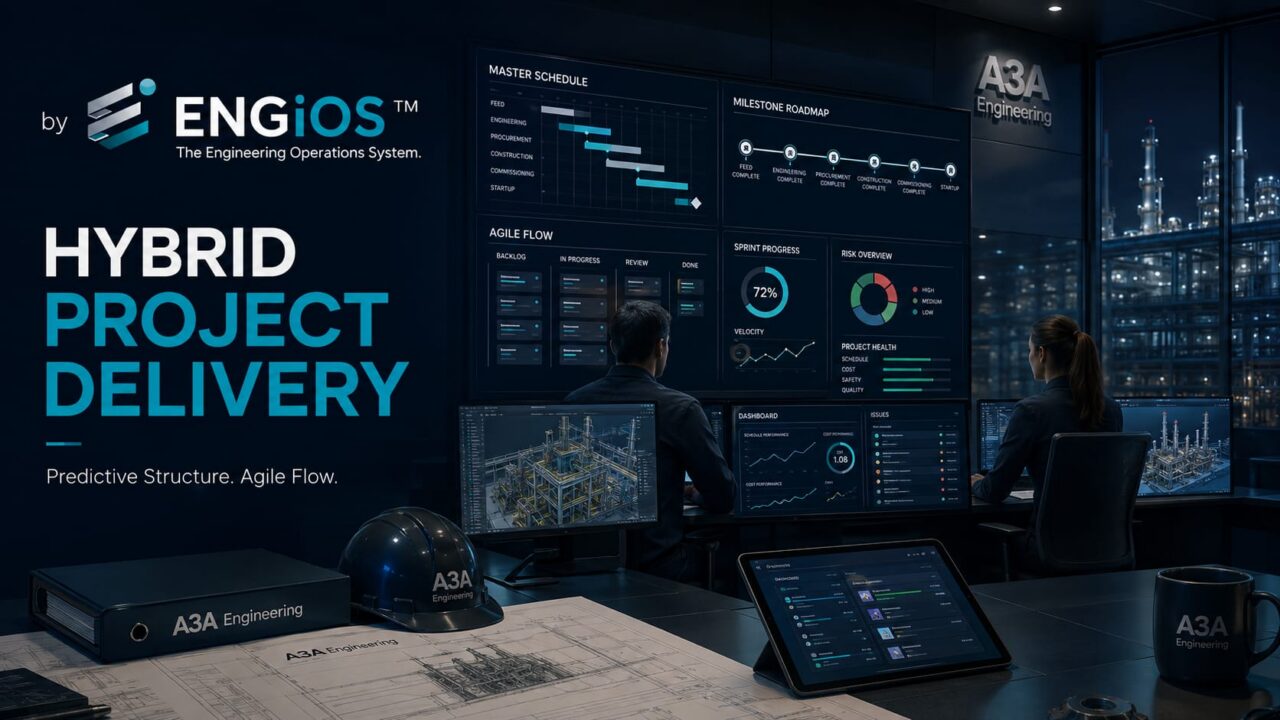
Learn how to apply agile and hybrid management to engineering projects by combining governance, predictive planning, adaptive cycles, PMO, FEL and Owner’s Engineering.
Check it out!
Agile project management, when applied to engineering, does not mean eliminating schedules, design freezes, acceptance criteria, technical responsibilities or formal controls. It means increasing the project’s ability to adapt and make decisions without giving up the governance required to control scope, schedule, cost, risk, quality and interfaces.
In engineering projects, the most useful approach is rarely the full adoption of a single method. Part of the project requires predictability: contractual milestones, releases, budget, long-lead procurement, legal requirements, design criteria and technical documentation. Another part benefits from short planning, review and learning cycles: solution development, multidisciplinary coordination, issue resolution, interface management and response to information that emerges throughout the project.
Hybrid management therefore combines a predictive governance structure with adaptive practices at the level where they actually add value. The goal is not to turn an electrical, civil, telecommunications or automation project into a software project. It is to choose, for each layer of work, the management approach best suited to the nature of the decision and the existing degree of uncertainty.
What is agile project management in the engineering context?
The term agile project management is often associated with Scrum, sprints, backlogs and software development teams. That association is incomplete. Agility is, above all, an organizational capability: sensing relevant changes, turning information into decisions and adjusting work quickly enough to preserve value.
The Agile Practice Guide — Second Edition, published by the Project Management Institute in 2026, explicitly addresses the choice among predictive, agile and hybrid life cycles and reinforces a context-based tailoring approach. This is particularly important in engineering because physical projects have constraints that cannot simply be reorganized in every cycle.
A foundation, a substation, an electrical panel, a telecommunications network, an automation system or mission-critical infrastructure involves physical interfaces, standards requirements, supply dependencies and design decisions whose cost of change increases over time. Even so, the process of developing, reviewing and coordinating engineering can be highly adaptive.
In practice, agile management applied to engineering may use:
- shorter planning and review cycles;
- explicit prioritization of issues and deliverables;
- visual workflow management;
- work-in-progress limits;
- focused coordination meetings;
- frequent stakeholder reviews;
- progressive elaboration of planning;
- rapid treatment of constraints and impediments;
- flow metrics combined with traditional project indicators.
None of this requires abandoning the WBS, the integrated schedule, cost management, responsibility matrix or approval gates. A broader view of the practices and their limits is available in Agile Methods in Engineering Projects.
Predictive, agile and hybrid management: what is the difference?
The choice should not be treated as a dispute between schools of management. Each approach performs better under certain conditions.
| Approach | Dominant characteristic | Works best when | Typical limitation in engineering |
| Predictive | upfront planning and control against a reference | scope and interfaces are reasonably defined | may respond slowly when relevant information emerges during development |
| Agile/adaptive | short cycles, frequent feedback and reprioritization | uncertainty is high and the product can be changed progressively | not every physical, contractual or regulatory element supports frequent change |
| Hybrid | predictive governance with selected adaptive practices | the project combines stable elements with elements subject to discovery | requires clear rules defining what may change, when and through which process |
In engineering, the hybrid model can be especially powerful because the same project contains different types of work.
A legal requirement may be rigid. An operating assumption may require validation. The overall architecture may be approved while interface details continue to evolve. A long-lead item may need to be specified early while lower-impact deliverables are still being detailed.
Hybrid management recognizes these differences and avoids imposing the same logic on everything.
The core principle: separate governance from execution of the work
A common mistake is to assume that adopting agile practices means replacing the project’s entire governance system. In engineering, the most consistent solution is to separate two layers.
Governance defines boundaries and commitments: business case, objectives, mandatory requirements, budget, milestones, decision authorities, approval criteria, material risks and contractual obligations.
Execution of technical work defines how teams develop and coordinate the products required to meet those commitments.
It is entirely possible to maintain an approved baseline and, within it, use two-week coordination cycles to develop engineering packages. It is also possible to maintain formal gates between FEL, basic design, detailed design and implementation while disciplines work with issue backlogs, visual boards and progressive planning.
This separation makes it possible to adopt agility without losing control.
Does the project need to gain speed without losing its baseline, gates, responsibilities and traceability?
Engineering PMO Implementation and Structuring organizes governance, decision criteria, working methods, indicators and tailoring so that formal control and adaptive practices can coexist coherently.
What should remain stable and what can be adaptive?
A hybrid architecture begins by classifying project elements.
Elements that normally require formal control
Items that should not be treated as a simple reprioritizable backlog include:
- legal and standards requirements;
- safety criteria;
- professional technical responsibilities;
- contractual scope;
- battery limits and formalized interfaces;
- approved budget and contingencies;
- critical external dates;
- performance requirements;
- configurations already released for manufacturing or construction;
- acceptance and commissioning criteria.
Changes to these elements may occur, but they should go through Change Control, impact analysis and the appropriate approval authority.
Elements that can operate adaptively
Other components of the work can be managed much more dynamically:
- development sequence of documents not yet released;
- review priorities;
- comment resolution;
- RFI handling;
- pending survey items;
- multidisciplinary coordination;
- technical clarification activities;
- preparation of alternatives;
- organization of discipline work;
- prioritization of critical interfaces.
The distinction is essential: agility does not eliminate change control; it reduces latency between information, analysis and decision.
How to structure hybrid management in three levels
A practical way to implement the model is to divide the management system into three levels.
Level 1 — project governance
This is the level of objectives, gates, budget, baseline, key milestones, strategic risks and investment decisions.
Traditional management and governance instruments predominate here. The structure may be linked to the PMO, the sponsor, the project committee or the Owner’s Engineering function.
Level 2 — integrated planning
This is where scope, schedule, costs, procurement, deliverables and interfaces are integrated.
At this level, CPM, WBS, contractual milestones, progress curves and Rolling Wave Planning can coexist. The near-term horizon receives more detail, while future activities remain at a level compatible with the information available.
Level 3 — engineering production flow
This is the level at which designers, specialists and coordinators perform day-to-day work.
Practices that are particularly useful here include:
- Kanban;
- visual management;
- deliverable and issue backlogs;
- short review cycles;
- WIP limits;
- short coordination meetings;
- explicit definition of completion criteria;
- impediment logging;
- throughput and cycle-time metrics.
The benefit lies precisely in connecting the three levels. The visual board does not replace the schedule; it helps the team deliver what the schedule requires.
Where the hybrid approach adds value across the engineering life cycle
Application changes according to the project stage.
FEL and early development
In Front-End Loading — FEL, the project progresses as hypotheses are tested and decisions mature. It is naturally compatible with progressive elaboration.
Governance can maintain well-defined gates while studies and alternatives are developed in analysis cycles. Each cycle reduces uncertainty, updates risks and improves the decision basis for the next gate.
Conceptual and basic design
At these stages, agility appears mainly in information and interface management.
A team can organize development into packages, prioritize decisions that unlock several disciplines and establish frequent reviews. Instead of each discipline progressing in isolation until a large final review, coordination occurs continuously.
This directly connects with Design Management in Engineering and Interface Management.
Detailed design
During detailed design, the cost of change increases. Adaptive freedom should be lower for items already released or tied to procurement and construction.
Even so, document workflow management can use agile practices: review queues, limits on documents simultaneously under review, comment resolution and prioritization of deliverables that release critical work fronts.
Procurement
Procurement requires firm milestones and lead times. However, preparing specifications, technically equalizing bids, handling clarifications and closing technical interfaces can use visual management and adaptive prioritization.
The rule is simple: the external deadline remains controlled; the internal flow can be optimized.
Implementation and Owner’s Engineering
In Owner’s Engineering, RFIs, submittals, deviations, field issues, decisions, interfaces and documentation arise simultaneously.
Management based only on weekly meetings and long issue lists tends to accumulate latency. Flow boards, criticality classification, WIP limits and short decision cycles make oversight more responsive without reducing the formality required for technical approvals.
Rolling Wave Planning as a bridge between traditional planning and agility
One of the most natural mechanisms for engineering projects is Rolling Wave Planning.
The concept is to detail the near-term horizon intensively and keep future activities at a more aggregated level until enough information exists to decompose them with confidence.
This avoids two distortions:
1. creating an extremely detailed schedule for activities about which little information is available; 2. failing to plan because the project still contains uncertainty.
Hybrid management occupies the space between these extremes: an integrated plan exists, but the degree of detail evolves with maturity.
This logic is explored in depth in Project Planning: How to Apply Rolling Wave Planning in Engineering Projects.
An engineering backlog is not a wish list
The term backlog can be useful, but it needs to be properly adapted to engineering.
A technical backlog may contain:
- deliverables to develop;
- comments to incorporate;
- RFIs to answer;
- interfaces to close;
- pending input data;
- analyses to perform;
- decisions awaiting an owner;
- documents to review.
The mistake is to mix everything into a single unstructured list.
An engineering backlog should include, where applicable:
- discipline;
- system or area;
- owner;
- priority;
- predecessor or dependency;
- required date;
- criticality;
- status;
- evidence of completion;
- link to a document or requirement.
This turns it into a technical production instrument rather than merely a visual tool.
Kanban and WIP limits in document production
Another practice highly suited to engineering is limiting Work in Progress — WIP.
Consider a team with twenty documents open simultaneously and none reaching issue status. Utilization may appear high, but throughput may be low and cycle time high.
By limiting the number of items in specific stages — development, verification, approval — bottlenecks become easier to identify.
Kanban does not need to represent tasks only. It can represent documents, packages, interfaces, RFIs or submittals.
The question shifts from “how many things are we doing?” to “how many things are we actually completing to the required quality?”.
Does the schedule exist, but documents, RFIs, reviews and interfaces continue to build up in queues?
Engineering Project Management integrates planning, coordination, interface management, risks, changes and technical production to turn operational flow into controlled delivery.
Sprints can be useful, but not for everything
Short time-boxed cycles can organize part of engineering work, but they should not be adopted mechanically.
An analysis that requires three weeks should not be artificially split just to fit into a two-week sprint. Likewise, a regulatory approval or equipment manufacturing process does not change its nature because the organization decided to use Scrum.
Sprints make more sense when there is a set of verifiable outcomes that can be planned, developed and reviewed within a short cycle.
Possible examples:
- close a specific system architecture;
- resolve a critical set of interfaces;
- produce and review a document package;
- complete one round of alternatives analysis;
- address a prioritized group of issues.
The duration of the work should respect its technical nature.
Requirements management remains indispensable
Adaptive methods do not authorize loss of traceability.
In engineering, requirements must be identified, classified, assigned, verified and validated. Material changes must leave evidence of who decided, why the decision was made and what impact was assessed.
Hybrid management should therefore work together with Requirements Management in Engineering.
The backlog can help operationalize the work; it does not replace the formal requirements record.
How to combine Stage-Gates with adaptive cycles
Stage-Gates and agile practices are not necessarily incompatible.
Gates can continue to establish formal decision points — for example, authorizing progression from FEL 2 to FEL 3, approving basic design or releasing procurement. Between gates, development can occur in shorter cycles.
The gate answers the question: is there sufficient maturity to assume the next level of commitment?
The adaptive cycle answers: what is the most efficient way to produce the information required to reach that maturity?
This distinction is especially important in CAPEX projects.
Hybrid PMO: governance without turning method into bureaucracy
An Engineering PMO should not measure maturity by the number of templates used.
In a hybrid model, the PMO establishes minimum governance standards and allows tailoring according to the type of project.
It may define, for example:
- minimum baseline structure;
- gate criteria;
- risk methodology;
- Change Control criteria;
- common indicators;
- documentation structure;
- executive reporting cadence.
And allow each team to define operational practices compatible with its workflow.
This creates consistency where it is needed and flexibility where it creates value.
How the approach connects to Owner’s Engineering
Owner’s Engineering needs to preserve independence, traceability and a systems view. At the same time, it must respond quickly to implementation dynamics.
A hybrid model is particularly suitable because it enables:
- formal governance for material decisions;
- visual management of issues;
- rapid review cycles;
- criticality-based prioritization;
- intensive interface coordination;
- impediment treatment;
- continuous risk monitoring;
- integration with schedule, procurement and commissioning.
The objective is not to accelerate every decision. It is to distinguish decisions that can be handled quickly from those that require more extensive formal analysis.
Traditional metrics and flow metrics can coexist
The hybrid approach does not require choosing between EVM and agile metrics.
Traditional indicators remain relevant:
- physical progress;
- milestones achieved;
- schedule variance;
- cost variance;
- SPI;
- CPI;
- completion forecast;
- risk exposure.
At the same time, flow metrics reveal problems that consolidated indicators may hide:
- throughput: number of items completed in a period;
- cycle time: time between starting and completing an item;
- lead time: total time from request to delivery;
- WIP: number of items simultaneously in progress;
- aging: age of items not yet completed.
A project may show apparently adequate physical progress while simultaneously accumulating documents in review or interfaces that remain unresolved. Flow metrics help expose this queue before it turns into a milestone delay.
Criteria for deciding how much agility to use
Not every project needs the same degree of adaptation. An initial assessment may consider:
| Criterion | More predictive tendency | More adaptive tendency |
| requirements stability | high | low |
| cost of change | high | low/moderate |
| irreversible physical content | high | limited |
| need for frequent feedback | low | high |
| regulatory dependency | high | low/moderate |
| technical uncertainty | low | high |
| evolving interfaces | few/stable | numerous/dynamic |
| required decision speed | moderate | high |
The result does not need to be “agile” or “traditional”. It may indicate that some workstreams should operate adaptively while others should not.
Common mistakes when implementing agile management in engineering
Copying software Scrum literally
Roles, ceremonies and artifacts only make sense if they solve a real problem. Renaming a coordinator as Scrum Master or an issue list as a backlog does not transform the management system.
Confusing flexibility with the absence of a baseline
Projects need a reference to know whether they are deviating. Without a baseline, there is no control; there is only monitoring.
Reprioritizing items without assessing systemic impact
A change in priority may affect interfaces, procurement and field work. The decision must consider predecessors and consequences.
Using a visual board without integrating schedule and documentation
The board is an operational layer. It needs to connect with documents, WBS, milestones, the responsibility matrix and systems of record.
Holding short meetings while keeping decisions slow
A fifteen-minute daily does not create agility if approvals remain stalled for two weeks. The decision flow must also be designed.
Measuring speed instead of value
More completed tasks do not mean better engineering. The indicator must consider quality, criticality and impact on the project.
A practical roadmap for implementing hybrid management
Adoption can be structured in eight steps.
1. Map the current system
Identify how work is planned, distributed, reviewed and approved. Measure queues, rework and waiting times.
2. Classify rigid and adaptive elements
Separate requirements, gates and commitments that require Change Control from activities that can be prioritized dynamically.
3. Define planning levels
Establish executive planning, the integrated schedule and short-term planning.
4. Create a visual workflow
Represent the actual work rather than a generic task list.
5. Define entry and exit criteria
An activity should only enter execution when it has the minimum information required. Likewise, there should be an objective definition of completion.
6. Establish cadences
Define when planning, coordination, technical review and executive reporting occur.
7. Integrate indicators
Combine schedule and cost indicators with flow and quality metrics.
8. Review the model
The management system itself should be inspected periodically. If a ceremony, indicator or template does not improve decision-making or control, it should be adjusted.
Hybrid management is not a single methodology
This is probably the most important point.
Hybrid management should not become another rigid package. It is a management architecture built around the characteristics of the project.
Contemporary PMBOK guidance reinforces tailoring practices to the project context. PMI research on traditional, agile and hybrid approaches also indicates that the hybrid model should not be treated as an inferior alternative: when properly applied, it can achieve comparable results on traditional constraints while supporting stronger stakeholder engagement.
In engineering, this tailoring capability is particularly valuable because projects combine knowledge work, multidisciplinary decisions, physical supply, construction, commissioning and regulatory obligations.
Application in Engineering Consulting
Engineering Consulting essentially works with knowledge, analysis and technical decision-making. This creates significant room for adaptive practices.
Surveys can reveal new data. Studies can eliminate alternatives. Interfaces can require coordination. Technical opinions can generate new decisions. The project progresses by reducing uncertainty.
At the same time, consulting must produce verifiable documentation, respect professional technical responsibility and preserve traceability.
For this reason, combining formal governance with adaptive flow is not merely compatible with Engineering Consulting: in many contexts, it is a more realistic representation of how technical work actually evolves.
Do schedule, costs, technical maturity and flow metrics need to be combined in a single control layer?
Project Management and Project Controls connects baseline, schedule, costs, EVM, forecast and operational indicators so that adaptive practices remain subordinate to the project’s objectives and commitments.
When to seek support to structure management
The need arises mainly when the problem is no longer a lack of team effort, but the absence of a coherent management system.
Recurring signs include:
- many meetings and few decisions;
- a growing backlog of issues;
- slow document reviews;
- priorities changing without impact analysis;
- disciplines working in isolation;
- a schedule disconnected from technical production;
- difficulty identifying which interface is blocking the project;
- indicators that reveal delay only after it has already occurred.
In these cases, structuring may involve diagnosis, governance definition, PMO, integrated planning, visual management, review workflows and indicators.
A3A Engenharia applies management and governance practices as part of Engineering Consulting, project management and Owner’s Engineering, tailoring the level of control and adaptation to the nature of each project.
Technical references
[1] PROJECT MANAGEMENT INSTITUTE. Agile Practice Guide — Second Edition. PMI, 2026. Available at: PMI.
[2] PROJECT MANAGEMENT INSTITUTE. A Guide to the Project Management Body of Knowledge (PMBOK® Guide) — Eighth Edition. PMI, 2025. Available at: PMI.
[3] GEMINO, A.; REICH, B. H.; SERRADOR, P. M. Agile, Traditional, and Hybrid Approaches to Project Success: Is Hybrid a Poor Second Choice? Project Management Journal, 2021. Available at: PMI.
Frequently asked questions
It is a management approach based on adaptation, short feedback cycles, prioritization and continuous improvement. In engineering, it should be applied in a manner compatible with technical requirements, milestones, physical interfaces, standards and formal responsibilities.
Yes, especially in knowledge work, coordination, interface management, reviews, issue handling and short-term planning. Physical, regulatory and contractual elements, and items already released for execution, generally require more predictive controls.
It is the intentional combination of predictive and adaptive practices. A project can maintain formal baselines, gates, schedule and budget while using Kanban, short cycles, visual management and progressive planning to execute the work.
No. In engineering, the integrated schedule remains an essential reference. Agile practices can operate in a short-term workflow layer connected to the schedule.
Some Scrum practices can be useful, but literal adoption is rarely appropriate for all activities. The decision should consider the natural duration of the work, cost of change, physical dependencies, procurement, regulatory requirements and acceptance criteria.
The PMO can establish minimum governance standards, indicators and approval criteria while allowing operational practices to be tailored to the type of project. This avoids both lack of control and unnecessary bureaucracy.
Supplementary technical materials
Related solutions
- Engineering PMO Implementation and Structuring
- Project, Program and Portfolio Governance
- Requirements, Evidence and Acceptance Criteria Management
Related engineering services
Related technical content
- Agile Methods in Engineering Projects
- Project Planning with Rolling Wave Planning
- PMO: What It Is, Types and Functions
- Design Management in Engineering
- Interface Management in Engineering Projects