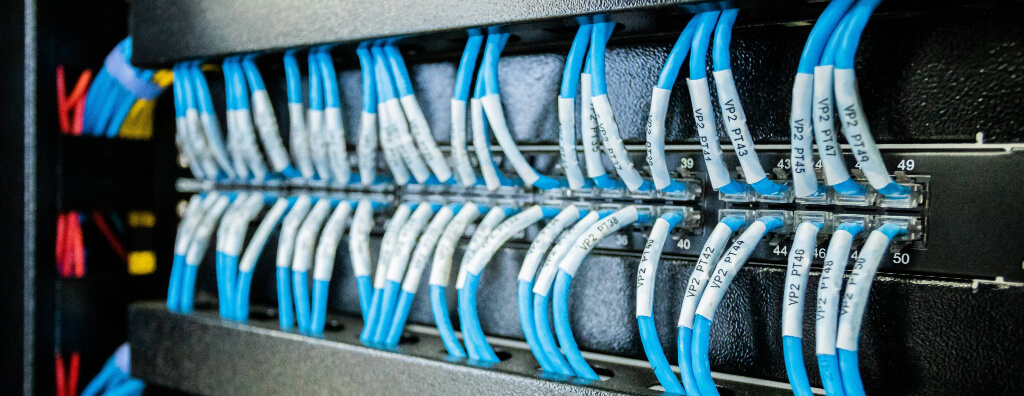
Network cabling is the set of cables and physical components that form the fundamental infrastructure for data transmission.
Check it out!
Network cabling is the physical infrastructure responsible for interconnecting communication devices and enabling data transmission in IT environments. Made up of copper or optical cables and their respective connectors, it serves as the structural foundation for the operation of local area networks (LANs), communication systems, automation, and internet access. Its specification and installation follow technical standards to ensure performance, safety, and compatibility with active network equipment.
In this article, you will find everything you need to know about Network Cabling, including all the essential technical aspects for developing a robust and efficient infrastructure.
Check it out
[elementor-template id=”24446″]
What Is Network Cabling?
Network Cabling refers to the physical infrastructure made up of cables and essential components for Data Transmission in a telecommunications network.
This infrastructure is responsible for connecting devices such as computers, routers, switches, and other network equipment to ensure efficient and reliable communication.
Importance of Network Cabling
Network Cabling is essential to support services such as voice communication (VoIP), video conferencing, video streaming, and internet access.
Despite the growing popularity of wireless connections, cables still provide more efficient and stable signal transmission compared to radio wave propagation (Wi-Fi).
Whether in residential, corporate, or industrial environments, a well-planned and properly implemented Network Infrastructure is crucial to ensure performance and operational reliability.
Network Cabling Categories
Network cabling categories define the technical performance standards for data transmission, establishing limits for frequency, transfer rate, interference immunity, and supported applications. These classifications are standardized by norms such as ANSI/TIA-568 and determine compatibility between the physical infrastructure and active equipment.
Among the most commonly used categories are:
- Cat5e – Supports up to 1 Gbps at frequencies of up to 100 MHz. It is still common in older networks or basic applications.
- Cat6 – Operates up to 250 MHz, supporting 10 Gbps over reduced distances. It is currently the most widely deployed category in corporate environments.
- Cat6A – Designed for 10 Gbps over distances of up to 100 meters, with enhanced shielding against external interference (alien crosstalk).
- Cat7 and Cat8 – Categories with more specific use in data centers or ultra-high-speed networks, with shielded cables and frequencies above 600 MHz.
Structured Cabling System
The Network Cabling infrastructure, known as Structured Cabling, is a system designed to be modular and standardized, allowing different types of equipment and devices to be integrated efficiently.
Archive: A3A Engenharia de Sistemas
To understand the complexity and importance of this system, let us look at its main components and fundamental characteristics.
Technical Standards
With the goal of standardizing cabling systems, industry specialists came together under the coordination of organizations such as ISO/IEC, ANSI/TIA, and ABNT to develop the Technical Standards for Structured Cabling.
These standards are essential to ensure the correct implementation of the system, guaranteeing interoperability and compliance with quality and safety requirements in different network environments.
Types of Network Cabling
Choosing the type of Network Cabling is one of the critical factors in designing a telecommunications infrastructure, since there is no single solution that meets every need.
Different types of cables are designed for specific applications, each with technical characteristics that directly influence network performance. The selected transmission medium significantly affects speed, reliability, and the total cost of the network infrastructure.
Therefore, the decision about which cable to use should be based on detailed technical criteria, taking into account performance requirements and network operating conditions.
Twisted Pair Cables
Twisted pair cable is a type of metallic cable composed of 4 pairs of conductive wires, twisted together to improve electromagnetic compatibility and minimize interference.
These cables are categorized according to performance and quality specifications, adapting to the speed, reach, and other specific requirements of each application.
The main categories of twisted pair cables include Cat5E, Cat6, Cat6A, Cat7, Cat7A, and Cat8, each with different bandwidth capacities, transmission rates, and maximum reach.
In order to further improve protection against electromagnetic interference, twisted pair cables may be shielded. In data communication applications, cables can be classified according to their construction characteristics as UTP, FTP, and STP.
Fiber Optic Cables
Fiber optic cable is a type of cable that uses glass or plastic filaments to carry information in the form of light pulses.
The construction of fiber optic cable consists of a series of layers designed to protect fiber integrity. Each fiber is made up of an ultra-thin glass core, surrounded by a cladding layer, which reflects light back into the core, minimizing signal loss and ensuring transmission efficiency.
There are two main types of fiber optics used in networks: Multimode and Single-mode.
Network Equipment
Network Equipment plays an essential role in the interconnection and management of the various network segments.
This equipment can be classified as active or passive, and each type performs specific functions within the system.
Active equipment, such as switches and routers, is responsible for dynamically managing data traffic on the network.
It automatically adapts to load and demand conditions, optimizing performance and ensuring that data is transmitted efficiently and securely among connected devices.
Passive equipment, such as patch panels, racks, and faceplates, plays an essential role in organizing, connecting, and protecting the cables that make up the cabling infrastructure.
The proper choice of equipment is crucial to ensure that the network operates with maximum efficiency, without bottlenecks, and is ready for future expansions and technological upgrades.
Network Topology
Network Topology refers to the physical and logical configuration or layout of the devices connected in a network, determining how they interconnect and communicate with one another.
The choice of topology has a significant impact on network performance, efficiency, and scalability, while also influencing aspects such as ease of maintenance, expansion capability, and fault redundancy.
There are several network topologies, each with specific characteristics and applications. The most common are star and ring topologies.

Documentation
Documentation is an essential stage throughout the entire planning and Structured Cabling Design process. It includes the record of all relevant information, from network requirements to implementation, configuration, and certification details for Network Cabling.
The lack of proper documentation can cause several operational problems, such as difficulties in maintenance and troubleshooting, and may also lead to rework, loss of time, and wasted resources when mapping an existing infrastructure.
How to Choose a Network Cabling Company
Hiring an engineering company to provide Network Cabling design and consulting services is essential for a successful system deployment, because it offers a series of advantages that go far beyond simply pulling cables.
A well-designed project and qualified execution ensure that the cabling is installed in accordance with technical standards, minimizing the risk of failures, interruptions, and rework.
Although it may initially seem tempting to save money by implementing the system without the support of specialized consulting, this approach generally results in much higher long-term costs. The lack of adequate technical support can turn an initiative that should bring efficiency and savings into a constant source of problems and rework.
When choosing a specialized Network Cabling company, it is essential to evaluate its experience, certifications, and track record of successful projects. The company must have proven capability to develop solutions aligned with the specific needs of your business, ensuring a robust, scalable infrastructure prepared to support current and future technological demands.

Final Considerations
The proper choice and implementation of a Network Cabling System are essential to ensure the performance, scalability, and reliability of the IT infrastructure in any organization.
Hiring a company specialized in network cabling is a crucial step to ensure that all these stages are carried out according to industry best practices, avoiding future problems and guaranteeing a network capable of supporting constantly evolving technological needs.
Learn About Our Work
With more than 25 years in the market and an extensive technical portfolio in which it has worked on many types of projects, from the simplest to the most complex, A3A Engenharia de Sistemas has specialists in large-scale projects and critical infrastructure, standing out in the design, consulting, and implementation of high-performance Structured Cabling Systems.
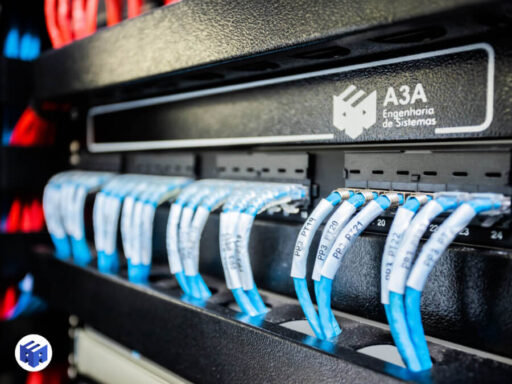
Archive: A3A Engenharia
Our Engineering Department is made up of professionals certified by the largest manufacturers in the market and with proven experience working on major deployments.
Contact us today and find out how we can help your company build a robust Network Infrastructure ready for the future!
Relevant Links (Complementary Technical Materials)
Telecommunications Network Design
Structured Cabling Design – Complete Guide
Technical Standards for Structured Cabling
Standard 14565 – Structured Cabling
eBook – Why hire a Structured Cabling Design Project?
Fiber Optic Cable
Indoor Optical Distributor (DIO)
Testing and Performance
Network Certification for Structured Cabling Systems
Consulting in Structured Cabling Projects
Structured Cabling Installation
How to avoid common problems in Structured Cabling Systems?
Components and Subsystems
Main benefits of Structured Cabling
Network Cabling in CAT5e vs CAT6
Network Cabling in CAT6 vs CAT6A
Topology and Architecture
Network Architecture and Topology – How to Ensure Performance
Network Topology: Types and Applications in Telecommunications Networks
Services
Regulatory References
“NBR 14565 – Structured Cabling for Commercial Buildings” – ABNT (Brazilian Association of Technical Standards)
“ISO/IEC 11801 – Generic Cabling for Customer Premises“- ISO/IEC (International Organization for Standardization) & (International Electrotechnical Commission)
“”ANSI/TIA 568 – Generic Telecommunications Cabling for Customer Premises” – ANSI/TIA (American National Standards Institute) & (Telecommunications Industry Association)
“What are structured cabling services and their respective technical responsibilities?” – CREA (Regional Council of Engineering and Agronomy)
“Structured Cabling Systems: the Fact File” – CommScope
