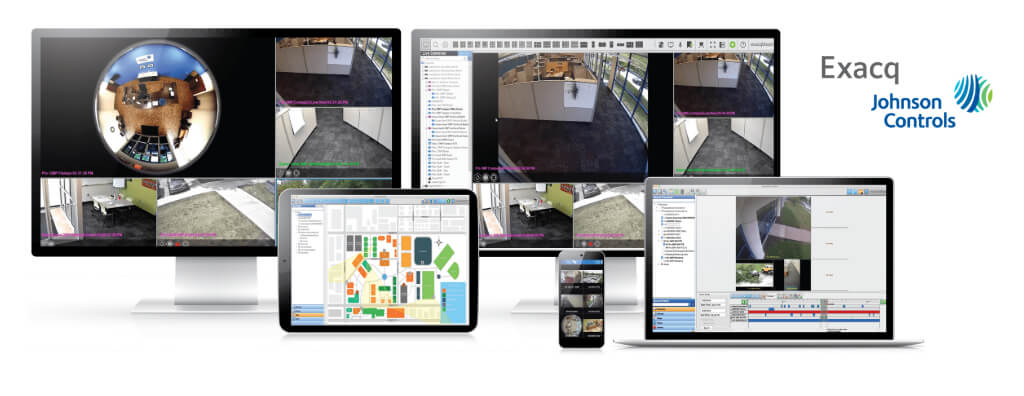
exacqVision is a video management software (VMS) developed by Johnson Controls that combines ease of use with a comprehensive set of features.
Compatible with thousands of IP camera models and a wide variety of access control systems, point-of-sale (POS) solutions, and video analytics software, exacqVision stands out as one of the most flexible solutions available on the market.
System Overview
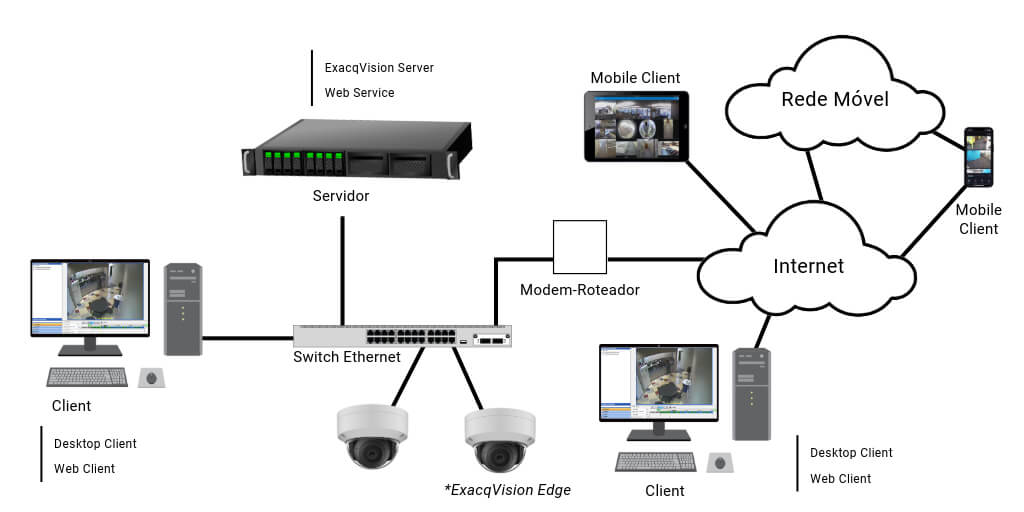
exacqVision features a client-server architecture, allowing each computer to be configured as a client, server, or as a combination of both.
Client
The exacqVision client is the software component responsible for establishing a connection to the exacqVision server over a TCP/IP network, consuming the exposed services for access to real-time video streams, playback of recorded footage, sending control commands (such as PTZ, for example), querying metadata, configuring devices, and managing the platform.
The authentication and authorization flow is managed through a credentials system that can be validated directly by the exacqVision server itself or, in enterprise environments, integrated with an LDAP server, allowing existing access control policies (such as user groups and centralized permissions) to be applied directly within the video system.
Only properly authenticated users with associated permissions are authorized to modify system parameters, change recording policies, adjust other users’ permissions, and perform critical actions related to the operation and security of the platform.
In terms of authentication and access control, the exacqVision Server natively supports local authentication, but can be configured for integration with LDAP servers, enabling centralized credential management and enforcement of corporate access control policies directly within the video system.
Each authenticated user has an associated profile, where specific permissions determine which cameras can be viewed, which settings can be changed, which events can be acknowledged, and which administrative actions can be performed.
All activities carried out by authenticated users are recorded in detailed audit logs, ensuring complete traceability of critical operations.
The desktop client is implemented as a “thick client“, meaning that the responsibility for decoding and decompressing received video streams is transferred to the local machine where the software is installed.
This architecture decentralizes the processing load, reduces CPU and memory usage on the server, and allows each workstation to locally manage the rendering and manipulation of images, leveraging hardware resources such as GPU acceleration.
On the other hand, both the web client and the mobile client are implemented as “thin clients“, where video decoding, decompression, and processing are performed directly on the exacqVision server before being sent to the browser or mobile device.
This usage model concentrates the computational load on the backend and simplifies the client application side, enabling access without the need for pre-installation or local dependencies, but increasing the processing capacity and bandwidth requirements on the central server.
Server
The server is responsible for establishing direct and persistent connections with each configured IP camera/encoder, processing the received streams, storing video data and metadata on local or remote volumes, and making this content available to connected clients in real time.
All communication occurs over a TCP/IP network, using standardized protocols such as RTSP or ONVIF, or through native drivers for certain manufacturers, depending on the model and the integration applied.
The exacqVision Server runs as a system service with no local graphical interface, with all management, configuration, and operational processes carried out remotely by the clients.
After receiving video streams, the server can apply motion detection algorithms, segment recordings into configurable-size blocks, and index associated metadata to enable fast and efficient searches based on time, event, or camera.
For each established connection, the server negotiates parameters such as codec, resolution, bitrate, and authentication, dynamically adjusting reception buffers according to network stability and the conditions of the remote device.
Every recording is accompanied by event logs, associating videos not only with timestamps, but also with system events such as signal loss, hardware failures, or external triggers.
These events are stored in local databases and can be queried or audited by clients, in accordance with each user’s permissions.
Web Service
The server can optionally host an integrated web service, responsible for providing the web client and mobile device interface.
In these scenarios, the server takes full responsibility for the transcoding, decompression, and repackaging of video streams into formats compatible with browsers and mobile systems, which imposes an additional processing load that must be considered when sizing the infrastructure.
The ability of the exacqVision Server to serve multiple simultaneous clients, process events in real time, and maintain stable and resilient operation depends directly on the correct sizing of the hardware infrastructure.
In distributed environments, exacqVision supports cluster operation, with independent servers serving different groups of cameras and a top-level consolidated management layer via Enterprise Manager, unifying monitoring, configuration, and auditing.
ExacqVision Edge
ExacqVision Edge is an option within the exacqVision platform for running directly on the embedded hardware of compatible IP cameras.
Rather than relying on a centralized server for processing and storage, Edge converts the camera itself into an autonomous recording and analytics node, operating as a distributed VMS micro-server.
The ExacqVision Edge package is installed directly within the camera’s operating environment, using the manufacturer’s API or SDK to integrate with the internal storage subsystem (edge storage) and with the camera’s native video encoding pipelines.
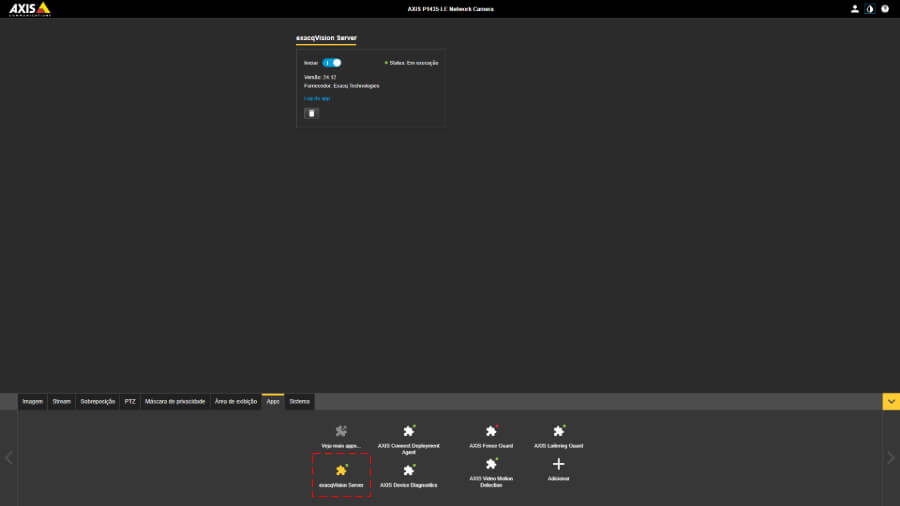
ExacqVision Edge is an excellent alternative for small and medium-sized applications, offering a distributed recording solution that significantly reduces the need for centralized infrastructure, and is also a strategic option for camera-as-a-service deployments.
Client and Server
There are also configurations where the same machine simultaneously runs both the server and client components of exacqVision.
In this case, the system operates in integrated standalone mode, eliminating the need for remote communication between the main modules.
This model is commonly used in exacqVision appliances (NVRs), where the client application is pre-installed to allow monitoring and management directly from the server hardware itself.
This flexibility makes the combined client-server architecture particularly well-suited for small-scale environments, isolated installations, or scenarios where simplicity and local performance are critical factors for operation.
At the same time, the system remains compatible with larger distributed environments, where the same equipment can later be integrated into a broader architecture through Enterprise Manager or other centralized discovery and management mechanisms.
Licensing
The exacqVision licensing mechanism is based directly on the MAC address identification of a network interface present on the server where the service is installed.
In environments where the server uses advanced network configurations, such as link aggregation or interface virtualization, the consistent visibility of a fixed MAC address may be compromised, preventing proper license recognition.
exacqVision does not use a base license to enable the server itself.
The licensing model is entirely based on individual licenses associated with each video channel configured on the server.
Each channel, corresponding to an IP camera or analog encoder, consumes a dedicated license tied to the channel’s logical identifier in the system.
Expanding a server’s camera capacity is accomplished by applying incremental licenses, allowing new channels to be activated as demand grows.
Integrations
The exacqVision platform was developed with a modular and extensible architecture, enabling the incorporation of new features and data flows through plugins and direct integrations with third-party systems.
This integration capability is essential for scenarios where the VMS needs to operate as part of a larger ecosystem, encompassing physical security, building automation, access control, and transaction auditing.
Plugins
exacqVision offers a plugin framework that allows the addition of software components running directly on the server or client, expanding the system’s native features. Plugins can be developed for various purposes, such as:
- Real-time analytical processing, applying facial recognition algorithms, object detection, or people counting directly on the received streams.
- Recording metadata enrichment, associating external information (such as data from sensors or IoT devices) with video-captured events.
- Internal process automation, such as executing custom scripts in response to specific events triggered by the server, including alarms, hardware failures, or motion detections.
Plugins are developed in compliance with the exacqVision Plugin SDK, made available to partners and developers. This SDK provides direct access to the event, metadata, and device control layers of the exacqVision Server, enabling the creation of native extensions that operate with the same efficiency as the platform’s internal functions.
Plugin installation and management is performed directly through the exacqVision Client or via the administrative interface, with granular permission controls to determine which users can enable or disable extensions on each server. Specific execution logs and plugin error logs are maintained for diagnostics and auditing.
Other Systems
exacqVision was also designed for direct integration with external security and automation systems, including access control, point-of-sale (POS) systems, building automation platforms, and alarm and fire monitoring systems.
Integration with access control allows access events to be directly associated with video recordings.
Each event is indexed alongside the corresponding video, enabling operators to perform searches combining criteria such as time, camera, and access event.
For integrations with point-of-sale (POS) systems or transaction platforms, exacqVision is capable of recording transaction streams directly into the event database, associating each transaction line with a timestamp and a video channel.
This enables the execution of specific text-based searches (item descriptions, product codes, values) directly from the exacqVision Client interface, with synchronized playback of the recording corresponding to the queried transaction. This feature is particularly used in retail environments, where sales auditing and fraud investigation are critical requirements.
In more complex environments, integration with PSIM (Physical Security Information Management) systems is supported, allowing exacqVision to expose its operational state, events, and camera status directly to centralized command-and-control platforms.
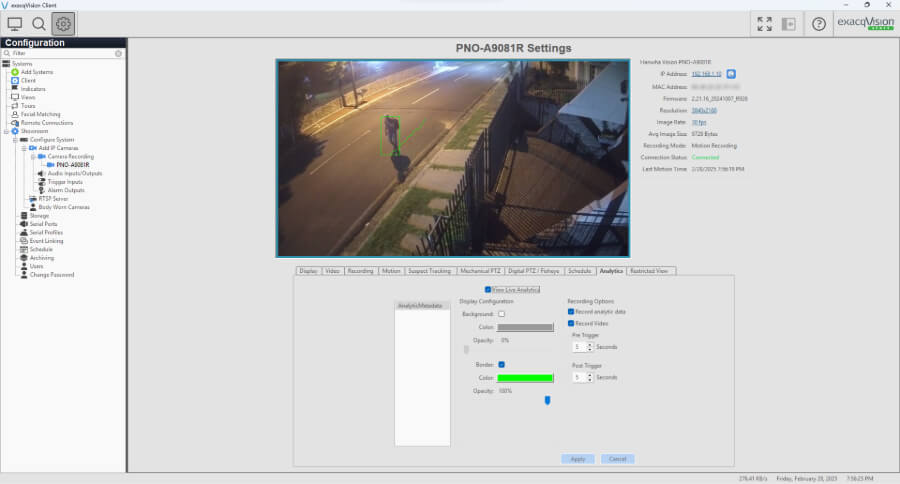
The management and configuration of integrations with external systems is performed through the Event Linking layer, where events received from external sources can be configured to trigger automatic actions in the VMS, such as starting recordings, generating visual alerts, or activating output devices.
All communication between exacqVision and external systems can be secured with TLS and mutual authentication mechanisms, ensuring that only authorized systems are permitted to inject events or query sensitive data within the recording environment.