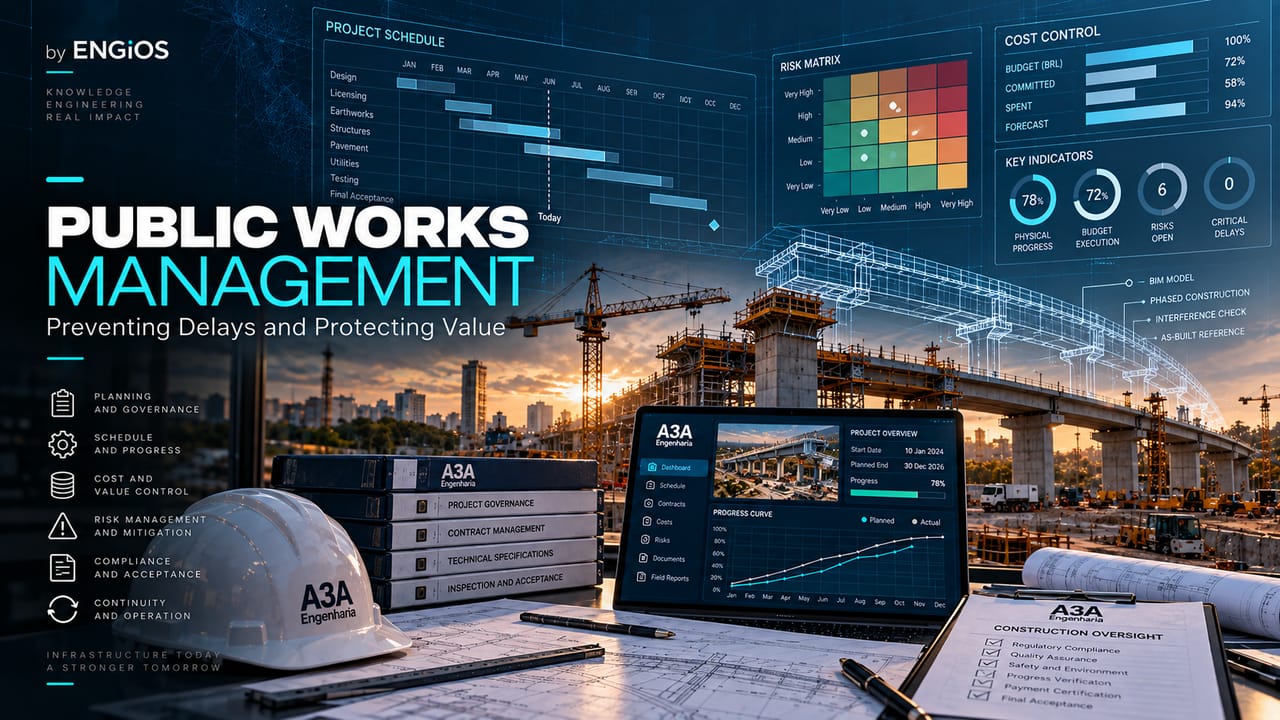
Technical guide to structuring public engineering investments through planning, design, governance, procurement, and inspection capable of reducing stoppages and decision-making risks.
Check it out!
A public works project does not fail only when the construction site stops. Failure begins earlier, when the project moves to procurement without sufficient information about the need, existing conditions, design, cost, schedule, risks, institutional capacity, and execution strategy. Public works management must treat investment as a complete technical cycle: make sound decisions before tendering, contract a sufficiently defined scope, monitor execution through evidence, and preserve the ability to correct deviations before they become critical delays, cost overruns, or stoppages.
Data from Brazil’s Federal Court of Accounts (TCU) show why this approach is necessary. The share of stalled projects in the portfolio monitored by TCU rose from 38.5% in 2022 to 41% in 2023 and 52% in 2024. In April 2025, 11,469 of 22,621 mapped projects were stalled, or 50.7%. In 2026, the Court updated its classification criteria and released a new dashboard extract with April data, more clearly distinguishing stalled, canceled, and completed projects. The methodological change requires caution in direct comparisons between percentages, but reinforces the same management conclusion: Brazil needs to improve information quality, project maturity, and the ability to convert resources into infrastructure that is actually delivered.
The problem is not only stalled construction: it is investment that delivers no benefit
A stalled public works project represents immobilized public capital, asset deterioration, remobilization costs, the need to update designs and prices, and, above all, delays in delivering the public policy that justified the investment. An unfinished school creates no new places. An incomplete healthcare facility serves no patients. Partially implemented sanitation infrastructure may provide no functional benefit until the entire system is operational.
TCU classified the management of stalled public works as a high-risk issue for Public Administration. In the 2024 snapshot, stalled projects had already consumed approximately BRL 9 billion and would still require about BRL 29.4 billion for completion. The analysis therefore cannot be limited to counting inactive construction sites. It is necessary to ask why resources were committed before projects had sufficient conditions to achieve the expected result.
This change in perspective matters for public managers. The objective of public works management is not simply to tender, sign a contract, measure, and pay. It is to govern the investment until the infrastructure is ready to fulfill its intended public function.
TCU historical series and what changed in 2026
The trend recorded by TCU between 2022 and 2025 shows a significant increase in stalled projects within the portfolio then being monitored.
| Reference date | Stalled projects | Monitored portfolio | Share |
| 2022 | approximately 8.7 thousand | approximately 22.6 thousand | 38.5% |
| 2023 | 8,603 | 21,005 | 41.0% |
| April 2024 | 11,941 | 22,958 | 52.0% |
| April 2025 | 11,469 | 22,621 | 50.7% |
In 2025, TCU added a particularly important finding: among 5,505 projects started between April 2024 and April 2025, about 1,200 were already stalled, approximately 22% of that group. This shows that the problem could not be explained solely by a legacy stock of older projects. New projects were also quickly becoming stalled.
In July and August 2026, the Court announced a revision of the classification criteria used in the Stalled Public Works Dashboard. Minutes 27/2026-Plenary highlighted the distinction between stalled and canceled projects; Minutes 30/2026 recorded a new extract with April 2026 data, including 3,737 projects classified as canceled and 6,141 as completed. The portfolio also underwent additions, removals, and data cleansing.
Therefore, public managers should not interpret the 2026 snapshot as a simple linear decline from the 50.7% recorded in 2025. The universe and classification were handled differently. The governance lesson is equally relevant: without consistent data on status, stage, cost, and project constraints, Public Administration cannot prioritize, compare, and decide correctly.
Why public works projects stop: the causes form a system
TCU’s historical assessments associate stoppages with a combination of factors. Different reviews identify planning failures, deficient designs, funding-transfer or counterpart-funding problems, contractor issues, limited operational capacity of public entities, licensing and expropriation difficulties, inspection failures, scope changes, and contract-management deficiencies.
The mistake would be to seek a single nationwide cause. One project may stop because the design was incomplete; another because funding was insufficient; another because the contractor lacked capacity; another because the site had not been released; and another because no decision was made while the deviation was still controllable.
For effective management, it is useful to separate causes into six families.
Investment structuring failures
The project receives political priority or funding before a technically mature solution has been defined. The agency knows it needs a school, hospital, bridge, or system, but has not yet consolidated requirements, existing conditions, alternatives, constraints, and the recommended solution.
At this stage, pressure to tender can turn technical uncertainty into a poorly defined contractual obligation.
Design failures
Insufficient, incompatible, or outdated designs generate incorrect quantities, clashes, changes during execution, and late field decisions. Law 14,133 assigns specific technical content to the Basic Design, and TCU treats its sufficiency as a central element of procurement and execution.
The risk does not disappear because design was outsourced. Public Administration must assess whether what it receives is adequate to support procurement.
Cost and schedule failures
A project may be technically conceived and still be economically unfeasible. Incomplete quantities, inadequate reference prices, incorrect BDI, a schedule incompatible with the construction method, or lack of contingency make the contract vulnerable from the outset.
Procurement-strategy failures
Inappropriate packaging, a poorly selected execution regime, disproportionate qualification criteria, a generic risk matrix, or deficient measurement criteria shift problems from the preparatory phase into the contract.
Execution and inspection failures
Insufficient productivity, delayed supplies, nonconformities, interfaces between contractors, and pending decisions must be identified early. Purely documentary inspection tends to recognize the problem only after schedule, cost, or quality has already been affected.
Institutional-capacity and governance failures
Public entities may receive funding and undertake projects larger than their capacity to plan, design, procure, inspect, and manage. This is not an individual civil servant’s failure; it is an institutional-capacity issue that must be recognized before procurement.
The critical question: is the project mature enough to proceed?
Availability of funds is not the same as technical readiness. Before tendering, the agency must demonstrate that the need, existing conditions, solution, design, budget, schedule, risks, and institutional capacity have reached a level of maturity compatible with procurement.
Availability of funding does not mean the project is ready for tender. The manager must distinguish financial opportunity from technical readiness.
A decision to proceed should verify at least five conditions:
- the public need and expected outcome are clearly defined;
- existing conditions and relevant constraints are known;
- the engineering solution has maturity compatible with the procurement regime;
- cost, schedule, and risks have been estimated on a sufficiently reliable basis;
- the agency has the capacity to procure, inspect, decide, and accept the scope.
If any of these conditions is not met, the answer is not necessarily to cancel the investment. Studies, surveys, designs, independent review, or specialized support may need to be procured before execution is tendered.
This is a fundamental governance point: delaying tendering to mature the scope may preserve the project’s overall schedule and resources. Premature tendering may simply move uncertainty into a phase where any correction becomes more expensive.
The ETP must demonstrate that procurement makes sense before defining how to procure
The Preliminary Technical Study (ETP) should not be treated as a form. For engineering works and services, it is an opportunity to test the investment rationale before consolidating the solution.
The ETP must relate need, alternatives, requirements, estimates, risks, and feasibility. The central question is: is the selected solution the technically appropriate and economically justifiable way to meet the public need?
A robust ETP helps identify problems such as:
- an oversized or insufficient solution;
- scope dependent on unplanned preliminary works;
- incompatible existing infrastructure;
- lack of operation and maintenance capacity;
- technology dependencies not considered;
- unaddressed licensing requirements;
- life-cycle cost incompatible with the agency’s capacity.
An organized preparatory phase reduces the likelihood of discovering these problems after procurement.
Basic Design: the document that turns intent into a contractible scope
An insufficiently defined design transfers uncertainty to construction. An independent review can identify incompatibilities, requirement gaps, weak quantities, and interfaces before these issues enter the contract.
The Basic Design is the main boundary between administrative intent and the engineering scope. It must define the solution precisely enough to enable assessment of cost, method, schedule, requirements, interfaces, and risks, subject to the characteristics of the selected execution regime.
TCU has consolidated case law concerning responsibility associated with approving deficient designs. This does not mean every design error creates liability, but it shows that Public Administration cannot treat approval as a merely formal act.
A maturity review should verify:
- consistency across disciplines;
- compliance with the requirements of the needs program;
- compatibility with field surveys;
- interface definition;
- performance criteria;
- traceable quantities;
- consistent design narratives and specifications;
- execution assumptions;
- commissioning and acceptance requirements;
- relevant technical risks.
The later an incompatibility is identified, the higher its correction cost tends to be.
AGU helps turn technical maturity into a procurement process
The templates and standardization instruments of Brazil’s Office of the Attorney General (AGU) show that the preparatory phase does not end with design. The process must coherently connect technical and legal-administrative documents.
AGU itself clarifies that, under Law 14,133, the Basic Design serves as an engineering document, while the Terms of Reference contain legal-administrative elements specific to procurement. In 2026, federal templates for Terms of Reference, tender documents, and contracts continued to be updated, reinforcing the need to use current versions and adapt them to the specific characteristics of the scope.
AGU’s Statement of Relevant Technical Justifications is especially useful because it requires the process to make explicit decisions that might otherwise remain implicit: execution regime, packaging, qualification criteria, confidential or public budget, guarantees, subcontracting, and other matters capable of affecting competition and risk.
This is the role of sound procurement documentation: turning technical choices into justified and auditable decisions.
Engineering estimates must represent the solution, not merely populate a spreadsheet
The estimate is an economic model of the project. If the technical model is incomplete, the estimate will be incomplete as well.
A reliable spreadsheet depends on:
- quantities extracted from consistent documents;
- cost compositions compatible with the construction method;
- appropriate reference costs;
- justified quotations where necessary;
- correct treatment of BDI and labor burdens;
- site administration, mobilization, and indirect items consistent with the schedule;
- auditable calculation records;
- a defined base date;
- alignment with the schedule.
Public Administration must be able to reconstruct how the estimated cost was obtained. Without calculation records, a total value may appear precise and still not be technically defensible.
Schedule: duration must be a consequence of the execution method
Arbitrary deadlines create two types of problems. An excessive duration increases indirect costs and delays public policy; an unachievable duration creates contractual delay from the outset.
The schedule must consider construction sequence, productivity, resources, critical supplies, releases, approvals, testing, and commissioning. For complex scopes, it must also reflect interfaces between disciplines and contracts.
The manager does not need to master planning software, but must require a verifiable time baseline compatible with the contracted solution.
Risk matrix: who controls each event and how the response will be triggered
A risk matrix should not be a generic list of possible events. It must connect event, cause, consequence, allocation, response, and management trigger.
Examples of risks that may compromise a public works project include:
- site unavailable;
- expropriation incomplete;
- license pending;
- unrecorded interference;
- third-party design not delivered;
- long-lead item;
- extraordinary input-price variation;
- requirement change;
- public utility unavailable;
- low productivity;
- critical supplier failure.
When a risk materializes, Public Administration must be able to respond quickly: who should act, which document records the event, which impact must be measured, and which decision is required?
Procurement strategy: there is no universally superior regime
Law 14,133 provides different execution regimes. The choice must reflect design maturity, ability to define the scope, risk allocation, and the desired degree of integration.
Unit-price contracting, lump-sum contracting, integrated contracting, and semi-integrated contracting create different risk structures. The decision should not be based on the agency’s historical preference or administrative convenience.
Technical justification is also required for decisions concerning:
- scope packaging or integrated procurement;
- consortia;
- subcontracting;
- guarantees;
- technical qualification criteria;
- quality-and-cost selection where applicable;
- sample or proof-of-concept requirements;
- measurement and acceptance criteria.
The procurement strategy is an extension of the project execution strategy.
Technical qualification must filter risk without unnecessarily restricting competition
Insufficient requirements may admit companies without capacity compatible with critical portions of the scope. Excessive requirements restrict competition and may make the tender vulnerable.
The balance lies in linking qualification to the portions of greatest technical relevance and significant value, observing proportionality and applicable case law.
To do so, the agency must understand the scope in depth. Sound technical qualification cannot be defined for a scope that is not yet technically structured.
Inspection must act on evidence and trends, not only documents received
After procurement, the primary governance function is to detect early when the project trajectory stops converging toward the expected outcome.
Effective inspection cross-checks field conditions, design, schedule, measurement, quality, and contractual obligations. It does not wait for the final deadline to expire before recognizing delay.
Useful indicators include:
- planned versus actual progress;
- productivity of critical work fronts;
- float consumption;
- pending design items;
- critical supplies;
- open nonconformities;
- rejected or disallowed measurements;
- scope changes;
- materialized risks;
- pending decisions by the contracting authority.
Periodic reports should turn these data into decisions, not merely record that a problem exists.
Measurement and payment are execution controls
Public payment must correspond to what was actually executed and accepted under the contractual criteria.
A sound measurement system associates:
- contract item;
- executed quantity;
- calculation record;
- location;
- photographic evidence where applicable;
- inspection or test;
- technical approval;
- corresponding value.
When measurement and execution cease to align, the manager loses one of the contract’s primary control lines.
Scope changes must be recorded before they become claims
Many construction disputes originate in informal decisions. A change is requested in a meeting, executed in the field, and only later appears as a request for additional time or cost.
Governance should maintain a change register capable of separating:
- identified need;
- origin of the change;
- technical impact;
- cost impact;
- schedule impact;
- risk allocation;
- required approval;
- decision status.
Contemporaneous records protect both Public Administration and the contractor because they reduce late reconstruction based only on memory.
Institutional capacity: can the agency govern the project it is undertaking?
This is one of the most important and least discussed issues.
A municipality may receive funding for a major project and still lack all the internal capabilities required to develop studies, review designs, prepare estimates, produce procurement documentation, analyze bids, inspect specialized disciplines, manage the schedule, and accept complex systems.
Recognizing this limitation does not mean relinquishing responsibility. It means structuring capacity before assuming excessive risk.
The institutional assessment may consider:
| Dimension | Control question |
| Team | Are there enough professionals with the appropriate competencies? |
| Processes | Are defined procedures in place for design, procurement, and inspection? |
| Information | Does the agency have a reliable document repository and control system? |
| Decision | Are roles, authority levels, and responsible parties clear? |
| Field | Is there capacity for the required frequency and specialties of field oversight? |
| Contract | Can the agency control schedule, measurement, risks, and changes? |
| Acceptance | Are there criteria and a team to test and accept the scope? |
When the answer is no, the gap should be addressed before it becomes an execution failure.
Law 14,133 allows specialized technical support for inspection
When Public Administration has a duty to inspect but lacks all required specialties or field capacity, Law 14,133 allows technical support to be contracted to provide inspectors with verifiable information.
Article 117 of Law 14,133 allows third parties to be contracted to assist and support inspectors with information relevant to inspection. The third party is responsible for the truthfulness and accuracy of the information provided, but does not replace the exclusive duties of the inspector and contract manager.
This distinction enables specialized support for activities such as:
- field inspections;
- design analysis;
- quantity verification;
- schedule analysis;
- quality control;
- measurement analysis;
- evidence consolidation;
- technical reports;
- risk analysis;
- technical support for acceptance.
The benefit is greater technical capacity available to support administrative decisions.
Engineering consulting acts before, during, and after procurement
Engineering consulting should not be called only after a project is already in crisis. Its greatest value appears when it reduces uncertainty before uncertainty becomes contractual cost.
During planning, it can structure surveys, ETP, feasibility studies, needs programs, design, estimates, and risks. During procurement, it can support strategy, Terms of Reference, tender documents, technical bid analysis, and procurement. During execution, it can integrate Owner’s Engineering, inspection support, risk management, change analysis, and document control. At delivery, it can support commissioning, technical acceptance, As Built, and handover.
This cross-functional role creates continuity between decision, design, procurement, execution, and operation.
Owner’s Engineering: governance from the owner’s perspective
In multidisciplinary projects, several contracts may be formally compliant and still fail to converge into a functional delivery. Owner’s Engineering integrates interfaces, decisions, risks, schedule, documentation, and readiness from the owner’s perspective.
In projects involving multiple contracts, disciplines, and systems, the challenge goes beyond inspecting a single contractor. Interfaces must be coordinated and the owner’s objectives preserved.
Owner’s Engineering can integrate:
- project requirements;
- designers;
- suppliers;
- contractors;
- master schedule;
- risks;
- changes;
- documentation;
- commissioning;
- acceptance and transition to operations.
Its function is to ensure that each contract contributes to the final outcome, preventing formally completed parts from producing a project that still does not operate as a system.
Document governance: a decision without traceability is a fragile decision
Public works generate large volumes of designs, minutes, daily construction reports, measurements, technical opinions, emails, NCRs, test records, photographs, revisions, and contractual documents.
Without an official repository and version rules, questions arise that should be simple:
- which design was current when the service was executed;
- which schedule was the baseline;
- which decision approved a given change;
- which document supports a measurement;
- which report version was accepted;
- which pending item was actually closed.
Document governance is not peripheral administrative organization. It is part of the project’s evidentiary and decision-making system.
What the manager should verify before authorizing the tender
Before issuing the tender, an executive gate can test whether the project has minimum conditions to proceed.
Need and outcome
- the public benefit is defined;
- the demand is justified;
- the solution has been compared with reasonable alternatives.
Existing conditions
- required surveys have been completed;
- relevant interferences are known;
- ownership, access, and site availability have been verified;
- critical licenses and conditions have been mapped.
Design
- documents are mutually consistent;
- the level of definition is compatible with the execution regime;
- quantities are traceable;
- risks and interfaces are identified.
Cost and schedule
- the estimate corresponds to the design;
- the base date and references are clear;
- the schedule is feasible;
- resources and funding sources are compatible.
Procurement
- the regime has been justified;
- packaging has been analyzed;
- qualification criteria are proportionate;
- measurement and acceptance are defined;
- the risk matrix is usable.
Execution capacity
- the manager and inspectors can be appointed;
- the agency has technical capacity;
- competency gaps have been addressed;
- decision and documentation flows are defined.
If tendering proceeds without answering these questions, the process transfers uncertainties to the contract.
What to verify during the first 90 days of execution
The first months quickly reveal whether the contract is executable in practice.
At the outset, inspection should confirm mobilization, current design, baseline schedule, quality plan, responsibility matrix, document flow, critical supplies, and field prerequisites.
It must then observe whether actual execution confirms the productivity and sequencing assumptions. Early delays, even small ones, may indicate structural problems when they occur in critical activities or long-lead items.
A minimum dashboard should highlight:
- physical progress;
- financial progress;
- critical path;
- milestones;
- NCRs;
- risks;
- changes;
- pending decisions;
- critical suppliers;
- measurements;
- updated completion forecast.
When the project is already delayed
Delay should not be addressed merely by rescheduling dates. Its cause, impact on the critical path, responsibility, constraints, and recovery action must be identified.
The recovery plan may involve increasing resources, changing sequence, releasing areas, revising design, expediting supplies, or decisions by the contracting authority. Each action must have an expected benefit and be monitored in short cycles.
If the trajectory continues to deteriorate, the manager should assess stoppage risk before the project loses its operational ability to recover.
When the project is already stalled
At this stage, the priority changes. Before deciding on resumption, the agency must understand the project’s actual condition.
This normally requires:
- survey of executed work;
- condition and conservation assessment;
- verification of available documentation;
- design review for current conditions;
- updated quantities and costs;
- analysis of contracts and liabilities;
- risk assessment;
- definition of a continuation or new-procurement strategy.
The stalled-public-works cluster explores this process in greater depth. This guide’s objective is to act earlier: increasing the probability that the investment never reaches this condition.
How to integrate TCU, AGU, and engineering within the same governance model
TCU and AGU play complementary roles for public managers.
TCU provides the control framework: observed risks, recurring failures, case law, audit criteria, and guidance for planning and execution.
AGU provides legal-administrative structuring instruments: templates, checklists, the Statement of Relevant Technical Justifications, and procurement standardization instruments.
Engineering turns these requirements into concrete technical artifacts: surveys, ETP, design, estimates, schedules, risk matrices, specifications, measurement criteria, inspection, and acceptance.
Procurement becomes more defensible when these three layers are consistent with one another.
A governance model driven by decision gates
Instead of controlling a project only through chronological phases, the agency can use maturity gates. Progression to the next stage occurs when sufficient evidence exists to support the decision.
Examples:
- authorize a study after validating the need and objectives;
- authorize design after understanding existing conditions and constraints;
- authorize tendering after validating technical maturity, cost, schedule, and risks;
- authorize start after verifying execution prerequisites;
- authorize acceptance after demonstrating performance and documentation.
This concept is explored in the whitepaper 7 Maturity Gates for Public Engineering Investments, which organizes a decision methodology across the full cycle.
How to contract engineering support without transferring the manager’s responsibility
Contracting consulting or technical support should not create a gray area of responsibility. The Terms of Reference must clearly separate production of technical information from administrative decision-making.
Possible deliverables include:
- maturity assessment;
- as-is survey;
- ETP;
- feasibility study;
- Basic Design review;
- estimate and calculation records;
- risk analysis;
- procurement strategy;
- review of Terms of Reference and tender documents;
- technical bid analysis;
- inspection support;
- construction reports;
- analysis of amendments and claims;
- commissioning and acceptance.
Each deliverable should have a scope, schedule, acceptance criterion, technical responsibility, and measurement method.
A roadmap for agencies seeking to reduce risk before the next project
A public administration seeking to strengthen its investment portfolio can begin with five actions.
Map the portfolio
Identify planned, contracted, ongoing, delayed, stalled, and acceptance-stage projects. Without a portfolio view, risks compete for attention without prioritization.
Classify maturity
Assess each project across dimensions such as need, surveys, design, cost, procurement, institutional capacity, and execution.
Prioritize critical gaps
Not every missing document has the same impact. Priority should reflect what may prevent procurement, execution, or operation.
Structure specialized support
Decide which capabilities will be performed internally and which require specialized engineering services.
Create formal gates
Define which evidence is required to approve tendering, start, material changes, and acceptance.
This model increases transparency and reduces dependence on improvised decisions.
Final considerations
The stalled-public-works crisis cannot be treated solely as a resumption problem. TCU data show the need to address the conditions that allow an investment to advance with insufficient maturity. Deficient design, limited institutional capacity, weak estimates, poorly structured procurement, and late inspection are different problems, but they share one characteristic: they reduce the ability to make evidence-based decisions before correction costs increase.
Public works management means governing continuity between need, engineering, procurement, execution, and operation. The manager does not need to concentrate every capability within the agency, but must ensure that critical decisions are technically supported, responsibilities remain clear, and evidence is sufficient to demonstrate why the project advanced.
When investment is managed this way, engineering consulting, Owner’s Engineering, inspection support, Design Review, ETP, and risk management cease to be isolated services. They become controls that increase the probability that public resources will be converted into the outcome for which they were intended.
The best time to reduce stoppage risk is before the tender. A maturity assessment can turn diffuse gaps into an objective plan of studies, designs, controls, and decisions required for the project to proceed.
Technical references
[1] FEDERAL COURT OF ACCOUNTS (TCU). Decision 2,600/2024-TCU-Plenary. Third monitoring cycle of stalled public works financed with Federal Government resources. Available at: https://pesquisa.apps.tcu.gov.br/doc/acordao-completo/2600/2024/Plen%C3%A1rio
[2] FEDERAL COURT OF ACCOUNTS (TCU). Half of projects financed with federal resources are stalled. Stalled Public Works Dashboard update, data through April 2025. Available at: https://portal.tcu.gov.br/imprensa/noticias/metade-das-obras-financiadas-com-recursos-federais-estao-paradas
[3] FEDERAL COURT OF ACCOUNTS (TCU). Decision 2,451/2025-TCU-Plenary. Fiscobras 2025 Consolidated Report. Available at: https://pesquisa.apps.tcu.gov.br/doc/acordao-completo/2451/2025/Plen%C3%A1rio
[4] FEDERAL COURT OF ACCOUNTS (TCU). Minutes 27/2026-Plenary, July 15, 2026. Update and classification criteria for the Stalled Public Works Dashboard. Available at: https://pesquisa.apps.tcu.gov.br/documento/btcu/planilha%2520car%25C3%25A1ter/%2520/DTRELEVANCIA%2520desc/2
[5] FEDERAL COURT OF ACCOUNTS (TCU). Minutes 30/2026-Plenary, August 5, 2026. New extract from the Stalled Public Works Dashboard, April 2026 data. Available at: https://pesquisa.apps.tcu.gov.br/documento/btcu/%2522saneamento%2522/%2520/DTRELEVANCIA%2520desc/1
[6] FEDERAL COURT OF ACCOUNTS (TCU). Federal Public Administration High-Risk List: Management of stalled public works. Available at: https://sites.tcu.gov.br/listadealtorisco/gestao_das_obras_paralisadas.html
[7] BRAZIL. Law No. 14,133 of April 1, 2021. Public Procurement and Administrative Contracts Law. Available at: https://www.planalto.gov.br/ccivil_03/_ato2019-2022/2021/lei/l14133.htm
[8] OFFICE OF THE ATTORNEY GENERAL (AGU). Law No. 14,133/2021 templates for bidding and competition — Engineering Works and Services. Available at: https://www.gov.br/agu/pt-br/composicao/cgu/cgu/modelos/licitacoesecontratos/14133/pregao-e-concorrencia
[9] OFFICE OF THE ATTORNEY GENERAL (AGU). Instruments for Standardizing Procurement Procedures. Available at: https://www.gov.br/agu/pt-br/composicao/cgu/cgu/ipp
Frequently asked questions
It is the technical, contractual, and administrative governance of an investment from definition of the need through acceptance and operation. It includes planning, studies, design, estimates, risks, procurement, inspection, measurement, changes, and acceptance.
There is no single cause. TCU reviews identify combinations of failures in planning, design, funding, procurement, institutional capacity, execution, licensing, inspection, and contract management.
No. Financial availability must be accompanied by technical maturity: a defined need, known existing conditions, adequate solution and design, reliable cost and schedule, treated risks, and institutional capacity to procure and inspect.
Yes. Article 117 of Law 14,133 allows third parties to be contracted to assist and support inspectors with technical information. The third party does not replace duties exclusive to the inspector or contract manager.
Yes. TCU case law requires adequate assessment of the Basic Design and may hold agents accountable when perceptible deficiencies or ignored minimum requirements contribute to losses. Liability depends on the specific case, conduct, and causal link to the damage.
TCU acts as an oversight body and provides case law, guidance, and risk assessments. AGU provides procurement templates and legal-administrative instruments. Engineering turns these references into studies, designs, estimates, technical criteria, risks, and execution controls.
When the agency needs additional capacity for studies, design, independent review, estimates, procurement strategy, risk analysis, inspection, Owner’s Engineering, commissioning, or acceptance, always with clearly defined scope and responsibilities.
Additional technical materials
Key content on this topic
- Public procurement governance: structuring leadership, strategy, risks, and control
- What TCU verifies in procurement of engineering works and services
- Preparatory Phase for Public Works Procurement: documents, sequence, and responsibilities according to AGU/MGI
Related technical content
- Stalled public works: a manager’s guide to diagnosing, unblocking, and preventing further stoppages
- Stalled public works in Brazil: updated TCU map and most affected sectors
- Operational capacity for funded public works: assessing teams, processes, and risks before accepting resources
- Basic Design under Law 14,133 according to TCU: requirements, deficiencies, and audit risks
Related services
- Technical Planning for Engineering Procurement
- Preliminary Technical Study (ETP) for Engineering Works and Services
- Technical Design Review and Validation — Design Review
- Owner’s Engineering
- Technical Support for Inspection of Engineering Works and Contracts
- Engineering Risk Management