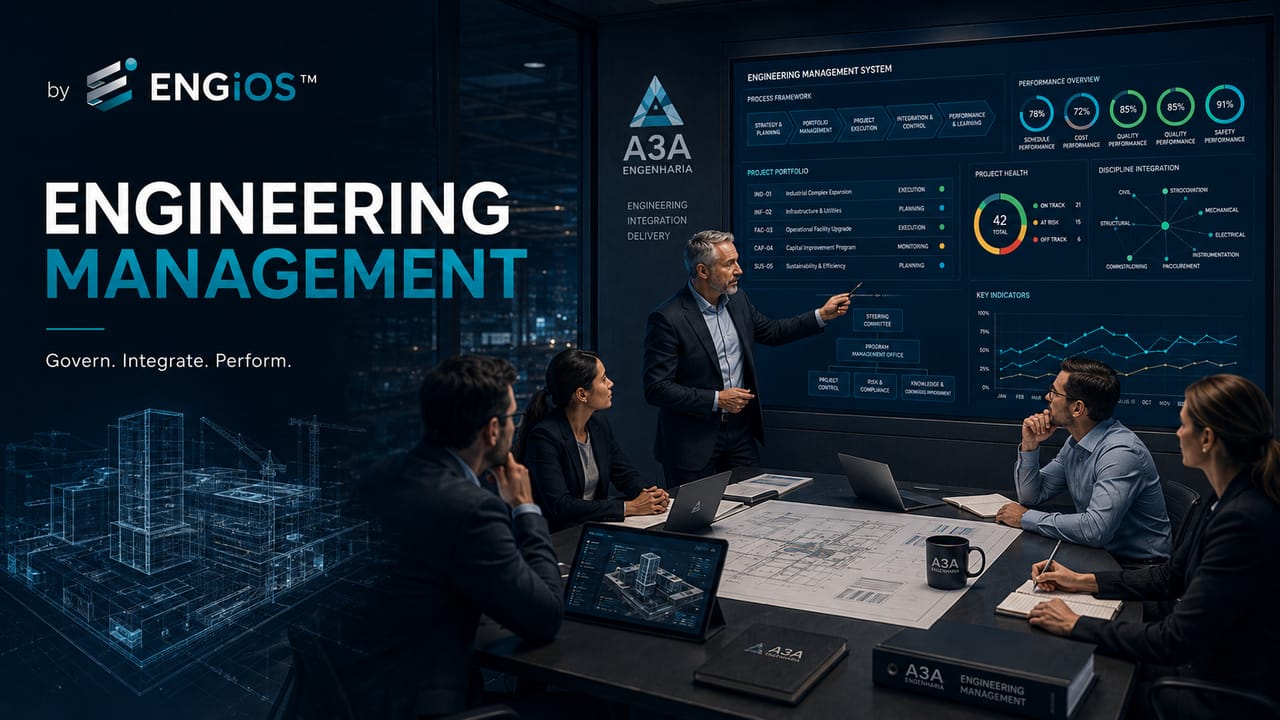
Guide to Engineering Management: governance, PMO, Project Controls, portfolio, technical processes, information, indicators, and the project life cycle.
Check it out!
Engineering management organizes the Engineering function as a system for decision-making, technical production, control, and delivery. Its role is to connect business needs, requirements, investments, projects, resources, documents, contracts, and assets so that technical decisions are not treated in isolation and each stage produces verifiable conditions for the next.
In companies with CAPEX portfolios, critical facilities, modernization programs, or multiple disciplines and suppliers, the challenge is not merely to develop good designs. It is to define priorities, responsibilities, and decision criteria; coordinate interfaces; control changes; integrate schedule and costs with technical production; keep information traceable; and ensure that what was designed, contracted, implemented, and tested remains consistent with project objectives.
For this reason, Engineering Management is broader than schedule monitoring or coordination of designers. It combines governance, management, technical processes, Project Controls, information management, risks, contracts, assurance, implementation, and transition to operations. The exact structure varies according to the organization’s size, criticality, and maturity, but the principle remains the same: transform Engineering into a governable, measurable function capable of sustaining decisions throughout the life cycle.
How Engineering Management connects strategy, management, and technical production
In practice, the function needs to connect decisions that often remain distributed across different areas. Strategy defines why to invest and which outcomes to pursue; management transforms that direction into portfolios, programs, projects, resources, and controls; and Engineering converts requirements into verifiable technical solutions.
This connection can be understood at three complementary levels:
- strategic, where objectives, priorities, investments, constraints, and decision criteria are defined;
- management, where portfolios, programs, projects, resources, risks, contracts, and information are organized and supervised;
- technical, where requirements are transformed into studies, designs, specifications, documents, solutions, tests, and acceptance evidence.
When these levels are not connected, familiar symptoms appear: projects started without clear priority, undocumented technical decisions, schedules disconnected from Engineering deliverables, purchases made before sufficient maturity, revisions without impact control, conflicts between disciplines, outdated documents, and difficulties during commissioning or acceptance.
Engineering management acts precisely on these interfaces. It creates the structure for strategy, governance, and technical production to operate as part of the same management system.
Engineering Management, Project Management, PMO, and Project Controls are not the same function
The terms are related, but they represent different perspectives. In mature organizations, these functions may coexist and complement one another.
| Function | Main focus | Central question |
| Engineering Management | Organization and governance of the Engineering function | How should people, processes, information, and technical decisions be structured? |
| Project Management | Integrated delivery of an initiative | How do we deliver this project and its outcomes? |
| PMO | Methods, governance, support, capability, and portfolio | How do we standardize and sustain project management? |
| Project Controls | Planning, measurement, analysis, and forecasting | Where are we, and where are schedule, costs, and progress heading? |
| Owner’s Engineering | Technical representation of the owner | Do the solution and execution preserve the client’s requirements and interests? |
| EPCM | Integrated management of Engineering, Procurement, and Construction | How do we coordinate implementation across multiple packages and contractors? |
Engineering Project Management acts on a specific project, integrating objectives, scope, schedule, costs, resources, risks, stakeholders, contracts, interfaces, and delivery. Engineering Management, by contrast, may define the processes, standards, authorities, and structures under which multiple projects will be conducted.
The PMO may be part of this architecture, especially for methodology, governance, reporting, portfolio management, and organizational capability development. Project Controls adds the planning and control discipline required to transform schedule, progress, costs, and trends into decision-making information.
The important difference is not terminology. It is responsibility. An effective management model needs to make clear who directs, who decides, who manages, who produces, who controls, who verifies, and who accepts.
How Engineering Management is structured within the organization
The structure does not need to be the same in every company. An organization with a small number of recurring projects may operate with simple mechanisms; a company with a CAPEX portfolio, critical assets, and multiple sites may require a more formal architecture. The design should be proportionate to risk and complexity.
Strategy and portfolio
The Engineering function needs to understand which organizational needs justify investments, which initiatives compete for resources, and how priorities will be reviewed. project portfolio management connects selection, balancing, and prioritization to actual delivery capacity.
The objective is not merely to maintain a list of projects, but to distinguish operational demands, mandatory projects, continuity investments, growth, modernization, and strategic initiatives, considering benefits, risks, dependencies, and constraints.
Governance and authority
Governance defines who has authority to approve investments, authorize phases, accept risks, approve changes, and decide on exceptions. Committees, sponsors, responsible engineers, and managers need to operate within understandable and documented rules.
governance in engineering projects does not replace management. It establishes direction, boundaries, decision rights, oversight, and accountability so that management operates within a clear mandate.
ABNT NBR ISO 21505:2018 reinforces this separation by treating governance as the function that authorizes, directs, supervises, and establishes boundaries for management. In practice, this reduces ambiguity among who decides, who executes, who controls, and who remains accountable for decisions.
Engineering governance needs to transform authority into a traceable decision-making process. The organization must know who decides, using which criteria, and what evidence is required to advance between phases.
Programs and projects
Related projects may be grouped into programs when there is technical, operational, or benefits interdependence. This is common in plant modernization, standards-compliance programs, infrastructure expansion, and master plans, where electrical, automation, security, telecommunications, civil, HVAC, or digital systems need to evolve in a coordinated manner.
Program management should address dependencies between projects, shared resources, common milestones, systemic risks, transitions, and benefits that cannot be attributed to a single initiative.
Engineering and Design
Technical production needs processes for requirements, design criteria, interfaces, reviews, approvals, and maturity control. Issuing a document does not automatically mean the solution is mature enough for contracting or execution.
Practices such as Design Review, design coordination, independent verification, and stage-gates help distinguish documentary progress from actual technical maturity.
Planning and Project Controls
Schedules and costs need to reflect the logic of Engineering deliverables. A plan that records only construction dates and ignores studies, approvals, documents, procurement, manufacturing, releases, and testing does not adequately represent the project.
Project Controls structures baselines, progress, trends, forecasts, and indicators so that deviations are identified before they become irreversible consequences.
Information and documentation
Technical decisions depend on reliable information. Documents, revisions, transmittals, RFIs, meeting minutes, decision records, changes, reports, and test evidence need to remain controlled and traceable.
Engineering technical documentation and Document Control are not peripheral administrative activities: they sustain the very ability to demonstrate what was defined, approved, executed, and accepted.
Engineering Management throughout the project life cycle
Engineering Management should accompany the project from identification of the need through transition to operations. Controls change in intensity, but continuity of decisions and information must be preserved.
This continuity preserves the logic between strategy, investment justification, projects, and benefits. ABNT NBR ISO 21500:2021 relates strategic objectives to the selection of projects, programs, and portfolios and then to deliverables, outcomes, and benefits; applied to Engineering, this logic requires requirements and decisions to remain traceable across feasibility, design, contracting, execution, and operations.
| Stage | Management question | Expected evidence |
| Need / opportunity | What problem or benefit justifies the initiative? | justification, initial requirements, assumptions |
| Feasibility and definition | Which alternative is technically and economically appropriate? | studies, risks, estimates, decision criteria |
| Engineering | Is the solution mature, integrated, and verifiable? | designs, specifications, reviews, approvals |
| Procurement | Does the contracted package correctly represent the need? | scope, requirements, technical criteria, bid equalization |
| Implementation | Does execution remain aligned with the design and approved decisions? | field records, changes, progress, quality |
| Commissioning | Does the system perform according to requirements? | procedures, tests, evidence, outstanding items |
| Handover | Does operations receive a usable and documented asset? | As-Built, manuals, data book, training, acceptance |
| Operations | Do outcomes and benefits remain verifiable? | performance, lessons learned, asset data |
During definition and contracting, integration with Procurement in Engineering projects is critical. Incomplete specifications or packages released before adequate maturity transfer uncertainty to suppliers and tend to reappear as change orders, RFIs, delays, or changes during implementation.
At closeout, management needs to connect testing, outstanding items, documentation, and acceptance. technical handover should be planned before physical completion because operational requirements need to influence Engineering, procurement, and commissioning.
Essential processes in an Engineering Management structure
There is no universal number of processes. The set needs to reflect the context of the organization and its assets. However, some mechanisms appear repeatedly in mature structures.
Requirements management
Requirements translate needs into verifiable conditions for design and acceptance. They need an origin, owner, priority, version, relationship to deliverables, and verification method. Without this discipline, important criteria can disappear between briefing, design, contracting, and execution.
Interface management
Interfaces exist between disciplines, contracts, systems, operational areas, and organizations. An interface issue usually does not belong entirely to a single party; it therefore needs identification, an owner, a due date, dependencies, and closure criteria.
Risk and issue management
Risks address future uncertainties; issues address situations that have already materialized. Both need to be linked to owners, decisions, and potential impacts on scope, schedule, costs, safety, performance, and operations. risk management in Engineering projects should feed governance rather than exist as an isolated register.
Change management
Changes are inevitable in complex projects. The problem is incorporating them without impact analysis or proper authority. Engineering Change Management structures the request, analysis, decision, update of references, and traceability of consequences.
Contract, scope, and deliverable management
Contracts need to be read as part of the Engineering system. Scope, exclusions, assumptions, responsibilities, deliverables, measurement criteria, and acceptance criteria must remain consistent with planning and with the project’s technical structure.
Assurance, verification, and quality
Quality should not depend exclusively on final inspection. Reviews, verifications, audits, gates, and independent assessments may be used at higher-risk points to increase confidence that the next decision is supported by sufficiently mature information.
ABNT NBR ISO 21502:2021 treats project assurance as planned and systematic actions intended to provide confidence to the sponsoring organization and sponsor that the project is likely to achieve its objectives. In Engineering Management, this logic may justify independent reviews, technical audits, additional verification, or decision gates at points of greatest exposure.
Documents and instruments that form the management system
Documentation is not synonymous with bureaucracy. A good system uses only the instruments needed to make responsibilities, references, and decisions visible.
| Instrument | Function |
| Engineering Management Plan | define how the Engineering function will be organized and governed |
| Project Charter | formalize objective, sponsor, authority, and initial boundaries |
| RACI Matrix | define responsibilities and organizational interfaces |
| WBS | structure the work into controllable packages |
| MDR / master document register | control document deliverables, owners, and revisions |
| Master schedule | integrate Engineering, procurement, execution, testing, and delivery |
| Cost baseline | establish the economic control reference |
| Risk register | maintain risks, responses, owners, and evolution |
| Interface Register | control critical interfaces |
| Change Log | record and control changes |
| Decision Log | preserve the history and basis of decisions |
| Executive dashboard | consolidate information for governance |
| Commissioning and handover plan | structure tests, evidence, outstanding items, and transition |
The value lies in integration among these instruments. An MDR disconnected from the schedule shows which documents exist but does not demonstrate which ones condition a procurement action, construction release, or test. Likewise, a change approved without updating the baselines creates two competing versions of project reality.
Indicators for Engineering Management
Indicators should support decisions, not merely produce dashboards. The set varies according to the project stage but needs to combine management performance and technical maturity.
| Dimension | Examples of indicators |
| Portfolio | investments by stage, committed capacity, projects at risk |
| Engineering | planned vs. issued deliverables, revisions, maturity, technical backlog |
| Schedule | milestones, critical path, variance, and trend |
| Costs | budget, committed, actual, forecast, contingency |
| Requirements | verified, pending, and changed requirements |
| Interfaces | open, critical, overdue, and closed interfaces |
| Changes | quantity, origin, impact, and approval time |
| Risks | exposure, trend, overdue responses, and critical risks |
| Documentation | overdue documents, approval time, revisions, and backlog |
| Quality | nonconformities, recurrence, closure time |
| Handover | punch list, tests, final documentation, and operational readiness |
Quantity without context can induce poor decisions. Many issued documents can coexist with low maturity; a high physical-completion percentage may hide systems that have not yet been tested; apparent cost reduction may represent scope transferred to future phases. Indicators need to be interpreted together with technical and governance criteria.
Project Controls, PMO, and governance within Engineering Management
These structures complement one another when their boundaries are explicit.
Governance establishes direction, authority, tolerances, forums, and decision points. The PMO organizes methods, support services, standards, reporting, and organizational capability. Project Controls transforms plans and execution data into performance information and forecasts. Management uses this information to coordinate people, contracts, decisions, and deliveries.
In smaller organizations, some of these functions may be concentrated in the same team. In larger structures, separate teams may exist. The important point is to avoid two extremes: duplicating controls across different areas or leaving gaps because each area assumes responsibility belongs to another.
The Engineering PMO Implementation and Structuring solution is appropriate when the organization needs to formalize this capability permanently, defining mandate, service catalog, processes, indicators, tools, and an evolution model.
PMO, Project Controls, and Management create value when they operate as complementary functions. Methods and controls need to feed decisions, not create parallel reporting structures.
Deep-dive map: Management, PMO, governance, and Engineering consulting
Engineering Management functions as an integrated architecture. To deepen each capability without mixing responsibilities, the content in this cluster is organized into complementary tracks.
| Track | Content for further study |
| Management, programs, and investments | CAPEX Management · Program Management · Benefits Management |
| PMO and organizational capability | Engineering Project Office · EPMO · Maturity Assessment · PMO as a Service |
| Technical governance and decisions | Project Assurance · Technical Authority |
| Technical production and integration | Design Management · Requirements Management · Interface Management |
| Contracting and external support | Engineering Consulting |
These tracks are not silos. In complex projects, governance, PMO, Project Controls, requirements, interfaces, assurance, and technical authority need to operate on the same baselines, decisions, and business objectives.
How to implement an Engineering Management structure
Implementation should begin with the organizational problem, not the tool. Buying software, creating templates, or establishing meetings before clarifying responsibilities usually only digitizes undefined processes.
Assess the current state
The assessment should evaluate portfolio, governance, roles, processes, systems, team capability, documentation, data quality, indicators, interfaces, and the main causes of rework or delay. The objective is to identify where the organization depends on informal knowledge and where risks justify greater control.
Define the target model
The target model establishes which capabilities need to exist and at what level of formality. Not all need to be centralized. Engineering, PMO, Project Controls, Document Control, procurement, and operations may remain distributed, provided interfaces and responsibilities are defined.
Establish governance and decision rights
Sponsors, managers, responsible engineers, and committees need to know which decisions belong to them and which tolerances they can manage. Stage-gates should have verifiable criteria rather than functioning as ceremonial meetings.
Standardize essential processes
Priority should be given to processes that solve real problems: requirements, scope, planning, risks, changes, interfaces, documents, approvals, and acceptance. Extensive procedures that do not change behavior or decisions do not increase maturity.
Integrate information and tools
Systems come after process. PMIS, EDMS, CDE, BIM, dashboards, and corporate platforms should share coherent identifiers and structures to reduce duplicate data entry and divergence between sources.
Measure value and evolve
The structure should be reviewed periodically. Indicators of performance, adherence, rework, decision time, predictability, and information quality make it possible to verify whether controls are producing value or merely increasing administrative effort.
Mistakes that weaken Engineering Management
Some problems recur:
- confusing management with monitoring: meetings and reports do not constitute management when decisions, owners, and actions are not controlled;
- creating processes without authority: procedures that can be ignored do not function as governance;
- separating Engineering from Project Controls: schedule and costs need to reflect the logic of technical deliverables;
- controlling documents without controlling maturity: an issued document does not mean the solution is validated or released;
- leaving requirements and decisions scattered across emails: critical information needs a controlled record;
- treating procurement as an isolated stage: Engineering, purchasing, manufacturing, and implementation share dependencies;
- planning commissioning only at the end: testing and acceptance need to influence design and contracting;
- implementing technology before defining processes: a tool does not correct undefined responsibility or criteria.
The pattern behind these mistakes is fragmentation. Each area may execute its part correctly and the project may still lose performance because interfaces were not managed as part of a single system.
When to engage external support for Engineering Management
External support is useful when the organization needs to add capability, technical independence, or method without immediately structuring all competencies permanently.
| Primary need | Most suitable support model |
| Diagnose a problem, compare alternatives, or support a decision | Engineering Technical Consulting |
| Implement method, processes, and organizational capability | Engineering PMO / management consulting |
| Plan, measure, and forecast schedule, costs, and progress | Project Controls |
| Lead and integrate project execution | Project Management |
| Technically represent the owner’s interests | Owner’s Engineering |
| Integrate Engineering, procurement, and construction across multiple packages | EPCM |
| Maintain recurring technical support on demand | Continuous Consulting Engineering Services |
The choice should start from the actual gap. If the problem is decision-making, it makes no sense to contract control alone. If the problem is predictability, a one-off consulting engagement may not solve the absence of Project Controls. If the owner requires independence in verification, monitoring, and acceptance, the scope needs to incorporate technical representation.
The Engineering Technical Consulting service addresses diagnostic, analysis, study, and decision-support demands. For projects requiring integrated leadership, the engagement may evolve into Project Management, Owner’s Engineering, EPCM, or continuous models according to the level of responsibility required.
The contracting model should correspond to the organization’s actual gap. Diagnostics, process structuring, controls, management, and owner representation require different scopes.
Engineering Technical Consulting for diagnostics and decision support →
What a mature Engineering Management structure should deliver
A mature structure should produce clearer, verifiable decisions, not simply more documents. Strategy and capacity need to guide priorities; governance should make authority and escalation explicit; technical processes need to preserve requirements, interfaces, and acceptance criteria; Project Controls should anticipate trends; and information should remain reliable from investment justification through handover.
The degree of formalization varies according to size, criticality, and risk exposure. Organizations with few projects may operate with lighter mechanisms; CAPEX portfolios, critical assets, and multiple contracts require greater discipline. Maturity lies less in the number of procedures and more in the coherence among responsibilities, baselines, decisions, evidence, and control instruments.
When these capabilities work as a system, Engineering stops depending on scattered decisions and begins to support priority, predictability, technical traceability, and a more controlled transition among investment, design, implementation, and operations.
Technical references
[1] INTERNATIONAL ORGANIZATION FOR STANDARDIZATION. ISO 21500:2021 — Project, programme and portfolio management — Context and concepts. Geneva: ISO, 2021.
[2] INTERNATIONAL ORGANIZATION FOR STANDARDIZATION. ISO 21502:2020 — Project, programme and portfolio management — Guidance on project management. Geneva: ISO, 2020.
[3] INTERNATIONAL ORGANIZATION FOR STANDARDIZATION. ISO 21505:2017 — Project, programme and portfolio management — Guidance on governance. Geneva: ISO, 2017.
Frequently asked questions
It is the integrated organization of the Engineering function through governance, technical processes, projects, resources, controls, and information so that needs and requirements are transformed into verifiable deliverables and assets.
No. Project management conducts a specific initiative. Engineering Management has a broader organizational scope and may establish processes, standards, resources, governance, and control mechanisms used across multiple projects.
The PMO may be one of the structures within Engineering Management, providing methodology, governance, support, reporting, and portfolio management. Engineering Management also involves technical processes, requirements, interfaces, information, assurance, and the asset life cycle.
Project Controls structures planning, baselines, measurement, performance analysis, trends, and schedule and cost forecasts to transform project data into useful decision-making information.
When it has multiple projects or CAPEX investments, diverse teams and suppliers, low predictability, rework, prioritization difficulties, interface conflicts, document problems, or a need for stronger governance and traceability.
Yes. Specific capabilities can be complemented by Technical Consulting, PMO, Project Controls, Project Management, Owner's Engineering, EPCM, or Continuous Services according to the gap and the level of responsibility required.
Complementary technical materials
Related solutions
- Project, Program, and Portfolio Governance
- Engineering PMO Implementation and Structuring
- Requirements, Evidence, and Acceptance Criteria Management
Related engineering services
- Engineering Project Management
- Project Management and Project Controls
- Owner’s Engineering
- Engineering Technical Consulting
Related technical content
- PMO: what it is, types, functions, and how to structure a project office
- Processes and governance in engineering projects
- Project Controls: planning and control of engineering projects
- Project portfolio management
- Risk management in engineering projects
- Engineering Change Management in engineering projects
Guides and references