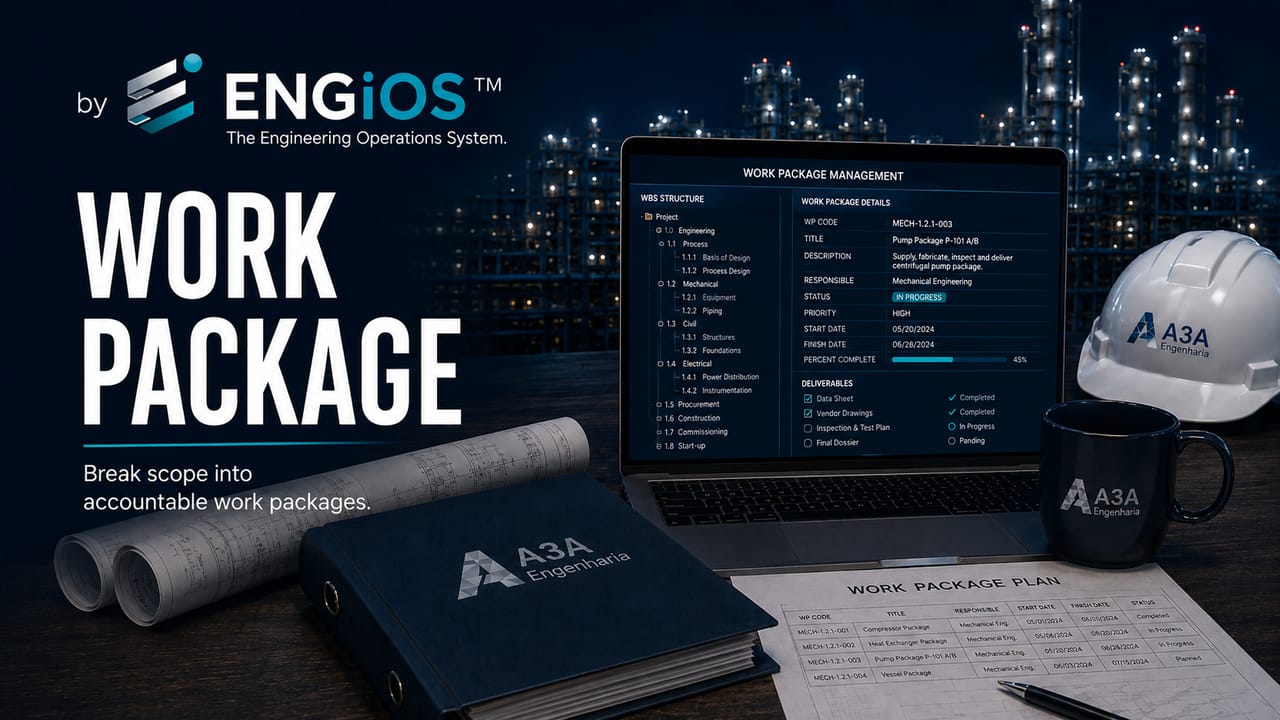
Understand Work Packages in engineering: WBS decomposition, scope, cost, schedule, EVM, interfaces, completion criteria, and change control.
Check it out!
A Work Package is the unit defined at the lowest level of a Work Breakdown Structure — WBS — at which work can be estimated, planned, assigned, and controlled in a manageable way. PMI’s lexicon defines a work package as the work at the lowest level of the WBS for which cost, effort, duration, and resources are estimated and managed. In engineering projects, this turns a broad scope into units with boundaries, an owner, deliverables, budget, schedule, completion criteria, and progress evidence.
A work package is not simply a schedule activity. An activity describes a time-based action; the work package represents a portion of scope and may contain several activities required to produce a deliverable or controllable result. It is also not synonymous with Scope of Work: the SOW establishes the contracted work at the overall or contractual level, while the WBS decomposes that work and work packages create practical units for planning and control.
The quality of this decomposition affects estimating, procurement, planning, EVM, interface management, measurement, and accountability. Packages that are too large hide variation; packages that are too small create bureaucracy. The goal is to reach a unit detailed enough to have an owner and objective criteria without fragmenting the project to the point of losing the system view.
What is a Work Package
The Work Package is the component at the lowest WBS level at which the organization decides to exercise integrated planning and control.
PMI relates the work package to estimating and managing cost, effort, duration, and resources. NASA adds useful characteristics: the package represents a clearly distinguishable unit of work, assigned to an organizational element, with start and finish dates, budget or value, and integration with detailed schedules.
These definitions show that a professional work package needs to answer at least five questions:
- what work is included?
- what result must exist at completion?
- who is accountable for it?
- what cost and schedule are authorized?
- how will we know it is complete?
Work Package, WBS, and Scope of Work
The three concepts are complementary.
| Element | Primary function |
| Scope of Work / SOW | define the obligation and work boundary |
| WBS | hierarchically decompose the total scope |
| Work Package | create a manageable unit at the lowest WBS level |
The Scope of Work in Engineering explains the contractual definition. The work package takes that definition into a structure that can be estimated, assigned, and controlled.
A Work Package is not an activity
A Work Package is not a schedule line. It is a scope unit that needs to connect owner, budget, schedule, deliverables, and objective completion criteria.
Structure WBS and packages with Technical Engineering Consulting
This is a recurring distinction in planning.
A package such as WP-EL-220 — Main Distribution Board MDB-02 may contain activities for:
- detailed engineering;
- component procurement;
- manufacturing;
- inspection;
- FAT;
- transportation;
- installation;
- connection;
- tests;
- documentation.
The work package represents the scope unit. Activities represent the sequence required to execute it.
A Work Package is not a Control Account
In Earned Value Management environments, the Control Account is a control point where scope, budget, and schedule are integrated for performance measurement. A Control Account may contain several work packages.
The actual architecture depends on the project control system, but these levels should not be used as synonyms.
The principle of decomposition
Decomposition means dividing scope until controllable units are reached without losing product logic. The WBS needs to cover the total scope, but this does not mean turning every operational task into an independent package. The appropriate level is where the work gains an owner, deliverable, schedule, cost, and completion criterion without creating a structure that is impossible to maintain.
| Condition | How it appears | Management effect |
|---|---|---|
| Insufficient decomposition | Broad packages such as “execute electrical works” or “implement telecommunications.” | Estimating, measurement, delay analysis, forecasting, and interfaces become too aggregated to explain deviations. |
| Balanced decomposition | Packages associated with deliverables, subsystems, areas, or boundaries that can be managed independently. | Enables control of cost and schedule, assignment of responsibility, and consolidation of results at the upper level. |
| Excessive decomposition | Every small action or schedule activity becomes a work package. | The WBS starts reproducing the schedule, multiplies administrative items, and loses its ability to summarize. |
The balance depends on risk, value, duration, discipline, reporting cycle, and governance model. A critical or high-value package may justify greater granularity than simple repetitive work.
100% rule and scope coverage
A WBS should represent 100% of the defined scope, including management work where applicable.
This does not mean that all known details need to be at the same level. It means that no required work can remain without a place in the structure.
O uso do SOW as a source and Requirements Management as a reference helps verify coverage.
How to define the boundary of a Work Package
The boundary should be observable.
A package may be defined by:
- subsystem;
- equipment;
- area;
- discipline;
- deliverable;
- physical section;
- lot;
- integration stage;
- a controlled combination of these elements.
Avoid mixing criteria without a clear logic. An inconsistent WBS may have one branch by discipline, another by supplier, and another by schedule, making roll-up difficult.
Minimum Work Package structure
A work package should have a record or WBS Dictionary with enough information for execution and control. The objective is not to increase bureaucracy, but to eliminate ambiguity between the WBS code and what actually needs to be delivered.
| Field | What it needs to define | Why it matters |
|---|---|---|
| Identifier and title | Unique code and unambiguous name, consistent with the parent WBS element. | Enable traceability among scope, schedule, cost, and documents. |
| Scope description | Included work, expected result, boundaries, and exclusions. | Prevents the package from being interpreted only by its short name. |
| Deliverables | Physical, documentary, or digital products that evidence completion. | Make progress verifiable. |
| Owner | Person or unit accountable for completion. | Creates an owner to integrate disciplines and interfaces. |
| Budget | Budget or authorized value for the package and its estimate basis. | Enables cost control at the same level where the work is managed. |
| Schedule and milestones | Relevant dates, predecessors, successors, and intermediate milestones. | Connects the package to the actual schedule logic. |
| Completion criteria | Objective conditions for declaring the package 100% complete. | Prevents progress based only on perception. |
| Interfaces | Inputs, outputs, dependencies, and handoffs with other packages or contracts. | Exposes gaps before execution. |
| Assumptions, constraints, and risks | Baseline conditions, limits, and specific material exposures. | Improves estimating, planning, and change control. |
Recommendation from ABNT NBR ISO 21502:2021: the standard defines the WBS as decomposition of scope into progressively lower levels consisting of work packages and characterizes a work package by defined scope, deliverable, time, and cost. This reinforces that a package is not merely a grouping of tasks: it must have sufficiently clear boundaries and product to be planned, assigned, and controlled.
The Requirements Management in Engineering Projects helps verify whether the packages cover the required work, while Interface Management makes dependencies among them visible.
WBS Dictionary
A visual WBS without a WBS Dictionary may hide different interpretations of the same package. The textual description is what turns the code into an auditable scope baseline.
A visual WBS shows the hierarchy, but it is rarely enough to explain each element.
The WBS Dictionary complements the structure with detailed descriptions. It may record:
- code;
- scope;
- owner;
- deliverables;
- milestones;
- budget;
- acceptance criteria;
- references;
- interfaces;
- assumptions.
This dictionary is important when short WBS names could be interpreted in different ways.
Work Package and accountability
Each package needs a clear owner.
This does not mean that one person will execute all the work. It means there is a point of accountability capable of integrating disciplines and answering for the result.
The RACI Matrix may complement the definition when several areas participate.
Work Package and Organizational Breakdown Structure
The WBS shows what must be delivered. The OBS shows who is organized to execute it.
The intersection may generate a Responsibility Assignment Matrix — RAM.
In EVM, this relationship helps associate work packages with Control Account Managers and organizational units.
Work Package and cost estimating
The package is a natural unit for the Basis of Estimate.
An estimate may decompose:
- materials;
- equipment;
- labor;
- engineering hours;
- mobilization;
- third-party services;
- specific contingency;
- applicable indirect costs.
The clearer the scope, the more defensible the estimate.
Basis of Estimate
The Basis of Estimate records how the value was developed.
It may include:
- quantities;
- productivity;
- quotations;
- historical data;
- assumptions;
- exclusions;
- baseline date;
- uncertainty.
This allows cost review without reconstructing the entire logic.
Work Package and schedule
The package needs to be linked to schedulable activities.
A good practice is to ensure that the schedule can answer:
- when does the package start?
- which predecessors release the work?
- which activities demonstrate progress?
- which milestone closes the package?
- which successors depend on it?
A package without a clear relationship to the schedule becomes an accounting item without operational dynamics.
Work Package and milestones
Milestones may represent objective points of physical accomplishment:
- IFC issued;
- equipment released for manufacturing;
- FAT approved;
- delivery to site;
- installation completed;
- energization;
- SAT approved;
- final documentation accepted.
When a package has a long duration, weighted milestones can support objective measurement.
Work Package and Earned Value
EVM requires a disciplined way to measure completed work. The method should reflect the nature of the package and reduce subjective judgment in progress reporting.
| Method | Typical application | Key consideration |
|---|---|---|
| Weighted milestones | Long packages with verifiable technical milestones. | Weights need to represent the real value of the work. |
| Fixed formula | Short, repetitive activities. | Avoid formulas that recognize progress without evidence. |
| Units complete | Work measured by homogeneous completed units. | The unit must have an unambiguous technical definition. |
| Apportioned effort | Work proportional to another measurable activity. | The causal relationship needs to be defensible. |
| Level of effort | Continuous support without a dominant discrete product. | Do not use it to hide work that could be measured by deliverable. |
Recommendation from ABNT NBR ISO 21502:2021: the schedule can be controlled at the level of phases, work packages, and activities, while costs can be assigned to scheduled elements to form a performance baseline. The standard also recognizes Earned Value Management as a possible control technique. In practice, this reinforces the need to align the measurement method with the same package in which scope, schedule, and budget are governed.
Declaring 80% complete based only on the owner’s opinion weakens the indicator. Evidence should come from documents, quantities, milestones, tests, or other verifiable results.
Weighted Milestones
The package budget is distributed among verifiable milestones.
Example:
| Milestone | Weight |
| Design approved | 20% |
| Materials available | 20% |
| Installation completed | 30% |
| Tests approved | 20% |
| Documentation accepted | 10% |
Weights should represent the value of the work, not merely ease of reporting.
100% completion criterion for a Work Package
Declaring 100% physical completion before tests and documentation can distort progress. The package completion criterion should reflect the product actually ready for handover or the next stage.
A package should only be completed when its contractual and technical Definition of Done has been satisfied.
In engineering, this may require more than physical construction:
- reviewed documents;
- completed tests;
- blocking punch items closed;
- As-Built issued;
- records incorporated;
- formal acceptance.
This rule avoids declaring physical progress complete while closeout obligations remain open.
Work Package and deliverables
Each package should produce one or more verifiable results.
If the description contains only effort — “engineering support for 200 hours” — the organization needs to explain what product or capability that effort should generate, except when the service is legitimately Level of Effort.
Professional services can also be structured by deliverables.
Work Package in Consulting Engineering
Examples of packages:
- document Due Diligence;
- field survey;
- alternatives study;
- conceptual design;
- basic design;
- TBE;
- Design Review;
- construction monitoring;
- commissioning;
- closeout report.
Each package may have specific deliverables, authorized hours, and completion criteria.
Work Packages in multidisciplinary projects
Decomposition should address interfaces among electrical, telecommunications, automation, civil, mechanical, and systems disciplines.
Structuring exclusively by discipline can hide system-level deliverables.
For example, an “operational CCTV system” depends on:
- cameras;
- network;
- power;
- servers;
- VMS;
- infrastructure;
- integration;
- testing.
It may be necessary to combine a product-oriented WBS with subordinate discipline packages.
Work Package and Interface Management
The Interface Management should identify inputs and outputs among packages.
An interface may involve:
- document;
- power supply;
- communication;
- space;
- signal;
- material;
- access;
- approval;
- configuration data.
A package without a defined interface may appear complete individually and fail at the system level.
Work Package and Procurement
Work packages may guide procurement lots, but the WBS and procurement strategy do not need to be identical.
A supplier may receive several work packages. A work package may also involve items from several contracts when governance requires it.
The Technical Requisition should maintain traceability with the WBS to avoid scope being lost between contracts.
Contract Work Breakdown Structure
Large contracts may have a CWBS aligned with the owner’s structure.
This relationship facilitates:
- cost roll-up;
- integrated schedule;
- EVM;
- change control;
- reporting;
- supplier integration.
The extent to which the structure is imposed should be proportional to the owner’s control needs.
Work Package and Change Control
When a change occurs, its impact can be located by package.
Questions:
- which WP received the new requirement?
- which dependent packages are affected?
- which budget changes?
- which milestone shifts?
- who needs to approve?
A well-structured WBS improves impact analysis.
Work Package and baseline
Approved scope, budget, and schedule form the package baseline.
Changes need to be version-controlled.
Silently updating the description to accommodate new work destroys the change history.
Work Package and risk
Risks may be associated with the package where they materialize.
Example:
WP: industrial switch supply.
Risks:
- lead time;
- obsolescence;
- qualification;
- import;
- firmware compatibility.
The association makes it possible to connect response, contingency, and owner.
Work Package and contingency
Contingency should not be distributed arbitrarily merely to make packages add up to the total budget.
The reserve should follow the project’s risk and governance methodology.
Packages with greater uncertainty may require wider estimate ranges, but this is different from releasing reserve without an event or authorization.
Work Package and forecast
The owner should update completion and final-cost forecasts based on actual information.
Useful indicators:
- committed cost;
- actual cost;
- estimate to complete;
- estimate at completion;
- physical progress;
- milestone forecast;
- deviations;
- risks.
Work Package and contract measurement
Not every work package needs to be a payment item, but there is value when commercial measurement is connected to verifiable technical progress.
A contract may pay for milestones that aggregate several packages or for independent units.
The important point is to avoid a disconnect in which 90% of the financial value is paid while documentation and acceptance remain without associated value.
Work Package and planning package
In EVM, a planning package represents future work within a Control Account whose content is known at a high level but has not yet been detailed into work packages.
As execution approaches, it is detailed.
It should not be confused with a generic scope reserve.
Rolling Wave Planning
The Rolling Wave Planning allows near-term work to be detailed while future packages remain at a higher level until sufficient information is available.
This is particularly useful in long programs and projects with progressive engineering.
Work Package duration
There is no universal duration.
A package should be short enough to allow control and long enough to represent a meaningful result.
Factors:
- reporting cycle;
- criticality;
- value;
- risk;
- nature of the work;
- availability of intermediate milestones.
Packages that are too long
An 18-month work package with only a start and finish makes objective progress measurement difficult.
Alternatives:
- decompose;
- use weighted milestones;
- create packages by intermediate deliverable.
Packages that are too short
Hundreds of one- or two-day packages may duplicate the activity schedule and make the WBS bureaucratic.
Use work packages for scope control, not to reproduce every operational task.
Example: telecommunications project
Simplified WBS:
- 1.0 Telecommunications
- 1.1 Engineering
- 1.2 Optical backbone
- 1.3 Radio
- 1.4 IP network
- 1.5 Integration and testing
Under 1.2, work packages may include:
- WP-1.2.1 route survey;
- WP-1.2.2 optical infrastructure section A-B;
- WP-1.2.3 optical infrastructure section B-C;
- WP-1.2.4 Tier 1/Tier 2 certification;
- WP-1.2.5 As-Built documentation.
Each has a distinct owner and criteria.
Example: electrical project
A package for a medium-voltage switchboard may contain:
- detailed engineering;
- manufacturing;
- inspection;
- FAT;
- transportation;
- installation;
- tests;
- energization;
- documentation.
If manufacturing and installation have different suppliers, the WBS may decompose them into separate packages with a formal interface.
Example: software/automation project
A work package may be a function or controllable release, provided it has:
- requirements;
- owner;
- effort;
- schedule;
- test criteria;
- acceptance evidence.
It does not necessarily need to be a physical component.
Example: Owner’s Engineering
Monitoring packages may be defined by phase:
- design review;
- procurement;
- manufacturing inspection;
- implementation;
- commissioning;
- handover.
The Owner’s Engineering can use this structure to link hours and deliverables to concrete objectives.
How to create a Work Package step by step
- Identify the parent WBS element.
- Confirm which deliverables are under that branch.
- Define boundaries and interfaces.
- Assign an owner.
- Identify required activities.
- Estimate resources, cost, and duration.
- Define milestones.
- Establish completion criteria.
- Link requirements and documents.
- Record risks and assumptions.
- Integrate with the schedule and budget.
- Approve the baseline.
The package is only ready for execution when it has enough information to be managed.
Criteria for determining whether decomposition has reached the right level
Ask:
- is there a single owner?
- can we estimate cost?
- can we estimate duration?
- is there a verifiable result?
- can we measure progress without subjective opinion?
- are interfaces identified?
- would deviation be detected within the management cycle?
If not, the package may still be too large or poorly defined.
Signs of a poor Work Package
- generic name;
- has no deliverable;
- mixes several responsibilities without integration;
- has no completion criterion;
- budget is arbitrary;
- schedule is not connected to the project schedule;
- depends on undocumented interfaces;
- progress is reported by perception;
- description changes without change control;
- has no link to requirements.
Work Package and quality
Completion criteria should include quality where applicable.
Example: “installation completed” does not mean only that the equipment is physically mounted. It may require:
- recorded torque;
- identification;
- inspection;
- testing;
- report;
- NCR closure;
- documentation.
Work Package and commissioning
Construction packages should produce a clear handoff to pre-commissioning and commissioning.
Required documentation needs to be included in the original package scope to avoid the commissioning team discovering missing records at the end.
Work Package and Data Book
The Data Book should not be treated as a disconnected activity at the end.
Each package should produce its records during execution:
- certificates;
- inspections;
- tests;
- datasheets;
- final drawings;
- material traceability.
The Data Book consolidates what the packages should already have generated.
Work Package and As-Built
When there is a field change, responsibility for redlines, updates, and As-Built issuance should be assigned.
Without this, everyone assumes another party will produce the final documentation.
Work Package and Definition of Done
The expression Definition of Done is common in agile methods, but the idea is useful in engineering: define objective completion conditions in advance.
Example:
- equipment installed;
- test approved;
- documentation issued;
- critical open items closed;
- internal acceptance recorded.
This reduces disputes over progress percentages.
Work Package and contractual interfaces
Two contracts may share the same physical boundary.
Example:
- supplier A delivers the rack;
- supplier B delivers the switch;
- supplier C installs power;
- the owner provides IP;
- integrator D configures the system.
The work packages need to indicate the handoffs between each party.
Work Package and master schedule
The Integrated Master Schedule should be able to consolidate milestones from critical packages.
It is not necessary to expose every microactivity at the executive level, but the roll-up needs to preserve schedule causality.
Work Package and critical path
A package may contain critical activities or feed critical successors.
The WBS alone does not determine the critical path; it emerges from the schedule network logic.
Even so, associating packages and activities makes it easier to understand which scope is causing delay.
Work Package and Claims
In claims analysis, a well-structured WBS helps locate:
- original work;
- changed work;
- impact by package;
- additional cost;
- affected interfaces;
- shifted milestones.
This improves the factual traceability of the analysis.
Change governance
When a package scope changes:
- preserve the previous baseline;
- identify the change request;
- assess cost and schedule;
- review interfaces;
- obtain approval;
- update the WBS Dictionary;
- update the schedule and budget.
The change should not be made only in the schedule without updating the scope.
Work Package in agile or hybrid contracts
Hybrid projects can use work packages at product or release levels while teams detail tasks in a backlog.
The structure can coexist with Scrum or Kanban, provided governance maintains traceability among scope, budget, and deliveries.
Work Package and backlog
The Engineering Project Backlog organizes pending work dynamically. It does not necessarily replace the baseline WBS.
Backlog items can be traced to work packages when they belong to the approved scope.
Work Package and engineering maturity
In early FEL, packages may remain at a higher level. As definition matures, decomposition increases.
The mistake is to artificially detail a still-uncertain scope merely to appear precise.
Planning should reflect actual maturity.
Checklist for approving a Work Package
Before releasing execution, confirm:
- code and title;
- parent WBS element;
- scope description;
- exclusions;
- deliverables;
- owner;
- budget;
- associated activities;
- dates and milestones;
- completion criteria;
- requirements;
- interfaces;
- input data;
- assumptions;
- risks;
- applicable documents;
- measurement method;
- authorization status.
When Consulting Engineering adds value
The Technical Engineering Consulting can structure WBS and work packages when projects involve multiple disciplines, contracts, and interfaces.
The work may include:
- scope decomposition;
- WBS Dictionary;
- definition of deliverables;
- RAM/RACI;
- linkage to budget;
- integrated schedule;
- measurement criteria;
- interface management;
- change control;
- package readiness for execution.
This work increases the ability to detect gaps before mobilization and explain deviations during execution.
Final considerations
A Work Package is a scope-management unit, not just a schedule line. It connects what needs to be delivered with the owner, budget, schedule, activities, interfaces, and completion criteria. When well defined, it makes it possible to estimate and control a portion of the project without losing its relationship with the WBS and project objectives.
Decomposition needs to be proportional. Packages that are too large hide problems; packages that are too small create bureaucracy. The right level is where cost, schedule, resources, and progress can be managed with objective evidence and interfaces remain visible.
In complex projects, work packages also support EVM, procurement, commissioning, the Data Book, and change analysis. The discipline of defining the package before executing it reduces forgotten work, improves accountability, and turns scope into an operational control structure.
Well-designed decomposition makes gaps and interfaces visible before execution and makes it possible to explain cost and schedule by actual portions of scope.
Technical references
[5] BRAZILIAN ASSOCIATION OF TECHNICAL STANDARDS. ABNT NBR ISO 21502:2021 — Project, programme and portfolio management — Guidance on project management. Rio de Janeiro: ABNT, 2021. Available at: https://www.abntcatalogo.com.br/
[1] PROJECT MANAGEMENT INSTITUTE. PMI Lexicon of Project Management Terms. Version 5.0. Newtown Square: PMI, 2026. Available at: https://www.pmi.org/-/media/pmi/documents/registered/pdf/pmbok-standards/pmi-lexicon-pm-terms.pdf
[2] PROJECT MANAGEMENT INSTITUTE. Practice Standard for Work Breakdown Structures. Newtown Square: PMI. Available at: https://www.pmi.org/learning/library/practice-standard-work-breakdown-structures-8063
[3] NASA. Program/Project Planning and Control Handbook. Washington, DC: National Aeronautics and Space Administration. Available at: https://www.nasa.gov/wp-content/uploads/2024/09/ppc-handbook-1-5-17.pdf
[4] PROJECT MANAGEMENT INSTITUTE. The Standard for Project Management and A Guide to the Project Management Body of Knowledge (PMBOK® Guide). 8th ed. Newtown Square: PMI, 2025. Available at: https://www.pmi.org/standards/pmbok
Frequently asked questions
It is the unit at the lowest WBS level where cost, effort, duration, and resources can be estimated and managed, with clearly defined scope and outcome.
A work package represents a portion of scope and may contain several activities. An activity represents an action or task in the schedule.
The SOW defines contracted work at the overall or contractual level. The WBS decomposes that scope, and the work package is a manageable unit of that decomposition.
No. In EVM, the Control Account is a control point that may contain several work packages.
Code, description, deliverables, owner, budget, schedule, completion criteria, interfaces, assumptions, risks, and applicable references.
If it is not possible to estimate cost and duration, assign an owner, measure progress objectively, or detect deviation within the management cycle, it probably needs further decomposition.
Yes. Studies, designs, TBE, Design Review, inspection, and commissioning can be structured as packages with their own deliverables and criteria.
Not necessarily. The commercial measurement structure may group or cross packages, but it should maintain a connection with verifiable technical progress.
Additional technical resources
Related solutions
- Contract, Scope, and Deliverables Management
- Project, Program, and Portfolio Governance
- Process, Workflow, and Technical Approval Management
- Engineering PMO Implementation and Structuring
- Engineering Document Management: DMS, EDMS, revisions, and traceability
Related services
- Technical Engineering Consulting
- Owner’s Engineering
- Engineering Project Management
- Technical Analysis of Amendments, Scope Changes, and Claims
- Technical Acceptance of Engineering Works and Services
- Technical Audit of Data Book and Final Engineering Documentation
Core content on the topic
- Scope of Work (SOW) in Engineering
- Contractual Scope in Engineering
- Requirements Management in Engineering
- Interface Management in Engineering Projects
- Rolling Wave Planning in Engineering Projects
- Engineering Project Backlog
- RACI Matrix in Engineering Projects
Related technical content
- RFP in Engineering
- Technical Requisition in Engineering
- Contracting Strategy in Engineering
- Data Book in Engineering
- Project Management: complete guide to engineering, governance, and control
- Engineering Management: guide to processes, governance, and performance
- Commissioning: complete guide to planning, testing, acceptance, and handover
- Owner’s Engineering: executive framework for procurement, governance, and acceptance
- Technical Handover Framework for Works and Systems
