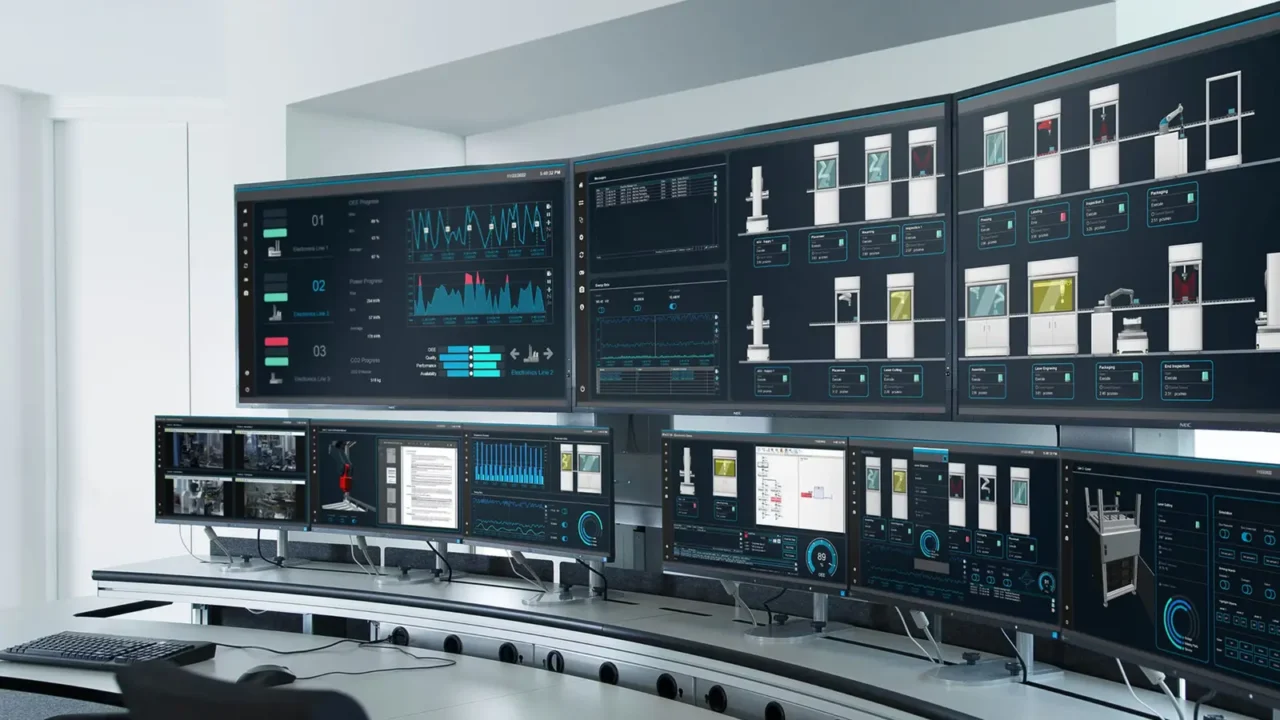
In this article, we explore the main concepts of SCADA in the electric power sector, its basic architecture, its operational applications, and its relationship with systems such as substation automation, EMS, and DMS.
Check it out!
What does SCADA mean and what is its role in the electric power system?
SCADA stands for Supervisory Control and Data Acquisition, a term used to designate systems intended for operational supervision, data acquisition, and remote control of geographically distributed processes.
In the context of the electric power sector, this definition takes on a more specific character: it is the infrastructure responsible for allowing operators, from control centers, to monitor the status of remote equipment and installations, receive field information in near real time, and execute operational actions without the need for physical presence on site.
In functional terms, SCADA exists to convert electrical conditions and operational states of the grid into usable information for supervision, analysis, and remote action.
From the perspective of power systems engineering, the role of SCADA is not limited to the display of synoptic screens or the simple reading of status signals.
Its purpose is to structure the complete flow between field, communication, processing, and operation, encompassing the collection of analog and digital signals, the conversion of these signals into transmissible data, the sending of this information to the operations center, its processing and presentation to the operator, as well as the reverse path for the execution of remote commands over switching and control devices.
This operational logic is precisely what distinguishes a SCADA system from a merely local monitoring solution.
In its classic configuration, SCADA is composed of field elements, remote units, communication infrastructure, and a central supervision station.
In the electrical environment, the RTU has historically occupied a central position in this architecture, providing the interface between installation signals and the control center.
Its main function is to monitor digital states and analog quantities, transmit this information to the central system, and enable the remote control of switches, circuit breakers, and other equipment.
In modern applications, this role may coexist with or be partially shared by IEDs, data concentrators, and substation servers, especially in more digitalized automation architectures.
In the electric power system, SCADA plays a cross-functional role across the chains of generation, transmission, distribution, and substations. Its basic layer includes functions such as data acquisition, telecontrol, alarm management, historical analysis, and report generation.
From this base, the system can be expanded into more complex applications such as SCADA/AGC in generation, SCADA/EMS in transmission, SCADA/DA and SCADA/DMS in distribution, in addition to its integration with substation automation systems.
This means that SCADA should be understood as the fundamental operational platform on which other advanced functions of management, analysis, and automation of the electric power system rely.
From a practical point of view, its role in the electric power sector is to ensure observability, traceability, and operational intervention capability.
It is through SCADA that the operator can identify abnormal states, recognize the sequence of events, evaluate operating conditions of the grid, issue remote commands, and record relevant data for post-event analysis.
In power systems, this translates into greater response capability in the face of failures, better operational coordination between remote installations, and greater support for supply reliability.
Thus, more than a supervisory system, SCADA constitutes an essential infrastructure for the safe, coordinated, and technically traceable operation of critical electrical assets.
