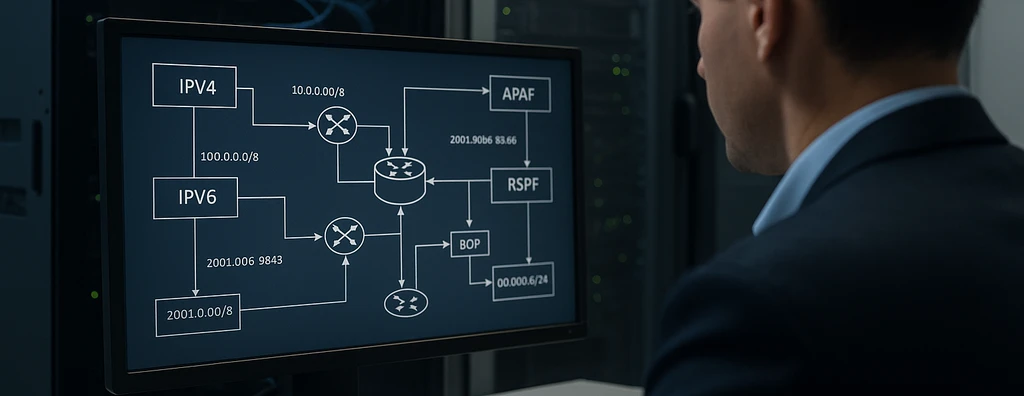
Addressing and routing structures are core elements of IP network architecture, forming the foundation upon which efficient communication, data flow control, and the integration of heterogeneous systems are built. The evolution of scalability, resilience, and security requirements, combined with the constant transformation of corporate and industrial environments, poses technical challenges focused on optimizing address distribution, […]
Check it out!
Addressing and routing structures are core elements of IP network architecture, forming the foundation upon which efficient communication, data flow control, and the integration of heterogeneous systems are built. The evolution of scalability, resilience, and security requirements, combined with the constant transformation of corporate and industrial environments, poses technical challenges focused on optimizing address distribution, implementing robust routing mechanisms, and ensuring the uninterrupted operation of critical applications.
In this article, we will explore the fundamentals of IP addressing (IPv4 and IPv6), subnetting schemes, routing tables and protocols (including RIP, OSPF, BGP, and their roles in modern environments), as well as design best practices for high availability, VLAN integration, and compliance with normative standards for corporate and mission-critical network projects.
Check it out!
[elementor-template id=”24446″]
IP Addressing: Structure and Objectives
IP addressing is the mechanism by which every device connected to an IP-protocol-based network is uniquely identified. IP addresses play a fundamental role in determining the destination of packets and in the operation of routing protocols. The two predominant addressing versions are IPv4 and IPv6: IPv4 is still widely adopted, while IPv6 was designed to overcome scalability and security limitations.
Structure of IPv4 Addresses
- IPv4: A 32-bit address, divided into four octets, usually represented in dot-separated decimal notation (e.g., 192.168.1.10).
- Each IPv4 address has a network portion and a host portion, defined by the subnet prefix (mask).
- Traditional address classes (A, B, C, D, E) — now superseded in modern environments by classless addressing (CIDR).
Structure of IPv6 Addresses
- IPv6: A 128-bit address, expressed in eight groups of four hexadecimal digits (e.g., 2001:0db8:85a3:0000:0000:8a2e:0370:7334).
- A solution designed to handle address exhaustion, global scalability, auto-configuration, mobility, and enhanced native security features.
Addressing Authorities
- Global address management is the responsibility of regulatory bodies such as IANA (Internet Assigned Numbers Authority) and ICANN (Internet Corporation for Assigned Names and Numbers).
Subnetting Concepts and Classes in IPv4
Initially, IPv4 used the concept of classes to define the segmentation between networks and hosts:
- Class A: 0.0.0.0 to 127.255.255.255 — large-scale networks.
- Class B: 128.0.0.0 to 191.255.255.255 — medium-scale networks.
- Class C: 192.0.0.0 to 223.255.255.255 — small-scale networks.
- Class D: 224.0.0.0 to 239.255.255.255 — multicast.
- Class E: 240.0.0.0 to 255.255.255.255 — reserved for future use.
Subnets
Subnet configuration allows dividing an IP network into smaller logical segments, optimizing address usage and improving performance and security concerns. This division is implemented through the subnet mask, which determines the number of available networks and hosts.
Classless Inter-Domain Routing (CIDR)
- CIDR replaces the fixed class concept by using variable-length prefixes (e.g., 192.168.10.0/24).
- It provides greater efficiency in the routing and address distribution process, enabling route summarization to simplify routing tables.
Structure of IP Routing Tables
Routing tables in routers and layer 3 switches are structures that store information about the possible paths for forwarding IP packets. Each entry in the table typically contains:
- Network destination (IP prefix and subnet mask/CIDR)
- Next hop
- Outgoing interface
- Metric/Administrative distance
- Learning source (static, dynamic protocol, etc.)
The hierarchical structure of the tables enables the route lookup process using the longest prefix match criterion — meaning the entry with the most specific prefix that covers the packet’s destination is selected.
Descriptive Example of a Routing Table
Destination: 10.0.0.0/8 Gateway: 192.168.1.1 Intf.: Eth0 Metric: 10 Source: OSPFDestination: 192.168.20.0/24 Gateway: 0.0.0.0 Intf.: Eth1 Metric: 1 Source: Static Route
Dynamic Routing Protocols
Dynamic routing protocols automate the process of updating and maintaining routes, supporting scalability, redundancy, and rapid adaptation to failures. The main protocols used in corporate and large-scale IP networks are:
- RIP (Routing Information Protocol)
- Distance-vector protocol with hop-count-based metrics.
- Suitable for small-scale environments or simple topologies.
- OSPF (Open Shortest Path First)
- Interior routing protocol based on link-state.
- Enables area segmentation and promotes rapid convergence in medium- and large-scale environments.
- Supports hierarchical design and multi-protocol routing.
- BGP (Border Gateway Protocol)
- Exterior routing protocol used in the interconnection of autonomous systems (AS) and in the global exchange of routes between service providers and multihomed corporations.
- Advanced capabilities for routing policy control, filtering, and aggregation.
In addition to these, protocols supporting multicast environments (e.g., IGMP) and high-availability protocols such as HSRP (Hot Standby Router Protocol) are noteworthy, enabling compliance and performance in critical topologies.
Logical Segmentation with VLANs and Inter-VLAN Routing Support
The use of VLANs, according to the IEEE 802.1Q standard, enables logical segmentation of broadcast domains at Layer 2. Inter-VLAN routing is typically performed by multilayer devices or by routers configured with subinterfaces.
- Reduction of broadcast scope and logical organization of departments or infrastructure processes.
- Ease of applying security policies and Quality of Service (QoS).
- Flexibility for modular network expansion while maintaining performance and security.
Risks and Countermeasures in the Security Context
Security within IP addressing and routing structures encompasses various threats, including unauthorized route manipulation, traffic interception, spoofing attacks, malicious asymmetric routing, and integrity compromise of routing tables. Recommended practices include:
- Implementing authentication between routers for dynamic protocols, restricting unwanted updates.
- Using access control lists (ACLs) to restrict traffic between domains and filter suspicious protocols.
- Continuous monitoring of routing tables, looking for unplanned changes.
- In IPv6, adopting IPSec for packet authentication and encryption, integrating native security metrics into the protocol.
Sizing and Scalability
- Use of route aggregation to simplify routing (route summarization via CIDR).
- Network segmentation into smaller areas to facilitate troubleshooting, apply policies, and contain failures.
- Redundancy-oriented design — both physical and logical — for example, with multiple standby routers (HSRP, VRRP, GLBP).
- Adoption of routing protocols with rapid convergence to minimize downtime and operational impact.
Standards and Regulations in Mission-Critical Environments
- Compliance with normative architectures, such as SLA (Service Level Agreements) concepts and Differentiated Services (DS) and Integrated Services (ISA) architectures.
- Planning routing tables with failover capabilities and load balancing.
- Implementation of multihoming policies and routing policy control, especially in the BGP context.
IP network addressing and routing structures represent indispensable foundations not only for secure and efficient data transmission, but also for the viability of large-scale projects, regional/global integration, and the sustainability of critical operations. The maturity achieved by protocols such as OSPF and BGP, the advancement of logical segmentation methodologies, and the maturation of international standards give engineers the capacity to conceive, implement, and sustain resilient, scalable architectures that comply with regulatory and business requirements.
Looking ahead, full adoption of IPv6, expansion of authentication and monitoring mechanisms, and solid integration of VLANs, physical and logical redundancy, and ongoing practices for updating and reviewing routing tables are recommended. Engineering decisions must continuously consider the balance between performance, reliability, security, and architectural flexibility.
