In CCTV (Closed-Circuit Television) systems, video compression plays a fundamental role in balancing image quality and the amount of storage required to record footage captured by cameras. Without adequate compression, systems using high-resolution cameras such as 4K or 1080p would require enormous storage resources and would overwhelm network infrastructure. In this article, we explore how […]
Check it out!
In CCTV (Closed-Circuit Television) systems, video compression plays a fundamental role in balancing image quality and the amount of storage required to record footage captured by cameras.
Without adequate compression, systems using high-resolution cameras such as 4K or 1080p would require enormous storage resources and would overwhelm network infrastructure.
In this article, we explore how different video compression techniques affect both image quality and storage in CCTV systems.
[elementor-template id=”24446″]
What Is Video Compression?
Video compression is the process of reducing the size of video files while preserving as much quality as possible. The goal is to minimize the amount of data needed to transmit and store videos without significantly compromising sharpness or image detail.
There are two main types of compression:
- Lossy Compression: Reduces file size by discarding some image data, which may result in quality loss.
- Lossless Compression: Compresses the video without eliminating any information, preserving original quality, but with lower efficiency in file size reduction.
Main Video Compression Technologies Used in CCTV
1. H.264 (MPEG-4 Part 10, AVC)
H.264 is one of the most widely used video compression technologies today, especially in CCTV systems. It offers a solid balance between video quality and file size, significantly reducing data volume without sacrificing too much image clarity.
- Advantages: H.264 provides up to 50% reduction in file size compared to older technologies such as MJPEG, while maintaining relatively high image quality.
- Disadvantages: Although efficient, H.264 can still generate large volumes of data in systems with multiple high-resolution cameras.
Application: Ideal for small to medium-sized CCTV systems where moderate storage demands exist and image quality is important, but does not need to be at maximum.
2. H.265 (HEVC – High Efficiency Video Coding)
H.265, also known as HEVC, is the successor to H.264, offering even more efficient compression. With H.265, file sizes can be reduced by up to 50% compared to H.264 while maintaining equivalent quality. This is especially useful for 4K recording and systems with many high-definition cameras.
- Advantages: Significant storage savings and reduced bandwidth usage, maintaining exceptional image quality even at very high resolutions.
- Disadvantages: H.265 requires greater processing power, both on the camera side and on the servers or NVRs that store the data. Hardware upgrades may be necessary to support this technology.

Application: Ideal for large-scale CCTV systems or environments using high-resolution cameras (such as 4K), where long-term storage and efficient bandwidth usage are critical.
3. MJPEG (Motion JPEG)
MJPEG is an older compression method that works by compressing each video frame individually, as if it were a JPEG image. Although it has fallen out of use for most high-definition video applications, MJPEG is still found in some CCTV systems due to its simplicity.
- Advantages: Easy to implement and delivers high image quality, since each frame is independent, making frame-by-frame analysis straightforward.
- Disadvantages: Inefficient in terms of storage and bandwidth, as it does not employ advanced inter-frame compression techniques.
Application: Used primarily in low-resolution CCTV systems or specialized applications where frame-by-frame analysis is important, but not recommended for large-scale or high-definition systems.
How Compression Optimizes Storage
Video compression can drastically reduce the amount of storage space required in a CCTV system. Cameras recording at high resolution generate large volumes of data, but efficient compression makes long-term storage of that footage viable.
Storage Impact Example:
- A 1080p camera without compression records approximately 1 GB of video per minute.
- With H.264, that drops to around 200 MB per minute, depending on the scene and compression settings.
- With H.265, the file size can fall to 100 MB per minute or less, while maintaining similar image quality.
This means a CCTV system with 20 cameras recording 24 hours a day would require approximately 29 TB of storage without compression, but with H.265, that requirement drops to 2.9 TB — a considerable space saving.
How Compression Affects Image Quality
While compression is essential for optimizing storage and bandwidth, it is important to note that excessive compression can compromise image quality, particularly in areas where visual detail is critical — such as facial recognition or vehicle license plate identification.
Factors That Influence Quality:
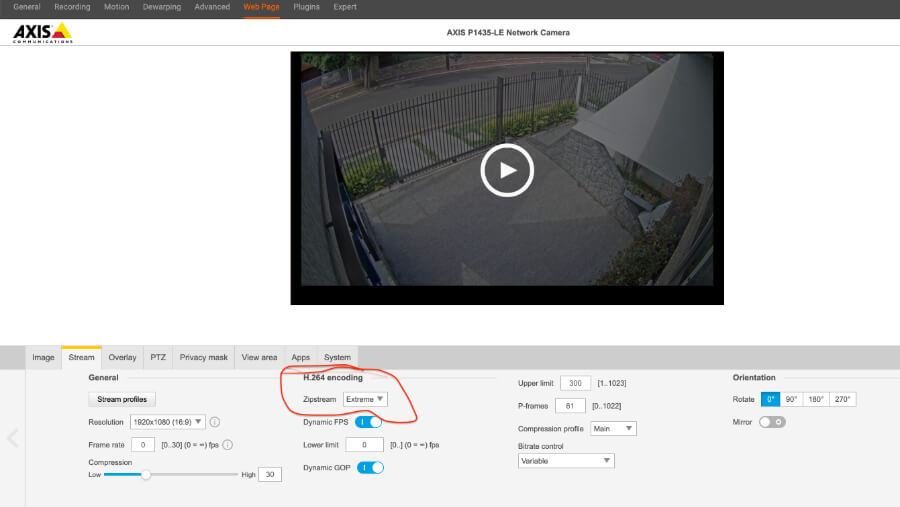
- Bitrate: The bitrate defines how much data is used per second of video. A higher bitrate improves image quality but increases file size. A lower bitrate saves space but may result in loss of detail.
- Frame Rate (FPS): Reducing the number of frames per second also saves space, but can impair video smoothness, making it harder to observe fast-moving events.
Finding the right balance between compression and quality is essential, adjusting recording parameters to the specific needs of each environment.
Impact on Bandwidth
Video compression also reduces the bandwidth required to transmit live video over the network. In large CCTV systems with many high-resolution cameras, data traffic can overwhelm network infrastructure, causing delays or packet loss.
- H.264: Significantly reduces bandwidth usage compared to MJPEG, enabling the transmission of multiple high-definition cameras simultaneously.
- H.265: More efficient than H.264, further reducing bandwidth requirements — which is critical for 4K video transmission or systems with many cameras.
Best Practice: Adjusting Compression by Environment
To optimize CCTV system performance, it is recommended to adjust compression parameters based on the monitored environment. For example, in high-priority areas such as entrances or ATMs, compression should be minimal to guarantee maximum image quality. In less critical areas, such as corridors or low-activity outdoor zones, more aggressive compression can be applied to save storage and bandwidth.
Conclusion
Video compression is an essential tool in CCTV systems, enabling the balance between image quality, storage efficiency, and bandwidth usage. Technologies such as H.264 and H.265 offer powerful solutions for reducing file sizes without sacrificing image clarity. However, it is important to adjust compression settings according to the specific requirements of each environment, ensuring that the CCTV system operates efficiently in both resource usage and visual quality. With the right compression strategy, it is possible to build high-definition monitoring systems that are simultaneously cost-effective and high-performing.
