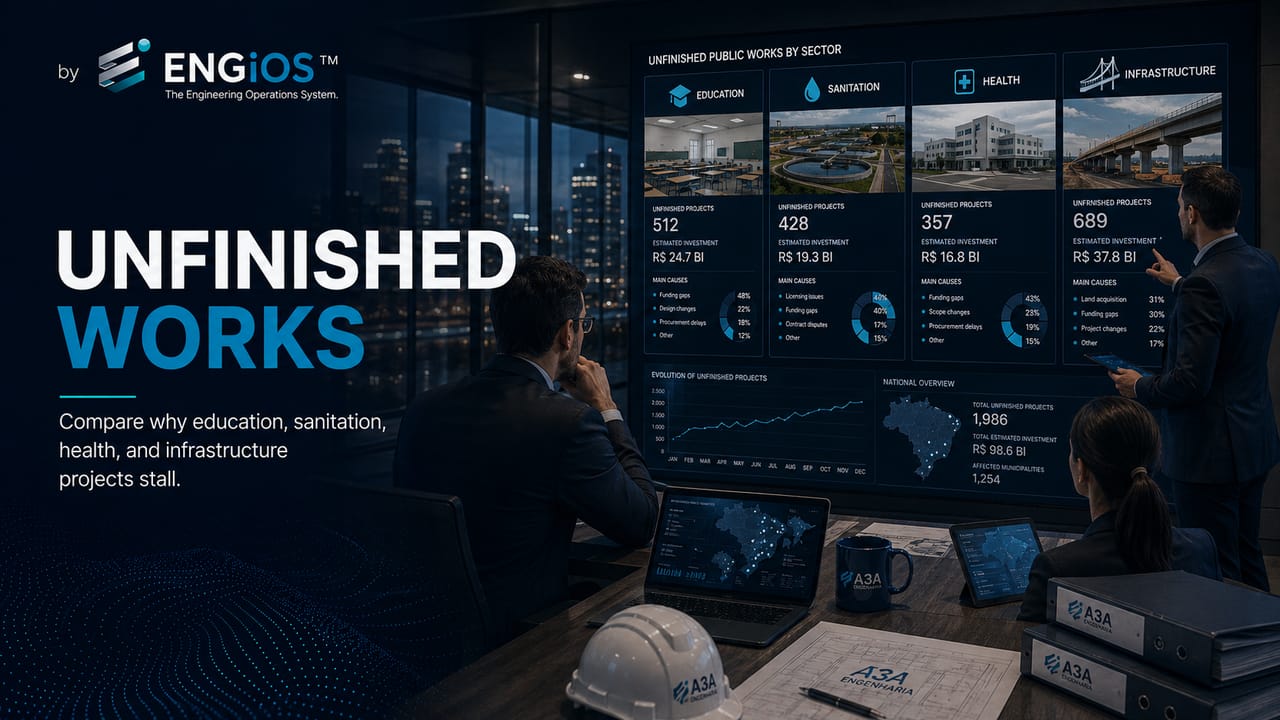
Understand why unfinished education, health, sanitation and infrastructure projects stop for different reasons and how to adapt diagnosis, prioritization and restart to each sector.
Check it out!
Unfinished public works are not a homogeneous problem. A daycare center, a primary health-care unit, a wastewater treatment plant, a bridge and an urban mobility system may appear on the same dashboard as a “stalled project,” but the technical chain that leads to interruption is different in each sector. Funding sources, required design maturity, dependence on equipment and utilities, licensing, interfaces with utility companies, future operating capacity, operating-cost structure and even the type of evidence required to restart the project all vary.
For this reason, the diagnosis of an unfinished public work should begin with a sector-specific question: what public system was this project intended to put into operation, and what technical, institutional and operational conditions are indispensable for it to deliver the expected benefit? The answer changes how the remaining work should be inspected, estimated, reprocured, prioritized and commissioned. Treating every project as merely an interrupted construction contract produces shallow diagnoses and increases the likelihood of a second stoppage.
Why the sector completely changes the risk of stoppage
The sector defines the project architecture. A public work is not merely concrete, building systems and finishes: it is an asset intended to operate within a public policy. A school needs places for students, furniture, accessibility, power, water, staff and authorization to operate. A health-care facility needs, in addition to the building, medical gases, equipment, clinical flows, sanitary requirements, backup power and systems integration. Sanitation depends on networks, plants, water availability, water-use permits, licensing, power and continuous operation. Infrastructure and mobility projects may depend on expropriation, buried utilities, traffic, utility companies, geotechnical conditions and construction sequencing in an active urban environment.
This difference explains why the number of stalled projects by itself does not reveal where the technical risk lies. The dashboard of Brazil’s Federal Court of Accounts (TCU) is indispensable for sizing the problem, but management must move from counting projects to identifying the typology of failures.
According to TCU data released for April 2024, health had 77.5% of projects stalled, education 67.1%, and infrastructure and urban mobility 38% within their respective monitored universes. The consolidation released in 2025, with a cutoff in April of that year, recorded 22,621 projects, of which 11,469 were stalled, equivalent to 50.7% of the total. Education and health together accounted for approximately 70% of stoppages. In June 2026, the TCU again treated education and health as priority areas in the Integrated Program for Resuming Public Works, known as Destrava.
The correct reading of these numbers is not to conclude that “health always stops for one reason” and “education for another.” The data demonstrate concentration and risk. Causality requires technical analysis on a project-by-project basis.
To understand the national picture and the limits of aggregated data, see the article on stalled public works in Brazil and the TCU dashboard.
The same stated cause can represent different technical problems
Administrative expressions such as “contractor abandonment,” “technical problems,” “lack of funds,” “termination,” “documentary pending issue” or “need for rescheduling” are insufficient to build a restart plan. They describe the administrative status of the contract, not necessarily the engineering cause.
A termination may have occurred because:
- the design did not represent actual site conditions;
- the contractor underestimated mobilization, productivity or logistics;
- unrecorded interferences were discovered;
- the reference estimate was outdated;
- payments were delayed;
- a licensing condition prevented execution;
- the contractor lacked financial or operational capacity;
- scope was repeatedly changed without governance;
- the municipality was unable to meet counterpart obligations;
- physical construction advanced before indispensable operating definitions were resolved.
A useful management classification must separate the administrative event, technical cause, contractual cause, financial cause, institutional cause and consequence for the asset.
This approach is consistent with the study by the Brazilian Chamber of the Construction Industry (CBIC), which identifies among recurring causes of stoppages poor quality of studies and designs, contractual nonperformance, budgetary and financial difficulties, expropriation, licensing, rigidity in processing changes, difficulty processing economic-financial rebalancing and interruptions by oversight bodies.
Education: standardization helps, but does not eliminate local risk
Basic-education projects repeatedly appear among the largest groups of interrupted projects. The CBIC study released in 2023 identified 3,580 interrupted basic-education projects in the database analyzed. Problems associated with the sector included lack of clear information, terminations, contractor abandonment, management irregularities and difficulties related to design standardization and adaptation.
Education has an important characteristic: many federal programs fund repeatable typologies — schools, daycare centers, sports courts, covered areas and expansions — while execution is decentralized and depends on the technical capacity of states and, especially, municipalities.
A standard design is not a design ready for every site
A standardized architectural typology reduces design effort, but it does not eliminate the need to adapt the project to local conditions. Risk arises when the reference design is treated as if it automatically resolves:
- topography;
- site investigation and foundations;
- drainage;
- retaining structures;
- site access;
- available public utilities;
- electrical service entrance requirements;
- water-supply and wastewater-disposal conditions;
- accessibility in the surrounding area;
- climate and exposure conditions;
- existing interferences;
- fire-prevention requirements;
- coordination among architecture, structure and building systems.
Construction may begin with an apparently complete design and reveal in the field that actual implementation requires solutions that were not anticipated. If these gaps affect quantities, construction methods, schedule or scope, the contract quickly enters a zone of amendments, stoppages and disputes over responsibility.
Therefore, before procurement, the Administration must verify whether the document set has reached sufficient maturity. The article Public Works Without a Detailed Design? What Law 14,133 Requires Before Starting explores this boundary in greater depth.
A school can be physically complete and still not be operationally ready
Another sector-specific risk is separating construction too much from operations. An educational facility delivers public value only when it has real conditions to operate. This includes furniture, equipment, connectivity, power, water, security, accessibility, applicable licenses and sufficient funding and personnel.
A project can therefore approach 100% physical completion and still deliver no social benefit. This difference between physical completion and operational readiness should be incorporated into portfolio analysis from the planning stage.
How to diagnose an interrupted educational project
The diagnosis should assess at least four dimensions:
- Suitability of site implementation: site conditions, drainage, access, retaining structures, utilities and interferences.
- Compliance of the adapted design: coordination, specifications, accessibility, fire safety, building systems and technical documentation.
- Condition of completed work: defects, exposure, vandalism, deterioration, concealed work and dimensional compliance.
- Readiness for operation: furniture, utilities, staff, operating funding, licenses and integration into education systems.
A restart that ignores the fourth item may complete a building that remains unused.
Health: the building is only one part of the care-delivery system
Health-care projects combine civil construction with higher-criticality technical systems. Even relatively small facilities may depend on sanitary requirements, clean and dirty flows, infection control, medical gases, HVAC, emergency power, electromedical equipment, data networks, access control, fire detection and alarm systems, lightning protection, accessibility and maintenance infrastructure.
This density of interfaces increases sensitivity to design failures and late changes.
The risk of designing the building before closing the clinical program
A health-care facility must originate from the service it will provide. Changes in the care profile alter spaces, loads, infrastructure, equipment and flows. If the functional program changes after the structure or building systems have already been constructed, the cost of change grows nonlinearly.
Typical examples include:
- late addition of equipment with high electrical load;
- need for power redundancy that was not anticipated;
- layout changes caused by incompatible clinical flows;
- HVAC that does not meet required pressure, filtration or air-change conditions;
- medical gases defined only after masonry is complete;
- emergency routes and compartmentation incompatible with the constructed architecture;
- rooms that are physically complete but lack data and support-system infrastructure;
- sanitary requirements discovered only during final licensing.
The problem may become visible during construction, commissioning or only when attempting to place the facility into operation.
Equipment is part of construction planning
In health care, separating “construction” and “equipment” into independent planning processes creates critical interfaces. Equipment defines dimensions, bases, loads, heat dissipation, water, gases, drainage, connectivity, shielding, environmental conditions and maintenance requirements.
The equipment list should be treated as design input even when procurement takes place under a separate process. Governance must trace who provides each item of information and when it is frozen for design.
Restarting a health-care project requires revalidating requirements, not merely completing quantities
After months or years of stoppage, it is not enough to compare the contract bill of quantities with percentages completed. The team must verify whether clinical, regulatory and technological requirements remain valid.
The diagnosis should answer:
- does the clinical program remain the same?
- is the facility still needed at that scale and location?
- are the planned equipment items still available and suitable?
- have applicable standards and regulatory requirements changed?
- have installed systems remained properly preserved?
- must materials with shelf-life or environmental sensitivity be replaced?
- are tests, inspections and certificates traceable?
- does the installed infrastructure support the current operating configuration?
This type of review is essential to avoid turning the restart into the simple completion of a technically obsolete scope.
Sanitation: the asset depends on a continuous physical and environmental chain
Sanitation projects rarely function in isolation. A pumping station needs an incoming network and a discharge main. A treatment plant depends on incoming flow, power, waste disposal, permits and continuous operation. A transmission main depends on intake, storage and connections. An installed network may remain useless if household connections, crossings or treatment units are not completed.
This interdependence creates a particular risk: physically completed components with no system-level functionality.
Licensing and land availability are critical-path constraints
Sanitation may involve:
- environmental licensing;
- water-use permits;
- crossing permits;
- easements;
- expropriations;
- interferences with highways, railways and existing utilities;
- sites for plants and reservoirs;
- effluent discharge;
- sludge and waste disposal.
If these fronts are not resolved before mobilization, the contract may advance in released sections and then lose productive continuity.
The article on expropriation and licensing in public works shows why these risks must be allocated in the procurement documents and contract rather than treated as construction surprises.
Buried networks require real knowledge of subsurface conditions
Incomplete utility records are a frequent cause of rescheduling. Old networks may lack reliable As-Built documentation; utility companies may have partial information; occupancy may have changed between design and construction.
The results include route changes, additional excavation, interference with drainage, telecommunications, power and gas, as well as impacts on traffic and urban restoration.
Therefore, cadastral surveys, investigations, utility locating, georeferencing and field validation must be sized according to the risk of the area.
Electromechanical equipment deteriorates differently from civil works
Pumps, panels, motors, drives, instruments, valves and automation systems may have been purchased and installed before the stoppage. Months of inactivity, humidity, inadequate storage or incomplete energization may compromise reliability and warranty.
Restart requires an equipment-by-equipment inventory, manufacturer traceability, verification of storage condition, electrical and mechanical testing, preservation, lubrication, calibration, firmware where applicable, and commissioning documentation.
A plant that is “95% complete” may require significant technical effort to return to a test-ready condition.
Infrastructure and mobility: territorial interfaces dominate risk
Highways, bridges, bus corridors, terminals, urban-development works, major drainage systems and road interventions share one characteristic: the project develops across active territory and crosses existing systems.
The work affects circulation, properties, utility companies, drainage, commerce, access and public services. Interface risk is therefore central.
Late expropriation fragments the work front
When the Administration does not make land available in a sequence compatible with the schedule, the contractor works in “islands.” This increases movements, reduces productivity, complicates logistics and may leave equipment idle.
The problem is not merely legal. It directly affects productivity and finances.
Law 14,133 recognizes the importance of allocating expropriation risks under integrated and semi-integrated contracting regimes. Even outside these regimes, planning should treat land availability as a readiness condition.
Interfaces with utility companies need their own governance
Water, sewer, power, telecommunications and gas networks cannot be treated as minor field adjustments. Each relocation involves:
- identification of the asset owner;
- relocation design;
- approval;
- cost estimate;
- contracting or execution by the utility company;
- operating window;
- communication with users;
- shutdown or transfer;
- inspection;
- record updating.
If the master schedule does not integrate these activities, construction can stop even when the contract and funding remain available.
Geotechnics and drainage concentrate physical uncertainty
In linear infrastructure, geotechnical conditions vary along the alignment. Insufficient investigation may underestimate rock excavation, slope stability, soil reinforcement, foundations and treatment of compressible areas.
Drainage, in turn, is often affected by urban occupation, watershed changes, existing networks and discharge restrictions. Failures in this area cause rework and may even destroy completed work during rainfall events.
A sector matrix helps prioritize the diagnosis
The comparison below does not replace inspection or a project-specific study. It organizes recurring investigation priorities.
| Sector | Dominant dependency | Recurring technical risks | Condition for delivering public benefit |
| Education | local adaptation and municipal capacity | site implementation, drainage, building systems, accessibility, operations | facility equipped, licensed and supported by staff/operating funding |
| Health | clinical program and critical systems | equipment interfaces, power, HVAC, gases, sanitary requirements and commissioning | validated and operational care environment |
| Sanitation | system continuity and licensing | networks, land, permits, electromechanical systems, automation, power | complete and tested hydraulic/sanitary chain |
| Infrastructure/mobility | territory, land and interferences | expropriation, utility companies, geotechnics, drainage, traffic | continuous corridor/asset integrated with the existing network |
The main message is that “percentage completed” by itself does not represent proximity to delivery. A project with 80% physical progress may be farther from generating benefit than one at 60%, depending on what remains and where those pending items sit in the functional chain.
How to separate root cause, stoppage trigger and consequence
For each project, the diagnostic team should structure a causal chain.
Root cause is the condition that originated the problem. Example: a design based on incomplete utility records.
Intermediate event is what appears during construction. Example: discovery of an existing network incompatible with the planned alignment.
Administrative stoppage trigger is the act that formalizes or consolidates the interruption. Example: suspension of the work front, a stop-work order or contract termination.
Consequence is the resulting damage. Example: schedule extension, need for a revised design, deterioration of materials, economic-financial rebalancing, remobilization and delay in delivering the public service.
Without this separation, the Administration tends to attribute the stoppage to the last visible event. This harms accountability and, more importantly, allows the same cause to remain in the new contract.
The logic is similar to that used in Diagnostic Engineering: evidence, mechanism, cause and recommendation must form a verifiable chain.
The restart diagnosis must be multidisciplinary
A portfolio of stalled public works needs technical triage before resources are spent on designs and new procurements. Due Diligence identifies the real condition, documentary gaps, risks, liabilities and restart effort to support investment prioritization.
An unfinished public work requires more than a visual inspection. The team must reconstruct the technical and documentary status of the project.
The minimum package normally includes:
- contract and amendments;
- current designs and revisions;
- design reports and specifications;
- baseline estimate and contracted bill of quantities;
- original and updated schedules;
- measurements and payments;
- construction daily reports;
- inspection reports;
- RFIs and responses;
- nonconformance reports;
- work orders and stop-work orders;
- licenses and conditions;
- ARTs/RRTs;
- supplier documentation;
- tests and certificates;
- warranties;
- inventory of items purchased but not installed;
- correspondence concerning claims and rebalancing requests.
In the field, the work completed must be surveyed, its condition assessed, concealed work verified based on available evidence, stored materials inspected, equipment inventoried and safety risks identified.
The article Survey of Completed Work and Condition Assessment details this stage.
Physical progress must be converted into delivery readiness
Physical-financial progress is necessary for measurement and control, but it is not sufficient for deciding a restart. The analysis should add a measure of functional readiness.
A practical method is to divide the project into systems and verify, for each one:
- approved design;
- procurement completed;
- installation completed;
- inspections completed;
- individual tests completed;
- integrated tests completed;
- documentation delivered;
- punch items classified;
- technical acceptance;
- operating condition.
This logic reduces the risk of concentrating investment on finishes while critical subsystems remain undefined.
In more complex facilities, the boundary between physical completion and operation should be managed through formal pre-commissioning, commissioning and operational-readiness processes.
The decision to restart must revalidate the public need
A stalled project should not be restarted automatically simply because investment has already been made. This reasoning can create the classic sunk-cost trap: continuing to spend so as “not to lose what has already been spent,” even when the original solution is no longer the best one.
Before a new procurement, the Administration should confirm:
- does the public demand still exist?
- is the scale still appropriate?
- is the location still appropriate?
- does the technological solution remain valid?
- is the cost to complete proportional to the expected benefit?
- is there funding to operate and maintain the asset after delivery?
- are there more efficient alternatives?
- does the design need to be resized or redefined?
This stage is particularly important for old projects in regions where population, urban occupation, public utility networks or sector policies changed during the stoppage.
The analysis of sunk cost in engineering projects helps separate investment already made from the current economic decision.
How to choose which projects to restart first
When there is a large portfolio of unfinished projects, prioritizing only by percentage completed creates distortions. A project that is 90% complete may still require complex licensing, expropriations or expensive equipment. Another at 60% may be completed quickly and deliver immediate benefit.
The prioritization matrix should combine at least:
- social relevance;
- population benefited;
- criticality of the service;
- cost to complete;
- time to complete;
- state of preservation;
- risk of losing the investment already executed;
- design maturity;
- land availability;
- licensing;
- availability of funds;
- operating capacity after delivery;
- contractual complexity;
- existence of litigation or liabilities;
- ability to execute independently of other projects.
Weighting should be transparent. There is no universal weight: health may receive greater weight for criticality; sanitation may require greater weight for environmental conditions; mobility may require high weight for territorial availability.
The new procurement documents must eliminate the cause that brought down the previous contract
Reprocuring the remaining work using the same document set and merely updating prices is one of the fastest ways to repeat the stoppage.
Before the new procurement, the Administration should verify that the following have been corrected:
- design errors and gaps;
- inconsistent quantities;
- conflicting specifications;
- pending licenses;
- unavailable land;
- unresolved interferences;
- outdated cost estimate;
- inadequate measurement criteria;
- incomplete risk matrix;
- ambiguous responsibilities;
- lack of acceptance criteria;
- dependencies on utility companies;
- interfaces with equipment and parallel contracts.
The article Remaining Public Works: How to Procure What Is Left Without Inheriting the Previous Contract’s Problems explores this process in greater depth.
The role of Consulting Engineering in a portfolio of unfinished public works
When the project enters a new contract, the risk does not end. Owner’s Engineering creates an independent governance layer over scope, interfaces, evidence, changes, measurement, quality and acceptance through entry into operation.
When a public body has dozens or hundreds of projects in different situations, the challenge is not simply to carry out an inspection. It is to create portfolio governance capable of comparing projects, prioritizing resources and structuring repeatable decisions.
Consulting Engineering can operate in layers:
Layer 1 — portfolio screening
Classification by sector, stage, amount already executed, deterioration risk, funding source and social relevance.
Layer 2 — rapid technical diagnosis
Preliminary inspection, documentary review and identification of the main gaps to decide whether deeper analysis is warranted.
Layer 3 — due diligence of the priority project
Detailed survey, preservation condition, designs, contracts, cost estimate, licenses, risks and liabilities.
Layer 4 — engineering for restart
Design revisions, estimate for the remaining work, schedule, contracting strategy, risk matrix, Terms of Reference, procurement documents and acceptance criteria.
Layer 5 — implementation oversight
Owner’s Engineering, technical support for inspection, evidence management, changes, RFIs, nonconformities, measurement and commissioning.
This structure avoids spending the same level of technical effort on every project before determining which ones truly deserve priority.
What changes in the restart strategy by sector
The final strategy must reflect the system that will be delivered.
Education
Prioritize design adaptation, site condition, facility functionality, accessibility, building systems, furniture, staffing and future operating funding.
Health
Revalidate the clinical program, equipment, sanitary requirements, critical systems, power, HVAC, gases, integration and commissioning.
Sanitation
Confirm hydraulic/sanitary continuity, land, licensing, permits, networks, power, electromechanical equipment, instrumentation and operations.
Infrastructure and mobility
Resolve territorial availability, expropriations, interferences, utility companies, geotechnics, drainage, sequencing, road safety and integration with the existing network.
The common denominator is simple: the new contract should begin only when conditions that depend on the Administration are sufficiently mature and when residual risks have been identified and allocated.
Final considerations
Unfinished public works should be analyzed as incomplete sector assets, not as a single category of interrupted contract. Education, health, sanitation and infrastructure have different value chains, risks and operating conditions. These differences change the diagnosis, required documentation, order of decisions and type of engineering needed for restart.
Effective management begins by separating cause, administrative trigger and consequence. It then reconstructs the asset’s actual condition, revalidates the public need, calculates the effort required to complete the project and removes from the new scope the gaps that produced the previous failure.
When this logic is applied at portfolio level, the public body stops managing a list of stalled projects and begins managing an investment portfolio with technical criteria for prioritization, restart and delivery of public benefit.
Technical references
[1] BRAZIL. Federal Court of Accounts. High-Risk List of the Public Administration — Management of stalled public works. Brasília, DF: TCU. Available at: https://sites.tcu.gov.br/listadealtorisco/gestao_das_obras_paralisadas.html
[2] BRAZIL. Federal Court of Accounts. TCU President signs agreement to resume stalled public works. Brasília, DF, June 11, 2026. Available at: https://portal.tcu.gov.br/imprensa/noticias/presidente-do-tcu-assina-acordo-para-retomada-de-obras-publicas-paralisadas
[3] BRAZILIAN CHAMBER OF THE CONSTRUCTION INDUSTRY. CBIC presents study on the main causes of stalled public works in Brazil. Brasília, DF, December 15, 2023. Available at: https://cbic.org.br/cbic-apresenta-estudo-sobre-principais-causas-de-obras-paralisadas-no-brasil/
[4] BRAZILIAN CHAMBER OF THE CONSTRUCTION INDUSTRY. The stubbornness that leads to paralysis of public works. Brasília, DF, August 21, 2025. Available at: https://cbic.org.br/artigo-a-teimosia-que-leva-a-paralisia-das-obras-publicas/
[5] BRAZIL. Law No. 14,133 of April 1, 2021. Public Procurement and Administrative Contracts Law. Brasília, DF: Presidency of the Republic. Available at: https://www.planalto.gov.br/ccivil_03/_ato2019-2022/2021/lei/l14133.htm
Frequently asked questions
In addition to the large number of projects in these sectors, many are decentralized and depend on the technical and financial capacity of local governments. Education and health also require operating conditions after physical construction, such as staff, funding, equipment, licenses and complementary systems.
No. Physical progress is only one criterion. Prioritization should consider social benefit, cost and time to complete, preservation condition, design maturity, licenses, land, risks, available funding and the ability to operate the asset after delivery.
In sanitation, functionality depends strongly on system continuity: networks, plants, power, licensing, permits, land and equipment must operate as a chain. Physically completed components may deliver no benefit if the system remains interrupted.
No. Standardized designs must be adapted to topography, geotechnics, drainage, access, public utilities, power, accessibility, fire safety and other local conditions. Using a standard typology without sufficient implementation engineering transfers uncertainty to construction.
The completed work must be surveyed and assessed, and the designs, estimate, licenses, interferences, land, equipment, measurements, liabilities and causes of the stoppage must be reviewed. The new procurement documents must correct the conditions that made the previous contract unviable.
It can structure portfolio screening, prioritization criteria, technical diagnosis, due diligence, design review, remaining-work estimates, contracting strategy, risk matrix, procurement support, inspection, Owner’s Engineering and commissioning.
Complementary technical materials
Related solutions
- Contracts, Scope and Deliverables Management
- Requirements, Evidence and Acceptance Criteria Management
- Project, Program and Portfolio Governance
- Pending Items, RFIs and Nonconformities Management
Related services
- Technical Engineering Due Diligence
- Engineering Cadastral Survey
- Technical Support for Public-Works and Engineering-Contract Inspection
- Owner’s Engineering
- Public Works and Engineering Services Cost Estimating
- Technical Review of Procurement Documents for Engineering Contracts
Key content on this topic
- Stalled Public Works in Brazil: Updated TCU Map and Most Affected Sectors
- How to Restart a Stalled Public Work: 8-Step Technical Protocol
- Survey of Completed Work and Condition Assessment: The Document That Unlocks Restart
- Remaining Public Works: How to Procure What Is Left Without Inheriting the Previous Contract’s Problems
Related technical content
- Diagnostic Engineering: What It Is, Inspection, Diagnosis and Action Plan
- Sunk Cost in Engineering Projects
- Risk Allocation Matrix in Engineering Contracts
- Complete Guide to Public Procurement and Contracts for Public Works and Engineering Services
- Owner’s Engineering: Executive Framework for Contracting, Governance and Acceptance