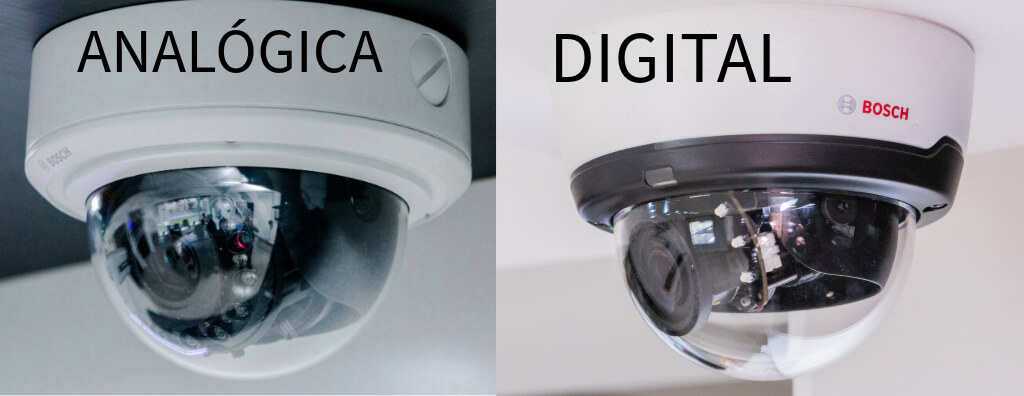
In this article, we will talk about the main differences between IP cameras and analog cameras in CCTV systems, highlighting how these technologies impact image quality, installation flexibility, and the scalability of monitoring systems. Understanding these distinctions is essential for designing an efficient system that meets the security needs of each environment. [elementor-template id=”24446″] Image […]
Check it out!
In this article, we will talk about the main differences between IP cameras and analog cameras in CCTV systems, highlighting how these technologies impact image quality, installation flexibility, and the scalability of monitoring systems. Understanding these distinctions is essential for designing an efficient system that meets the security needs of each environment.
[elementor-template id=”24446″]
Image Quality
IP cameras generally offer superior image quality compared to analog cameras. This is because IP cameras can capture and transmit video with higher resolution, often reaching resolutions up to 4K or more, while traditional analog cameras are limited to lower resolutions. This allows IP cameras to provide sharper and more detailed images, essential for identifying faces, license plates, and small details in monitored environments.
- IP Cameras: Varied resolutions, supporting images in HD, Full HD, 4K, and beyond.
- Analog Cameras: Limited to lower resolutions, such as D1 (704×480) or, in more advanced systems, resolutions up to 960H (960×480).
Installation Flexibility and Scalability
IP camera systems use data networks to transmit images, which offers greater flexibility in installation, especially in locations with existing network infrastructure.
It is possible to integrate multiple cameras into large monitoring systems using switches, routers, and network cables (usually twisted pair cables). Additionally, IP cameras can be powered via Power over Ethernet (PoE), which eliminates the need for dedicated power points for each camera, facilitating installation.
On the other hand, analog cameras depend on coaxial cables to transmit images, which limits transmission distance and system scalability. Adding new cameras to an analog system requires the installation of new cables and often additional equipment such as multiplexers and DVR recorders, which can increase the complexity and cost of the system.
- IP Cameras: High scalability, can be easily integrated into existing networks and powered via PoE.
- Analog Cameras: Limited scalability, demands greater physical infrastructure and additional equipment.
Installation and Maintenance Costs
Digital systems tend to have a higher initial investment due to the price of the cameras and the necessary network infrastructure. However, the total cost of ownership can be lower in the medium and long term, as IP systems are easier to expand and maintain, besides offering greater flexibility for future adaptations.
Analog systems, on the other hand, have a lower initial cost, both in terms of cameras and infrastructure. However, their limited scalability and the need for additional equipment for advanced features can increase costs as the system expands.
- IP Cameras: Higher initial investment, but with better cost-benefit in the medium and long term.
- Analog Cameras: Low initial cost, but costs increase as the system grows.
Integration with other Security solutions:
Integration of CCTV System with Access Control:
The integration between CCTV and access control systems is one of the most powerful innovations in the field of electronic security, and this functionality is only fully possible in digital systems, based on IP cameras.
Let’s explore how this integration works and the benefits it provides in terms of security and automation.
Integration Overview
The main advantage of the integration between CCTV and access control is the ability to create a unified system in which access control events, such as people’s entry and exit, are directly connected to the images captured by the cameras. This allows system operators to visually monitor and verify any access event in real-time, in addition to storing the images for later audit.
In digital systems, such as those using IP cameras, integration is seamless, with devices communicating through the network. IP cameras and access control systems can be managed by centralized software that consolidates information, offering a complete view of security activities.
Integration Benefits
- Real-Time Monitoring and Event Verification One of the greatest benefits of this integration is the ability to visually verify any access control event in real-time. Whenever a door is unlocked or a person uses an access card or biometrics to enter a controlled area, the CCTV system can automatically record and display the images from that moment. This allows the operator to immediately validate if the person accessing the area is authorized, preventing intrusions.
- Practical example: When an employee uses a biometric terminal or access card, the camera positioned at the entrance automatically captures the action, allowing the operator to verify who is accessing.
- Automation of Incident Responses With the integration between CCTV and access control, it is possible to configure automated responses to incidents. For example, if an unauthorized access attempt occurs, the CCTV system can be configured to focus on certain areas, trigger alarms, notify the security team, or even automatically block access in adjacent areas, preventing intruders’ advance.
- Practical example: A report can show that a certain employee accessed a restricted area outside of working hours. By reviewing the CCTV images, it is possible to verify if there was any irregular behavior.
- Improvement in Security Management The integration of these two systems allows for more efficient security management. With all events consolidated in a single interface, operators can make decisions quickly, based on real-time visual and access control information. This decreases incident response time and increases the overall safety of the environment.
- Practical example: An operator can monitor multiple access points and cameras simultaneously without the need to switch between different systems, allowing for a quick response to any situation.
- Intelligent Recording and Storage Reduction In digital systems, integration can be configured so that CCTV cameras record only during critical moments, such as during an access control event. This optimizes storage space use, as recordings are focused on relevant moments, avoiding the need for continuous recording, which saves space and resources.
Limitations of Analog Systems
In analog systems, integration between CCTV and access control is extremely limited. As these systems lack the capability to connect via a network and exchange information in real-time, it is much more difficult to automatically correlate access control events with camera images. Generally, verifications are done manually, reviewing recordings after the event, which reduces the effectiveness of the integration.
Conclusion
When comparing IP and analog cameras, it’s evident that the choice depends on the specific needs of the project.
IP cameras are the ideal choice for those seeking high image quality, advanced features, and scalability. Analog cameras may still be useful in scenarios where initial cost is a concern and system flexibility is not critical. However, as technology advances, IP cameras are certainly the best options, offering more robust and efficient solutions for electronic security.
