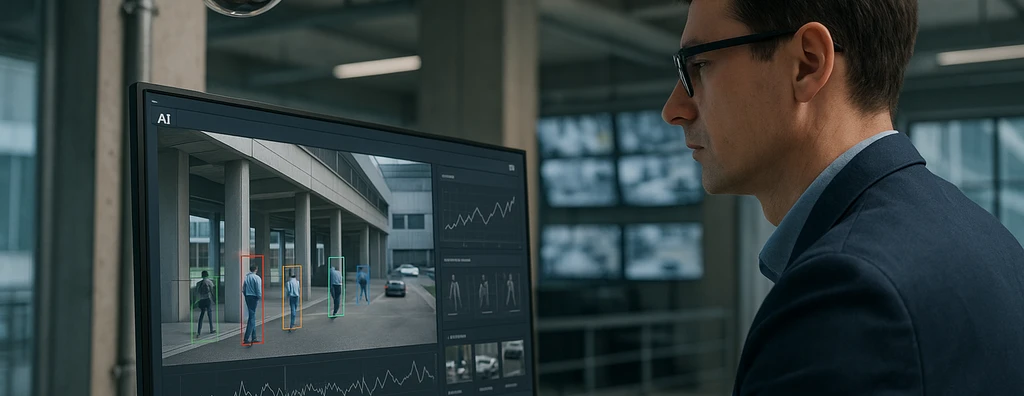
Discover the future of video synopsis and AI in electronic security. Learn how DLPU and Edge Analytics transform monitoring into actionable intelligence.
Check it out!
The field of computer vision, highlighted by video synopsis and its applications in electronic security systems, presents significant advances driven by artificial intelligence (AI). The use of video analytics has become a technical differentiator, providing actionable insights, real-time analysis, and advanced processing of large volumes of visual data. The growing demand for efficient monitoring and automated event responses has raised the level of project complexity and expanded the requirements for system quality, in both hardware and algorithms.
In this article, we will address the current scenario, perspectives, and trends of video synopsis with AI, encompassing conceptual foundations, regulatory requirements, implementation architectures, operational impacts, integration challenges, ethical aspects, and future projections for professional electronic security systems.
Check it out!
[elementor-template id=”24446″]
Current Panorama of Video Synopsis with AI in Electronic Security
Video synopsis consists of processing and analysis techniques that allow for condensing hours of recordings into summary clips, highlighting relevant events. Modern video surveillance systems generate large volumes of visual data, most of which is not reviewed, potentially resulting in security events not being detected in a timely manner.
- AI-based analytics allow for examining live or recorded streams, generating detailed descriptions (metadata) of scenes, people, vehicles, and behaviors.
- Intelligent processing uses algorithms to highlight critical events: detection of presence in restricted areas, unusual movement, vehicle approach, among others.
Standards such as ABNT NBR IEC 62676-1-1:2019 formally conceptualize Video Content Analysis (VCA) practices, establishing requirements for detection, classification, alarm generation, and metadata integration with higher-level systems.
Evolution of Video Analytics and the Role of Artificial Intelligence
The evolution of video analytics has been strongly driven by the use of artificial intelligence, especially advanced deep learning models. The main observed trends include:
- Object Detection and Classification: Deep neural networks effective the identification, tracking, and classification of multiple objects simultaneously, even in adverse conditions.
- Recognition of Complex Activities: AI models detect behavior patterns and anomalies, allowing for automated responses and incident anticipation.
- Extraction and Use of Metadata: The analysis generates precise attributes of the recorded objects and events, fostering efficient search and automated forensic auditing.
Professional cameras incorporate high-performance processors (SoCs with DLPU – Deep Learning Processing Unit), such as the ARTPEC-9, which enable embedded analytics and continuous learning of behavioral patterns.
Implementation Architectures for AI Video Analysis
The architecture of AI-based video analysis and video synopsis systems can be segmented into four main operational models:
- Edge Analytics: Processing is performed directly on the capture device (camera), reducing latency and the bandwidth needed to send full streams.
- Server-based: Large volumes of video are processed by centralized servers, suitable for complex environments, multiple sources, and corporate integrations.
- Cloud-based: Analysis occurs in a distributed manner, allowing for scalability, flexible storage, and continuous algorithm updates.
- Hybrid Architecture: Combines edge resources, local servers, and the cloud for load balancing, redundancy, and operational flexibility.
The choice of architecture depends on the project objective, performance requirements, privacy policy, and regulatory compliance.
Technical Features and Operational Benefits of Video Synopsis
The main operational benefits of video synopsis with AI for electronic security systems are:
- Forensic Efficiency: Drastic reduction in the time required to review large amounts of video, facilitating investigations and audits.
- Alarm Automation: Automatic generation of notifications and actions in response to event detection, integrating with access control systems, building automation, and critical operations management.
- Analytical Precision: Possibility of highly refined searches based on attributes and behaviors extracted from visual data.
- Scalability and Flexibility: Systems based on open standards allow for organic integration and expansion as needs evolve.
- Active Privacy Protection: Algorithms can be used to mask sensitive areas and anonymize individuals in monitored scenarios.
Technical Challenges and Current Limitations of Video Synopsis with AI
Despite the advances, video synopsis projects with artificial intelligence face important technical challenges and limitations:
- Image Quality and Integrity: Noise, inadequate lighting, and optical limitations of the sensors impact the performance of AI algorithms, requiring high-performance cameras and optical systems.
- Data Volume and Variety: Analysis of multiple simultaneous HD/4K streams imposes high demands on processing hardware, networks, and storage solutions.
- False Positives/Negatives: Environmental interference and model limitations can lead to inadequate detections, making it necessary to calibrate algorithms according to the operational context.
- Integration with Legacy Systems: The use of open platforms and compliance with international standards becomes fundamental to ensuring interoperability and secure integration with other system layers.
Standards, Patterns, and Ethical Considerations
The use of video synopsis and AI analytics in electronic security requires compliance with international and national standards and technical recommendations:
- ABNT NBR IEC 62676 (all parts): Defines requirements for video surveillance systems, performance criteria, integration, interoperability, and data security.
- Privacy Requirements: Data derived from video analysis can be sensitive. It is recommended to employ anonymization, automatic masking, and auditing techniques for metadata access.
- Operational Responsibility: Automated systems must provide for human review in critical cases, avoiding decisions based exclusively on AI.
The ethical adoption of AI requires transparency, event traceability, and clear data governance policies in electronic security projects.
Emerging Trends and Future of Video Synopsis with AI
Trends for the coming years include:
- Deep Learning Advancements: Expanded use of DLPUs and algorithms trained with large volumes of data, increasing real-time detection and classification capabilities.
- Decentralized Analysis: Increasingly distributed edge processing, increasing agility and reducing privacy risks.
- Standard Interoperability: Systems adhering to technical standards will facilitate multi-vendor integrations and rapid adoption of new features.
- Applications Beyond Security: Use of video synopsis for analyzing people flow, logistics, process auditing, and supporting tactical decisions in industrial and urban environments.
- Privacy by Design: Algorithms natively prepared to respect regulatory restrictions and ensure anonymization in analytical processing.
- Cyber Resilience: Focus on protecting sensitive data and managing vulnerabilities in surveillance system processing and network layers.
Conclusion
The adoption of video synopsis with artificial intelligence in electronic security systems represents a robust transformation in how relevant events are identified and addressed operationally. The integrated use of advanced analytics, scalable architecture, and high-performance AI models allows for a predictive and automated view, optimizing co-responsibility and results. Compliance with technical standards, secure integration, and a commitment to privacy are structural elements for successful initiatives.
It is recommended that networking engineering decisions consider not only immediate efficiency gains but also the ongoing challenges of maintenance, information security, and technological updates. Long-term projects should prioritize flexible, interoperable architectures that adhere to normative best practices, consolidating technical and operational sustainability.
Final Considerations
Given the analyzed trends and the requirements imposed on the sector, the use of video synopsis with AI shows tangible gains in efficiency, precision, and governance of electronic security systems. We thank you for reading this article and encourage professional teams to follow A3A Systems Engineering on social media for news, technical reference information, and continuous updates in security applied technology.
