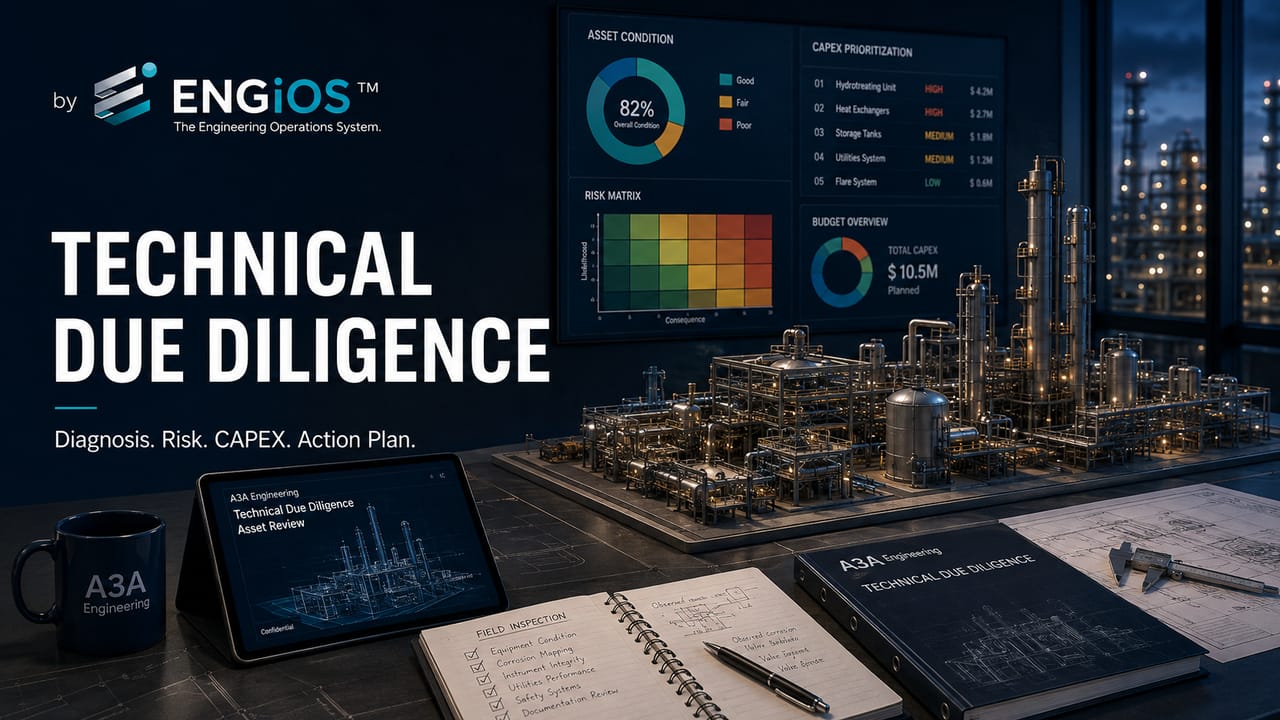
Understand how technical due diligence of assets and facilities works: scope, documents, field inspection, condition, risks, CAPEX, priorities, and action plan.
Check it out!
Technical due diligence of assets and facilities is a structured, evidence-based assessment designed to reduce uncertainty before a significant decision: acquisition, investment, modernization, contracting, renewal, expansion, or assumption of responsibility for existing infrastructure. The work compares documentation, physical condition, performance, compliance, criticality, and risks to turn an insufficiently known installed base into a technical diagnosis with priorities and recommendations.
Due diligence should not be confused with a simple visual inspection, a document audit, or a single-discipline technical report. The scope must be proportional to the decision being made and to the consequences of incorrect or missing information. In complex facilities, the outcome may guide CAPEX, corrective actions, design work, contingencies, contracts, maintenance, and asset management.
What Is Technical Due Diligence of Assets and Facilities?
Technical due diligence seeks to determine whether the actual condition of the assets is compatible with the intended use, which risks are present, which gaps must be addressed, and which technical and financial commitments may arise after the decision.
In an acquisition, it reduces the risk of buying infrastructure with hidden technical liabilities. In a modernization program, it helps identify what can be safely reused and what requires adaptation. In operations, it can establish a baseline for a master plan, asset management, or renewal strategy.
The term is broad. RICS uses technical due diligence for technical assessments of commercial and industrial property and emphasizes that the scope should be adapted to the asset type, purpose, and jurisdiction. ASTM E2018-24, focused on property condition assessments, also treats the process as a baseline subject to uncertainty and adaptable to user objectives. These references are useful methodological principles, but they do not replace applicable local standards, legal requirements, or discipline-specific specialists.
Due Diligence Is a Decision Process, Not a Form
A checklist can support data collection, but it is not the principal intellectual product. The value lies in interpreting evidence and distinguishing isolated defects, systemic risks, obsolescence, noncompliance, missing documentation, and investment needs.
Two facilities with the same defect may require different recommendations if their criticality, redundancy, future use, and recovery capability differ.
When to Perform Technical Due Diligence
The best-known application is before acquiring an asset or property, but there are many others.
| Situation | Main question | Decision supported |
|---|---|---|
| Acquisition or investment | Does the asset have relevant technical liabilities? | Buy, negotiate, impose conditions, or withdraw |
| Modernization | What can be safely reused? | Define scope and CAPEX |
| Operations/maintenance contracting | What baseline is being transferred to the contractor? | Define responsibility and SLA |
| Expansion | Can existing infrastructure support the new demand? | Reinforce, replace, or expand |
| Operator transition | What condition and documentation are being received? | Handover and technical acceptance |
| Master plan | Which systems require intervention first? | Investment roadmap |
| Asset management | What risks and conditions exist in the installed base? | Prioritize maintenance, renewal, and contingency |
The Decision Determines the Depth of the Scope
A large acquisition may require multidisciplinary investigation, document review, specialized inspections, and investment estimates. A retrofit decision may focus on interfaces, capacity, condition, and implementation risks.
A scope that is too narrow creates false confidence. An excessive scope consumes resources without changing the decision. The definition must state what will be assessed and what will remain outside the work.
Due Diligence, Technical Report, Inspection, Audit, and Diagnosis: Differences
These terms can appear together, but they are not equivalent.
| Work | Focus | Typical result | Limitation when used alone |
|---|---|---|---|
| Inspection | Observe condition and anomalies | Field records and findings | May not assess risk, documentation, or the decision itself |
| Technical report | Answer a bounded technical question | Conclusion and professional responsibility | Usually a specific scope |
| Audit | Verify compliance with criteria | Conformities and nonconformities | May not prioritize CAPEX or alternatives |
| Diagnosis | Explain condition and causes | Technical understanding and recommendations | May not be tied to a transaction or executive decision |
| Due diligence | Reduce uncertainty for decision-making | Risks, gaps, priorities, limitations, and action plan | Strongly dependent on scope and available evidence |
A due diligence process may incorporate inspections, technical reports, and audits when necessary.
How to Define the Technical Scope
When the decision involves acquiring, assuming, or modernizing existing infrastructure, the main risk is committing capital or entering contracts before understanding liabilities, capacity, condition, and documentation gaps. Due diligence creates a technical baseline before that commitment.
The scope should start from the decision objective, the nature of the assets, and the risks. In building, industrial, or mission-critical facilities, disciplines may include civil works, architecture, electrical systems, lightning protection, HVAC, plumbing, fire protection, automation, telecommunications, electronic security, utilities, and energy systems.
The list should be calibrated. There is no value in including every possible discipline when it does not affect the decision.
Physical Scope and Information Scope
Field assessment alone is insufficient when the decision requires demonstrating capacity, compliance, or historical performance. Likewise, current documents do not prove that the actual installation matches the design.
The scope should define which documents will be reviewed, which areas will be inspected, which systems will be sampled, and whether tests or measurements will be performed.
Materiality Criteria
Materiality determines what deserves attention in proportion to the decision. A cosmetic defect may be irrelevant in an industrial acquisition, while an apparently minor defect in electrical protection may have critical consequences.
Materiality may consider safety, continuity, cost, correction lead time, regulatory impact, spare-part availability, obsolescence, and expansion capability.
The Documentation Phase: What to Look for Before Going to the Field
Documents help build hypotheses and prepare the field inspection. Drawings, diagrams, specifications, certificates, records, reports, contracts, maintenance history, plans, work orders, tests, failure records, warranties, and inventories can reveal the maturity of the installed base.
Missing documentation is also a finding. However, the absence must be qualified: which document is missing, why it matters, which decision is impaired, and what action is required.
As-Built Documentation Must Be Compared with Actual Conditions
In brownfield environments, documents may have been technically correct when issued and become outdated after years of modifications. The value of due diligence lies in comparing documentation with field conditions.
Discrepancies can affect safety, maintenance, future designs, and investment estimates.
Field Inspection: Evidence, Sampling, and Limitations
The inspection should be driven by the scope and by documentary hypotheses. Photographs, TAGs, readings, access conditions, signs of degradation, and interfaces help build traceability.
A basic due diligence does not require dismantling or testing every asset. However, when a material condition cannot be concluded visually, the team should recommend further investigation rather than imply certainty that the available evidence does not support.
Sampling Must Be Declared
In large facilities, inspecting every component may be impractical. Sampling should be technically coherent and explicitly described in the report.
A sample may prioritize critical assets, different ages, manufacturers, areas, and operating conditions. Recurrent findings may justify expanding the sample.
Condition Assessment: More Than “Good, Fair, or Poor”
Generic classifications are quick but provide little value if no criterion is defined. Condition should be related to function, degradation, evidence, and consequence.
An old asset is not automatically poor. A new asset may also be unsuitable because of installation, specification, or operating regime.
Condition, Obsolescence, and Capacity Are Different Dimensions
An asset may be physically well preserved and technologically obsolete. Another may still have vendor support but operate close to capacity. A third may function correctly but lack redundancy consistent with its criticality.
| Dimension | Question | Typical evidence |
|---|---|---|
| Physical condition | Is there degradation or a defect? | Inspection, testing, history |
| Performance | Does it deliver the required function? | Measurements, logs, indicators |
| Capacity | Can it support current and forecast demand? | Load, calculation, margin |
| Obsolescence | Are support, parts, and upgrades available? | Manufacturer, market, contracts |
| Compliance | Does it meet applicable requirements? | Design, standards, documentation, field evidence |
| Maintainability | Can it be properly inspected and repaired? | Access, procedures, spares |
| Resilience | How does it respond to failures and component loss? | Redundancy, contingency, tests |
How to Analyze Technical Risks
ISO 31000:2018 provides principles and a process for risk management. It is not a due-diligence-specific standard, but it offers a useful framework for identifying, analyzing, evaluating, and treating risks in a structured way.
Technical risk should be described as a scenario. “Old panel” is not a complete risk statement. A better formulation might be: failure of an obsolete component with no available spare could extend the outage of a critical system beyond the acceptable operational objective.
Probability, Consequence, and Exposure
Matrices help communicate risk but should not replace scenario description. Consequences may involve safety, operations, finance, environment, compliance, or schedule.
High uncertainty should also be reported. Sometimes the most important risk is that there is insufficient evidence to determine the condition.
A robust decision flow connects decision objective, scope and criteria, documents, field inspection and measurements, evidence reconciliation, technical findings, risk analysis, priorities, action plan and CAPEX, and finally the decision.
How to Turn Findings into Priorities
Recurring findings, critical assets without redundancy, or failures whose consequences exceed routine maintenance require reliability analysis and often an engineering decision on redesign, renewal, or contingency.
A list of hundreds of findings without prioritization merely transfers the problem to the client. The report should distinguish urgency, materiality, and intervention horizon.
System criticality, finding severity, likelihood of progression, redundancy, cost, and correction lead time help define priority.
Not Every Finding Requires Immediate Construction Work
| Finding type | Possible treatment | Example output |
|---|---|---|
| Insufficient evidence | Investigate | Test, opening, measurement, survey |
| Documentation discrepancy | Update documentation | As-Built, asset register, records |
| Isolated defect | Correct through maintenance | Planned work order and acceptance criterion |
| Systemic risk | Develop engineering solution | Study, design, retrofit |
| Obsolescence | Plan renewal | Roadmap and CAPEX |
| Insufficient capacity | Expand or redistribute | Load study and design |
| Relevant noncompliance | Correct and control risk | Prioritized action plan |
CAPEX: How to Estimate Without Creating False Precision
Due diligence often needs to indicate the order of magnitude of investments. This is not a detailed construction estimate when there is no completed design, full quantity takeoff, or specification.
The maturity of the estimate must be stated. The value may be parametric, conceptual, or based on market references, but the assumptions and contingencies must be consistent with the uncertainty.
Immediate, Short-Term, and Life-Cycle CAPEX
Separating investments by horizon improves the decision. Critical corrections may require immediate expenditure; obsolescence may justify renewal in two or three years; expansion may depend on future demand growth.
The report should avoid adding every risk as if all investments were simultaneous and certain.
How to Consider OPEX and Maintenance
An installed base with high maintenance cost, recurring downtime, or fragile service contracts may justify a different decision than a technically similar base with predictable operations.
Backlog, failures, spare parts, consumption, and contract data help estimate future operational effort.
Poor History Can Matter More Than a Good Snapshot
Equipment may look well preserved during inspection and still have a history of recurring failures. Due diligence must combine observed condition with behavior over time.
Due Diligence and Asset Management
ISO 55000:2024 and ISO 55001:2024 help connect findings to life-cycle management. When an organization already has or intends to implement an asset management system, due diligence can feed the asset register, criticality assessments, risk records, renewal plans, and decision criteria.
The work then stops being a report that ages on a shelf and becomes a baseline for continuous management.
Asset Registers and Hierarchies Improve Report Traceability
Each finding should be associated with the relevant asset, system, or location. TAGs and hierarchy allow actions to be converted into projects, work orders, or portfolio items without losing context.
Due Diligence of Electrical Installations
For electrical systems, the scope may include distribution architecture, capacity, selectivity, protection, condition of panels and substations, grounding, lightning protection, documentation, safety, and required records as applicable.
Thermography can be useful as a complementary technique, but it is not synonymous with electrical due diligence. Tests and studies should be defined according to risk and objective.
Inspection Safety Limits Access
Opening energized panels or entering hazardous areas requires procedures, qualification, and safe conditions. If a necessary inspection cannot be performed, the limitation should be recorded and treated as uncertainty.
Due Diligence of Mission-Critical Systems
Data centers, hospitals, industrial plants, and essential infrastructure require a strong focus on continuity. It is not enough to verify that equipment operates; dependencies, single points of failure, redundancy, autonomy, recovery, and test capability must be understood.
The same principle applies to telecommunications, electronic security, automation, and critical utilities.
Due Diligence Before Retrofit and Modernization
Brownfield projects fail when engineering begins without understanding the existing condition. Due diligence reduces this risk by mapping interfaces, capacity, documentation, access, obsolescence, and operational constraints.
The outcome may identify additional studies required before detailed design, preventing incorrect assumptions from being embedded in the procurement scope.
Due Diligence and Procurement
In procurement processes, due diligence can improve the technical scope of work. By understanding the actual condition, the owner reduces ambiguity, separates existing liabilities from new scope, and creates measurement and acceptance criteria.
This also improves bid comparability. Suppliers respond to a technically described problem rather than a generic demand.
How to Structure the Final Report
The report should allow decision-makers to understand material issues quickly while enabling the technical team to trace each conclusion back to evidence.
A robust structure includes objective, scope, limitations, methodology, documents reviewed, condition, findings, risks, evidence, recommendations, and action plan.
The Executive Summary Must Not Hide Uncertainty
The summary may classify critical issues, but it must preserve relevant limitations. If a system could not be tested or essential documents were missing, that uncertainty belongs in the executive decision.
The Action Matrix Needs Ownership and a Time Horizon
Each significant action should identify the expected responsible party, priority, horizon, dependencies, and delivery type: maintenance, test, design, procurement, CAPEX, or monitoring.
How to Specify a Technical Due Diligence Engagement
A well-defined engagement states the objective, scope, disciplines, assets, available documentation, access conditions, measurement requirements, report format, classification criteria, and expectations regarding CAPEX.
It should also clarify exclusions. If invasive testing, detailed structural analysis, or legal validation will not be performed, this should be explicit.
Do Not Require a Conclusion the Scope Cannot Support
It is not technically reasonable to ask a team to certify that everything is compliant when the engagement provides only for a sample-based visual inspection. Conclusions must remain consistent with the evidence obtained.
Limitations and Uncertainty: Mandatory Elements of Good Work
Every due diligence has limits. Systems may remain in operation, areas may be inaccessible, documents may be missing, and defects may be hidden.
The professional must distinguish fact, evidence, inference, and recommendation. Declaring uncertainty does not weaken the report; it improves its reliability.
A Finding Not Observed Does Not Mean a Problem Does Not Exist
Sampling and non-destructive inspection have limits. The report should avoid generalizations beyond what the evidence supports.
Common Mistakes in Technical Due Diligence
A common mistake is applying a generic checklist without considering the intended use of the asset. Another is rating risk solely by visual appearance. It is also common to mix opinion, fact, and hypothesis in the same conclusion.
Other failures include CAPEX without assumptions, lack of photographic evidence, findings not linked to assets, vague recommendations, and omission of access limitations.
When Due Diligence Should Evolve into Design or Owner’s Engineering
When due diligence reveals multiple corrective workstreams, the next step is not simply to start construction. Risks must be converted into requirements, studies, designs, procurement packages, and acceptance criteria under technical governance.
After diagnosis, the most material findings may require additional studies, surveys, designs, and specifications. At that point, due diligence ends and solution development begins.
Owner’s Engineering can support procurement, technical bid analysis, implementation, supervision, testing, and acceptance, preserving the logic of the diagnosis through delivery.
Continuity between diagnosis and execution reduces the risk that the due diligence report becomes merely a reference file.
Final Considerations
Technical due diligence of assets and facilities is a tool for reducing uncertainty before decisions that commit risk, capital, and operational performance. Its value depends on a proportionate scope, traceable evidence, multidisciplinary analysis, and the ability to turn findings into priorities.
For existing assets, the most useful conclusion is rarely simply “compliant” or “noncompliant.” A strong product shows what exists, what remains unknown, which risks matter, what actions are required, and when they should enter maintenance, engineering, or CAPEX planning.
Technical References
[1] ROYAL INSTITUTION OF CHARTERED SURVEYORS. Technical due diligence of commercial property, 1st edition. 2023. Available at: https://www.rics.org/profession-standards/rics-standards-and-guidance/sector-standards/real-estate-standards/technical-due-diligence-of-commercial-property .
[2] ASTM INTERNATIONAL. ASTM E2018-24 — Standard Guide for Property Condition Assessments: Baseline Property Condition Assessment Process. 2024. Available at: https://store.astm.org/standards/e2018 .
[3] INTERNATIONAL ORGANIZATION FOR STANDARDIZATION. ISO 31000:2018 — Risk management — Guidelines. 2018. Available at: https://www.iso.org/standard/65694.html .
[4] INTERNATIONAL ORGANIZATION FOR STANDARDIZATION. ISO 55000:2024 — Asset management — Vocabulary, overview and principles. 2024. Available at: https://www.iso.org/standard/83053.html .
[5] INTERNATIONAL ORGANIZATION FOR STANDARDIZATION. ISO 55001:2024 — Asset management — Asset management system — Requirements. 2024. Available at: https://www.iso.org/standard/83054.html .
Frequently Asked Questions
What is technical due diligence?
It is a structured assessment of documents, condition, performance, compliance, and risks designed to reduce uncertainty before a decision involving assets, facilities, or investments.
When is technical due diligence useful?
It is useful for acquisitions, expansion, modernization, operator transitions, maintenance contracting, CAPEX planning, master plans, and other decisions involving existing infrastructure.
Is due diligence the same as a technical report?
No. A technical report usually answers a bounded technical question. Due diligence integrates different evidence and disciplines to support a broader decision.
Does due diligence always require testing?
No. The need for testing depends on the objective, risk, and limitations of visual inspection. When the condition cannot be concluded from available evidence, the report should recommend further investigation.
Can due diligence include CAPEX estimates?
Yes, provided the maturity and assumptions of the estimate are stated. Without detailed design, values are usually conceptual or parametric rather than a detailed construction estimate.
What is the difference between due diligence and the due diligence report?
Due diligence is the investigation and analysis process. The report consolidates the resulting evidence, risks, limitations, recommendations, and action plan.
Related Services
- Engineering Technical Due Diligence: assets, risks, compliance, and recommendations
- Technical Engineering Consulting: diagnosis, strategy, and decision support
- Reliability and Availability Engineering: criticality, failures, performance, and continuity
Key Content on the Topic
- Technical Due Diligence Report: evidence, risk matrix, and action plan
- Brownfield Projects: engineering in existing facilities, surveys, As-Built, and retrofit
Related Technical Content
- Asset Management: life cycle, value, risk, and performance
- Asset Criticality Analysis: criteria, matrix, and prioritization