
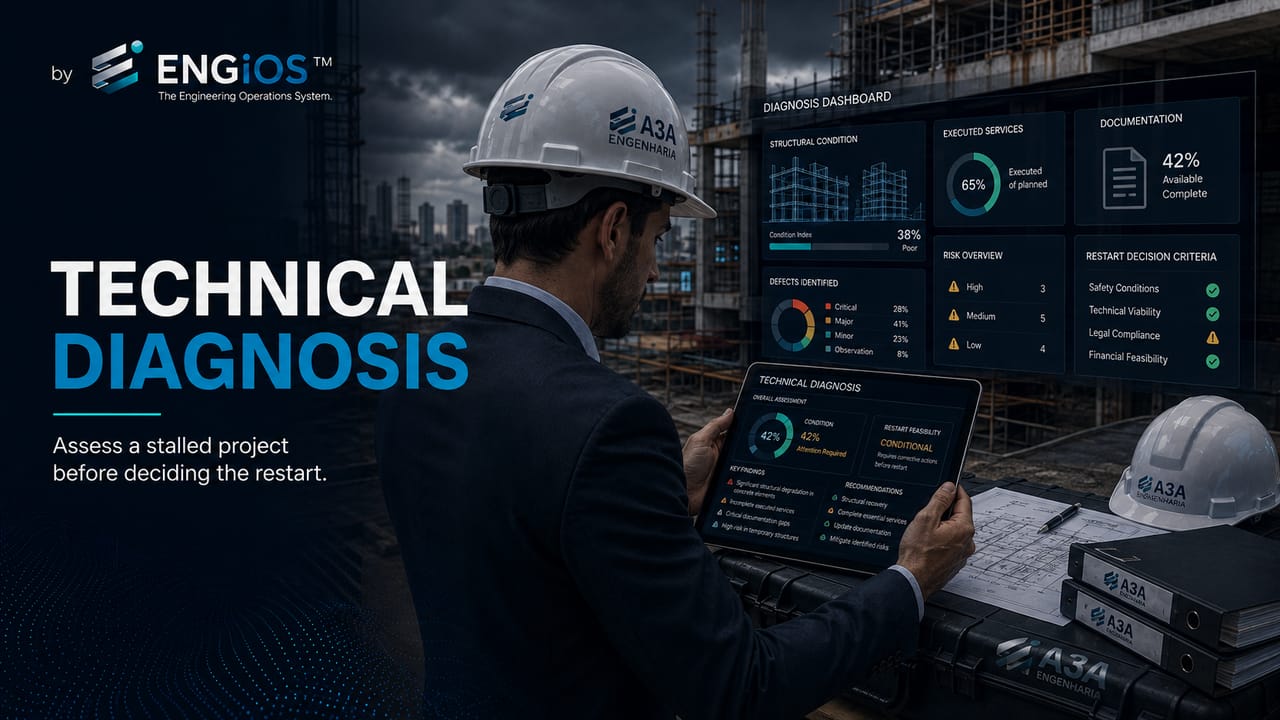
See how to structure the technical diagnosis of a stalled construction project: physical condition, completed work, designs, quantities, budget, contracts, permits, risks and resumption plan.
Check it out!
A stalled public works project should not be resumed simply because budget is available, there is political interest, or a new contractor is being considered. Before any decision, the Administration must accurately understand the project’s physical condition, what was actually executed, what can still be reused, which designs remain valid, which permits must be renewed, how much the remaining scope will cost, and which risks could cause another stoppage.
The technical diagnosis of a stalled construction project is therefore an engineering due diligence process oriented toward the resumption decision. Its product is not a simple site inspection or photographic report: it is a multidisciplinary technical baseline capable of supporting the decision to resume, redesign, reprocure, complete in phases, change the solution, or, in exceptional situations, not proceed with the project.
What is the technical diagnosis of a stalled construction project?
Resuming a project with progress measurements, designs and quantities that no longer represent field conditions transfers uncertainty into the new procurement. The result often appears later as change orders, rework, responsibility disputes or another stoppage. Technical Due Diligence reconstructs the project’s actual condition before the resumption decision.
Technical diagnosis is the structured process of surveying, verifying, analyzing and consolidating the current conditions of a project whose execution has been interrupted. It must reconstruct the project’s actual situation at a defined cutoff date and transform dispersed information — field conditions, designs, progress measurements, contracts, permits, budget and administrative records — into a single, technically defensible view.
The main difference from a conventional inspection lies in the question that must be answered. A building inspection seeks to identify defects, conservation conditions or performance. A document audit verifies record compliance. A progress measurement quantifies executed work. In the diagnosis of a stalled project, all these dimensions must converge on one decision: what exists, what condition it is in, what is missing, how much completion will cost and under what conditions resumption is technically feasible.
This framing avoids a common mistake: treating resumption as merely the administrative continuation of the previous contract. A project left without execution for months or years may have suffered deterioration, expired permits, changes in technical standards, discontinued equipment, changes in demand, design incompatibilities, vandalism, water intrusion, corrosion, settlement, technological obsolescence and loss of document traceability. The actual condition at the time of resumption may be very different from that recorded in the last progress measurement.
The contractual completion percentage is only one input to the diagnosis, never its conclusion. A project administratively recorded as 72% complete may contain installed systems that were never tested, supplied materials not incorporated into the works, exposed components, temporary works, or items that lost their reuse condition during the stoppage.
The technical protocol for resuming a stalled construction project organizes the broader resumption sequence. The diagnosis addressed here is the engineering layer that provides evidence so that sequence can be executed without relying on fragile assumptions.
Why resumption must begin by reconstructing the project’s actual condition
A stoppage creates a break between three realities that should remain closely aligned during a normal project: contractual reality, documentary reality and physical reality. The longer the interruption lasts, the greater the divergence among them tends to become.
Contractual reality is what is recorded in the contract, amendments, work orders, progress measurements, schedules and payments. Documentary reality consists of designs, revisions, field records, reports, daily logs, tests, certificates, permits, approvals and communications. Physical reality is what actually exists on site.
A reliable diagnosis must reconcile all three.
This reconciliation is essential because cumulative financial data does not indicate the project’s actual completion capability. Part of the measured work may serve a temporary function. Systems may be physically installed but lack performance testing. Materials may have been purchased and stored without being incorporated. Completed elements may have deteriorated. Equipment may have lost its warranty or become incompatible with the current solution.
The decision to resume must therefore start from a new technical baseline. Without it, the new tender risks inheriting incorrect quantities, omissions, unresolved interfaces and assumptions that no longer represent the project.
The eight minimum workstreams in the diagnosis
A stalled-project diagnosis should be multidisciplinary and proportional to the project’s scale and complexity. As a practical reference, eight workstreams should be assessed in an integrated manner.
| Workstream | Main question | Expected evidence |
| Physical condition | What exists and what condition is it in? | inspections, photographic records, tests, surveys |
| Quantities | How much was actually executed? | as-built survey, quantity takeoff records, reconciliation with progress measurements |
| Designs | Does the technical documentation still represent an executable solution? | design review, revision register, multidisciplinary coordination |
| Compliance | Does the executed work comply with designs, standards and requirements? | inspections, tests, NCRs, technical opinions |
| Budget | How much will completion cost under current conditions? | remaining-scope budget, cost build-ups, mobilization, corrective work |
| Contracts | Which obligations, liabilities and open issues remain? | contract, amendments, notices, claims, warranties |
| Permits | Does the project still have valid authorizations? | permits, approvals, licenses, conditions |
| Risks | What could stop the project again? | risk register, action plan, owners and deadlines |
The value of the diagnosis lies precisely in integration. A physical nonconformity may require a design revision; the revision changes quantities; the new quantities modify the budget; the correction may depend on a permit; and the solution may create a new contractual obligation. Assessing each workstream in isolation tends to hide these relationships.
The investigation should also separate facts, hypotheses and conclusions. A fact is what was observed or demonstrated. A hypothesis is a technically plausible explanation that has not yet been proven. A conclusion is an understanding supported by the body of evidence. This discipline is especially important when the diagnosis may support accountability reviews, a new procurement or oversight decisions.
Step 1 — define the cutoff, objective and level of depth
Before going to the site, it is necessary to establish what the diagnosis must support. The same project may require different levels of depth depending on the decision under analysis.
If the Administration only intends to preserve the asset while preparing a new procurement, the immediate focus will be physical condition, safety, protection and deterioration. If there is already an intention to re-tender the remaining scope, the diagnosis must advance into quantities, designs, budget and acceptance criteria. If the discussion involves termination, accountability or recovery of amounts, the chain of evidence must be even more rigorous.
The first methodological note should define:
- diagnostic cutoff date;
- scope and physical boundaries assessed;
- disciplines involved;
- documents received and documents missing;
- sampling criteria, when 100% of the elements are not inspected;
- assumptions and access restrictions;
- planned tests;
- expected accuracy level for quantities and budget;
- decisions the report is expected to support.
This step prevents the final product from being technically sound but unsuitable for the administrative decision that motivated its commissioning.
It is also advisable to establish an identification convention from the outset. Photographs, findings, drawings, samples and nonconformities should have unique codes. Without a minimum taxonomy, the team wastes time trying to correlate records produced by different disciplines.
Step 2 — perform document due diligence before the field inspection
Going to the site without knowing the available documentation reduces the quality of the inspection. The engineer must arrive in the field knowing what should be found, which points are uncertain, which design revisions are current and which records require specific verification.
The document review normally includes:
- original contract and appendices;
- basic and detailed design, with revision control;
- design reports, specifications and performance criteria;
- original budget and quantity schedules;
- physical-financial schedule;
- work orders and stoppage records;
- amendments and administrative adjustments;
- progress measurements and calculation records;
- site diaries;
- oversight and supervision reports;
- nonconformity records;
- RFIs, technical queries and responses;
- test reports and quality-control records;
- material and equipment receipt documentation;
- warranties and certificates;
- licenses, permits and authorizations;
- notices, claims, defenses and dispute records;
- partial as-built drawings, when available.
The objective is not merely to build an archive. It is to create a traceability matrix linking requirements, execution, evidence and open issues.
When this review identifies gaps, they must be recorded as findings. Missing documentation must not be silently replaced by assumptions. If there is no watertightness test report, for example, the diagnosis should state that the performance of that section has not been demonstrated and define whether a new test is required.
Engineering Technical Due Diligence is particularly useful at this stage because it structures the investigation around risk and decision-making, rather than merely around document availability.
Step 3 — survey the current physical condition by discipline
The inspection should be planned by systems and disciplines, avoiding the model of a generic site visit accompanied by photographs with no spatial reference or link to requirements.
In a building, for example, workstreams may be required for architecture, structures, waterproofing, roofing, electrical installations, LPS, plumbing, HVAC, fire protection, telecommunications, electronic security, automation, elevators and external works. In linear infrastructure, earthworks, drainage, pavement, retaining structures, bridges and similar structures, networks and utility conflicts are added. In industrial facilities, process, mechanical, instrumentation, automation and operational safety disciplines also apply.
Each workstream should record at least:
- the element or system inspected;
- an unambiguous location;
- the observed condition;
- the applicable design reference;
- photographic or instrumental evidence;
- evidence of deterioration or nonconformity;
- the need for additional testing;
- the consequence for reuse or resumption.
Visual inspection is the first level, not necessarily the last. Depending on the risk, nondestructive testing, core extraction, electrical tests, insulation measurements, thermography, network inspections, hydrostatic tests, torque verification, grounding analysis, functional tests or other specialized verifications may be required.
The principle is simple: the higher the cost of being wrong about an element’s condition, the stronger the evidence should be.
The team should also record inaccessible areas. An area that was not inspected cannot be implicitly presented as approved. The report must state the limitation and its effect on confidence in the diagnosis.
Step 4 — reconcile executed, measured and reusable work
One of the most sensitive parts is separating three concepts that are often mixed together:
- executed work;
- measured or paid work;
- work that remains technically reusable for resumption.
They may coincide, but not necessarily.
The survey must compare physical quantities with progress measurement reports and the current condition. The article on surveying executed work and preparing a condition assessment report explores this reconciliation in greater depth; it is one of the foundations of the remaining-scope budget.
A useful classification is to divide items into five groups:
| Class | Condition | Treatment in the remaining scope |
| A | executed and compliant | preserve and integrate |
| B | executed, with verification pending | test before accepting |
| C | executed with localized correction required | include repair |
| D | executed but not reusable | demolish, remove or replace |
| E | not executed | include in full in the remaining scope |
This classification is more useful than simply subtracting cumulative progress measurements from the original bill of quantities because it incorporates quality and current condition.
Reconciliation should be performed by relevant item and, when necessary, by location. A global quantity can hide the fact that work was concentrated in one area and is absent in another. For the future procurement, it matters to know exactly where each scope item starts and ends.
It is also prudent to separate incorporated materials from materials that were merely supplied. Remaining inventory requires verification of ownership, storage, shelf life, integrity, compatibility, warranty and traceability.
Step 5 — verify whether the designs are still executable
Design documents for a stalled project should not automatically be considered valid merely because they were approved at the beginning of the original contract.
The technical review should verify:
- whether the current document version matches what was executed;
- whether field changes were formally documented;
- whether incompatibilities exist among disciplines;
- whether the designs reflect the equipment actually purchased;
- whether technical standards or legal requirements have changed;
- whether the project’s functional demand has changed;
- whether any components have been discontinued;
- whether utility interfaces remain valid;
- whether permits impose new conditions;
- whether the remaining scope can be executed without redesigning completed portions.
This analysis should not turn into a complete new detailed design without need. The initial objective is to identify design gaps that prevent safe resumption. From there, the Administration decides which revisions, supplements or new designs must be commissioned.
On complex projects, an independent Design Review can be decisive in distinguishing documentation failures from execution problems and legitimate changes in condition.
Brazilian Law 14.133/2021 reinforces the planning approach and requires the preparatory phase to address technical, market and management considerations that may affect procurement. In a resumption process, the project’s current condition becomes essential information for that preparation.
Step 6 — assess deterioration, exposure and obsolescence
A stoppage changes the project’s risk profile. Systems designed to operate in a protected environment may remain exposed for months; incomplete structures may receive water at unintended locations; partially energized equipment may degrade; and packaging or temporary protection may lose effectiveness.
The diagnosis should identify deterioration mechanisms compatible with each material and system. Common examples include:
- corrosion of reinforcement and metallic components;
- carbonation and chemical attack in concrete;
- water intrusion and persistent moisture;
- degradation of membranes and sealants;
- deterioration of wood and hygroscopic materials;
- degradation of electrical insulation;
- oxidation of panels and connections;
- contamination of piping and tanks;
- UV damage to exposed components;
- vandalism, theft and removal of parts;
- loss of calibration or instrument validity;
- obsolescence or discontinuation of electronic equipment.
It is important to separate actual damage from potential risk. The report should not condemn a component merely because it was stored, nor approve it merely because it appears visually intact. The decision must be linked to manufacturer criteria, tests, standards and observed condition.
When technological equipment has been stored for a long period, the diagnosis should also verify manufacturer support, firmware, compatibility with current systems, spare-parts availability and when the warranty period began. In electronic security, automation, telecommunications and IT, obsolescence may occur even before physical degradation.
Step 7 — map permits, authorizations, interfaces and external constraints
A project that is technically recoverable may still remain unfeasible if external dependencies are unresolved. The diagnosis should therefore include a permissions and interfaces track.
The analysis may include:
- environmental license and conditions;
- construction permit;
- Fire Department approval;
- utility-company authorizations;
- water-use or other statutory permits;
- expropriations and area releases;
- conflicts with public utility networks;
- access rights and easements;
- heritage or urban-planning authorizations;
- approvals from sector-specific agencies.
The objective is not to issue a legal opinion on each instrument, but to identify technically which approvals constrain the design, execution method, schedule or entry into operation.
The diagnosis should record validity, responsible party, pending action and required date for each interface. A permit that will expire during the new execution period is a schedule risk even if it remains formally valid on the report date.
Step 8 — recalculate the remaining-scope budget
The cost to complete is not simply the original contract value minus what has already been paid.
The new budget must start from the current condition and include, as applicable:
- work not yet executed;
- correction of existing work;
- demolition and removal;
- protection and preservation;
- remobilization;
- site facilities and temporary installations;
- design revision and supplementation;
- new tests and verifications;
- price updates;
- equipment replacement due to obsolescence;
- compliance upgrades;
- commissioning and testing;
- handover documentation;
- contingencies associated with remaining uncertainties.
The budget should also state its level of maturity. When many areas are inaccessible, designs are incomplete or tests remain pending, the Administration needs to understand the uncertainty range and which actions are required to reduce it before the tender.
The remaining-scope cost must also account for interfaces. Repairing a section of waterproofing may require removing finishes, reinstalling services and restoring adjacent areas. Pricing only the directly defective item underestimates the actual correction cost.
How to turn findings into a decision matrix
An extensive diagnosis can lose value if it ends with dozens of pages of observations without prioritization. Every relevant finding must be converted into a decision or action.
A practical matrix may contain:
| Field | Content |
| ID | unique identifier |
| Discipline | structural, electrical, plumbing, etc. |
| Location | floor, gridline, room or section |
| Finding | observed condition |
| Evidence | photo, test, document, measurement |
| Impact | safety, cost, schedule, performance, permit |
| Criticality | low, medium, high or critical |
| Action | test, repair, revise design, replace, remove |
| Owner | responsible unit or party |
| Deadline | due date or milestone |
| Dependency | design, permit, budget, procurement |
| Status | open, in progress, resolved |
The governance benefit is significant. The Administration stops managing the resumption process through memory or meetings and instead maintains a traceable portfolio of open issues.
Open Issues, RFIs and Nonconformities Management is a natural extension of this logic during subsequent execution.
Criticality: what must be resolved before the new tender
Not every finding must be fully closed before tendering the remaining scope, but every relevant finding must have a defined treatment.
Blocking issues
These are issues that prevent the scope from being defined or make it unsafe to proceed. Examples include uncertainty about structural stability, an area that has not been released, a missing essential design, a highly significant quantity that cannot yet be measured, or an indispensable permit with no defined path to resolution.
Issues that change scope or budget
These do not necessarily prevent planning from continuing, but they must be reflected in the procurement documents. Examples include replacing discontinued equipment, repairing waterproofing, requiring new tests, or adapting to an updated requirement.
Execution-stage issues
These may be addressed by the future contractor, provided that the tender documents clearly define responsibility, measurement criteria and risk allocation. They should not be transferred in a generic and unlimited manner.
Closeout issues
These are matters that do not prevent resumption but must form part of the handover plan: Data Book, As-Built documentation, training, operating documentation, final tests and acceptance.
This classification helps avoid two extremes: trying to resolve absolutely everything before the tender, making resumption unnecessarily slow, or tendering too early and transferring unquantified uncertainties into the new contract.
How to distinguish design failure, execution failure and deterioration caused by the stoppage
This distinction is technically important and also affects accountability and budgeting.
A crack, for example, may result from a design calculation error, inadequate execution, anticipated movement without a joint, settlement caused by an unidentified geotechnical condition, or prolonged exposure without protection. A photograph of the crack does not establish its cause.
The diagnosis should establish a technical causal link by asking:
- what was the design requirement;
- how the work was executed;
- what evidence exists from the execution period;
- when the problem became apparent;
- which conditions acted during the stoppage;
- which hypotheses are technically plausible;
- which tests or verifications can discriminate among those hypotheses.
When the cause cannot be determined with sufficient confidence, the report should state the uncertainty. Assigning responsibility without adequate support weakens the document and may contaminate subsequent decisions.
The same reasoning applies to dimensional deviations, performance failures and incompatibilities. The analysis should distinguish what originated in the design, what occurred during execution, what resulted from an undocumented change, and what arose during the period of abandonment.
The diagnosis must include safety conditions at the stalled project
Even when no resumption date has been defined, the project must be maintained in a safe condition. The diagnosis should identify immediate risks to workers, neighbors, users and property.
Items that require verification include:
- unauthorized access;
- open excavations;
- guardrails and collective protection measures;
- temporary structures;
- temporary electrical installations;
- unstable materials;
- tanks and pits;
- risk of falling elements;
- fire risk;
- temporary drainage;
- slope stability;
- fencing and signage.
Safety findings should not wait for the final report when a significant risk exists. The procedure should provide for immediate and traceable communication to the Administration.
It is useful to separate emergency measures from resumption measures. Shoring a structure, isolating an area or pumping out water may be necessary immediately even if the permanent solution depends on later design and procurement.
What is the role of the as-built survey?
On many projects, the available drawings no longer represent what was actually built. In these situations, the Engineering As-Built Survey becomes one of the foundations of the diagnosis.
The survey may involve topography, point clouds, geometric measurements, identification of equipment, visible networks, panels, switchboards, piping, routes and constructed elements. Its objective is to reduce the gap between documentation and the physical asset.
When resumption depends on supplementary design, this as-built baseline prevents the new engineering work from being developed on outdated drawings.
On projects with a high density of building services, the survey also reduces interface conflicts. The resumption designer needs to know which shafts are occupied, which routes were actually used, what spare capacity remains and where equipment has already been positioned.
When to use testing and supplementary investigation
Testing everything is expensive and often unnecessary. Testing too little may leave unacceptable risks. Selection should be driven by criticality.
An efficient procedure uses three filters:
- consequence of failure of the element;
- uncertainty about its condition;
- cost of correction if the decision is postponed.
Elements with high consequence, high uncertainty and high rework cost should receive priority.
This logic also helps define sampling. Repetitive systems may allow technically justified samples, while singular or critical elements may require full inspection.
Test results must return to the findings matrix. A test with no associated decision only increases document volume. The diagnosis should indicate whether the result releases the element, requires correction, demands further investigation or changes the design.
The diagnosis must inform the future procurement strategy
The deliverable does not end with the diagnostic report. It must directly inform the documents used for resumption.
The results need to be converted into:
- scope of the remaining work;
- revised basic or detailed design;
- updated budget;
- reference schedule;
- risk matrix;
- technical qualification criteria;
- measurement criteria;
- quality requirements;
- inspection and test plan;
- acceptance criteria;
- documentation obligations;
- commissioning plan, when applicable.
This transition is where the diagnosis becomes a prevention tool. For years, the Brazilian Federal Court of Accounts (TCU) has associated stalled public works with design deficiencies, resource-flow problems and institutional capacity, while CBIC also treats the issue as the result of systemic planning and execution failures. A report that merely records defects without changing the next procurement misses the opportunity to address the root cause.
Procurement of the remaining scope should disclose the current condition rather than pretending it is a new project. Interfaces with existing work, responsibilities for corrections, tests of partial systems and acceptance criteria need to be explicit.
Diagnosis and Owner’s Engineering
The diagnosis shows what needs to be corrected, but it does not govern the resumption. Without independent coordination, the same failures in interfaces, decision-making, scope change and acceptance may reappear in the new contract. Owner’s Engineering keeps the resumption technically aligned with the owner’s interests.
On more complex projects, the Administration may need an independent technical function that follows not only the initial survey but also the conversion of findings into designs, procurement, oversight, testing and acceptance.
Owner’s Engineering performs precisely this integration. Its role does not replace the public-sector manager or inspector; it provides technical capability, traceability and multidisciplinary coordination for decisions that cross different project phases.
This approach is especially useful when the original cause of the stoppage includes fragmentation among designers, oversight teams, the contractor, permitting agencies and user departments.
Continuity between diagnosis and follow-up reduces knowledge loss. The team that identified critical conditions can verify whether designs, budgets, tender documents and execution actually incorporated the recommended actions.
Recommended structure for the final report
A diagnostic report for project resumption should be easy to audit and sufficiently executive to guide decision-making. A robust structure may follow:
- objective, scope and cutoff date;
- summary project history;
- documentation reviewed;
- methodology and limitations;
- physical survey by discipline;
- quantity reconciliation;
- compliance analysis;
- status of designs and documents;
- permits and external interfaces;
- condition of materials and equipment;
- tests performed and pending;
- remaining-scope budget;
- risks and criticalities;
- prioritized action plan;
- conditions for resumption;
- conclusion on technical feasibility;
- evidence appendices.
For large projects, detailed matrices work better as controlled appendices than inside the narrative body. The main report should consolidate critical findings and decisions.
Each appendix should have revision control and a clear relationship with the main report. Marked-up drawings, quantity takeoff records, photographic logs, test results and the open-issues matrix are examples of appendices that gain value when managed as independent and traceable documents.
What not to do in the diagnosis of a stalled construction project
Some shortcuts create a false sense of security.
Use only the latest progress measurement as a picture of the project
A progress measurement is a contractual-financial record; it does not replace a current physical survey.
Produce only a photographic report
A photograph without location, requirement, diagnosis and consequence is incomplete evidence.
Assume that everything installed can be reused
Condition must be verified, especially after prolonged exposure.
Budget only the difference from the original cost schedule
The remaining scope includes corrections, deterioration, mobilization, price updates and possible solution revisions.
Transfer every uncertainty to the next contractor
Poorly defined risks tend to return as price, claims, disputes, delay or another stoppage.
Confuse diagnosis with assignment of responsibility
The diagnosis may provide evidence for accountability reviews, but it should not force a causal link when the available data do not support a reliable conclusion.
Issue conclusions without stating limitations
Reliability depends on transparency about inaccessible areas, missing documents, sampling and adopted assumptions.
Executive checklist: is the diagnosis ready to support resumption?
Before using the report as a decision-making basis, the Administration should confirm that it can answer the following questions with evidence:
- is the current physical condition documented by discipline and location?
- has executed work been reconciled with progress measurements?
- is it clear what is reusable, repairable and unsuitable for reuse?
- have the main structural and safety risks been assessed?
- have current design documents been identified and compared with what was built?
- are design gaps that prevent resumption listed?
- have permits and external interfaces been verified?
- have critical equipment condition, warranty and obsolescence been assessed?
- do remaining-scope quantities have calculation records?
- does the budget include corrective work and remobilization?
- are relevant uncertainties explicitly stated?
- is there an action matrix with owners and deadlines?
- is it defined what must be resolved before the tender?
- have inspection, testing and acceptance criteria been derived from the findings?
- is the conclusion on technical feasibility consistent with the evidence?
If several of these answers are negative, the Administration does not yet have a resumption diagnosis; it has only partial information.
From a snapshot of the problem to the resumption plan
The best diagnosis is not the one that records the greatest number of defects. It is the one that reduces uncertainty enough to enable a technically rational decision.
This requires transforming the current condition into a set of executable actions: correct the design, test a specific system, obtain a permit, protect an area, recalculate quantities, revise the budget, redefine risk, prepare the procurement and establish acceptance criteria.
Resumption then becomes a sequence of verifiable decisions, not a bet that the next contract will solve inherited problems.
The Administration can also organize actions through gates. First, eliminate immediate risks; then close uncertainties that prevent the scope from being defined; next consolidate design and budget; only then authorize the tender. This governance reduces the likelihood of accelerating the formal process at the expense of technical maturity.
Final considerations
Diagnosing a stalled public works project means technically reconstructing the project before making new schedule and budget commitments. The Administration needs to know not only how much was executed, but how much of the executed work remains valid, compliant, safe and reusable.
When field conditions, documentation, designs, quantities, budget, contracts, permits and risks are integrated into a single decision baseline, resumption stops beginning with the tender documents and begins with real knowledge of the asset. This change reduces information asymmetry, improves the quality of the remaining scope to be procured and lowers the probability of repeating the causes that led to the previous stoppage.
Before re-tendering the remaining scope, the Administration must transform the project’s actual condition into technically verifiable scope, quantities, budget, risks and acceptance criteria.
Technical references
[1] BRAZIL. Law No. 14.133, of April 1, 2021. Public Procurement and Administrative Contracts Law. Available at: [https://www.planalto.gov.br/ccivil_03/_ato2019-2022/2021/lei/l14133.htm](https://www.planalto.gov.br/ccivil_03/_ato2019-2022/2021/lei/l14133.htm)
[2] TRIBUNAL DE CONTAS DA UNIÃO. Acórdão 1.079/2019 — Plenário. Diagnosis of stalled public works financed with Federal Government resources. Available at: [https://portal.tcu.gov.br/data/files/91/C2/A5/44/5E9628102DFE0FF7F18818A8/Acordao%201079_2019%20%20Plenario.pdf](https://portal.tcu.gov.br/data/files/91/C2/A5/44/5E9628102DFE0FF7F18818A8/Acordao%201079_2019%20%20Plenario.pdf)
[3] TRIBUNAL DE CONTAS DA UNIÃO. Management of stalled public works — High-Risk List of the Public Administration. Available at: [https://sites.tcu.gov.br/listadealtorisco/gestao_das_obras_paralisadas.html](https://sites.tcu.gov.br/listadealtorisco/gestao_das_obras_paralisadas.html)
[4] CÂMARA BRASILEIRA DA INDÚSTRIA DA CONSTRUÇÃO. Stalled Public Works in Brazil: diagnosis and proposals. Available at: [https://brasil.cbic.org.br/acervo-coinfra-publicacao-obras-publicas-paralisadas-no-brasil-diagnostico-e-propostas](https://brasil.cbic.org.br/acervo-coinfra-publicacao-obras-publicas-paralisadas-no-brasil-diagnostico-e-propostas)
[5] TRIBUNAL DE CONTAS DA UNIÃO. Half of the public works financed with Federal Government resources are stalled. July 30, 2025. Available at: [https://portal.tcu.gov.br/imprensa/noticias/metade-das-obras-financiadas-com-recursos-federais-estao-paradas](https://portal.tcu.gov.br/imprensa/noticias/metade-das-obras-financiadas-com-recursos-federais-estao-paradas)
Frequently asked questions
It should integrate physical condition, a survey of executed work, reconciliation with progress measurements, design review, compliance, permits, the remaining-scope budget, contracts, risks and a prioritized action plan for resumption.
No. Photographs are important evidence, but they do not replace the review of designs, quantities, progress measurements, tests, documents, permits, budget and risks required to define the remaining scope and the resumption strategy.
Not necessarily. Measured or paid work may require verification, correction or even replacement after the stoppage. The diagnosis must classify executed work as compliant, requiring verification, repairable or unsuitable for reuse.
When visual inspection and available documentation are insufficient to demonstrate the condition of an element whose performance or failure has a relevant impact on safety, cost, schedule or operation.
Yes. The completion cost should start from the current condition and include the remaining scope, corrections, demolition, remobilization, price updates, design revisions, tests, commissioning and the other costs required to complete the project.
It is necessary to reconstruct the design requirement, the way the work was executed, the available evidence, the chronology of the problem and the exposure conditions during the stoppage. When the causal link cannot be demonstrated, the uncertainty should be stated.
Yes. Its results should inform scope, designs, quantities, budget, risk matrix, qualification criteria, measurement, inspection, testing, acceptance and documentation for procurement of the remaining work.
The composition depends on the project, but it normally includes professionals from the affected disciplines, cost and planning specialists, as well as specialists in testing, permitting, commissioning or specific systems when criticality requires them.
Complementary technical materials
Related solutions
- Contracts, Scope and Deliverables Management
- Open Issues, RFIs and Nonconformities Management
- Project, Program and Portfolio Governance
Related services
- Engineering Technical Due Diligence
- Engineering As-Built Survey
- Owner’s Engineering
- Technical Support for Construction and Contract Oversight
Key content on this topic
- How to Resume a Stalled Construction Project: an 8-Step Technical Protocol
- Survey of Executed Work and Condition Assessment Report
- Remaining Construction Scope: How to Tender What Is Left
