
Understand the main structured cabling standards, from ISO and ANSI/TIA references to Brazilian ABNT standards, and learn how they affect performance, safety, and certification.
Check it out!
What Are Structured Cabling Technical Standards?
Structured Cabling Standards are technical guidelines and specifications developed by national and international organizations to standardize the implementation of a Structured Cabling System.
These standards were developed in response to the need to integrate computer networks that are becoming increasingly complex and vital.
The main purpose of these standards is to ensure the quality, performance, and reliability of network infrastructure by establishing specific criteria for system installation, organization, and maintenance.
These standards define technical requirements for selecting cables, connectors, components, and installation techniques, ensuring that systems meet the performance specifications required for data transmission.
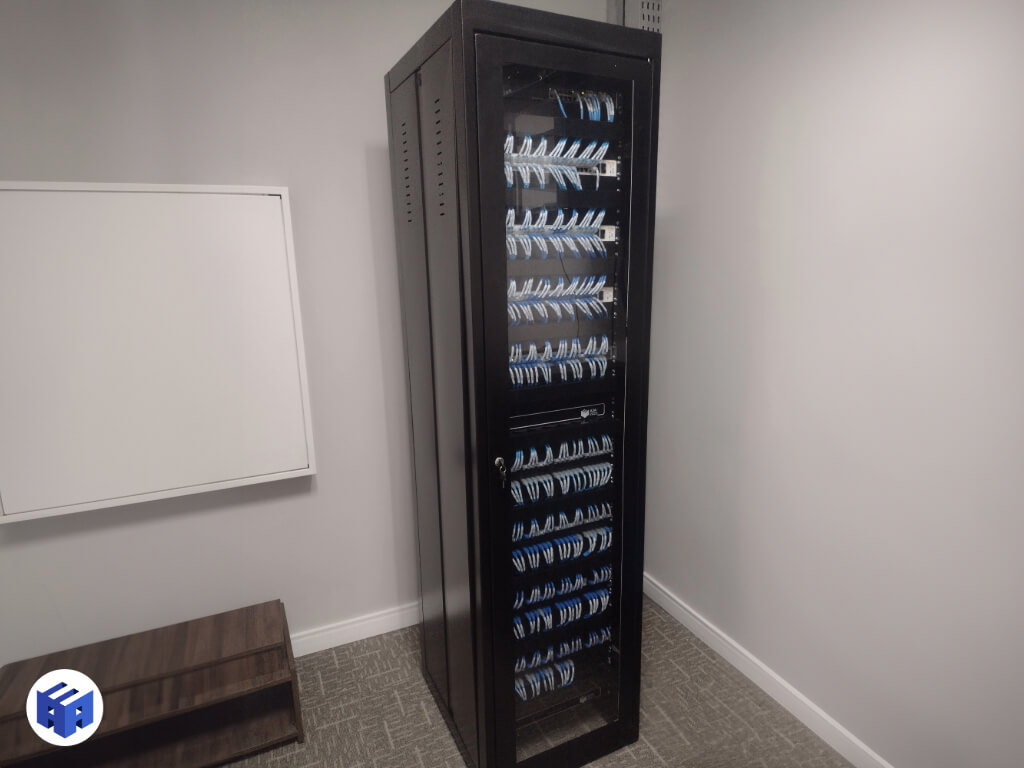
A3A Engenharia de Sistemas archive.
The standards also address important aspects such as administration, documentation, cable identification, and change management, making system management and ongoing maintenance easier over time.
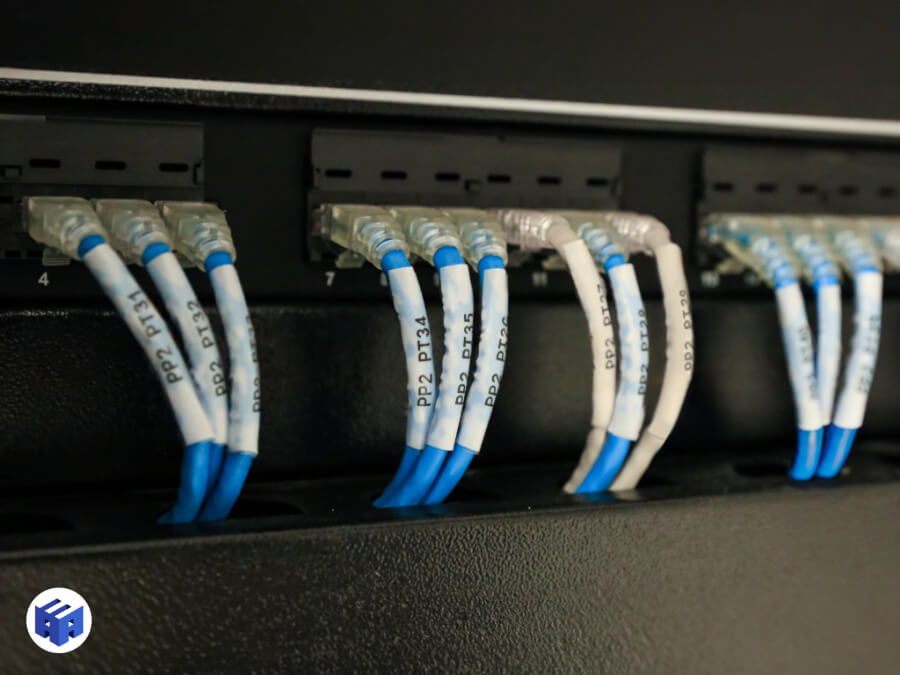
A3A Engenharia de Sistemas archive.
Compliance with technical standards helps minimize downtime, reduce incompatibility issues, and improve the operational efficiency of telecommunications infrastructure, providing reliable support for applications and current technology demands.
Main Structured Cabling Standards
In this section, we cover the most relevant standards in the industry, both nationally and internationally.
Each of these standards has unique characteristics and applications, and understanding their particularities is essential for ensuring the proper and efficient implementation of cabling systems.
There are several organizations and standards that a network designer should be familiar with:
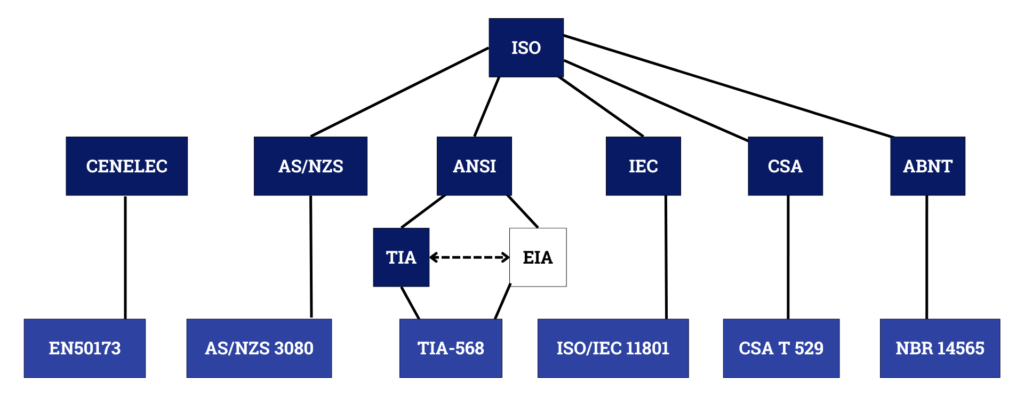
A3A Engenharia de Sistemas archive.
The International Organization for Standardization (ISO) is the main body that establishes standards for international telecommunications systems.
In partnership with the International Electrotechnical Commission (IEC), which certifies components for electrical performance, ISO developed the ISO/IEC 11801 standard, titled “Generic Cabling for Customer Premises.”
In Europe, the European Committee for Electrotechnical Standardization (CENELEC) developed the EN50173 standard, which is essentially a regional version of ISO/IEC 11801.
Similarly, the Australian/New Zealand Standard (AS/NZS) created AS/NZS 3080, and the Canadian Standards Association (CSA) developed CSA T529, both similar to ISO/IEC 11801 and used in their respective countries.
In the United States, the American National Standards Institute (ANSI) coordinates several standardization organizations. Among them are the Telecommunications Industry Association (TIA) and the Electronic Industries Alliance (EIA), which joined forces to develop cabling standards for commercial installations, creating the ANSI/TIA-568 standard, very similar in scope to ISO/IEC 11801.
In Brazil, the Brazilian Association of Technical Standards (ABNT) created NBR 14565, which is the standard most widely used in Structured Cabling Projects in the country.
Throughout the design process for cabling systems in buildings, the designer is free to consult any of these standards as needed.
International Standards
The main international structured cabling standards established global benchmarks for the industry, defining technical requirements that ensure compatibility, safety, and efficiency in telecommunications infrastructure:
ISO/IEC 11801: “Generic Cabling for Customer Premises”
The ISO/IEC 11801 standard defines general requirements for cabling systems in different environments, including commercial buildings, industrial facilities, data centers, and homes.
It addresses essential aspects such as cable, connector, and component selection, installation techniques, and the performance characteristics that the cabling system must meet.
It is subdivided into six parts, each focused on a specific type of installation:
- ISO/IEC 11801-1 – Part 1: General Requirements
- ISO/IEC 11801-2 – Part 2: Office Premises
- ISO/IEC 11801-3 – Part 3: Industrial Premises
- ISO/IEC 11801-4 – Part 4: Single-tenant Homes
- ISO/IEC 11801-5 – Part 5: Data Centres
- ISO/IEC 11801-6 – Part 6: Distributed Building Services
ANSI/TIA-568: “Generic Telecommunications Cabling for Customer Premises”
The ANSI/TIA-568 standard, in turn, has a scope very similar to ISO/IEC 11801. It establishes technical specifications for cables, connectors, patch panels, telecommunications outlets, and other components used in cabling systems.
In addition, ANSI/TIA-568 also addresses the installation, testing, and certification techniques for cabling systems.
It is divided into four parts:
- ANSI/TIA-568-D.1 – Commercial Building Telecommunications Cabling Standard – General Requirements
- ANSI/TIA-568-D.2 – Balanced Twisted-Pair Telecommunications Cabling and Components Standard
- ANSI/TIA-568-D.3 – Optical Fiber Cabling Components Standard
- ANSI/TIA-568-D.4 – Broadband Coaxial Cabling and Components Standard
Other Standards
In addition to those two, there are several other international standards that complement one another and define best practices for implementing Structured Cabling.
These standards cover a wide range of subjects, from implementation and operation of automated infrastructure management systems to requirements for field test instruments and measurements for balanced twisted-pair cabling.
Here are some of these standards:
- ISO/IEC 14763 – Implementation and Operation of Customer Premises Cabling
- ISO/IEC 18598 – Automated Infrastructure Management Systems – Requirements, data exchange and applications
- ISO/IEC 30129 – Telecommunications bonding networks for buildings and other structures
- ANSI/TIA-569 – Telecommunications Pathways and Spaces
- ANSI/TIA-570 – Residential Telecommunications Infrastructure Standard
- ANSI/TIA-606 – Administration Standard for Telecommunications Infrastructure
- ANSI/TIA-607 – Generic Telecommunications Bonding and Grounding for Customer Premises
- ANSI/TIA-862 – Structured Cabling Infrastructure Standard for Intelligent Building Systems
- ANSI/TIA-942 – Telecommunications Infrastructure Standard for Data Centers
- ANSI/TIA-1005 – Telecommunications Infrastructure Standard for Industrial Premises
- ANSI/TIA-1152 – Requirements for Field Test Instruments and Measurements for Balanced Twisted-Pair Cabling
- ANSI/TIA-1179 – Healthcare Facility Telecommunications Infrastructure Standard
- ANSI/TIA-4966 – Telecommunications Infrastructure Standard for Educational Facilities
BICSI (Building Industry Consulting Service International), although not an official standardization body, also publishes widely recognized industry guidelines, complementing official standards with best practices for telecommunications installations.
- BICSI 001 – Educational Facilities
- BICSI 002 – Data Center Design
- BICSI 003 – Building Information Modelling
- BICSI 004 – Healthcare
- BICSI 005 – Electronic Security System
- BICSI 006 – Distributed Antenna System
- BICSI 007 – Internet of Things / Intelligent Building
- BICSI 008 – Wi-Fi / WLAN
- BICSI 009 – Data Center Operations
Main Brazilian Structured Cabling Standards
Brazilian standards are developed by the Brazilian Association of Technical Standards (ABNT).
ABNT develops Brazilian standards based on ISO and ANSI international standards, but adapts them to meet the specific requirements and realities of Brazil.
This adaptation ensures that the standards are relevant and applicable to the Brazilian context, taking into account factors such as climate, existing infrastructure, and local working practices.
NBR 16869: “Structured Cabling”
Divided into several parts, this standard focuses on critical infrastructure aspects:
- Part 1 – Planning Requirements
Specifies requirements for designing and planning the entire necessary infrastructure — including pathways, spaces, documentation, grounding, and equipotential bonding — in support of the rules established by other cabling standards. - Part 2 – Optical cabling testing
Defines procedures, tools, and test criteria for single-mode and multimode fiber optic links, including connector inspection and attenuation measurement. - Part 3 – Configurations and tests for balanced links
Covers requirements for balanced cables (Cat5e, Cat6, Cat6A, etc.), including performance testing for classes D, E, EA, F, FA, I, and II. - Part 4 – Automated management systems
Establishes guidelines for systems that automate the physical management of telecommunications infrastructure — asset tracking, alerts, physical security, and integration with IT.
NBR 14565: “Structured Cabling for Commercial Buildings”
NBR 14565 is the Brazilian standard that establishes criteria for structured cabling infrastructure in commercial buildings, based on ISO/IEC 11801.
This standard defines the structure and minimum configuration required for a Structured Cabling System. It defines interfaces for telecommunications outlets (TO), performance requirements for individual cabling links and channels, and the minimum and maximum distances that must be observed. In addition, the standard details verification and compliance procedures to ensure that the system meets established benchmarks.
The standard also addresses administration and system management, recommending the use of software-based systems in large installations to ensure traceability and precise maintenance of all system components.
It establishes cabling performance requirements, including specifications for permanent links and channels, interfaces for wireless access points, and power delivery over balanced cabling.
Although electrical safety and electromagnetic compatibility (EMC) regulations are outside its direct scope, the standard takes these aspects into account and provides recommendations that can be useful for compliance.
NBR 16264: “Residential Structured Cabling”
NBR 16264 is the Brazilian technical standard that establishes technical criteria and guidelines for implementing structured cabling infrastructure in residential environments.
Based on ISO/IEC 15018, it guides the proper selection of cables, components, and telecommunications equipment, providing detailed guidance for the installation and configuration of residential systems.
It addresses a variety of aspects, including cabling topology, connection interfaces, organization and management of termination points, and communication channel performance metrics.
The purpose of this standard is to provide a solid technical foundation for creating robust, secure home networks prepared to support present and future connectivity demands.
NBR 16521: “Industrial Structured Cabling”
NBR 16521 is the Brazilian standard that establishes specific criteria for structured cabling in industrial environments.
It covers everything from selecting cables, connectors, and components resistant to industrial conditions to installation guidelines that ensure the reliability of communication networks.
In addition, it defines a configuration structure adapted to industrial installations, where information technology must support monitoring and process control functions.
It includes additional requirements that reflect the variety of operating environments found in these installations, ensuring compatibility and performance even under challenging conditions.
NBR 16665: “Structured Cabling for Data Centers”
NBR 16665 is the Brazilian standard that establishes specific criteria for structured cabling in data center environments.
This standard was originally a section within NBR 14565, which addressed Structured Cabling for both Commercial Buildings and Data Centers. However, in the latest revision (2019), the section related to data centers was extracted from NBR 14565 and turned into the new NBR 16665.
NBR 16665 details the functional elements — the main connection points and cabling that must be present in a data center cabling project.
NBR 16665 includes two annexes. Annex A is an informative annex discussing the use of high-density connectivity with fiber optic cabling, specifically addressing standard MPO (Multi-fiber Push On) connectors.
Annex B is the normative annex that addresses best practices for the design and installation of data center infrastructure. This annex contains several recommendations that apply not only to cabling, but also to other critical areas of data center infrastructure.
NBR 16415: “Pathways and Spaces for Structured Cabling”
NBR 16415 is the Brazilian standard that establishes requirements for the proper installation of cables.
This standard defines pathway types such as cable trays, conduits, and raceways, in addition to providing detailed guidance for installing and organizing cables in buildings.
It addresses aspects such as safety, electromagnetic compatibility, and environmental requirements that must be considered during installation.
NBR 16415 influences space allocation within buildings, whether in single-tenant or multi-tenant construction.
It ensures that cabling systems are implemented efficiently and safely, without compromising the structural integrity or functionality of spaces intended for telecommunications.
Finally, the standard provides examples and recommendations for conduit and cable tray fill rates, riser sizing, and firestop systems.
NBR 17040: “Equipotential Bonding of Cabling Infrastructure”
This standard specifies requirements and recommendations for the design and installation of an equipotential bonding system among various electrically conductive elements in buildings and other structures during construction or renovation phases in which active equipment will be installed, in order to: a) minimize the risk of electrical damage to the proper operation of active equipment and the structured cabling and telecommunications system; b) ensure the installation of telecommunications systems with a reliable signal reference plane, improving immunity to electromagnetic interference.
Which Standards Should Be Followed?
Although there are several standards developed by different organizations, all of them share the common objective of establishing guidelines and technical requirements for the proper implementation and efficient performance of structured cabling infrastructure.
When planning and implementing a structured cabling project, it is crucial to consider whether there is a specific national standard for the country involved. Such standards take into account factors such as construction practices, electrical rules, and safety requirements relevant to that location.
Therefore, it is extremely important that professionals hired for these projects are well acquainted with and up to date on national standards, using them as the basis for their structured cabling designs.
At the same time, the designer should be aware of the most relevant international standards and use them as complementary references to ensure efficient performance and a comprehensive design approach.

Structured Cabling Certification
Network Certification is an essential process that ensures the proper functionality of network infrastructure and its adherence to the standards defined by technical regulations.
This process involves a series of rigorous tests performed on every physical network component, including cables, connectors, and patch panels.
The purpose of these tests is to verify whether all network components are functioning correctly and whether they comply with the technical specifications established by the standards.
Network Certification not only validates the integrity and efficiency of network infrastructure, but also identifies any potential issues that could affect network performance in the future.
This allows organizations to resolve issues before they cause interruptions or service degradation.

Main Benefits of a Structured Cabling Project
Implementing structured cabling standards offers a series of significant advantages for organizations. By adhering to these technical guidelines and best practices, it is possible to obtain:
Reliability: Standards ensure that network infrastructure is designed and implemented in a reliable manner, minimizing the risk of failures and interruptions in data transmission.
Performance: The precise specifications established by the standards guarantee superior network performance, enabling fast and stable data transmission.
Standardization: Standards bring uniformity to the installation and organization of cables and devices, making maintenance and future network expansion easier.
Interoperability: Applying the standards ensures compatibility among different components and systems, enabling effective integration of equipment from multiple manufacturers.
Cost Reduction: With well-planned and organized infrastructure, maintenance and troubleshooting costs are reduced, generating long-term savings.
Simplified Management: Standards address administration, documentation, and cable identification, making continuous management and control of the cabling system easier.
Adaptation to Future Technologies: By following up-to-date standards, infrastructure remains prepared to support new technologies and future connectivity demands.
Security: Proper implementation of standards contributes to network security, protecting data and minimizing the risk of breaches and cyberattacks.
Structured Cabling Standards provide a solid foundation for building efficient, reliable network infrastructure prepared to face the technological challenges of both the present and the future. Therefore, adopting these standards is a crucial step for any organization seeking to optimize its network infrastructure.
Final Considerations
In conclusion, we have seen that Structured Cabling Standards are indispensable for any organization that wants to maintain high-quality, reliable network infrastructure ready for future technological challenges.
Adopting these standards results in standardized, secure, and efficient network infrastructure, with a significant reduction in maintenance and troubleshooting costs.
This allows organizations to focus on their core activities without worrying about failures in their communications network.

At A3A Engenharia de Sistemas, we specialize in Structured Cabling and are committed to providing reliable solutions in compliance with established standards. Our team of certified professionals has the knowledge and experience required to ensure excellence in every project.
Our certified team is ready to support you from planning to implementation of your Structured Cabling Project. We work closely with our clients, understanding their needs and providing customized, high-value solutions.
Talk to our Engineering Department and find out how we can improve the connectivity and efficiency of your Network Infrastructure.
Conclusion
Normative References
- ABNT (Brazilian Association of Technical Standards): https://www.abnt.org.br/
- ANSI (American National Standards Institute): https://www.ansi.org/
- TIA (Telecommunications Industry Association): https://www.tiaonline.org/
- ISO (International Organization for Standardization): https://www.iso.org/
- BICSI (Building Industry Consulting Service International): https://www.bicsi.org/
Frequently Asked Questions
The main standards that govern structured cabling are ABNT NBR 14565 (Brazil), ISO/IEC 11801 (international), and ANSI/TIA-568 (United States).
In Brazil, structured cabling projects should mainly consider two standards: ABNT NBR 14565 and ABNT NBR 16869.
ABNT NBR 14565 is the main standard and establishes the general requirements for the design, installation, administration, and performance of structured cabling systems in commercial, industrial, and residential environments. It addresses aspects such as topology, cable categories, identification, documentation, and best practices to ensure network efficiency and interoperability.
ABNT NBR 16869 complements NBR 14565 by providing detailed guidelines for infrastructure planning, testing, optical and metallic link configuration, and automated infrastructure management requirements. It is especially relevant for high-complexity environments such as data centers and large corporate facilities, but it can also be applied in
ABNT NBR 14565 is the Brazilian standard that establishes requirements and best practices for the design, installation, and administration of structured cabling systems in commercial, industrial, and residential environments. It covers aspects such as topology, performance, identification, and documentation of cabling systems.
In addition to NBR 14565, ABNT has other important standards for network infrastructure, such as NBR 16264 (optical cabling), NBR 16415 (cabling systems for residential buildings), NBR 5410 (low-voltage electrical installations), among others related to infrastructure and safety.
ISO/IEC 11801 is the main international standard for structured cabling, specifying standards for the design, installation, and performance of cabling systems in commercial buildings, industrial facilities, and data centers. It serves as a global reference and the basis for several national standards.
ANSI/TIA-607 is an American standard that addresses grounding and equipotential bonding requirements in structured cabling systems. It defines practices to ensure electrical safety and minimize electromagnetic interference in network systems.
Relevant Links (Complementary Technical Materials)
eBook – Why hire a Structured Cabling Project?
Structured Cabling Technical Standards
Network Certification for Structured Cabling Systems
Consulting in Structured Cabling Projects
Structured Cabling Installation
How to avoid common problems in Structured Cabling Systems?
Key benefits of Structured Cabling