Understand the stages, costs, standards, and technical deliverables involved in a structured cabling design and why the executive design reduces risk and total cost.
Check it out!
Structured cabling design is the foundation of every high-performance network infrastructure, ensuring scalability, security, and compliance with technical standards in the most demanding organizations on the market.
A Structured Cabling Executive Design consists of preparing a detailed plan for implementing the physical layer of Network Infrastructure. Whether the goal is to ensure the operation of critical systems, support digital transformation, or enable scalable growth, structured cabling is the starting point for organizations that value performance, security, and predictable costs.
This guide was prepared for leaders and decision-makers who want to understand, hire, or evaluate structured cabling projects from a strategic, pragmatic perspective aligned with the demands of today’s market.
Let’s dive in.
Excellence in project execution requires strategic vision. As Technical Director at A3A Engenharia, I lead our team by combining my CommScope NDI certification with a management perspective (MBA MIT/Babson). My commitment is to ensure that your project is technically flawless and financially strategic, eliminating rework risks and hidden costs.
[elementor-template id=”24446″]
What Is a Structured Cabling Design?
A structured cabling design is the technical process of planning, documenting, and standardizing the physical infrastructure that supports data, voice, video, and smart systems networks. By following standards such as TIA/EIA-568 and NBR 14565, the design ensures performance, security, and scalability to meet current and future telecommunications needs in corporate, industrial, and building environments.
Main fundamentals of a structured cabling design:
- Standardization: Strict compliance with national and international standards (NBR, TIA/EIA, ISO/IEC).
- Modularity: Infrastructure designed for expansions and upgrades without rework.
- Executive documentation: Drawings, reports, material lists, and records, essential for maintenance, audits, and compliance.
- Lower future costs: It avoids rework, reduces failures, and lowers TCO (Total Cost of Ownership) throughout the infrastructure life cycle.
Why invest in a Structured Cabling Executive Design?
In the corporate environment, where every infrastructure decision affects costs, compliance, and competitiveness, investing in a Structured Cabling Executive Design is not optional. It is a requirement for companies that want to avoid risks and create value.
Strategic Benefits of the Executive Design
- Risk Anticipation and Reduction:
Structured Cabling executive designs identify, still in the planning phase, possible technical bottlenecks, critical points, and environmental limitations. This avoids surprises during execution, reduces rework costs, and eliminates improvisation. - Standards and Legal Compliance:
Compliance with technical standards such as NBR 14565, TIA/EIA, and ISO/IEC is essential to ensure infrastructure approval, audit readiness, and compliance with contractual requirements, especially in corporate, industrial, or public environments. - Resource Optimization:
With an executive design, each component is specified according to the real need, avoiding wasted materials and inefficient allocation of resources. This translates into direct savings and better use of the budget. - Investment Predictability:
The detailed scope, schedule, material lists, and costs enable transparent financial planning, avoiding change orders and inflated budgets during implementation. - Ease of Expansion and Maintenance:
An infrastructure designed at the executive level is modular, documented, and prepared for future expansions, upgrades, and technology integrations, with minimal impact on day-to-day operations.
Gain predictability and avoid surprises in your network investment.
Request a professional diagnosis for your infrastructure now
Expert insight:
“Without an executive design, the risk of rework, nonconformities, and hidden costs increases exponentially. Companies that skip this step almost always end up spending more in the medium term.”
Eng. Altair Galvao – PMP/MBA Specialist in Telecommunications Systems
Operational Challenges in Network Infrastructure: Diagnosis and Solutions
In many organizations, recurring issues involving performance, expansion, and structured cabling infrastructure management end up affecting productivity, security, and the IT budget. Among the main challenges observed in the market are:
- Instability, slowness, or frequent network interruptions
- Lack of detailed technical documentation for the existing infrastructure
- Difficulty comparing supplier proposals due to lack of technical standardization
- Limitations on expanding or upgrading the cabling system
- Occurrence of unplanned expenses with corrective maintenance and emergency adjustments
- Obstacles in audits or certification processes due to technical noncompliance
- The need to support infrastructure investments with strong technical arguments for executive leadership
When these challenges are not addressed, they tend to accumulate, raise operating costs, and limit the performance and flexibility of IT environments.
How A3A Engenharia Can Support Your Company
A3A Engenharia works in a consultative and technical way, always starting with a detailed diagnosis of the existing infrastructure and the client’s operational requirements. Our approach includes:
- Detailed technical survey of current conditions and future needs
- Scope standardization to facilitate decision-making and transparent proposal comparison
- Precise specification of materials, equipment, and solutions suited to each client’s scenario
- Preparation of complete technical documentation, essential for audits, maintenance, and future expansions
- Technical support throughout the entire process, from planning to implementation of adjustments
With A3A Engenharia’s support, your company gains a partner to diagnose, plan, and implement solutions that ensure security, performance, and compliance, preparing your network infrastructure for present and future challenges.
Rely on A3A Engenharia’s experience and technical portfolio to ensure a reliable diagnosis and an adjustment design aligned with your business goals.
Request a personalized technical diagnosis with our specialists.
Specialized Technical Consulting
Detailed evaluation of the IT environment, needs assessment, topology analysis, review of previous designs, and recommendations for compliance with applicable standards.
Site Survey
On-site technical inspection to physically map the infrastructure, identify network points, assess environmental conditions, and detect possible interference (EMI/EMX) or restrictions.
Cable Testing and Certification
Execution of electrical tests, certification of network points (UTP and fiber optics), performance analysis, fault identification, and generation of technical reports in accordance with international standards.
Technical Inspection and Assessment
Visual and instrumental evaluation of the entire existing infrastructure, identification of nonconformities, wear, risk points, and improvement opportunities.
Documentation Diagnosis
Analysis and validation of the existing technical documentation, including drawings, reports, certificates, and ART, with identification of gaps and guidance for updates or formal regularization.
Logical and Physical Network Mapping
Preparation or update of the logical and physical map of network points, racks, cable routes, and active equipment, making management and future expansions easier.
Technical Adjustment Plan
Development of a detailed report with problem diagnosis, improvement suggestions, corrective action plan, and investment recommendations.
Diagnostic services can be hired as an integrated package covering the entire infrastructure assessment cycle, or individually, according to the specific needs of each company. Talk to our specialists and discover which solution is most suitable for your scenario.
Talk to the Engineering Department.
Main Standards Applicable to a Structured Cabling Design
Strict compliance with technical standards is one of the pillars of success in any structured cabling design. Far beyond formality, compliance with standards ensures safety, performance, longer system life, and, above all, makes audits, certifications, and future expansions easier.
Main applicable standards:
- ABNT NBR 14565: The basis for structured cabling design and installation in Brazil.
- ABNT NBR 16869-1: Requirements for structured cabling planning.
- TIA/EIA-568 and ISO/IEC 11801: International references for cabling standardization, essential for corporate, industrial, and healthcare environments.
Companies that disregard technical standards face serious risks of noncompliance, loss of warranties, and even the need to redo part of the infrastructure to meet legal or client requirements. That is why adopting designs and installations that are 100% standards-based is a mark of excellence and a competitive differentiator in the market.
Suggested reading:
To dive deeper into the topic and understand each standard in detail, read our complete article on Structured Cabling Standards.
Stages of a Structured Cabling Design
A Structured Cabling Design follows a series of defined stages to ensure the performance, stability, and scalability of the deployed system.
Information Gathering and Initial Planning
The first phase involves a detailed survey of client needs, analysis of the physical environment, and mapping of the existing systems.
It includes site visits, interviews with managers, plan analysis, and identification of critical points.
Goal: understand the real demands, infrastructure constraints, and anticipate challenges that may affect the design.
Basic Design
At this stage, the macro-structure of the solution is defined:
- Identification of coverage areas
- Preliminary selection of technologies and topologies
- Pre-sizing of the main components
- The basic design guides the first budget estimates and supports strategic decisions on future expansion, cabling types (copper, fiber), access points, and distribution.
Technical and Financial Consulting
At this stage, technology and investment alternatives are analyzed in search of the best cost-benefit ratio for the client.
- Comparison of solutions and brands
- ROI and TCO assessment
- Preparation of scenarios for different investment levels
- Professional consulting avoids rushed decisions, eliminates hidden costs, and prepares the design to meet both technical requirements and budget constraints.
Executive Design
Technical detailing is the backbone of a structured cabling design.
All executive documents required for implementation, inspection, procurement, and certifications are produced:
- Detailed drawings
- Connection and identification diagrams
- Material lists and descriptive reports
- Standards-based specifications
- This stage enables standardization of the received proposals and guarantees full traceability and quality during execution.
Document Delivery
At the end of the process, the client receives a complete dossier containing:
- Descriptive report
- As-built drawings and diagrams
- Material list used
- Technical specification booklet or Terms of Reference
- ART (Technical Responsibility Record)
- Operation and maintenance manual
- This documentation is the passport for audits and future expansions, and it provides legal and technical support throughout the system life cycle.
Technical and Financial Consulting

Deliverables of the Executive Design:
The Structured Cabling Executive Design goes far beyond planning. It consolidates all the documents, specifications, and records required to ensure a safe, standardized, and auditable implementation. These deliverables are essential so that the client has full control over the deployed infrastructure, can facilitate audits and future expansions, and can protect operations from technical and legal risks.
Detailed Executive Design:
Detailed drawings, diagrams, legends, and layouts specifying all network points, cable routes, racks, conduits, sector identification, and the other system elements.
Technical Specification Booklet / Terms of Reference:
A document that clearly and objectively defines the technical, standards-related, operational, and performance requirements for the system implementation, serving as the basis for price requests, tenders, and execution follow-up.
Descriptive Report:
A careful description of the proposed solution, technical justifications, methodology adopted, and reference to applicable standards.
Material List:
A quantitative and qualitative list of all materials, components, and equipment to be used, including technical specifications, recommended manufacturers, and quality criteria.
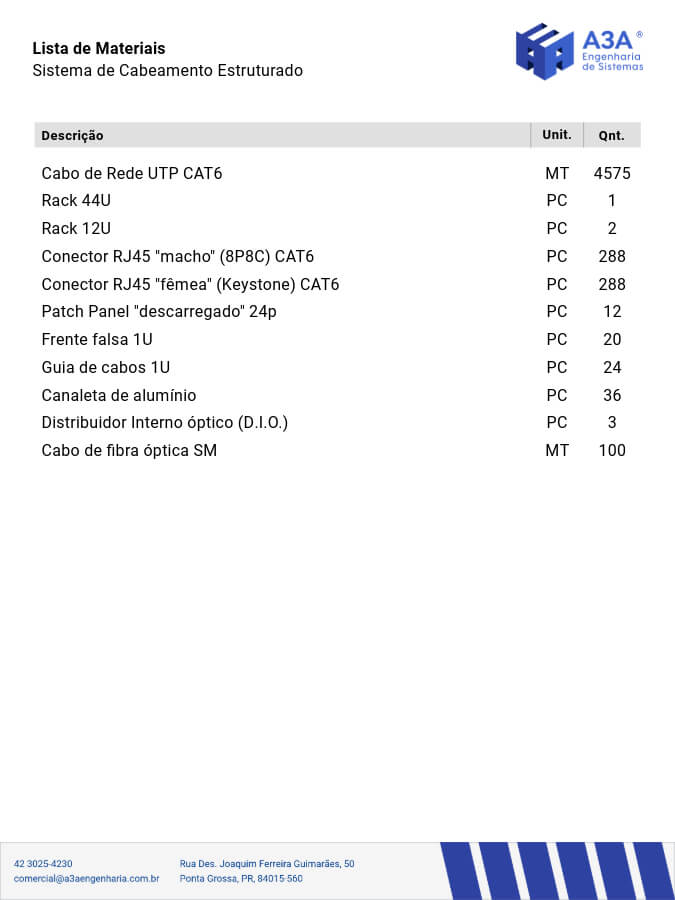
Example of a Material List for a Structured Cabling System (illustrative only).
This document facilitates the control and procurement of the required materials, allowing precise resource management and proper execution of the design.
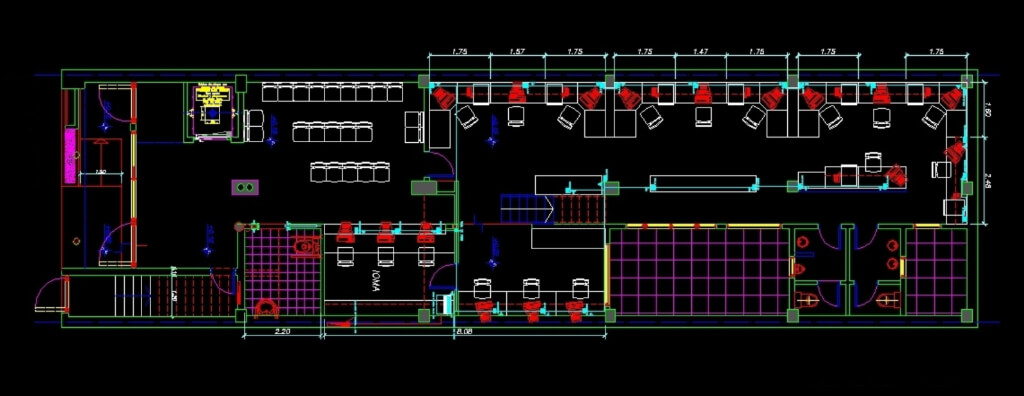
Plans and Diagrams
Preparing technical layouts involves creating detailed drawings that represent the distribution of network points, racks, patch panels, conduits, trays, and other components of the structured cabling infrastructure.
These layouts include floor plans, sections, and elevations that describe in detail the cable paths, equipment arrangement, and interfaces between components, providing a precise technical basis for project execution.
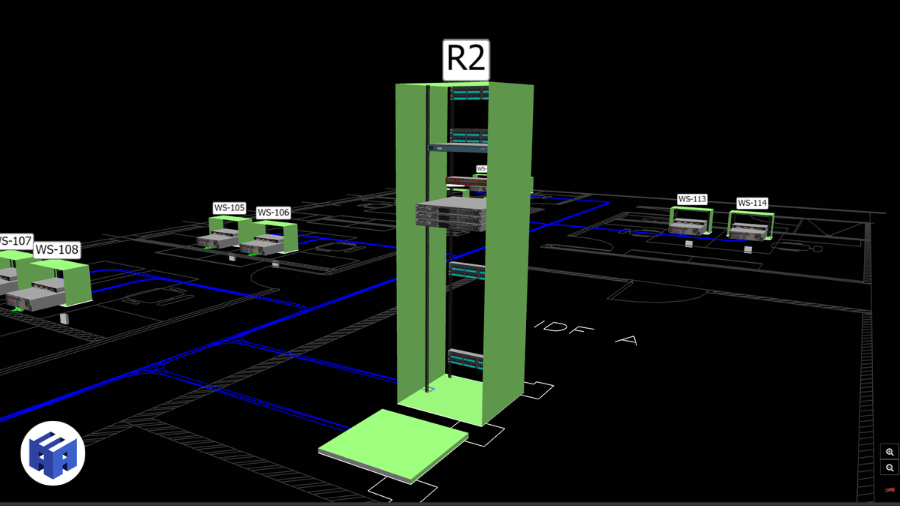
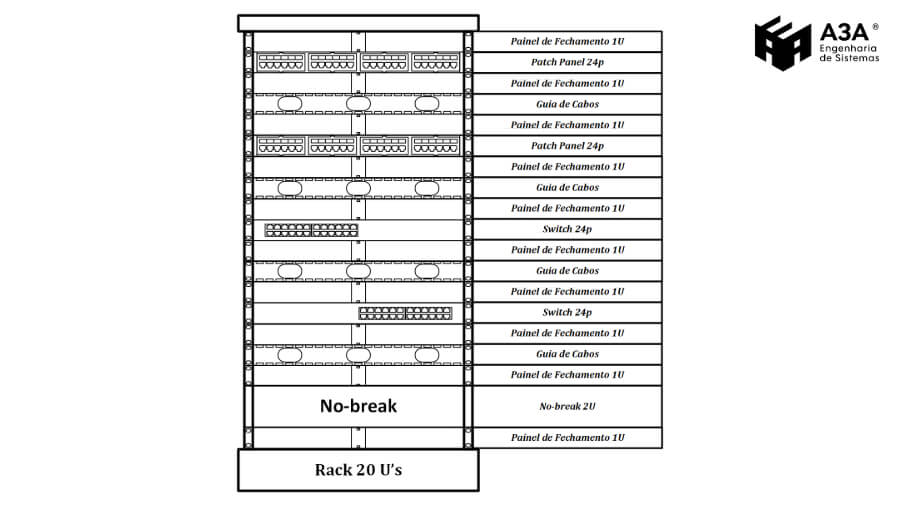
A3A Engenharia de Sistemas collection.
Layouts are essential for communicating the design, guiding the installation team, and reducing the margin for error during execution.
Besides guiding the assembly process, they serve as technical documentation for inspections, maintenance, and future adjustments, acting as a detailed reference that simplifies interventions and modifications to the infrastructure, ensuring that the network operates as planned and efficiently over time.
Analytical, Synthetic, and Summary Budget Sheets
Technical budget spreadsheets, prepared at three levels of detail (analytical, synthetic, and summary), allow precise analysis of the costs associated with each design component, covering materials, equipment, labor, and any additional services.
Technical Responsibility Record (ART)
The Technical Responsibility Record is the formal registration of the design with the Regional Council of Engineering and Agronomy (CREA), assigning legal responsibility to the qualified professional who signs it.
This instrument ensures that the design and its execution comply with technical standards and applicable legislation, providing legal support and validating the consistency of the engineering work.
Financial Engineering of the Structured Cabling Executive Design
Technical and Financial Benefits
Investing in a Structured Cabling Executive Design usually represents between 5% and 10% of the total deployment cost of a high-performance network. In larger projects, this percentage can be even lower, reaching only 2% to 3% of the total investment.
The advantage starts in the very first phase: with the support of a specialized engineering company, savings of 15% to 20% can already be achieved directly through more accurate purchasing of materials and contracting only the services that are truly necessary. This eliminates excess, inadequate purchases, and waste, all critical points for the financial and operational health of the project.
Hiring the executive design is far more economical than “buying wrong” or installing without planning. The cost of rework and purchasing more materials makes the design cost relatively small and quickly recovered through the reduction of the Total Cost of Ownership (TCO), avoiding waste and anticipating solutions aligned with market best practices.
Common Mistakes in Designs and How to Avoid Them
Even in large-scale projects, it is common to find failures that compromise the efficiency, longevity, and return on investment of structured cabling systems. Many of these problems are consequences of the absence of a detailed executive design and the lack of specialized technical follow-up.
Main Mistakes Found in the Market
- 1. Lack of a complete technical survey:
Starting implementation without a precise diagnosis of needs and environmental conditions leads to improvised solutions incompatible with the client’s reality. - 2. Poorly defined or generic scope:
Hiring services based only on a “number of points” or on budgets prepared by installers, without standardization, results in incomparable proposals and major cost variations. - 3. Failure to comply with technical standards:
Ignoring standards such as ABNT NBR 14565, TIA/EIA, and ISO/IEC exposes operations to legal risks, loss of warranties, certification issues, and even the need to redo the infrastructure. - 4. Inadequate material selection:
Choosing low-quality or non-standard materials in search of immediate savings may lead to failures, rework, and a significant increase in maintenance costs over the medium and long term. - 5. Lack of documentation:
Not delivering drawings, reports, test records, and other technical documents makes audits and future expansions harder and compromises system traceability. - 6. Lack of technical supervision:
Executing the work without follow-up from a responsible engineer increases the risk of inadequate installations, noncompliance with standards, and legal difficulties.
How to Avoid These Problems
- Invest in a detailed executive design tailored to your reality
- Require technical standardization and proposals based on clear documentation
- Always request the ART (Technical Responsibility Record) and the presence of a qualified professional in supervision
- Ensure that all materials comply with current standards
- Do not give up on complete documentation at the end of the project
Want to save up to 20% on your cabling deployment?
Talk to a specialist and understand how an executive design can make the difference
Success Case
Benchmarking and A3A Engenharia de Sistemas Technical Portfolio
One of the main advantages of hiring an executive design validated by specialists is the possibility of proving, in practice, the financial and operational impact.
Practical example: savings and technical standardization with an executive design
An industrial-sector company needed to deploy a new structured cabling system and, when requesting market quotations, found proposals ranging from BRL 600,000 to BRL 780,000, all with significant differences in scope, brands, and methodologies.
Each budget was structured according to the supplier’s commercial interests, with its own specifications, brands, and methodologies, without technical alignment with the actual needs of the requesting company. This lack of standardization made it difficult to compare proposals and increased the risk of an inadequate purchase or unnecessary costs.
To ensure the right choice and avoid waste, the solution was to hire a structured cabling executive design for BRL 50,000. The design technically defined all requirements, guided the price requests, and required suppliers to submit comparable proposals in line with the contractor’s real needs.
Concrete results:
- Best proposal after the design: BRL 510,000
- Direct savings: BRL 90,000 compared with the best initial quote and up to BRL 270,000 compared with the highest quote
- Savings percentage: 15% over the best initial quote, and up to 35% in the maximum scenario
- Investment in the design: BRL 50,000 (approximately 8% of the total value, quickly recovered through initial savings alone)
In addition:
- The infrastructure became standardized, documented, and ready for certifications
- A technical basis for future expansions and audits
- Reduced operational and maintenance risks
This example is based on real averages from the benchmarking and technical portfolio of A3A Engenharia de Sistemas, a company with 29 years in the market and hundreds of successful projects throughout Brazil. The client’s name is kept confidential due to a non-disclosure agreement (NDI).
In summary:
- The executive design “pays for itself” quickly, still during implementation.
- The client receives a high-performance system, ready for audits and expansions, with complete documentation and guaranteed compliance.
- Risks of emergency expenses, rework, and interruptions are minimized, ensuring stability and return on investment.
For any and every system deployment, the first thing to do is hire a specialized engineering company to prepare an executive design.
It is during the design phase that installation errors, material waste, time loss, personnel inefficiency, and possible failures in equipment specification are avoided.
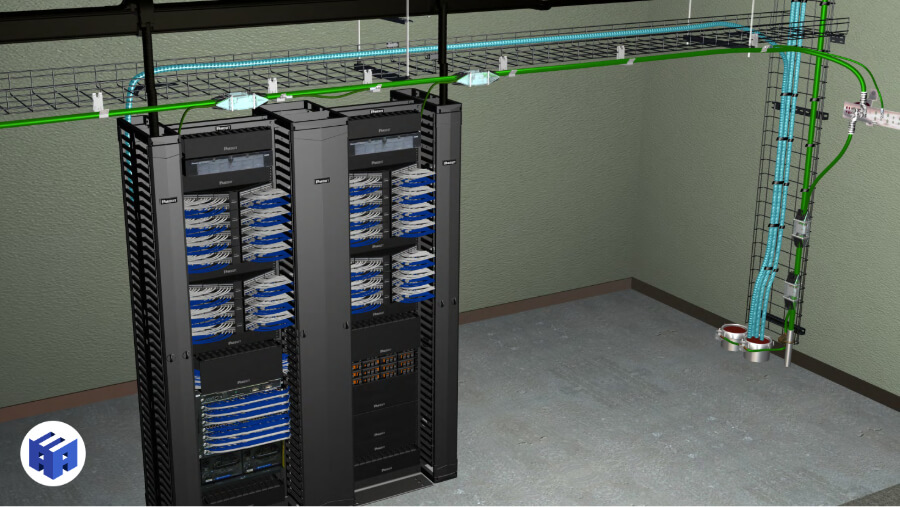
The main objective of a Structured Cabling Design is to ensure a physically organized and standards-compliant data network, capable of supporting increasing demands and relocation processes in an agile, safe, and operationally efficient way.
A well-prepared design minimizes the need for frequent maintenance, reduces network downtime, and avoids rework, providing substantial savings in the long term.
Conclusion: Invest in the Executive Design and Eliminate Risk
Hiring a Structured Cabling Design is the insurance policy against hidden maintenance costs and system failures. It is the only way to guarantee the predictability and compliance required by audits and legislation.
A3A Engenharia de Sistemas does not sell cables; it delivers high-performance infrastructure validated by specialists.
READY TO SECURE YOUR EXECUTIVE DESIGN? TALK TO OUR ENGINEERING DEPARTMENT VIA WHATSAPP 📲
Standards References
“NBR 14565 – Structured Cabling for Commercial Buildings” – ABNT (Brazilian Association of Technical Standards)
“ISO/IEC 11801 – Generic Cabling for Customer Premises” – ISO/IEC (International Organization for Standardization) & (International Electrotechnical Commission)
“ANSI/TIA 568 – Generic Telecommunications Cabling for Customer Premises” – ANSI/TIA (American National Standards Institute) & (Telecommunications Industry Association)
“What are structured cabling services and their corresponding technical responsibilities?” – CREA (Regional Council of Engineering and Agronomy)
“Structured Cabling Systems: the Fact File” – CommScope
Frequently Asked Questions
What is a Structured Cabling Design?
It is the technical planning of a standardized physical infrastructure system for communication networks, unifying services such as voice, data, and video in a modular and hierarchical architecture.
Who prepares a Structured Cabling Design?
A design should be prepared by engineers specialized in telecommunications, networks, or electrical systems, with legal qualification registered with CREA (Regional Council of Engineering and Agronomy).
How much does a Structured Cabling Design cost?
The price is determined by the size of the area to be covered, the architectural complexity of the building, and the density of required network points.
How does Structured Cabling work?
Structured Cabling works as the foundation of a building’s communication infrastructure, integrating heterogeneous services into a single, standardized, high-performance infrastructure.
Is the executive design really necessary?
Yes. The executive design is the basis for any professional implementation. It standardizes scope, avoids waste, eliminates improvisation, and ensures compliance with technical standards. Without it, the risk of rework, additional costs, and operational failures increases considerably.
What is the difference between an executive design and a simple installer’s budget?
An installer’s budget usually considers only the number of points and materials, without deep technical analysis, detailed documentation, or formal technical responsibility.
The executive design provides a complete diagnosis, official documentation, standards-based specification, accurate material list, and ART, protecting your investment and allowing fair proposal comparison.
What is the cost of an executive design compared to the total investment?
The executive design usually represents between 5% and 10% of the total implementation cost, depending on system complexity and scale. In large projects, this percentage may be even lower, reaching around 3%, thanks to the dilution of engineering costs over the overall investment.
Does the executive design really generate savings?
Yes. In addition to avoiding rework and unnecessary purchases, correct specification of materials and services can generate immediate savings of 15% to 20% in implementation cost, as demonstrated in real cases validated by A3A Engenharia’s technical portfolio.
What should be required from a structured cabling design supplier?
A detailed executive design, descriptive report, material list, executive and as-built drawings and diagrams, ART (Technical Responsibility Record), test reports, and point certification.
Is it possible to adapt the infrastructure for future expansions?
Yes. When the design is well-prepared and documented, the infrastructure is ready for future expansions, upgrades, and integrations without the need for rework or long downtimes.
How do I know whether my system complies with standards?
Request the complete technical documentation, including the executive design, reports, and ART, and ensure the service is executed by qualified and experienced professionals.
If you have doubts, request a specialized technical audit.
Relevant Links
Solutions
Books and Standards
eBook – Why hire a Structured Cabling Design?
Technical Standards for Structured Cabling
Standard 14565 – Brazilian Structured Cabling Standard
Engineering Services
Network Certification for Structured Cabling Systems
Specialized Structured Cabling Services
Consulting on Structured Cabling Designs
Structured Cabling Installation
Educational Content
How to avoid common problems in Structured Cabling Systems?
Main benefits of Structured Cabling