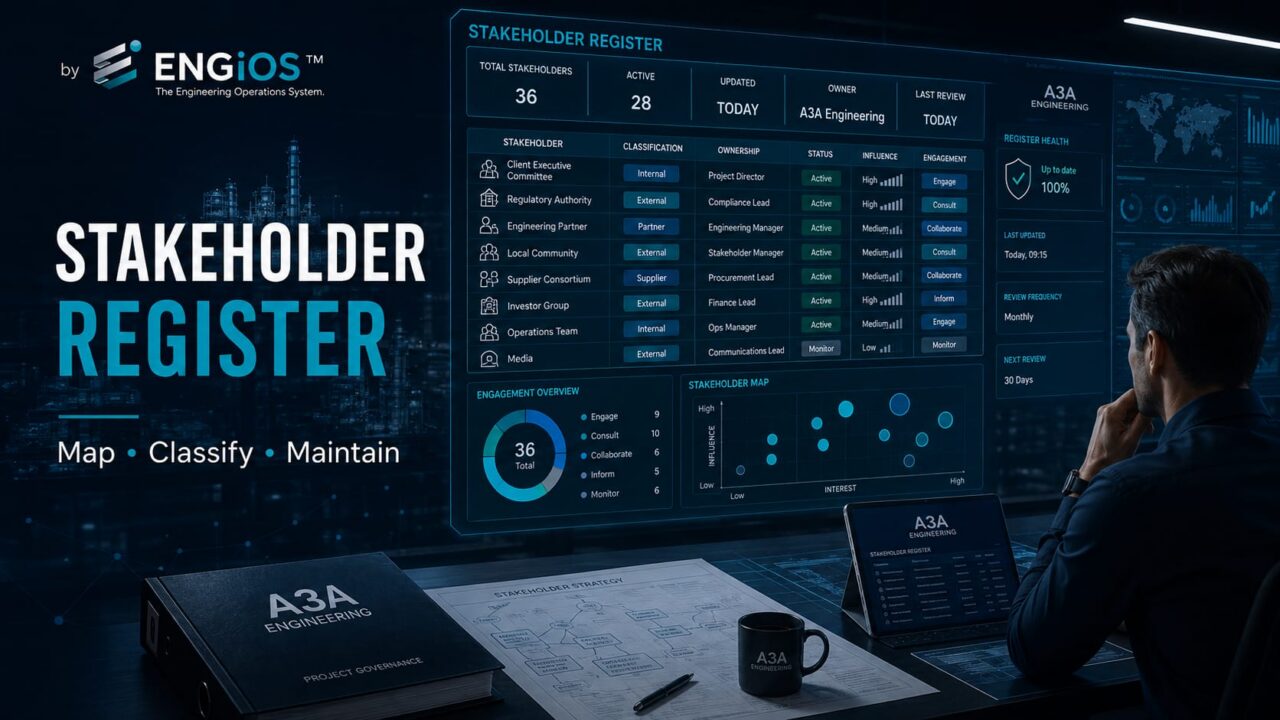
Learn how to structure and maintain a stakeholder register: fields, influence, impact, updates, confidentiality, and integration with communication and risks.
Check it out!
A stakeholder register is the controlled document or database that consolidates essential information about a project’s interested parties: who they are, their relationship with the project, their interests and impacts, how they influence decisions, their current and desired engagement level, who is responsible for the relationship, and when this information was last reviewed.
Unlike a contact list, the stakeholder register is a management artifact. It needs to support decisions, communication, prioritization, risks, requirements, and governance. If it only records names and job titles, it adds little value. If it gathers assessments without criteria or access control, it can create noise and organizational risk.
In engineering projects, the register should remain a living artifact throughout the life cycle. New suppliers enter, responsibilities change, authorities become critical, operations gains influence, conflicts alter relationships, and stakeholders that were previously peripheral may become decisive. For this reason, identifying stakeholders once and filing the information is not sufficient.
What is a stakeholder register
The stakeholder register is the structured source of information about the interested parties relevant to the project. It serves as the basis for stakeholder mapping, the stakeholder matrix, the engagement strategy, and the communication plan.
Its purpose is not to replace managerial judgment, but to preserve information in a consistent and reviewable form.
A good register answers questions such as:
- who the stakeholder is;
- which organization or department they represent;
- their relationship with the project;
- which decisions or deliverables affect them;
- how much influence they have;
- how much impact they receive;
- which requirements or constraints they may introduce;
- their current position;
- which engagement strategy is required;
- who manages the relationship;
- when the assessment was updated.
Why the stakeholder register is important
Without a structured register, stakeholder knowledge remains scattered across emails, meeting minutes, and team memory. When a manager changes, a supplier enters, or a phase ends, part of that knowledge is lost.
The register creates continuity. It helps prevent each new stage from rediscovering who needs to participate, which requirements have already been discussed, and which relationships require special attention.
It also improves governance by making it possible to trace why a particular party was prioritized, who should have been consulted, and which strategy was defined.
Stakeholder register, map and matrix: differences
The stakeholder register is not a contact list. It is the controlled source that supports the map, matrix, communication, and engagement strategy.
See how Stakeholder Mapping uses this foundation to represent relationships
The three instruments are complementary.
| Instrument | Main purpose | Question it answers |
| Stakeholder register | consolidate structured information | who are they, what do they represent, and how do they relate to the project? |
| Stakeholder map | visualize relationships and connections | how do these parties connect and influence each other? |
| Stakeholder matrix | prioritize according to criteria | who requires greater attention and why? |
Stakeholder mapping uses information from the register to represent relationships. The stakeholder matrix uses criteria to prioritize.
The register should remain the most complete and controlled information base.
Which fields should exist in the stakeholder register
There is no universal mandatory set. The fields need to be proportional to project complexity and management usefulness.
A robust structure may include:
| Field | Purpose |
| identification | name, role, or group |
| organization | company, agency, department, or community |
| relationship with the project | client, sponsor, supplier, user, authority, etc. |
| role | relevant contribution or responsibility |
| interest | what they expect to protect, obtain, or avoid |
| influence | ability to affect a decision or result |
| impact received | how much the project affects the party |
| current attitude | support, neutrality, resistance, or lack of awareness |
| desired engagement | state required for the project to move forward |
| associated requirements | needs, criteria, and constraints |
| interfaces | related deliverables, contracts, or disciplines |
| communication | channel, frequency, and expected feedback |
| relationship owner | person responsible for managing the relationship |
| sensitivity | need for access control |
| last review | date and person responsible for the update |
How to avoid turning the register into bureaucracy
The register needs to guide action. Fields that are never used increase maintenance cost and reduce quality.
Before adding a field, ask:
- does this information change a decision?
- does it change engagement priority?
- does it guide communication?
- does it help trace a requirement?
- does it influence risk or schedule?
- does it need to be preserved for team transition?
If the answer is no, the field may not need to exist.
How to identify stakeholders to populate the register
Identification should use actual project sources, not brainstorming alone.
Project charter and governance
They reveal the sponsor, client, committees, authority, and objectives.
Contracts and procurement documents
They show companies, responsibilities, interfaces, obligations, and formal recipients.
WBS and deliverables
Each deliverable may depend on who provides data, approves, verifies, operates, or receives impact.
Requirements and acceptance criteria
They help identify who defines, validates, or receives the deliverable.
Risk register
Risks frequently reveal stakeholders who control resources, approvals, or external interfaces.
Permits and approvals
They identify agencies, utilities, and authorities.
Operations and maintenance
They reveal users and teams that may not appear in the formal project structure.
How to record influence without oversimplifying
Influence is not synonymous with job title. A stakeholder may have little formal authority and still exercise relevant influence because they control knowledge, access, resources, permits, or legitimacy.
Sources of influence include:
- formal authority;
- budget control;
- rare technical knowledge;
- ownership of a critical requirement;
- ability to approve or block;
- contractual relationship;
- access to decision-makers;
- institutional legitimacy;
- impact on third parties;
- ability to mobilize other parties.
The register should preserve the rationale for the assessment, not merely a score.
How to record interest and impact
Interest represents the extent to which the project affects the party’s objectives, needs, or expectations. Impact received represents the intensity of the consequences for that party.
A user may have little formal power but experience high impact. Ignoring the user because they “do not decide” may lead to rejection during acceptance or operations.
Describe interests professionally and objectively. Instead of “does not like the solution,” record “is concerned about increased maintenance time and loss of front access to the equipment.”
How to record attitude and engagement
The current attitude can be classified simply as: unaware, resistant, neutral, supportive, or leading.
Stakeholder engagement uses this assessment to define the desired state and strategy.
It is important to record evidence. “Resistant” without explanation is a label. “Requested a review of the requirement because of its impact on maintenance routines and has not yet validated the solution” is management information.
How to control sensitive information
Assessments such as influence, resistance, and commercial interests may be sensitive. The usefulness of the register also depends on access governance and professional language.
Understand how Stakeholder Engagement addresses attitude and resistance
The register may contain sensitive assessments: position, informal influence, conflicts, commercial interests, and relationships between people or organizations.
This information requires access governance.
Good practices include:
- limit access according to role;
- avoid personal judgments;
- use professional language;
- record only necessary information;
- separate factual data from assessment;
- define a retention policy;
- avoid indiscriminate circulation by email;
- maintain a controlled version.
The register should not become a repository of personal opinions.
Who should maintain the stakeholder register
Responsibility may vary by project, but it should be explicit.
In smaller projects, the project manager may maintain it directly. In larger projects, the PMO or a project controls function may ensure standardization, while relationship owners update specific information.
The important point is to avoid two situations:
- no one is responsible and the register becomes outdated;
- several people edit it without governance and competing versions emerge.
When to update the stakeholder register
Update it whenever a relevant change occurs.
Common triggers include:
- entry or departure of a supplier;
- change of sponsor;
- change in organizational structure;
- new project phase;
- scope change;
- materialized risk;
- relevant conflict;
- new authority or permit;
- change in attitude;
- decision that changes impact;
- preparation for commissioning;
- transition to operations.
In addition to event-based triggers, long projects may establish periodic reviews.
How to connect the register to the communication plan
The communication plan depends on the register to determine who needs to receive information, for what purpose, at what time, and with what expected feedback.
Register fields can directly feed:
- audience;
- information need;
- channel;
- frequency;
- responsible party;
- response deadline;
- information classification.
This integration prevents a generic communication plan.
How to connect the register to requirements
When the register is connected to requirements, risks, interfaces, and communication, it stops being a simple directory and starts functioning as structured memory for project governance.
Stakeholders are sources of requirements, constraints, and acceptance criteria.
The register can indicate which requirements are associated with each party. This makes it possible to know who needs to be consulted when a change occurs.
Requirements management should maintain independent traceability, but the register helps locate origin and responsibility.
How to connect the register to risks
Some stakeholders control critical project conditions: regulatory approval, area access, budget decisions, long-lead supply, or operational acceptance.
The Risk Register should capture the associated risks. The stakeholder register indicates who influences those risks and who can act on the response.
How to connect the register to interfaces
Interface management identifies boundaries between disciplines, contracts, and organizations.
Associating interfaces with the register makes it possible to know which stakeholders need to participate when an interface changes.
How to connect the register to the RACI matrix
The RACI Matrix assigns roles by activity or deliverable. The stakeholder register contains broader information about interest, influence, and relationships.
A person may be responsible for several activities and still have low strategic influence. Another may execute nothing directly but be a decision-maker at a critical milestone.
How to use the register during scope changes
Changes alter impacts and may create new stakeholders.
When a change request is received, review:
- who becomes affected;
- who needs to decide;
- which requirement changes;
- which contract or supplier is impacted;
- which communication will be required;
- which new risk emerges.
The register should reflect the new configuration.
How to use the register during commissioning and acceptance
During testing and delivery, the importance of operations, maintenance, suppliers, and those responsible for acceptance increases.
The register helps confirm:
- who should witness tests;
- who approves results;
- who receives training;
- who validates documentation;
- who participates in the punch list;
- who signs acceptance;
- who assumes responsibility after handover.
How to structure access levels
Complex projects may adopt two layers.
Operational register
Contains the data required for day-to-day work: contacts, role, communication, interfaces, and responsibilities.
Restricted management register
Contains assessments of influence, attitude, conflict, or strategy that require limited access.
This separation reduces exposure risk without eliminating useful information.
How to version the register
The stakeholder register should have version control or a change history sufficient to answer:
- when the information changed;
- who changed it;
- what the previous assessment was;
- why the strategy was revised.
There is no need to bureaucratize every adjustment, but relevant changes need to be traceable.
Example stakeholder register for an industrial modernization project
| Stakeholder | Relationship | Influence | Impact | Current state | Desired | Strategy |
| sponsor | governance | high | medium | supportive | leading | exception decisions |
| operations | user | high | high | neutral | supportive | workshops and validations |
| maintenance | life cycle | medium | high | supportive | supportive | technical review |
| critical supplier | contract | high | medium | supportive | supportive | interface coordination |
| utility | external authority | high | medium | unaware | neutral | early formal consultation |
| affected users | operational impact | low | high | unaware | neutral | targeted communication |
The table is only a summary. The actual register may contain additional fields and supporting evidence.
How to assess register quality
A high-quality register should be:
Current
It reflects the project’s reality.
Useful
The information guides decisions and actions.
Traceable
Its origin and review history can be understood.
Proportional
It does not contain fields without a purpose.
Secure
Sensitive information has controlled access.
Integrated
It connects to communication, risks, requirements, and governance.
Common stakeholder register mistakes
Creating only a list of names
Without relationships, influence, impact, or strategy, the register loses its management function.
Never updating it
The document stops representing the project.
Using only job title to assess influence
This ignores knowledge, legitimacy, access, and dependencies.
Recording personal judgments
This creates risk and reduces analysis quality.
Mixing facts and opinions
This makes review and decision-making more difficult.
Exposing everything to everyone
Some assessments require confidentiality.
Maintaining parallel versions
Different personal spreadsheets create inconsistencies.
Not connecting information to actions
Information without an engagement strategy becomes a dead directory.
Checklist for a robust stakeholder register
Confirm that the register:
- has a clearly assigned owner;
- includes internal and external stakeholders;
- records the relationship with the project;
- describes interests and impacts;
- explains influence with evidence;
- defines the current and desired state;
- associates an engagement strategy;
- identifies the relationship owner;
- connects relevant requirements and interfaces;
- guides communication;
- considers risks;
- has access control;
- records the last review;
- is updated according to defined triggers and cycles;
- avoids personal judgments.
Stakeholder register and Consulting Engineering
In projects with multiple contracts, disciplines, and external parties, the register functions as structured governance memory. It helps the client maintain visibility of who influences decisions, who receives impacts, and where critical relationships exist.
Consulting Engineering can support the creation and maintenance of this artifact by integrating it with requirements, risks, interfaces, communication, changes, and acceptance criteria.
In Engineering Project Management, this integration is relevant to prevent decisions from depending only on the informal knowledge of specific individuals.
Final considerations
The stakeholder register is useful when it functions as a living information system, not as a spreadsheet created during initiation and forgotten. Its value lies in preserving relationships, impacts, influence, needs, and strategies in an updated and traceable form.
In engineering, where parties change in importance throughout the life cycle, keeping the stakeholder register updated helps anticipate decisions, reduce conflicts, and ensure that communication, requirements, risks, and acceptance involve the right people at the right time.
Technical references
[1] PROJECT MANAGEMENT INSTITUTE. A Guide to the Project Management Body of Knowledge (PMBOK® Guide). Newtown Square: PMI. Available at: https://www.pmi.org/standards/pmbok
[2] INTERNATIONAL ORGANIZATION FOR STANDARDIZATION. ISO 21502:2020 — Project, programme and portfolio management — Guidance on project management. Geneva: ISO, 2020. Available at: https://www.iso.org/standard/74947.html
Frequently asked questions
It is the structured information base that gathers data about a project’s interested parties, such as relationship, interest, influence, impact, engagement state, strategy, owner, and review date.
No. The register is the structured information source. The map visually represents relationships and connections. The matrix prioritizes stakeholders according to criteria.
Typically identification, organization, relationship with the project, interest, influence, impact, attitude, desired engagement, strategy, communication, owner, interfaces, requirements, and last review.
Responsibility should be explicit. It may belong to the project manager, PMO, or project controls function, with contributions from those responsible for specific relationships.
When there are changes in phase, scope, leadership, supplier, risk, conflict, authority, attitude, requirement, or preparation for commissioning and operations.
Yes, especially assessments of influence, attitude, and conflict. This information requires access control, professional language, and a legitimate purpose.
It provides audiences, needs, responsible parties, channels, frequency, and expected feedback, allowing the communication plan to be derived from actual needs.
It can structure the register and integrate it with requirements, risks, interfaces, changes, communication, and governance, preserving continuity and traceability.
Complementary technical materials
Main content on the topic
- Stakeholder Management in Projects
- Stakeholder Mapping
- Stakeholder Matrix
- Stakeholder Engagement
- Project Communication Plan
Related technical content
- Interface Management in Engineering Projects
- Requirements Management in Engineering
- Risk Register in Engineering Projects
Related solutions
- Requirements, Evidence and Acceptance Criteria Management
- Contract, Scope and Deliverables Management