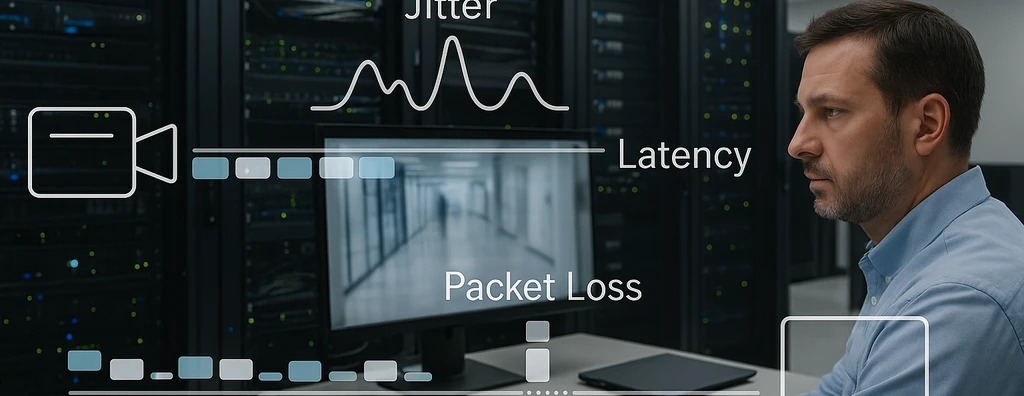
Understand how latency, jitter, and packet loss affect video transmission quality and which mitigation strategies are most effective in critical data networks.
Check it out!
Video transmission over data networks has become a strategic element in corporate environments, residential applications, and especially critical electronic security systems, where the integrity and delivery time of images are decisive factors for monitoring efficiency and operational response. However, challenges related to latency, delay variation, or jitter, and packet loss directly affect the final experience and can compromise everything from real-time visibility to faithful event recording. Technical understanding of these parameters is fundamental for network engineering aimed at high performance, availability, and quality of service.
This article examines the concepts of latency, jitter, and packet loss, their cause-and-effect relationships in video transmission, the mechanisms used to mitigate their impacts, and their practical implications in network design, operation, and sizing for video traffic. The goal is to provide technical support for critical decisions in engineering, architecture, and operation of audiovisual transmission systems.
Keep reading.
[elementor-template id=”24446″]
Latency: Concept, Origins, and Effects on Video Transmission
Latency is defined as the total time elapsed between the sending of a data packet by the source and its reception at the destination. This parameter includes several components, such as processing in network devices, physical signal propagation time, queueing in buffers, and protocol handling at each intermediate node.
In video transmission, high latency can generate excessive perceptible delay between the monitored event and its presentation to the user, making interaction difficult in time-sensitive applications such as videoconferencing and live video monitoring. It is important to distinguish between:
- Propagation latency: Physical time required for the signal to travel through the transmission medium;
- Processing latency: Time consumed at routing and switching nodes due to packet handling;
- Queueing latency: Delay caused by congestion in switch and router buffers;
- Application latency: Processing and buffering time at end devices, including video compression and decompression.
High values, even when constant, limit the agility and feasibility of certain video services.
Jitter: Delay Variation and Its Consequences
Jitter is the technical term for variation in packet arrival time at the destination relative to the originally expected timing interval. In data networks, especially those based on IP packets, jitter results from dynamic routing conditions, momentary congestion, route balancing, and differentiated traffic prioritization.
The impacts of jitter on video transmission include:
- Disruption of frame presentation continuity;
- Perceptible pauses or jumps in image playback;
- Loss of synchronization between audio and video in synchronized multimedia transmissions;
- The need to implement larger compensation buffers, increasing overall system latency.
Interactive and real-time monitoring applications require minimized jitter values, since large oscillations make effective system use impractical, generating degraded experiences and operational risks.
Packet Loss: Direct Effects on Visual Quality and Reliability
Packet loss refers to the failure of certain packets sent between source and destination to be delivered, due to discards in congested nodes, transmission errors, or failures in the processing of intermediate equipment.
In the context of video transmission, packet loss can cause:
- Frames partially or completely missing from the reproduced sequence;
- Fragmentation or visual distortion, noticeable in events of greater duration or frequency;
- Sudden scene jumps that compromise forensic analysis and real-time monitoring;
- In protocols that avoid retransmission in favor of lower latency, missing packets tend to be masked with techniques such as repetition of previous frames, insertion of blank frames, or filler sound ambience.
Critical systems and highly sensitive applications, such as perimeter security and video monitoring of strategic environments, must define maximum tolerable loss rates, sizing the architecture and appropriate quality-of-service mechanisms accordingly.
Relationships Between Latency, Jitter, and Packet Loss
These three parameters are interconnected because they depend on factors such as bandwidth occupancy rate, routing design, buffer overload, and the efficiency of prioritization algorithms, or QoS. Mitigating jitter often requires increasing buffer size, which can in turn raise total latency. On the other hand, buffers that are too small may cause packet discards under congestion, increasing the loss rate.
The sizing of the playback point on the client side depends on balancing:
- Acceptable latency: defined by the maximum tolerable delay that still preserves the usefulness of real-time video;
- Jitter accommodation: through sufficiently large buffers to absorb variation without perceptible interruptions;
- Loss risk: calculated based on the network’s ability to deliver packets in time before they are discarded or replaced.
This interdependence requires careful calculations and continuous monitoring, especially in critical topologies.
Mitigation Mechanisms and Strategies
Maintaining video transmission quality requires the implementation of specific techniques throughout the network infrastructure and at the endpoints:
- Jitter buffers: Implementation of temporary storage areas in receiving terminals to accommodate irregular packet arrival, releasing them for processing in continuous flows. Buffer sizing is directly proportional to expected delay variation, becoming larger as tolerable jitter increases.
- Quality of Service (QoS) mechanisms: Classification, prioritization, and bandwidth reservation for sensitive video flows, reducing the risks of congestion and packet loss. Technologies such as priority queuing and packet marking are fundamental.
- Monitoring and dynamic adjustment: Continuous analysis of network operating parameters, adaptive logic to adjust the playback point, intelligent route selection, and compression algorithms suited to the variability of measured indicators.
It is worth noting that the lower the latency and jitter, the narrower the window for fault recovery and packet replacement, requiring preventive solutions and clearly defined tolerance levels.
Practical Implications for Video Network Design and Operation
Projects involving real-time video transmission, such as video monitoring, telemedicine, and corporate broadcast, impose strict requirements on latency, jitter, and packet loss. For sensitive applications, it is recommended to clearly define SLA parameters, or Service Level Agreements, considering:
- Maximum end-to-end latency parameters, respecting the purpose of the system;
- Jitter indices compatible with the tolerance of the embedded application and the expectations of the end user;
- Maximum loss rates per flow, with redundancy and compensation measures where necessary;
- Monitoring, diagnostic, and automatic response capability for service degradation, including alerts and detailed logs for forensic analysis.
Network engineering must anticipate flexible and resilient architectures that accommodate usage peaks, environmental variations, and demand growth. Stress testing, simulations, and periodic measurements are part of the continuous cycle of improvement and quality assurance for these infrastructures.
Latency, jitter, and packet loss are central determinants of video transmission quality in data networks, requiring a systemic approach in design, operation, and maintenance. Precise parameter definitions and planning focused on tolerance and mitigation help reduce operational risks and raise performance in the most demanding applications. The success of video solutions lies in quality-of-service policies, buffer sizing, careful topology selection, and continuous monitoring. In critical and sensitive environments, the adoption of proactive practices, integration of diagnostic resources, and constant alignment of operational indicators with the quality expectations of the business and end users are recommended.