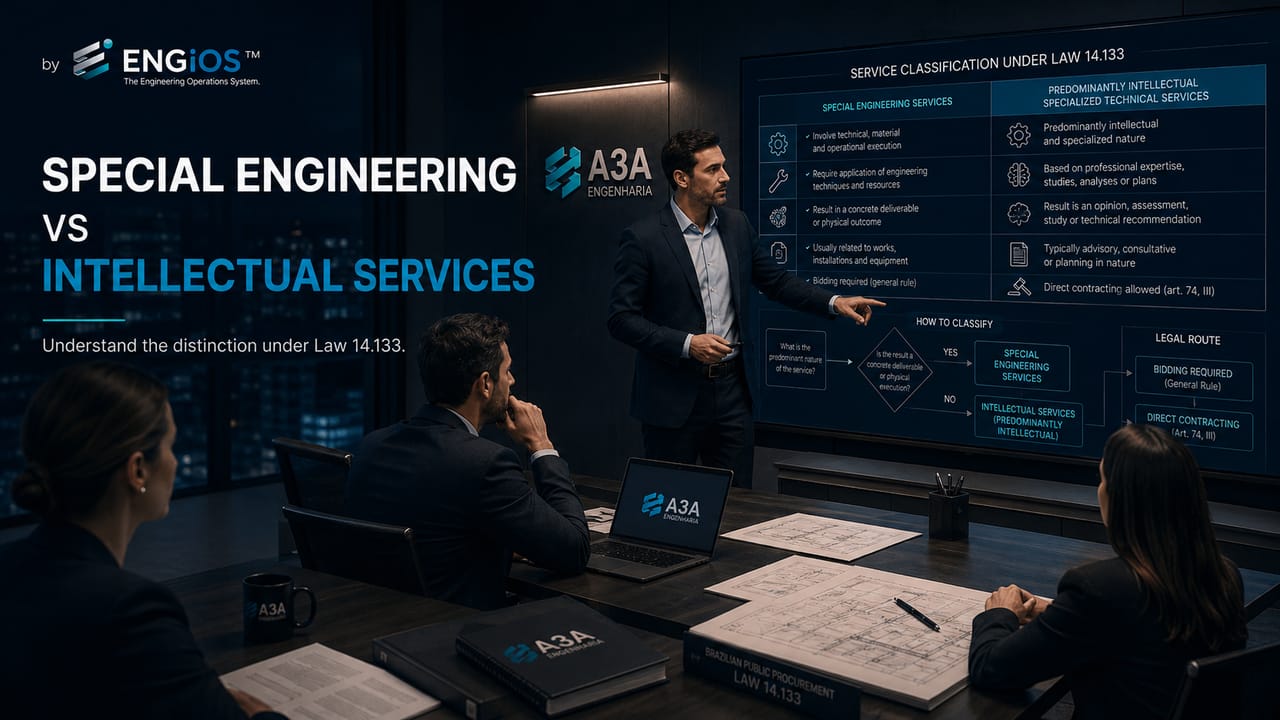
Understand the difference between special engineering services and predominantly intellectual specialized technical services under Law 14,133, including procurement procedure, technique and price, and non-competitive procurement.
Check it out!
A special engineering service and a predominantly intellectual specialized technical service are not the same category under Law 14,133/2021. The first concept appears in Art. 6, XXI, “b”, and classifies an engineering service by its high heterogeneity or complexity, that is, by its inability to be classified as a common engineering service. The second appears in Art. 6, XVIII, and identifies technical work centered on studies, planning, designs, opinions, assessments, consulting, inspection, supervision, management, quality controls, analyses, tests and other activities defined there, when the intellectual dimension predominates.
The two classifications answer different questions. Common vs. special asks how standardizable the engineering scope is. Predominantly intellectual asks about the nature of the technical work and the extent to which the outcome depends on knowledge, analysis, judgment, methodology and professional development. Therefore, the categories may overlap, but one does not automatically follow from the other.
A multidisciplinary detailed design procured by scope may simultaneously be a special engineering service and a predominantly intellectual specialized technical service. Complex and heterogeneous maintenance may be special without necessarily belonging to the same intellectual core. And procurement of staffed engineer positions may, in some circumstances, be considered a common engineering service even when the allocated professionals produce reports, inspections or support activities listed in Art. 6, XVIII — a distinction reinforced by the TCU in 2026 decisions.
The difference matters because it changes procurement strategy. Classification as a special engineering service rules out pregão as the ordinary route and points to competitive bidding (concorrência) when a tender is held. Predominantly intellectual work may require or favor technical evaluation, especially under Arts. 36 and 37. Non-competitive procurement, however, does not arise from either label alone: under Art. 74, III, it also depends on recognized expertise, the essentiality of that expertise to satisfy the scope and infeasibility of competition.
The difference can be understood through two axes
When “special,” “complex” and “intellectual” are treated as synonyms in the procurement process, the procurement procedure and award criterion may be built on a technically incorrect classification. The ETP should separate the two axes and demonstrate what actually characterizes the scope.
Preliminary Technical Study (ETP) for Public Works and Engineering Services
The safest way to interpret Law 14,133 is to abandon the idea of a single scale on which services progress from “simple” to “specialized.” The law uses different classifications for different purposes.
The first axis is standardization, heterogeneity and complexity. This is where common and special engineering services appear. The second axis is the nature of the technical work. This is where predominantly intellectual specialized technical services appear.
This means the public manager must perform two analyses, not one.
Axis 1 — common or special engineering service
Art. 6, XXI defines an engineering service and divides it into two categories. A common engineering service consists of actions that can be objectively standardized in terms of performance and quality, especially maintenance, adjustment and adaptation while preserving original characteristics. A special service is one that, because of high heterogeneity or complexity, cannot be classified under that definition.
The central question is: can performance and quality be defined sufficiently objectively through usual requirements so that competition does not depend on material technical differences among solutions?
The classification does not depend on the commercial name of the service or the professional’s degree. It depends on the structure of the scope.
Axis 2 — predominantly intellectual specialized technical service
Art. 6, XVIII lists technical work such as:
- technical studies, planning, basic designs and detailed designs;
- opinions, expert examinations and assessments;
- technical advisory and consulting services;
- inspection, supervision and management of public works and services;
- personnel training and development;
- restoration of works of art and historic assets;
- quality and technological controls;
- analyses, tests and field and laboratory testing;
- instrumentation and monitoring of specific parameters of public works and the environment;
- other engineering services falling within the statutory definition.
Here, the question is different: does the contracted outcome depend predominantly on qualified intellectual activity, analysis, conception, judgment, methodology or professional technical production?
The article Predominantly Intellectual Specialized Technical Services under Law 14,133 examines this second axis in depth. The purpose here is to explain how it relates to — and differs from — the classification of special engineering services.
The practical value of this reading is that it prevents the public manager from using one classification to draw conclusions that belong to the other.
Special service is a classification within engineering services
The concept of special service in Art. 6, XXI, “b” only makes sense within the category of engineering services. Before classifying it as common or special, the Public Administration must verify whether the scope is actually a service rather than a public work.
A public work, under Art. 6, XII, involves intervention in the environment through a coordinated set of actions that forms a whole and creates new physical space or substantially alters the original characteristics of real property. An engineering service, in turn, seeks a specific intellectual or material utility without falling within that definition of public work.
This distinction matters because a major renovation, for example, cannot simply be called a “special service” in order to fit the procurement into a preferred logic. If the intervention substantially alters the original characteristics of the property, the starting point may be classification as a public work.
After confirming that the scope is an engineering service, the Public Administration evaluates standardization. When the actions preserve original characteristics and can be objectively specified in terms of performance and quality, the service may be common. When heterogeneity or complexity prevents that classification, the service is special.
The article Common vs. Special Engineering Services under Law 14,133 details the boundary criteria between these two classes.
Predominantly intellectual does not simply mean “performed by an engineer”
One of the main sources of error is associating intellectual nature with the fact that the work is performed by a university-level professional. All engineering involves technical knowledge, but this does not mean that every engineering contract has a predominantly intellectual nature for the specific legal purposes of Law 14,133.
Recent TCU case law has made this difference very concrete.
In Decisions 25/2026, 987/2026 and 2,045/2026, the Court examined procurement of ongoing services through staffed positions for engineers and architects. The understanding was that, in certain contexts, the procured scope was the standardized provision of workforce capacity for continuous, variable and ancillary demands, rather than procurement by scope of a specific intellectual product in which the individual technical quality of the proposal determined the outcome.
The fact that these professionals produced analyses, reports, inspections or support for oversight did not automatically turn staffing procurement into a predominantly intellectual specialized technical service.
This reasoning is especially useful because it separates three elements:
- the profession of the allocated professional;
- the activities the professional may perform;
- the scope actually procured and remunerated.
If the scope is a standardized staffed position, supervised by the Public Administration itself and remunerated for workforce availability, its classification may differ from a contract in which a consulting firm assumes responsibility for a diagnosis, design, opinion or technical solution defined by scope and outcome.
Scope-based contracts and staffing contracts should not be confused
This distinction does not mean that a scope-based contract is always special and a staffing contract is always common. The point is that the way the scope is structured changes the analysis.
Scope-based contract
Under a scope-based contract, the company assumes responsibility for delivering a defined technical product or result. Examples include:
- multidisciplinary detailed design;
- engineering master plan;
- infrastructure diagnosis;
- technical audit;
- feasibility study;
- engineering opinion;
- commissioning plan;
- independent inspection based on products and deliverables;
- project management with defined deliverables.
The quality of the methodology, team, applicable experience and ability to integrate information can directly affect final quality.
Staffing contract
Under a staffing model, the scope may be the provision of professionals with specified qualifications to respond to demands under the direction and supervision of the Public Administration. When the deliverables are variable, ancillary and objectively standardizable, the TCU has recognized the possibility of classification as a common service in specific situations.
This difference is critical for Consulting Engineering. Procuring intellectual capability by outcome is different from procuring hours or professional availability. The contractual model must reflect what the Public Administration actually needs.
Engineering designs clearly show how the categories can overlap
Basic and detailed designs are expressly listed in Art. 6, XVIII, “a”. In a complex, multidisciplinary design procured by scope, there is a strong possibility of overlap: the service may be special engineering because it cannot be objectively standardized as a common service, and a predominantly intellectual specialized technical service because the outcome depends predominantly on conception, analysis, coordination and professional judgment.
TCU Decision 28/2026-Plenary, involving BIM design development, reinforced the relevance of this classification. The Court treated design development as a predominantly intellectual technical service and applied the specific rule in Art. 37, § 2 concerning technical evaluation when the statutory threshold is exceeded.
This reading helps explain why design should not be purchased as though it were a standardized material. Two bidders may satisfy minimum requirements while still offering significant differences in:
- understanding of the program of requirements;
- multidisciplinary coordination strategy;
- survey methodology;
- clash and interference management;
- BIM process;
- definition of information levels;
- constructability review;
- version control;
- requirements management;
- risk treatment;
- document quality.
When these differences affect the outcome, purely economic selection may fail to capture the technical value the Public Administration needs.
Inspection and management also require analysis of the contracting model
Inspection, supervision and management appear in item “d” of Art. 6, XVIII. But again, the name of the scope does not replace analysis.
Scope-based procurement of independent management, with responsibility for planning, risks, controls, technical opinions, deliverable verification, executive reporting and governance, has a different nature from a contract whose core is merely providing professionals to work under the direct command of the entity.
The same applies to inspection. Independent technical inspection may require a methodology, inspection plan, evidence matrix, acceptance criteria, document traceability and responsibility for technical deliverables. A continuous support model based on staffed positions may have another classification depending on the actual scope.
The legal and technical point is simple: the title in the spreadsheet does not determine the nature of the contract. The Public Administration must describe what it is buying, who decides, who assumes responsibility and which outcome will be delivered.
Testing, quality controls and monitoring may also vary
Item “h” includes quality and technological controls, analyses, tests, field and laboratory testing, instrumentation and monitoring of specific parameters of public works and the environment.
There is considerable diversity within this group. A highly standardized test, with a strict normative procedure and objective outcome, may have a different competitive dynamic from an investigative campaign requiring definition of methodology, sampling points, interpretation, correlation of results and a conclusive technical opinion.
Therefore, the fact that a service appears in the list in Art. 6, XVIII does not relieve the Public Administration from understanding how that specific scope will be performed and what portion of its value lies in intellectual judgment.
TCU case law in recent years has refined this analysis. Decision 2,381/2024 and later decisions discussed precisely the need to interpret the statutory list together with the intellectual predominance of the scope, avoiding automatic conclusions.
The ETP must record the two classifications separately
The Preliminary Technical Study should, when relevant, answer two explicit questions:
- is the scope a common or special engineering service?
- is the scope a predominantly intellectual specialized technical service?
The justifications are different.
To characterize a special service, the ETP must explain why heterogeneity or complexity prevents classification as common. To characterize predominantly intellectual work, it should demonstrate how analysis, conception, judgment, methodology, integration, experience or specialized knowledge predominate in producing the outcome.
This avoids circular reasoning such as “it is special because it is intellectual” or “it is intellectual because it is complex.” A scope may have both characteristics, but each must be demonstrated on its own grounds.
Useful elements for the ETP include:
- diversity of technically acceptable solutions;
- degree of uncertainty;
- need for diagnosis;
- importance of applicable experience;
- influence of methodology on the outcome;
- number and criticality of interfaces;
- need for multidisciplinary coordination;
- relevance of key professionals;
- possibility of objective standardization;
- degree of contractor technical autonomy;
- responsibility for the final product;
- possibility of measuring the service by result;
- impact of technical quality on total cost, schedule, risk and performance.
The preparation of Preliminary Technical Studies for Public Works and Engineering Services helps organize these decisions before the Public Administration enters the discussion of procurement procedure and award criterion.
How the difference changes the Terms of Reference
If the Public Administration needs an intellectual product, the contract must define the outcome, responsibility, quality criteria and acceptance — not merely professional hours or presence. The Terms of Reference are where this distinction must become a contractual obligation.
Terms of Reference for Public Works and Engineering Services
After the ETP, the Terms of Reference must convert the classification into contractual requirements.
If the scope is predominantly intellectual, the Terms of Reference should not reduce it to a generic list of professional hours without defining deliverables, decisions, quality criteria and responsibility. If the scope was classified as special, it also should not be specified so simplistically that it appears any method or team would produce exactly the same result.
The Terms of Reference should clarify:
- problem to be solved;
- scope;
- deliverables;
- limits and exclusions;
- interfaces;
- input data;
- assumptions;
- review levels;
- responsibilities;
- minimum team requirements;
- required methodology only when necessary;
- quality criteria;
- measurement;
- acceptance;
- ownership and use of technical deliverables;
- traceability;
- document-update requirements.
A technical product should not be confused with professional presence
A company may provide ten engineers and still deliver an inconsistent design. Another may mobilize a smaller, better-structured team and deliver a superior product. If the Public Administration needs an intellectual result, the contract should measure the result, not merely presence.
Technical autonomy must be clear
In consulting and design contracts, a significant share of the value lies in the ability to formulate recommendations and assume technical responsibility. If the entity intends to direct every decision in detail, it should assess whether it is procuring an intellectual product or merely operational support capacity.
The Terms of Reference for Public Works and Engineering Services page addresses scope, requirements, measurement and acceptance so the ETP strategy becomes a contractible scope.
What changes in procurement procedure and award criterion
Correct classification is not enough if the tender documents, procurement procedure and award criterion tell a different story. Technical review cross-checks the ETP, Terms of Reference, technical criteria, qualification, budget and draft contract before inconsistency leads to a challenge or inappropriate selection.
Technical Review of Tender Documents and Annexes for Engineering Procurement
The two classifications produce different and cumulative consequences.
If it is a special engineering service
Pregão ceases to be the ordinary procurement procedure because Art. 29 restricts it, in engineering, to common engineering services. When competition exists, competitive bidding (concorrência) is the natural procedure.
If it is a predominantly intellectual specialized technical service
Art. 29 also excludes predominantly intellectual specialized technical services from pregão. In addition, Arts. 36 and 37 establish important rules on technique and price and best technique.
Art. 36 provides for technique and price when the ETP demonstrates that evaluating and weighting technical quality above the minimum requirements is relevant. The listed scopes include predominantly intellectual specialized technical services and public works and special engineering services.
Art. 37, § 2 creates an even more specific rule. Except in cases of non-competitive procurement, for services under items “a”, “d” and “h” of Art. 6, XVIII that are predominantly intellectual and exceed the updated threshold, the award criterion must be best technique or technique and price, with a 70% technical weighting in the latter case.
For 2026, Decree 12,807/2025 updated the threshold to R$ 392,952.63.
If both classifications apply
The Public Administration must combine the consequences. A complex detailed design above the threshold, for example, may be both special and predominantly intellectual. In that scenario, it is not enough to say “competitive bidding because it is special”; the specific technical-award rule must also be verified.
Technique and price should not be used merely to “look more rigorous”
When the Public Administration chooses technique and price, the scoring items must measure attributes that have a causal relationship with the outcome. Indiscriminately scoring the number of certificates, years in business or number of professionals may create competitive barriers without increasing quality.
The technical evaluation should prioritize factors such as:
- methodology;
- understanding of the problem;
- execution strategy;
- directly applicable experience;
- qualifications of professionals whose personal performance is relevant;
- team organization and integration;
- interface management;
- quality controls;
- risk approach;
- consistency of schedule and work plan.
The criterion must distinguish a superior proposal, not simply a larger company.
Technical qualification is not technical evaluation
For high-technical-content services, excessive qualification requirements may restrict the market without selecting the best proposal. Specialized analysis of past-performance certificates, CAT, ART and experience separates minimum capability from technical differentiation.
This separation is decisive in specialized services.
Qualification defines the minimum threshold for participation. Technical evaluation compares proposals that have already exceeded that threshold. If the Public Administration uses qualification to require all the experience it would like to score, it may end up restricting the market instead of evaluating quality transparently.
Technical-operational capability
Demonstrates the organization’s experience in relevant portions of the scope. It should be proportionate and linked to concrete risks.
Technical-professional capability
Relates to the professionals responsible for technically relevant portions. When their experience is decisive, their contractual linkage and effective participation must be consistent with the contract rules.
Technical scoring
When provided for, it should evaluate relative quality above the minimum. It may consider experience, but within objective criteria linked to the outcome.
Technical Support for Qualification of Engineering Bidders supports the review of certificates, CAT, ART, technical-professional capability, operational capability, equivalence and clarifications without confusing qualification with proposal scoring.
2026 case law made the “real scope” even more important
The recent body of TCU decisions is useful to public managers because it reduces the reliability of classifications based only on the service title.
Decision 25/2026
The Court distinguished procurement of staffed engineer and architect positions from the future objective of developing studies, designs or support for inspection. The procurement scope was outsourced labor, which could be objectively standardized even though the professionals would perform technically qualified activities.
Decision 987/2026
The TCU reiterated the difference between scope-based contracts, in which technical quality is directly associated with a specific product and may be decisive, and contracts involving occasional and varied demands performed by allocated professionals.
Decision 2,045/2026
The Court accepted pregão for ongoing technical-support and engineering-inspection services based on staffed positions when the scope consisted of specialized workforce for continuous, variable and ancillary demands that were objectively standardizable and supervised by public servants responsible for the institutional technical conclusions.
Decision 28/2026
In a complementary direction, in the case of BIM design development, the Court treated the scope as a predominantly intellectual technical service and reinforced application of the specific technical-evaluation rules.
The decisions are not contradictory. They reinforce the same thesis: classify what the Public Administration actually procures.
Design, inspection and management should not automatically be treated as commodities
The commercial and institutional relevance of this distinction is significant. Law 14,133 expressly recognizes activities with high intellectual content. This prevents every engineering service from being reduced to the idea of interchangeable human resources and purely price-based comparison.
Designs, assessments, consulting, inspection, supervision, management, quality controls, testing and trials may involve technical knowledge that materially changes:
- the selected solution;
- life-cycle cost;
- risk of failure;
- design quality;
- inspection capability;
- constructability;
- safety;
- reliability;
- documentation;
- final project performance.
When this intellectual content is real, procurement must recognize it in both scope and selection. The error is not using price as a criterion in every possible case; the error is assuming price always captures best value when technical quality produces material differences.
But “specialized” cannot become an empty justification for restricting competition
The opposite movement is also dangerous. Labeling every activity “specialized” in order to require excessive résumés, rare certificates or experience nearly identical to the scope may restrict competition without justification.
The classification must be supported by facts. For each requirement, the public manager should be able to answer:
- which risk it controls;
- which portion of the scope justifies the requirement;
- why a less restrictive requirement would be insufficient;
- how it will be verified;
- whether it belongs to qualification or evaluation;
- whether it unnecessarily favors a particular supplier.
Consulting Engineering should not be differentiated by artificially inflating complexity. Its differentiation should arise from the actual intellectual content and responsibility assumed for outcomes.
When non-competitive procurement enters the analysis
Non-competitive procurement is a third analytical plane. Neither a special service nor a predominantly intellectual service is sufficient by itself.
Under Art. 74, III, Law 14,133 provides for procurement of certain predominantly intellectual specialized technical services from professionals or companies with recognized expertise. The TCU summarizes three central requirements:
- a predominantly intellectual specialized technical service;
- recognized expertise of the professional or company;
- demonstration that this expertise is essential and demonstrably appropriate to fully satisfy the scope.
In addition, non-competitive procurement remains subject to the general premise of infeasibility of competition in the main provision of Art. 74.
Removal of the singularity requirement did not eliminate the need for reasoned justification
Law 8,666 expressly used singularity. Law 14,133 did not retain this textual requirement in Art. 74, III. This does not mean that any service on the statutory list can be directly contracted.
The Public Administration must demonstrate why, for that scope, the provider’s differentiated expertise is essential. If several providers can compete on objective terms and one provider’s recognized expertise is not necessary to satisfy the scope, the basis for non-competitive procurement weakens.
Recognized expertise is a relationship between provider and scope
Publications, experience, team, studies, organization and prior performance help demonstrate recognized expertise, but they must be read in light of the concrete need.
The article Recognized Expertise under Law 14,133 explains this evidence. Infeasibility of Competition in Non-Competitive Procurement examines the rationale for direct contracting in greater depth.
A special service may exist without being predominantly intellectual
It is important to keep this possibility open. The heterogeneity or complexity of a service may arise from execution conditions, logistics, diversity of assets, operational constraints or physical integration, without the principal contracted utility being an intellectual product.
Consider, for example, an engineering service involving a wide variety of equipment, interferences and field conditions. It may not be objectively standardizable as common maintenance and therefore may be special. Even so, the core of the service may remain predominantly executive/material.
In that situation, classifying the scope as a predominantly intellectual specialized technical service merely because it is difficult would create a legal consequence without technical basis.
A predominantly intellectual service may require analysis even when tasks appear standardized
The reverse must also be considered. A method may follow predefined standards and procedures while the final product still depends significantly on professional interpretation and judgment.
A test may be standardized, but an investigation campaign and the opinion consolidating the results may require definition of strategy, sample selection, correlation, diagnosis and recommendation. The public manager must identify the main scope and the utility being procured.
This approach avoids artificially breaking an intellectual product into smaller tasks merely to make it appear common.
How the difference should appear in the tender documents
The tender documents do not need to reproduce a legal lecture, but they must be consistent with the rationale developed during the preparatory phase.
If the scope was classified as special and predominantly intellectual, there should be consistency among:
- procurement procedure;
- award criterion;
- technical weightings;
- qualification requirements;
- scope;
- risk matrix;
- execution regime;
- measurement;
- replacement of professionals;
- subcontracting;
- ownership of deliverables;
- acceptance criteria.
The Technical Review of Tender Documents and Annexes for Engineering Procurement verifies this consistency before publication, while inconsistencies can still be corrected without contaminating the competition.
How to avoid neutralizing technical value through the contract design
Even when the procurement recognizes the value of technical quality, the draft contract can cancel that gain if it does not preserve what was evaluated.
Examples include:
- scored team members can be freely replaced;
- methodology receives points but does not become a contractual obligation;
- a specialist’s experience is decisive in selection, but the specialist is not required to participate in execution;
- the product is intellectual, but measurement pays only for hours;
- the quality plan is scored, but there are no verification milestones;
- risk management is required, but changes have no formal workflow.
The rule should be: what justified selection of the provider must be verifiable during execution.
From selection to execution: preserve the contracted intelligence
The contracted intelligence must remain present during execution. If team, methodology and experience justified the selection, the Public Administration must verify deliverables, interfaces, changes and acceptance throughout the project.
Services with high intellectual content generate value not only through the final document, but through the quality of decisions throughout the process. This requires governance.
In complex designs and consulting engagements, the Public Administration must control:
- assumptions;
- requirements;
- versions;
- technical decisions;
- comments and responses;
- interfaces;
- risks;
- changes;
- approvals;
- evidence;
- acceptance criteria.
Owner’s Engineering can act as an independent technical layer to verify whether the deliverables, professionals, methodology and commitments that justified the procurement remain present during execution.
Owner’s Engineering structures technical governance, inspection, procurement, change control, commissioning, documentation and acceptance throughout the project.
A practical classification matrix
The table helps visualize possible combinations without turning examples into automatic rules.
| Scope | Common or special? | Predominantly intellectual? | Observation |
| standardized facility maintenance | tends to be common | generally no | performance can be objectively specified |
| highly heterogeneous maintenance in a critical environment | may be special | depends on the scope | execution complexity does not automatically mean intellectual predominance |
| multidisciplinary detailed design procured by scope | tends to be special | tends to be yes | conception, coordination and technical judgment are central |
| technical diagnosis with a conclusive opinion | depends on complexity | may be yes | the product and intellectual responsibility are relevant |
| ongoing engineer positions for ancillary demands | may be common | the scope may not be predominantly intellectual | TCU 2026 case law requires looking at the procured scope |
| independent management based on deliverables | may be special | may be yes | methodology and governance may differentiate proposals |
| isolated standardized normative test | may be common | depends on the scope | procedure and result may be highly objective |
| testing campaign with diagnosis and interpretation | may be special | may be yes | strategy and interpretation may dominate the outcome |
The expression “tends to” is deliberate. Classification must be based on the concrete scope, responsibility, deliverables, environment and contractual model.
An eight-question classification roadmap
Before selecting a procurement procedure or contracting route, the public manager can test the scope through eight questions:
- is the scope a public work or an engineering service?
- if it is a service, can the actions be objectively standardized in terms of performance and quality?
- does heterogeneity or complexity prevent classification as a common service?
- which product or utility is the Public Administration actually procuring?
- do analysis, conception, judgment or methodology predominate in the outcome?
- does the scope relate to the activities listed in Art. 6, XVIII?
- does quality above the minimum requirements produce a relevant benefit?
- is viable competition available, or is there a statutory case for direct contracting?
Only after answering these questions should the Public Administration consolidate the procurement procedure, award criterion, qualification and contract.
What this distinction means for Consulting Engineering
The distinction between the categories helps correctly position services with higher intellectual content. Consulting Engineering is not simply “engineer labor.” In many scopes, the Public Administration is buying the capability to diagnose, conceive, compare alternatives, assume technical responsibility, integrate disciplines and support decisions.
This applies to:
- engineering planning;
- feasibility studies;
- designs;
- due diligence;
- assessments and opinions;
- Owner’s Engineering;
- independent inspection;
- management;
- commissioning;
- technical audits;
- diagnostics;
- risk studies;
- specialized controls and testing.
When the scope has this content, the procurement process must be able to recognize quality differences among providers. This does not mean avoiding competition. It means building competition compatible with the nature of the service — or, when the legal requirements are demonstrated, recognizing the applicable direct-contracting case.
The article Consulting Engineering under Law 14,133: Competitive Bidding with Technique and Price or Non-Competitive Procurement? examines this decision in greater depth from the perspective of consulting procurement.
The mistake of putting all engineering into the lowest-price “commodity bucket”
Lowest price is a legitimate instrument when minimum requirements can adequately equalize the result. The problem arises when the Public Administration assumes technical equivalence where it does not exist.
For intellectual products, apparently small differences can significantly affect:
- the number of detected interferences;
- the quality of quantity takeoffs;
- scope maturity;
- the number of future change orders;
- energy performance;
- reliability;
- safety;
- system availability;
- specification quality;
- documentation clarity;
- inspection capability;
- implementation time.
A small saving in the engineering contract can generate a much higher cost in construction, operation or maintenance. The economic criterion should consider the value of the result, not merely the nominal price of the service.
The opposite mistake: turning every engineering service into “high specialization”
Valuing Consulting Engineering does not depend on artificially inflating complexity. Common services exist and should be treated as common when their standards can be objectively defined.
Technical credibility increases when the Public Administration distinguishes precisely:
- what is standardizable;
- what is heterogeneous;
- what requires intellectual judgment;
- what can be compared on price;
- what warrants technical evaluation;
- what truly presents unfeasible competition.
This separation protects both the public interest and specialized firms because it prevents intellectual services from being commoditized and prevents common services from receiving artificial barriers.
Document checklist to support the classification
A technically robust procurement process should retain evidence supporting its conclusions. This includes:
- description of the problem;
- alternatives study;
- market survey;
- justification for classification as common or special;
- justification of predominantly intellectual nature when applicable;
- definition of deliverables and responsibilities;
- analysis of the relevance of technical quality;
- value estimate;
- justification of the award criterion;
- qualification requirements;
- risk matrix;
- justification of non-competitive procurement or waiver, when applicable;
- price justification in direct contracting;
- measurement and acceptance criteria;
- mechanisms to preserve relevant professionals and methodology.
The objective is not to add bureaucracy. It is to make traceable the reasoning that connected the public need to the way the service provider was selected and managed.
Final considerations
Law 14,133 treats special engineering services and specialized technical services of a predominantly intellectual nature as different concepts. The first classifies an engineering service by its inability to fit the common-service category because of high heterogeneity or complexity. The second identifies technical work in which the intellectual dimension predominates and produces its own effects on procurement procedure, award criteria and potential analysis of non-competitive procurement.
The categories may overlap. Designs, management, independent inspection, diagnostics and other Consulting Engineering deliverables may combine both characteristics. But this conclusion must be demonstrated from the actual scope, not from professional labels.
TCU case law in 2026 reinforces exactly this interpretation: procuring engineering staff positions is not the same as procuring an intellectual deliverable under a defined scope. The manager should look at results, responsibility, autonomy, standardization, methodology and the remuneration model.
When the distinction is properly made, the Public Administration can choose a coherent strategy: pregão only for what is effectively common; competitive bidding for special services when competition exists; technical evaluation when additional quality is relevant or legally required; and non-competitive procurement only when its own prerequisites are effectively demonstrated. This removes engineering from generic classifications and places the decision where it belongs: in the nature and technical value of the contracted scope.
Technical references
[1] BRASIL. Law No. 14,133, of April 1, 2021. Public Procurement and Administrative Contracts Law. Available at: [https://www.planalto.gov.br/ccivil_03/_ato2019-2022/2021/lei/l14133.htm](https://www.planalto.gov.br/ccivil_03/_ato2019-2022/2021/lei/l14133.htm)
[2] BRASIL. Decree No. 12,807, of December 29, 2025. Updates the values established in Law No. 14,133/2021 for 2026. Available at: [https://www.planalto.gov.br/ccivil_03/_ato2023-2026/2025/decreto/d12807.htm](https://www.planalto.gov.br/ccivil_03/_ato2023-2026/2025/decreto/d12807.htm)
[3] TRIBUNAL DE CONTAS DA UNIÃO. Public Procurement and Contracts: Technique and Price. Available at: [https://licitacoesecontratos.tcu.gov.br/3-4-4-tecnica-e-preco-2/](https://licitacoesecontratos.tcu.gov.br/3-4-4-tecnica-e-preco-2/)
[4] TRIBUNAL DE CONTAS DA UNIÃO. Specialized technical services of a predominantly intellectual nature with professionals or companies of recognized expertise. Available at: [https://licitacoesecontratos.tcu.gov.br/5-10-1-3-servicos-tecnicos-especializados-de-natureza-predominantemente-intelectual-com-profissionais-ou-empresas-de-notoria-especializacao-inciso-iii/](https://licitacoesecontratos.tcu.gov.br/5-10-1-3-servicos-tecnicos-especializados-de-natureza-predominantemente-intelectual-com-profissionais-ou-empresas-de-notoria-especializacao-inciso-iii/)
[5] TRIBUNAL DE CONTAS DA UNIÃO. Decision 2,381/2024-Plenary. Special engineering services and predominantly intellectual nature. Available at: [https://pesquisa.apps.tcu.gov.br/doc/acordao-completo/2381/2024/Plen%C3%A1rio](https://pesquisa.apps.tcu.gov.br/doc/acordao-completo/2381/2024/Plen%C3%A1rio)
[6] TRIBUNAL DE CONTAS DA UNIÃO. Decision 25/2026-Plenary. Procurement of engineering and architecture staff positions. Available at: [https://pesquisa.apps.tcu.gov.br/doc/acordao-completo/25/2026/Plen%C3%A1rio](https://pesquisa.apps.tcu.gov.br/doc/acordao-completo/25/2026/Plen%C3%A1rio)
[7] TRIBUNAL DE CONTAS DA UNIÃO. Decision 28/2026-Plenary. BIM design development and technical evaluation. Available at: [https://pesquisa.apps.tcu.gov.br/doc/acordao-completo/28/2026/Plen%C3%A1rio](https://pesquisa.apps.tcu.gov.br/doc/acordao-completo/28/2026/Plen%C3%A1rio)
[8] TRIBUNAL DE CONTAS DA UNIÃO. Decision 987/2026-Plenary. Continuing engineering and architecture services through staff positions. Available at: [https://pesquisa.apps.tcu.gov.br/doc/acordao-completo/987/2026/Plen%C3%A1rio](https://pesquisa.apps.tcu.gov.br/doc/acordao-completo/987/2026/Plen%C3%A1rio)
[9] TRIBUNAL DE CONTAS DA UNIÃO. Decision 2,045/2026-Plenary. Technical engineering support through staff positions and scope classification. Available at: [https://pesquisa.apps.tcu.gov.br/doc/acordao-completo/2045/2026/Plen%C3%A1rio](https://pesquisa.apps.tcu.gov.br/doc/acordao-completo/2045/2026/Plen%C3%A1rio)
Frequently asked questions
No. A special engineering service is classified by high heterogeneity or complexity that prevents classification as a common service. A specialized technical service of a predominantly intellectual nature is related to the nature of the technical work and the services defined in Art. 6, XVIII. The categories may overlap, but they are distinct.
It may be both. Basic and detailed designs are listed in Art. 6, XVIII, and a complex design contracted by scope may also be a special engineering service. Classification should consider the actual characteristics of the scope.
No. In 2026, the TCU reinforced that the profession of allocated personnel does not by itself define the nature of the scope. Standardizable staff-position contracts may be classified as common services under certain conditions, even when the professionals perform technical activities.
In a scope-based contract, the provider assumes responsibility for a defined technical deliverable or result. In a staff-position contract, the scope may be the provision of workforce for Public Administration demands. This difference influences the analysis of standardization and predominantly intellectual nature.
If the scope has been correctly classified as a special engineering service, pregão is not the ordinary procurement procedure. Law 14,133 permits pregão, in engineering, for common engineering services.
The Law establishes technique and price as a relevant criterion in the cases under Art. 36 and a specific rule in Art. 37, § 2, for services under items a, d and h of Art. 6, XVIII above the updated threshold, except in cases of non-competitive procurement. Application depends on the specific case.
Decree 12,807/2025 updated the amount to R$ 392,952.63.
No. For the hypothesis under Art. 74, III, it is also necessary to demonstrate recognized expertise, the essential nature of that expertise to fully satisfy the scope, and unfeasible competition.
The Law lists them in Art. 6, XVIII, but the actual scope and procurement model must be analyzed. Recent case law distinguishes, for example, scope-based contracts from standardizable technical-support staff-position contracts.
Supplementary technical materials
Related solutions
Related services
- Preliminary Technical Study (ETP) for Public Works and Engineering Services
- Terms of Reference for Public Works and Engineering Services
- Technical Review of Bidding Documents and Annexes for Engineering Procurement
- Technical Support for Qualification of Engineering Bidders
- Owner’s Engineering
Main content on the topic
- Common vs. Special Engineering Services under Law 14,133
- Specialized Technical Services of a Predominantly Intellectual Nature under Law 14,133
- Consulting Engineering under Law 14,133: Competitive Bidding with Technique and Price or Non-Competitive Procurement?
- Special Engineering Services: When Competitive Bidding, Non-Competitive Procurement or a Waiver Applies