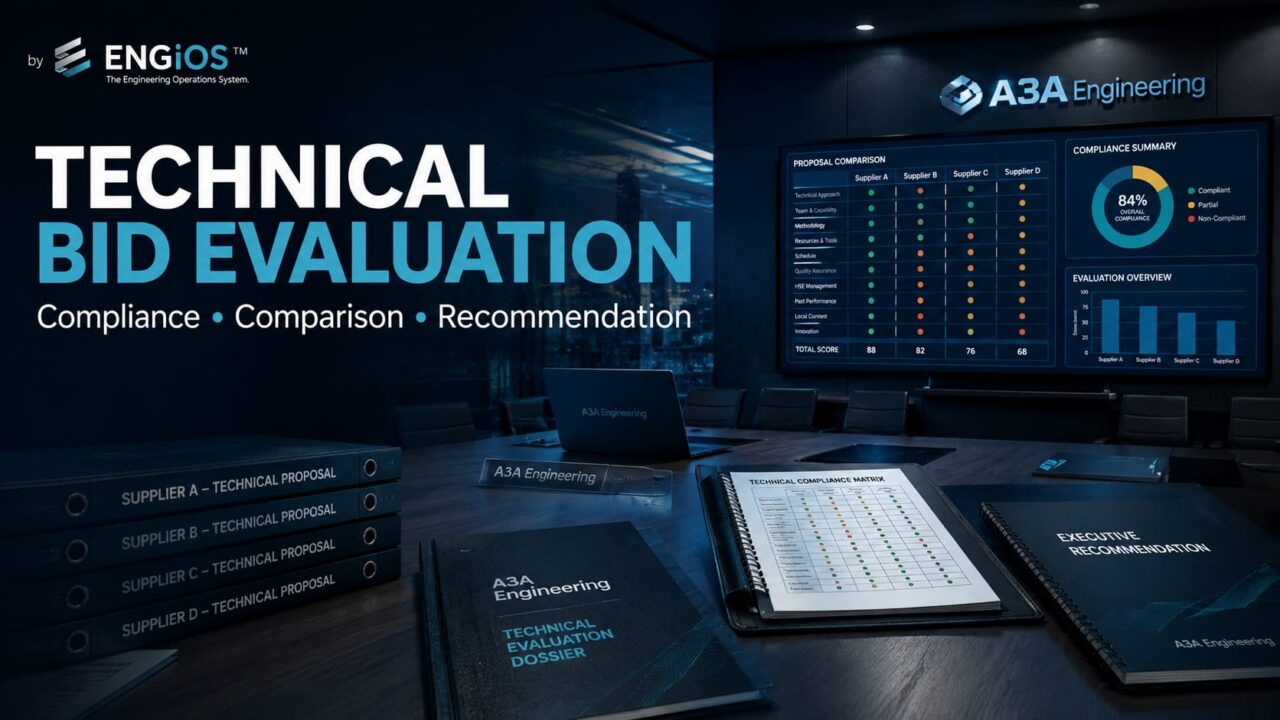
Learn how to structure a TBE in Engineering with a compliance matrix, clarifications, equalization, criteria, risks and a traceable technical recommendation.
Check it out!
A TBE in Engineering (Technical Bid Evaluation) is the formal technical evaluation of proposals received in a procurement process. Its purpose is to verify, in a documented and traceable manner, whether each proposal complies with the technical baseline, which deviations exist, which clarifications are required and which alternatives remain technically qualified for the contracting decision.
A TBE is not merely a scoring spreadsheet. In higher-criticality procurements, it functions as an Engineering decision record that connects requirements, proposal, evidence, clarifications, deviations, risks and recommendation. Price may be analyzed in a coordinated process, but the technical evaluation must preserve enough independence to prevent an apparently cheaper offer from being treated as equivalent when it has gaps in scope, performance, documentation, schedule or acceptance.
This content examines TBE as a specific method and deliverable. The article Engineering Technical Proposal Analysis: how to evaluate beyond the lowest price remains the broader content on proposal evaluation and equalization; here, the focus is the formal Technical Bid Evaluation procedure, its matrix, clarification cycles, criteria and conclusive report.
What does TBE mean and what is it used for?
TBE means Technical Bid Evaluation, a term used in Procurement, EPC, EPCM, Owner’s Engineering and industrial projects to designate the technical evaluation of offers or bids. Depending on the organization, similar names may be used, such as technical proposal evaluation, technical opinion on proposals, compliance map or technical recommendation report.
Its purpose is to answer an objective question: can the proposals be compared, and which of them demonstrate sufficient technical compliance to proceed in the procurement?
The answer requires more than checking whether a supplier marked “complies.” The team must locate evidence, evaluate exclusions, reconcile interfaces, identify risks and record the effect of each divergence.
What is the difference between TBE and technical proposal analysis?
The terms may be used as synonyms in some companies, but establishing an operational boundary is useful.
Technical proposal analysis is the broad process of examining an offer: scope, solution, team, methodology, schedule, price, risks, documentation and other relevant dimensions. TBE is the formalization of that process within a Procurement procedure, normally with a defined baseline, compliance matrix, controlled clarifications, evaluation rules and a documented result.
A TBE may contain technical equalization, but it is not limited to it. Equalization means placing different proposals on a comparable basis. TBE goes further: it records compliance, addresses deviations, applies criteria where applicable and concludes on technical qualification and conditions.
What must exist before starting the TBE?
The quality of the TBE depends on the quality of the procurement package. If the baseline is ambiguous, the evaluation will also be ambiguous.
Before opening the matrix, the team should identify the documentation governing the competition, such as:
- RFP, RFQ or equivalent document;
- Terms of Reference or Statement of Work;
- technical specifications;
- basic design, FEED or available Engineering documents;
- data sheets and bills of materials;
- requirements matrix;
- measurement and acceptance criteria;
- quality, inspection and testing requirements;
- schedule and contractual milestones;
- responsibility and interface matrix;
- instructions to bidders and evaluation criteria.
When these documents conflict, the first task is not to score suppliers: it is to determine which requirement prevails and record the interpretation adopted.
TBE starts with control of the version received
A proposal may be modified by revisions, attachments, clarification responses, supplementary technical narratives and new data sheets. Without version control, the team risks comparing an old revision from one supplier with the final revision from another.
The minimum record should contain the proposal identifier, revision, date, attachments, superseded documents, subsequent responses and status. If information was provided in a meeting or email and became part of the valid offer, that incorporation must be formalized.
Stage 1 — completeness screening and mandatory requirements
Screening avoids spending scoring effort on proposals that still lack the minimum information required for evaluation.
The team verifies whether required documents were submitted and whether mandatory requirements have sufficient evidence. This does not mean automatically eliminating every documentary omission: treatment depends on the process rules and the materiality of the requirement. What matters is clearly distinguishing:
- missing document;
- requirement not met;
- requirement apparently met without evidence;
- ambiguous information;
- declared deviation;
- permitted technical alternative.
This classification avoids turning “I did not find evidence” into “does not comply” without investigation, while also preventing generic declarations from being accepted as proof.
Stage 2 — requirement vs. evidence compliance matrix
The matrix is the backbone of the TBE. For each relevant requirement, it records what was requested and what each bidder actually submitted.
| Field | Function in the TBE |
| requirement | identifies the technical obligation to be verified |
| source | points to the document and item that generated the requirement |
| criticality | distinguishes mandatory requirements from differentiating factors |
| bidder response | records the declared position |
| evidence | points to page, drawing, data sheet, narrative or response |
| status | compliant, pending, deviation, alternative or non-compliant |
| clarification | records the question issued when required |
| impact | describes the effect on scope, performance, schedule, cost or risk |
| decision | records the final treatment of the requirement |
A good TBE avoids vague cells such as “OK,” “accepted” or “compliant” without traceable evidence.
Stage 3 — identification of deviations, assumptions and exclusions
The most relevant differences among proposals often do not appear in the main description of the solution. They are found in notes, exclusions, general conditions, installation assumptions, battery limits, responsibility reservations or warranty conditions.
The TBE must consolidate these differences and classify them by materiality.
Material deviation
Changes an essential requirement, performance, safety, responsibility, schedule, acceptance criterion or comparability in a manner incompatible with the procurement.
Manageable deviation
There is a difference from the baseline, but it can be corrected or negotiated without substantially changing the object.
Clarification
The available information does not allow a conclusion on compliance or deviation. The supplier must respond objectively.
Technical alternative
The bidder offers a solution different from the reference, as permitted by the competition rules. It must be evaluated on its own merits and impacts.
Stage 4 — technical clarification cycle
Clarifications are a normal part of a complex TBE. Their objective is to eliminate ambiguity and obtain evidence, not to allow a bidder to freely reconstruct its proposal after learning competitors’ positions.
Effective questions are specific, linked to a requirement and neutrally worded. Instead of “confirm that you comply,” prefer “identify in document X the evidence of compliance with requirement Y; if the proposed condition differs, describe the deviation and its impact.”
The cycle should control issuance, response, deadline, owner, matrix revision and closure.
Stage 5 — technical equalization
Equalization places heterogeneous proposals on a common basis. It is required when one supplier includes activities another excludes, warranties differ, tests have different scopes or responsibilities are transferred to the owner.
| Topic | Proposal A | Proposal B | TBE treatment |
| installation | included | excluded | record interface and effect on comparability |
| FAT | included | not stated | clarify and validate protocol |
| SAT/commissioning | included | partial | equalize testing and acceptance scope |
| final documentation | complete | limited | identify missing documents |
| integration | supplier responsibility | owner responsibility | evaluate interface and risk |
| warranty | 12 months | 24 months | compare coverage, start and exclusions |
Equalization does not modify proposals to make them identical. It makes visible the differences that must be considered in the decision.
Stage 6 — pass/fail criteria and rated criteria
After establishing a comparable basis, evaluation criteria may apply. The World Bank distinguishes minimum requirements from Rated Criteria and recommends that relevant technical factors be defined and weighted before the evaluation.
Pass/fail criteria verify a required minimum. Rated criteria differentiate quality among technically qualified proposals.
Examples of dimensions that may be rated, depending on the object, include:
- understanding of the problem;
- methodology and work plan;
- solution performance;
- risk management;
- relevant experience;
- key personnel;
- integration capability;
- schedule and supply strategy;
- quality, testing and commissioning;
- support, maintenance and life cycle.
Weights should reflect actual technical priorities. If everything receives a high weight, the model differentiates nothing.
How to avoid double counting in scoring
A common mistake is scoring the same attribute under several criteria. For example, “methodology,” “execution plan” and “technical capability” may end up evaluating the same information three times.
The matrix should separate criteria, evidence and scoring descriptors. For each score band, the team needs to know what characterizes insufficient, minimum, good or superior performance.
This reduces subjectivity and improves consistency among evaluators.
TBE and Value for Money criteria
The technical evaluation does not need to be isolated from the economic view, but integration must be methodological. The Value for Money concept used by the World Bank considers the optimum combination of total cost and quality or fitness for purpose.
In Engineering, this means recognizing that a proposal can have a lower initial price and a higher total cost due to maintenance, consumption, unavailability, rework, interfaces, spare parts, obsolescence or reduced service life.
The TBE should record the technical elements that influence cost and risk. Financial modeling can then address those effects without inventing technical equivalences that do not exist.
TBE and supplier qualification are different stages
Qualification verifies the supplier’s organizational capability and evidence before or during the selection process. TBE evaluates the specific proposal submitted for a specific object.
A qualified supplier may submit a technically insufficient proposal. Likewise, a technically attractive solution does not automatically compensate for the supplier’s lack of required capability.
Separating these two dimensions helps avoid reputation-based decisions: the company must be capable, and the proposal must also be compliant.
How to address schedule, supply chain and long lead items
The proposed schedule should be examined as a logical sequence, not merely as a final date. The TBE may verify mobilization, Engineering, approvals, manufacturing, inspections, logistics, installation, testing and documentation.
Long lead items deserve attention because they can make an apparently competitive schedule promise unfeasible. The team should look for evidence of production capability, purchasing conditions, dependencies, approvals and contingency margins.
Quality, inspections, FAT, SAT and acceptance
The TBE needs to verify how compliance will be demonstrated during execution. This includes, as applicable:
- quality plan;
- manufacturing inspections;
- ITP or inspection and test plan;
- FAT;
- receiving inspection;
- SAT;
- functional tests;
- commissioning;
- final documentation;
- objective acceptance criteria.
This dimension creates the bridge between Procurement and execution: what is promised and valued during selection must become a verifiable contractual obligation.
Risks and conditions in the technical recommendation
The result of a TBE does not have to be simply “approved” or “rejected.” A proposal may be technically recommendable subject to conditions that must be resolved before contracting.
A robust recommendation should record:
- proposals evaluated and valid revisions;
- criteria and baseline used;
- material deviations;
- closed and pending clarifications;
- residual risks;
- conditions for contracting;
- items to be incorporated into the contract;
- owners of subsequent open items.
Recommended structure for a TBE report
- objective and scope of the evaluation;
- reference documents;
- proposals and revisions analyzed;
- evaluation methodology;
- mandatory criteria;
- compliance matrix;
- clarifications and due diligence;
- technical equalization;
- rated criteria and result, when applicable;
- risks, deviations and conditions;
- conclusion and technical recommendation;
- attachments and evidence.
This structure can be simplified for low-complexity acquisitions or expanded for multidisciplinary packages.
Errors that reduce TBE reliability
- starting with scores without consolidating the baseline;
- evaluating price before making scopes comparable;
- accepting generic declarations without evidence;
- changing criteria after seeing the proposals;
- scoring the same attribute under different criteria;
- ignoring exclusions and general conditions;
- allowing clarifications without version control;
- mixing supplier qualification with proposal compliance;
- recommending contracting without recording residual risks;
- leaving relevant commitments outside the final contractual version.
TBE in multidisciplinary projects
In packages involving electrical, automation, telecommunications, civil, mechanical, security, software or special systems, the TBE needs to coordinate disciplines and interfaces. Each specialist may evaluate their part, but the final recommendation must consider the integrated system.
A proposal may individually comply with each discipline and still create incompatibility among them. Therefore, there should be cross-disciplinary consolidation for responsibilities, interfaces, schedule, integrated testing and documentation.
TBE as a Procurement governance instrument
A good TBE creates a verifiable trail between what was requested, what was offered, what was clarified and what will be contracted. This reduces later scope disputes and prevents the contracting decision from being based on an informal memory of the process.
TBE also improves organizational learning. Requirements that repeatedly generate questions can be rewritten; criteria that fail to differentiate proposals can be revised; interfaces that create risk can be anticipated in the next RFP.
Final considerations
Technical Bid Evaluation is the point at which Engineering transforms proposals into comparable evidence for decision-making. Its value lies less in the number of matrix rows and more in the ability to demonstrate, traceably, why a proposal complies, where it diverges, what risks remain and which conditions need to enter the contract.
When integrated with the RFP, supplier qualification, equalization, risk management and Technical Procurement, TBE stops being a formality and becomes a contracting governance mechanism.
A technical recommendation is defensible only when the final proposal version and clarification responses are reconciled with the requirements matrix and with the conditions that will actually enter the contract.
Technical references
[1] PROJECT MANAGEMENT INSTITUTE. A Guide to the Project Management Body of Knowledge (PMBOK® Guide). 8th ed. Newtown Square: PMI, 2025. Available at: [https://www.pmi.org/standards/pmbok](https://www.pmi.org/standards/pmbok)
[2] WORLD BANK. Evaluating Bids and Proposals with Rated Criteria. Washington, DC, 2025. Available at: [https://thedocs.worldbank.org/en/doc/9dcb7971706bf29b2732779c39922b77-0290012025/original/Evaluating-Bids-and-Proposals-with-Rated-Criteria-Feb-4-2025.pdf](https://thedocs.worldbank.org/en/doc/9dcb7971706bf29b2732779c39922b77-0290012025/original/Evaluating-Bids-and-Proposals-with-Rated-Criteria-Feb-4-2025.pdf)
[3] WORLD BANK. Rated Criteria: guidance for borrowers and suppliers. Available at: [https://www.worldbank.org/ext/en/what-we-do/project-procurement/rated-criteria](https://www.worldbank.org/ext/en/what-we-do/project-procurement/rated-criteria)
[4] WORLD BANK. Procurement Regulations for IPF Borrowers. 7th ed. Washington, DC, 2025. Available at: [https://thedocs.worldbank.org/en/doc/c84273d1b230aeb2b0b8134de5dc8cd7-0290012025/original/Procurement-Regulations-7th-Edition-Sep-2025.pdf](https://thedocs.worldbank.org/en/doc/c84273d1b230aeb2b0b8134de5dc8cd7-0290012025/original/Procurement-Regulations-7th-Edition-Sep-2025.pdf)
Frequently asked questions
TBE means Technical Bid Evaluation. It is the formal technical evaluation of proposals in a procurement, including verification of requirements, evidence, deviations, clarifications, equalization, risks and recommendation.
No. Technical equalization is a TBE stage used to place heterogeneous proposals on a comparable basis. TBE also includes compliance, clarifications, criteria, risks and the technical conclusion.
Proposal analysis is a broad concept. TBE usually designates the formal Procurement procedure, with a baseline, matrix, evaluation rules, clarification cycles and conclusive report.
The technical evaluation may record elements that affect total cost and risk, but price and technical merit should be integrated methodically without turning a technically inferior offer into an equivalent one merely because of a lower initial value.
It is the structure that links each requirement to the bidder response, evidence found, status, deviation, clarification, impact and decision.
Yes. Provided the conditions are objective, traceable and resolvable before contracting or formally incorporated into the contractual obligations.
Complementary technical materials
Main content on the topic
- Engineering Technical Proposal Analysis: how to evaluate beyond the lowest price
- Procurement in Engineering Projects: what it is, stages, criteria and supplier management
Related technical content
- RFP in Engineering: how to structure scope, requirements and selection criteria
- RFQ in Engineering: how to request commercially comparable quotations
- Quality Management in Procurement: requirements, suppliers, inspections and technical acceptance
- Contract and Supplier Risks in Engineering Projects: how to identify, allocate and control
