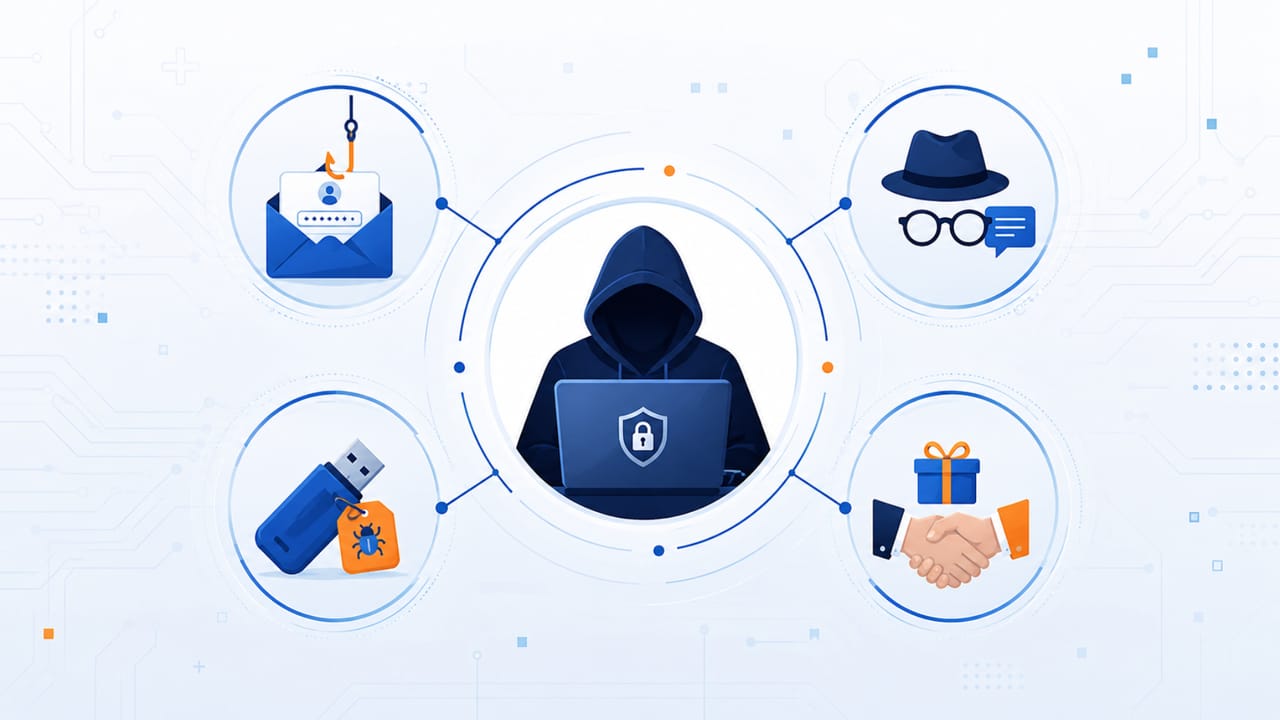
Understand how social engineering, phishing, and process failures can create digital risks, data leakage, and information-security challenges.
Check it out!
Many digital incidents do not begin with a sophisticated technical intrusion. They begin with a human decision: clicking, trusting, sharing, authorizing, or ignoring a warning sign.
This is the power of social engineering. It exploits behavior, routine, trust, urgency, and communication to induce a person to make a decision that may put data, accounts, systems, or operations at risk.
In the previous article, we explained what social engineering is and how it can be used for good or bad. Now the focus is more technical: digital risks, phishing, information security, data leakage, LGPD, and security culture.
The goal is not to create fear or treat people as the “weak link.” The objective is to show that digital security depends on technology, processes, and human behavior working together.
How social engineering amplifies risks in the digital environment
Not every digital risk begins with a technical failure.
Many incidents begin when a person receives a message, call, link, or apparently trustworthy request and must quickly decide what to do.
This is where social engineering amplifies digital risk. It does not first try to defeat the firewall, antivirus, or authentication system. It first tries to influence a human decision.
The goal may be to make someone click a link, disclose a password, share a verification code, approve a fake request, grant access, or send a document.
Therefore, the problem should not be seen merely as “user error.” Risk increases when the environment favors unsafe decisions: excessive urgency, unclear processes, informal communication, poorly defined permissions, or lack of official confirmation channels.
In information security, people, processes, and technology must work together. When one of these layers fails, phishing, data leakage, and other digital risks become more likely.
Phishing: when the attack begins with trust
Phishing is one of the best-known forms of misuse of social engineering.
It occurs when someone tries to induce a user to click a link, open a fake page, disclose data, download a file, grant access, or perform an unsafe action.
Phishing may appear in emails, text messages, messaging apps, social networks, QR codes, advertisements, fake call centers, and even communications that appear internal.
The common point is the attempt to look trustworthy.
A message may impersonate a bank, technology company, delivery service, public agency, supplier, or internal leader. The appearance changes, but the logic is usually similar: create a reason for the person to act quickly.
Some warning signs deserve attention:
- message with exaggerated urgency;
- request for a password, code, or sensitive data;
- link with a strange domain or one different from the official domain;
- unexpected attachment;
- an offer that seems too good;
- threat of blocking or loss;
- request outside the normal procedure.
For a more practical view of everyday digital scams, also see the content on digital scams and data protection.
Information security does not depend on technology alone
Information security involves protecting information against unauthorized access, alteration, loss, improper use, or unavailability.
In practice, this means confidentiality, integrity, and availability: ensuring that information is accessed only by those who should, remains correct, and is available when needed.
Technical tools are important. Firewalls, antivirus software, email filters, authentication, encryption, backups, and monitoring help reduce risks.
But technology alone does not solve everything.
A poorly understood policy, excessive permission, informal procedure, reused password, or approval made under pressure can compromise a well-equipped environment.
That is why information security also depends on processes, training, culture, and governance.
The goal is not to turn every employee into a technical specialist, but to create simple criteria for safer decisions.
Data leakage: when a small action creates a major consequence
A data leak can begin with an apparently small action.
A file sent to the wrong recipient. A publicly shared link. Credentials entered on a fake page. Access retained for someone who should no longer have permission. An exposed backup. An image or record handled carelessly.
The consequences may be technical, legal, operational, and reputational.
Personal data, sensitive data, internal documents, credentials, access records, images, biometrics, and financial information require proper controls.
When this information is exposed, the impact may affect customers, employees, suppliers, and the operation itself.
Therefore, data protection should not be viewed only as a legal obligation. It is also a security and continuity practice.
The greater the dependence on digital systems, cloud, cameras, access control, and networks, the greater the care required with permissions, records, storage, and sharing.
LGPD and social engineering: why personal data requires care
Brazil’s LGPD increased attention to the collection, processing, storage, and sharing of personal data.
In the context of social engineering, this is especially relevant because many scams seek precisely the data that allows people to be identified, approached, or deceived more accurately.
Name, CPF, phone number, email, address, job title, photo, camera image, biometrics, and access history can be used legitimately, but they can also be exploited if handled carelessly.
Some principles help reduce risk:
- collect only what is necessary;
- define a clear purpose;
- limit access;
- control sharing;
- protect sensitive data;
- document procedures;
- review permissions periodically.
In environments with biometrics, facial recognition, and video surveillance, this discussion becomes even more important. For further reading, see Biometrics and Facial Recognition: risks, LGPD, and good practices.
Security culture: what changes when the team knows how to recognize risks
Security culture is not just having a written policy or an annual presentation.
It exists when people know how to recognize risks, understand procedures, and feel authorized to verify before acting.
In a mature security culture, asking questions is not seen as a delay. Confirming an unusual request is not excessive distrust. Refusing to share a code is not a lack of cooperation.
It is procedure.
Information-security awareness needs to be practical. It should show real everyday situations: suspicious emails, urgent messages, requests for data, shared documents, remote access, QR codes, and financial requests outside the normal workflow.
Information-security training works best when it is recurring, clear, and connected to the team’s routine.
The goal is to create healthy reflexes: stop, verify, confirm, and record.
Information-security policy: simple rules prevent poor decisions
An information-security policy should help people make better decisions.
If it is too long, confusing, or disconnected from daily work, it tends to be ignored. If it is objective, practical, and well communicated, it becomes support for everyday decisions.
Some topics need to be clear:
- use of passwords and two-factor authentication;
- criteria for creating, changing, and removing access;
- rules for file sharing;
- procedures for approving payments;
- validation of registration changes;
- use of personal devices;
- remote access;
- processing of personal data;
- incident response;
- official communication channels.
Simple rules reduce improvisation. Reducing improvisation is one of the most efficient ways to reduce risk.
Physical and digital security are increasingly connected
The boundary between physical and digital security is becoming increasingly narrow.
IP cameras, access control, biometrics, alarm systems, VMS, servers, networks, cloud storage, and connected devices are part of the same ecosystem.
This means a configuration failure, weak password, uncontrolled remote access, or poorly defined permission can affect more than one isolated system.
A connected physical-security system must also be treated as digital infrastructure.
It depends on networking, power, credentials, updates, documentation, maintenance, and governance.
To better understand this connection, see the article on how to prevent physical-security systems from becoming entry points for cyberattacks.
Cloud computing is also part of this scenario. Digital services, data, and connected systems depend on well-structured physical and logical infrastructure, as explained in the article on cloud computing in practice.
How to reduce social-engineering risks without relying on a single barrier
Digital risks are not reduced by a single measure.
Protection improves when there are layers: technology, process, training, verification, documentation, and maintenance.
Some practices help people and companies:
- confirm requests through an official channel;
- do not share verification codes;
- use two-factor authentication;
- review access permissions;
- limit unnecessary privileges;
- record critical approvals;
- create procedures for payments and registration changes;
- train teams with real examples;
- maintain organized backups;
- update systems and devices;
- document assets, access, and responsibilities;
- perform periodic audits.
The central point is not to depend only on memory, goodwill, or individual attention.
Good procedures exist to help people make better decisions even under pressure.
The role of engineering in safer connected systems
Security is also an engineering issue.
Connected systems need to be designed, documented, tested, and maintained. Networks need to be organized. Access needs to be defined. Equipment needs to be configured correctly. Integrations need to be verified.
In critical environments, improvisation increases risk.
Commissioning, technical auditing, maintenance engineering, project management, and technical consulting help turn controls into verifiable practice.
This applies to corporate networks, electronic security, access control, video surveillance, cloud systems, and technical infrastructure.
Ultimately, reducing phishing, social-engineering, and data-leak risks is not merely about installing tools. It is about aligning technology, process, and human behavior.
Where A3A Engenharia fits in
A3A Engenharia works with projects, assessments, electronic security, networks, infrastructure, commissioning, audits, and technical consulting.
In environments where physical security, data, connected systems, and operations intersect, technical analysis helps reduce risks, organize procedures, and improve reliability.
Related technical content
- Social engineering: what it is, how it works, and why it can be used for good or bad
- Digital scams and data protection: how to recognize risks and protect yourself
- Cloud computing in practice: what it is, how it works, and why it depends on infrastructure
- Biometrics and Facial Recognition: risks, LGPD, and good practices
- How to prevent physical-security systems from becoming entry points for cyberattacks
- Types of Computer Networks
- Computer Network Performance
Related services
Technical references
- ISO/IEC 27001 — Information security.
- ISO/IEC 27002 — Information security controls.
- NIST Cybersecurity Framework.
- CIS Controls — cybersecurity good practices.
- LGPD — Brazilian General Data Protection Law.
- Internal cybersecurity, cloud, electronic security, and networking materials consulted in A3A Engenharia’s static index.
Recommended supplementary materials
FAQ
1. What is phishing?
Phishing is an attempt to deceive a user into clicking links, providing data, accessing fake pages, or taking actions that compromise accounts and information.
2. How is phishing related to social engineering?
Phishing uses social engineering because it exploits trust, urgency, fear, or apparent authority to induce a person to act without verifying.
3. Why does information security depend on the human factor?
Because many security decisions involve people: approving access, clicking links, sharing files, validating requests, and protecting credentials.
4. Can social engineering cause data leakage?
Yes. When a person discloses credentials, shares files improperly, or accesses fake pages, personal and corporate data may be exposed.
5. What does LGPD have to do with social engineering?
LGPD addresses personal-data protection. Social engineering may be used to obtain or exploit this data, increasing the need for controls and procedures.
6. What is security culture?
Security culture is the set of habits, procedures, and behaviors that help people and companies recognize risks and act safely.
7. How can companies reduce phishing and social-engineering risks?
Through training, two-factor authentication, permission reviews, official channels, clear policies, approval procedures, backups, audits, and security culture.
Conclusion
The power of social engineering lies in exploiting human decisions before confronting technical barriers.
Therefore, phishing, data leakage, and digital risks should not be treated only as technology problems. They also involve processes, culture, communication, and behavior.
Information security improves when people know how to recognize risks, procedures are clear, and connected systems are designed, maintained, and audited responsibly.
The most effective protection does not depend on a single barrier. It comes from combining technology, engineering, processes, and the human factor.
Does your company assess human and technical risks in connected systems?
Security does not depend only on technology. People, processes, networks, access, and infrastructure need to work together.
