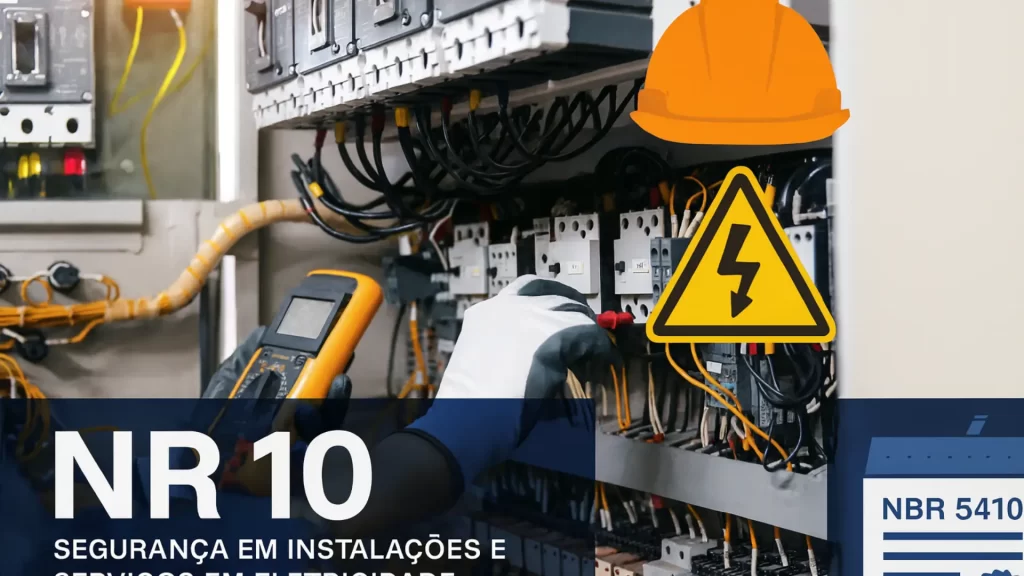
NR 10 is the regulatory standard that establishes requirements and control measures to ensure safety and health in electrical installations and services. It organizes the subject around key pillars: risk management, personnel qualification, operational procedures, PIE (Electrical Installations Register), collective and individual protection measures, and integration with technical standards (such as NBR 5410 and NBR […]
Check it out!
NR 10 is the regulatory standard that establishes requirements and control measures to ensure safety and health in electrical installations and services. It organizes the subject around key pillars: risk management, personnel qualification, operational procedures, PIE (Electrical Installations Register), collective and individual protection measures, and integration with technical standards (such as NBR 5410 and NBR 5419).
For companies, compliance with NR 10 means reducing accidents, mitigating labor liabilities, and ensuring operational continuity. For professionals, it is the foundation for safe practice — from risk analysis to lockout/tagout (LOTO), from de-energization to technical documentation.
As a multidisciplinary engineering firm, A3A supports organizations in regulatory compliance, technical report preparation, and integration of electrical safety throughout the asset lifecycle (design, construction, and operation).
[elementor-template id=”24446″]
What is NR 10?
NR 10 establishes minimum safety guidelines for electrical work at any stage of the asset lifecycle: generation, transmission, distribution, consumption, construction, assembly, operation, maintenance, and emergency interventions.
Its objective is to prevent electric shocks, electrical arcs, thermal effects, and fires through:
- Risk management: hazard identification, analysis, and control measures.
- Qualification and training of workers who interact with electrical installations and services.
- Standardized operational procedures (work instructions, LOTO, testing, commissioning, and release).
- Up-to-date PIE containing designs, single-line diagrams, specifications, inspections, reports, and intervention records.
- Integration with technical standards (e.g.: NBR 5410 for low voltage and NBR 5419 for SPDA), ensuring coherence between legal and technical requirements.
Expected outcome: a controlled and traceable environment capable of demonstrating compliance in audits and reducing incidents.
Who Does NR 10 Apply To?
NR 10 applies to all companies and professionals who design, install, operate, inspect, or maintain electrical installations — energized or de-energized — at any voltage level. It also covers contractors and third parties working within client facilities.
Key responsibilities:
- Employer: implement the electrical safety management system, provide training, CPE/PPE, keep the PIE up to date, and ensure procedures and supervision.
- Worker: follow procedures, maintain PPE/CPE, report anomalies, and refuse tasks without safe conditions.
Mandatory training: the standard requires specific training (e.g.: basic course and, when applicable, training for the Power Electrical System — SEP), with periodic refresher courses and formal records.
Key Requirements (Executive Overview) — draft for next validation
- Collective protection measures (CPE) and individual protection (PPE).
- Lockout/Tagout (LOTO), de-energization, and temporary grounding when required.
- Work permit, risk analysis, and formal release.
- Signage, safety distances, and controlled zones.
- PIE with minimum content and change management.
Core Requirements of NR 10
NR 10 establishes a set of minimum requirements that ensure worker safety and legal compliance. These requirements are divided into protection measures, operational procedures, and mandatory documentation:
1 Collective Protection (CPE)
- Visible isolation and lockout devices.
- Temporary grounding with appropriate devices.
- Physical barriers in energized areas.
- Hazard signage and controlled zone demarcation.
2 Individual Protection (PPE)
- Insulating gloves, helmets, safety goggles, and appropriate clothing for the voltage level.
- Certified insulated tools.
- Voltage and residual energy detection devices.
3 Operational Procedures
- De-energization: the priority rule for any intervention, ensuring the absence of voltage before work begins.
- Lockout/Tagout (LOTO): prevention of accidental re-energization during interventions.
- Risk Analysis: formal documentation before each activity, covering site conditions, resources, and control measures.
- Work Authorization: only qualified, trained, and formally authorized professionals may intervene in electrical installations.
4 PIE – Electrical Installations Register
Detailed PIE Checklist (Electrical Installations Register)
The PIE is the central document of NR 10. To be compliant, it must contain at minimum:
ART (Technical Responsibility Annotation) for all services and documents prepared.
Updated single-line diagrams — clear graphical representation of all circuits.
Technical specifications of equipment and protective devices.
Standardized operational procedures — work instructions, lockout/tagout (LOTO), inspections, and maintenance.
Inspection and measurement records — periodic reports on grounding, continuity, and system performance.
Complementary technical reports — SPDA (NBR 5419), electrical grounding (NBR 5410), and others as required.
Documented risk analysis for each type of intervention.
Formal training and authorization records for professionals working in the installation.
| Requirement | Regulatory Basis | Status |
|---|---|---|
| Updated Electrical Installations Register (PIE) | NR 10 | |
| Revised single-line diagrams | NR 10 / NBR 5410 | |
| Grounding technical reports | NR 10 / NBR 5410 | |
| SPDA Technical Report (Lightning Protection Systems) | NR 10 / NBR 5419 | |
| ARTs issued by a licensed electrical engineer | Law 5,194/66 | |
| NR 10 Basic Training (min. 40h) | NR 10 | |
| NR 10 SEP Training (min. 40h + refresher courses) | NR 10 | |
| Records of periodic inspections | NR 10 |
Documentation and Technical Reports
In addition to the PIE, NR 10 requires companies to maintain documentation that proves electrical safety and technical accountability:
- ART (Technical Responsibility Annotation): issued by licensed electrical engineers and registered with CREA, attesting to the legality and accountability of the services rendered.
- Grounding Technical Reports: reports verifying the continuity, resistance, and compliance of grounding meshes.
- SPDA Technical Reports (NBR 5419): mandatory for buildings and sites requiring lightning protection.
- Electrical Installation Reports (NBR 5410): ensure that circuits, protective devices, and sizing meet normative criteria.
This documentation ensures that the company is prepared for audits, Ministry of Labor inspections, and insurance company reviews, and provides legal protection in the event of accidents.
Both reports must be signed by a licensed electrical engineer with an ART registered with CREA, ensuring technical accountability and legal validity.
In addition to being a regulatory requirement, these documents play an essential role in audits, Ministry of Labor inspections, ISO certification processes, and insurance company reviews.
Integrating the SPDA and grounding reports into the NR 10 PIE reinforces the company’s compliance, while also creating a solid foundation for people safety, asset protection, and operational continuity.
Integration with Other Technical Standards
| Aspect | NR 10 | NBR 5410 |
|---|---|---|
| Nature | Regulatory Standard (legally mandatory) | ABNT Technical Standard (technical criteria) |
| Scope | Safety in electrical installations and services | Design and execution of low-voltage electrical installations |
| Responsible Party | Employer and worker (legal compliance) | Licensed electrical engineer (design/execution) |
| Documentation | PIE, ART, technical reports, training records | Diagrams, specifications, technical documentation |
| Focus | Protection of worker health and safety | Technical reliability and efficiency of the installation |
NR 10 establishes legal and safety requirements for electrical work, but its practical application depends on integration with specific technical standards:
1 Relationship with NBR 5410 (Low-Voltage Electrical Installations)
ABNT NBR 5410 defines technical criteria for the design and execution of low-voltage electrical installations.
- While NR 10 establishes the legal safety obligation, NBR 5410 specifies the technical criteria for sizing, isolation, protection, and grounding.
- Together, they ensure regulatory compliance and operational safety.
2 Relationship with NBR 5419 (SPDA – Lightning Protection Systems)
ABNT NBR 5419 addresses protection against lightning strikes.
- NR 10 requires that installations be protected against electrical hazards.
- NBR 5419 details how to size air terminals, down conductors, and grounding meshes to reduce the risks of lightning and overvoltage.
- For A3A, the integration between NR 10 and NBR 5419 is essential, as SPDA designs and compliance reports are part of our technical portfolio.
3 Other Related Standards
- ISO/IEC 11801: structured cabling (basis for electrical and telecom integration).
- NR 12: machinery and equipment (when involving electrical circuits).
- NR 35: work at height on electrical structures.
Benefits of Complying with NR 10
Complying with NR 10 goes far beyond avoiding fines: it means protecting lives, reducing risks, and optimizing operations. The main benefits include:
- Worker safety: reduction of serious accidents, electric shocks, and burns.
- Legal compliance: avoids fines, shutdowns, and labor lawsuits.
- Asset preservation: lower risk of fires and electrical failures that damage equipment.
- Operational efficiency: fewer unplanned shutdowns due to electrical failures.
- Credibility and governance: demonstrating compliance to insurers, auditors, and clients.
Case Studies / Examples
- Case 1 – Ministry of Labor Audit
A mid-sized company in São Paulo was fined for failing to maintain an up-to-date PIE. The register had outdated diagrams and was missing a grounding report. Result: fine and partial facility shutdown until compliance was achieved. - Case 2 – Grounding Failure (NBR 5410)
An industrial facility experienced malfunctioning circuit breakers and equipment burnout due to the absence of grounding in accordance with NBR 5410. NR 10 requires the report; NBR 5410 defines the technical criteria.
The Importance of NR 10 in Critical Environments
For companies operating in critical environments, such as power substations, the rigorous application of NR 10 is indispensable. These locations concentrate high voltage levels, switching systems, and equipment whose failure can compromise both worker safety and continuity of power supply.
A3A Engineering has proven expertise in the implementation of telecommunications systems in substations, including fiber optic networks, perimeter asset monitoring systems, and remote assistance solutions. Our projects also cover operational monitoring of sectionalizing switches, ensuring remote visibility and safe operation.
In these applications, NR 10 serves as the regulatory pillar, aligning electrical protection engineering with operation and maintenance practices. Integrating structured cabling, fiber optic networks, and surveillance systems into a NR 10-compliant design ensures that the environment is efficient, safe, and auditable.
Penalties and Risks of Non-Compliance
Non-compliance with NR 10 can lead to serious consequences for companies and professionals. Penalties range from administrative fines to civil and criminal liability in the event of accidents.
Main risks and penalties:
- Fines and shutdowns: Ministry of Labor inspections can result in penalties and even the suspension of operations in cases of non-compliance.
- Labor lawsuits: employees exposed to risks without proper compliance with the standard may sue the company.
- Criminal liability: in fatal accidents, managers and technical responsible parties may be held liable for negligence.
- Indirect financial losses: in addition to fines, electrical failures can cause fires, equipment damage, and production shutdowns.
Complying with NR 10 is not just a legal obligation, but a risk mitigation and asset protection strategy. A3A Engineering and NR 10
A3A Systems Engineering has extensive experience in projects requiring compliance with NR 10 and related standards. Our team of electrical engineers is qualified to:
- Prepare and keep up to date the Electrical Installations Register (PIE).
- Issue ARTs and technical reports for electrical installations, SPDA, and grounding.
- Conduct inspections and diagnostics to identify failures and propose corrective measures.
- Integrate NR 10 with projects for structured cabling, SPDA, data centers, CCTV, and access control, ensuring compliance across the entire infrastructure.
This multidisciplinary approach positions A3A as a strategic partner for companies that need to be 100% compliant with legislation and technical standards.
Conclusion
NR 10 is one of the pillars of safety in electrical installations, protecting professionals, companies, and assets against the hazards of electricity. Complying with the standard means preventing accidents, reducing liabilities, and ensuring operational efficiency.
NR 10 is not merely a legal obligation: it represents the central axis of electrical installation safety management in Brazil. Its application ensures that every stage — from design to operation — is supported by clear procedures, traceable documentation, and formalized technical accountability.
In critical environments, such as power substations, data centers, industrial plants, and hospitals, NR 10 serves as the convergence point between legislation and technical standards such as NBR 5410 (low-voltage electrical installations) and NBR 5419 (SPDA). When integrated with the PIE and reports signed by licensed electrical engineers, these frameworks ensure compliance, reliability, and operational continuity of vital systems.
Complying with NR 10 means adopting a culture of prevention and technical accountability, reducing the risks of shocks, fires, and failures that can compromise both people’s safety and the availability of strategic services.
A3A Engineering, with nearly three decades of experience in telecommunications projects, structured cabling, fiber optic networks, asset monitoring systems, and remote assistance in substations, applies NR 10 as a transversal pillar in all its projects. This approach ensures that every delivery is not only technically sound, but also protected by standards, best practices, and legal backing.
Frequently Asked Questions
What does NR 10 mean?
It is Regulatory Standard No. 10, which establishes safety requirements for electrical installations and services.
Who must take the NR 10 course?
Every worker who interacts with electrical installations — energized or not — must complete the NR 10 basic course. Those working in the SEP (Power Electrical System) are required to complete additional training.
What is the relationship between NR 10 and NBR 5410?
NR 10 defines the legal safety requirements; NBR 5410 defines the technical criteria for design and execution. They are complementary.
What is the relationship between NR 10 and NBR 5410 grounding reports?
NR 10 requires grounding reports as part of the PIE. NBR 5410 defines the technical criteria for their execution.
Who can sign NR 10 reports and ARTs?
Only licensed electrical engineers registered with CREA can issue ARTs and sign compliance reports.
