The LPS structure according to NBR 5419 is the starting point for any technical project aimed at effective protection against lightning strikes. The standard establishes a clear division between the external system — responsible for intercepting and conducting the current to the ground — and the internal system, which protects people and equipment against indirect […]
Check it out!
The LPS structure according to NBR 5419 is the starting point for any technical project aimed at effective protection against lightning strikes. The standard establishes a clear division between the external system — responsible for intercepting and conducting the current to the ground — and the internal system, which protects people and equipment against indirect effects, surges, and induced voltages. Understanding this integrated structure is essential for designing, installing, and maintaining a technically reliable LPS that is fully compliant with the standard.
In a previous article, we provided a brief overview of NBR 5419-1 and its relevance to lightning protection design. Now, as promised, we present how the LPS is structured: what its components are, how they integrate, and how they work together to ensure safety, regulatory compliance, and technical performance.
NBR 5419 divides the LPS into an external system and an internal system, each with specific functions — yet both are only effective when treated as a single, well-designed system.
[elementor-template id=”24446″]
Protection Measures (Protection Systems)
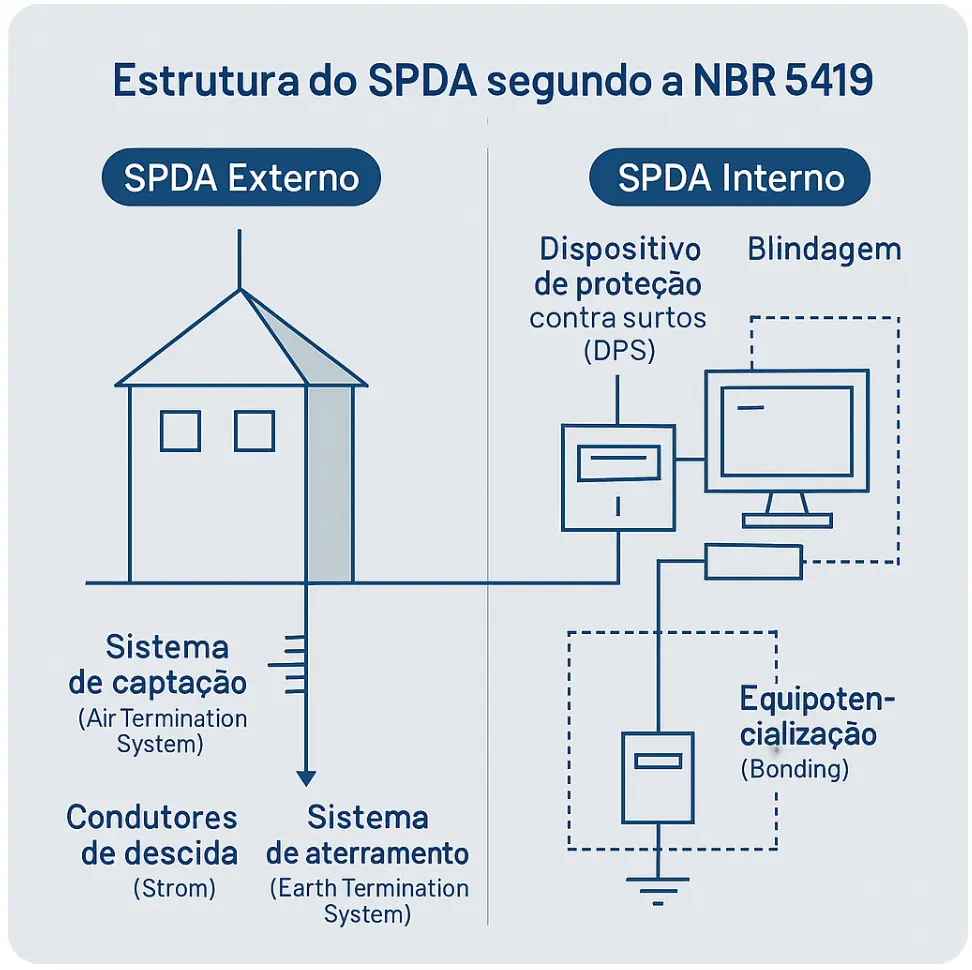
According to NBR 5419-1:2015 (item 8), the LPS consists of two main subsystems:
External LPS
Responsible for intercepting the lightning strike and safely conducting it to the earthing system.
It is divided into:
- Air-termination system (rods, cables, mesh, mast): intercepts the discharge, preventing it from striking the structure directly.
- Down conductors: carry the current in a controlled manner to the ground.
- Earthing system: dissipates the energy into the ground.
Internal LPS (SPM – Surge Protection Measures)
Designed for protection of people and equipment against indirect effects, overvoltages, and induced currents.
Includes:
- Main and supplementary equipotential bonding
- Surge protective devices (SPDs)
- Electromagnetic shielding, cable routing, and separation
- Use of isolating interfaces.
Interaction Between External and Internal Systems
The two systems cannot be treated in isolation. NBR 5419 reinforces that the effectiveness of protection depends on the functional interaction between the parts, meeting the following requirements:
- Single, continuous earthing system shared by both subsystems;
- Compatibility between the air-termination system and shielding;
- SPDs correctly connected to the equipotential bonding system;
- Electrical continuity of metallic structures;
- Adequate treatment of entry and exit interfaces (data lines and power).
Normative Requirements and Design Implications
An LPS that complies with the standard must:
Include complete documentation: technical memoranda, site plans, diagrams, and a maintenance plan;
Be designed based on the risk analysis specified in the standard;
Use components tested according to the parameters in Part 1 and Annex D;
Comply with the safety distance between active conductors and internal installations.
When We Talk About “Installing an LPS,” We Are Talking About Specialized Engineering
Designing an LPS requires more than installing cables and rods. It involves:
- Electrical calculation of the lightning current;
- Assessment of energy distribution in the ground;
- Definition of down-conductor topology (symmetrical, ring-type, radial);
- Integration with sensitive electrical and electronic systems.
Each decision influences the safety of people, equipment protection, and the technical compliance of the project.
Final Considerations
The structure of an LPS, as defined by NBR 5419, is not limited to the installation of rods or conductors. It requires a systemic approach in which the external and internal components act in an integrated manner to mitigate the direct and indirect effects of lightning strikes.
In practice, a well-designed LPS is the result of correct normative application, risk analysis, and a thorough technical understanding of the interactions between interception, conduction, earthing, equipotential bonding, and electronic system protection.
Hire a Specialist.
A3A Engenharia has a consolidated technical portfolio proven through successful cases in highly complex projects, operating in industrial, corporate, institutional, and regulatory-demanding environments.
We are specialists in the design, implementation, and regularization of Lightning Protection Systems, with full command of NBR 5419:2015 and integration with all related technical standards.
Our services include:
- LPS design, with risk analysis and dimensioning in accordance with the standard;
- Installation of external and internal protection systems, with technical responsibility;
- Specialized consulting for the upgrading of existing structures;
- Issuance of technical reports, inspections, and surveys for normative and contractual compliance;
- Complete documentation with CREA, including ARTs, technical memoranda, and inspection reports.
Don’t Miss the Next Article in the NBR 5419 Series: Risk Analysis
Determining whether a lightning protection system is mandatory is not a subjective decision — it must be technically substantiated.
The risk analysis, as established in NBR 5419-1 and detailed in Part 2 of the standard, is the starting point of any LPS project, serving as the basis for selecting the protection level, dimensioning components, and providing technical justification before regulatory bodies.
In the next article, you will understand how this analysis is conducted, what variables influence the outcome, and why it is essential for ensuring compliance, technical rationality, and effective safety.
Don’t miss the next installment in the series and deepen your understanding of the normative criteria that guide lightning protection systems.
Need Technical Support for LPS Design or Regularization?
A3A Engenharia offers complete solutions based on the rigorous requirements of NBR 5419, integrating risk analysis, executive design, installation, technical reports, inspections, and documentation with CREA.
Speak with a specialist engineer and ensure safety, compliance, and technical efficiency for your structure.
👉 Contact us and request a no-obligation assessment.
Follow Our Technical Content
Follow A3A Engenharia de Sistemas on social media and receive technical publications, regulatory updates, and real-world cases from lightning protection projects.
📘 Facebook
📷 Instagram
💼 LinkedIn
🎥 YouTube
Articles that complement this topic:
“If you haven’t yet read the article Introduction to NBR 5419, we recommend starting there to understand the normative context before diving into the LPS structure.”
Also read:
Lightning Strikes – Origin and Impact
The Effects of Lightning Strikes
Follow our profiles and access technical content on projects, standards, and field-tested engineering solutions.