
A router is an essential network device that plays a crucial role in efficient communication between different networks. It acts as a connection point between local are…
Check it out!
A router is an essential network device that plays a crucial role in efficient communication between different networks. It acts as a connection point between local area networks (LANs) and external networks, such as the internet. Its main function is to forward data packets between these networks, ensuring that information reaches its destination in the most efficient way possible. It establishes the most effective route for each packet based on the information contained in the packet headers.
How a Router Works
Routers operate at Layer 3 (Network Layer) of the OSI (Open Systems Interconnection) model. They receive and send data on the network using packets that contain various types of data, such as files and communications. Each data packet has several layers or sections, one of which contains identification information such as the sender, data type, size, and, most importantly, the destination IP (Internet Protocol) address. The router reads this layer, prioritizes the data, and chooses the best route for each transmission.
Routers use algorithms to calculate the best route for each data packet based on various metrics, such as bandwidth, delay, route reliability, route cost, or shortest path. This process is known as route determination.
What is Routing?
Network routing refers to the process of selecting paths in one or more networks. It can be applied to various types of networks, from telephone networks to public transportation networks. In packet-switched networks, such as the internet, routing determines the paths for IP packets to travel from their source to their destination, with this decision-making being performed by specialized devices called routers.
In the figure below, consider a data packet going from computer A to computer B, passing through networks 1, 3, and 5, or 2 and 4. The router makes constant decisions about which path to follow, taking into account not only the distance but also the forwarding efficiency.
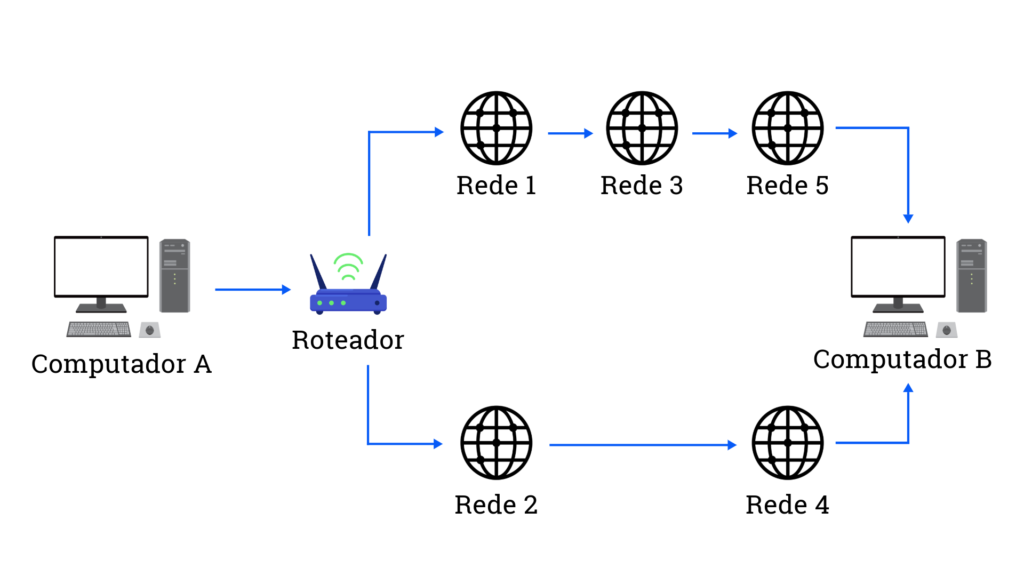
Routers use internal routing tables to decide how to route packets across the network. These tables, similar to train schedules for passengers, record the paths that packets must follow to reach their destinations. When a router receives a packet, it analyzes the headers to identify the destination and, based on the information in the routing table, decides where to forward the packet.
Routing Tables
Routing tables are fundamental data structures in a router that store information about available network routes. They are used by routers to determine the most efficient path to forward a data packet to its destination.
There are two main types of routing tables:
Static Routing Tables
Static Routing Tables are manually configured by network administrators. They contain predefined routes to specific destinations that remain constant unless explicitly changed by the network administrator. This type of routing table is ideal for smaller-scale networks where routes are relatively stable and do not change frequently.
The main advantages of Static Routing Tables include enhanced security and lower router resource consumption since the router does not need to dynamically learn and calculate routes. However, they are not scalable for large-scale networks and lack the ability to automatically adapt to changes in network topology.
Dynamic Routing Tables
Dynamic Routing Tables, on the other hand, are automatically updated through routing protocols. They are more suitable for large-scale and complex networks where routes can change dynamically. Routing protocols, such as Open Shortest Path First (OSPF) and Border Gateway Protocol (BGP), are used to exchange routing information between routers and update the Dynamic Routing Tables.
Dynamic Routing Tables have the ability to adapt to changes in network topology, providing greater resilience in case of network failures or path changes. However, they consume more router resources due to the need to dynamically learn and calculate routes.
Routing Protocols
Routing protocols are sets of rules used by routers to determine the most efficient path for forwarding packets across a network. They are essential for the operation of large-scale networks, as they allow routers to communicate with each other and exchange information about the network topology. Learn about some common routing protocols:
OSPF (Open Shortest Path First): OSPF is a link-state interior gateway protocol (IGP). It uses Dijkstra’s algorithm to calculate the shortest route for each data packet. In an OSPF network, each router maintains a complete view of the network topology and uses this information to independently calculate the best routes. OSPF is scalable and supports VLSM (Variable Length Subnet Masking), making it suitable for large and medium-sized networks.
BGP (Border Gateway Protocol): BGP is an exterior gateway protocol (EGP) used for routing between autonomous systems on the internet. Unlike OSPF, BGP does not use metrics to select paths but makes routing decisions based on paths, network policies, and routing rules. BGP is the predominant routing protocol on the Internet and is fundamental to its operation.
IP (Internet Protocol): IP is a protocol that specifies the source and destination of each data packet, being inspected by routers for forwarding. It is responsible for delivering data packets from source to destination.
RIP (Routing Information Protocol): RIP is an internal routing protocol that uses “hop count” to find the shortest path between networks. It is most suitable for smaller networks due to its maximum metric of 15 hops.
EIGRP (Enhanced Interior Gateway Routing Protocol): EIGRP is a Cisco proprietary routing protocol that considers multiple metrics to calculate the best route. It is an advanced protocol that offers superior routing features and is widely used in networks that utilize Cisco hardware.
IS-IS (Intermediate System to Intermediate System): IS-IS is a link-state routing protocol similar to OSPF but is primarily used in backbone networks. It is capable of handling large networks and offers excellent scalability.
Network Address Translation (NAT)
Routers frequently perform the function of Network Address Translation (NAT). This function allows multiple devices to share a single external IP address, thus optimizing the use of IP addresses.
Network Address Translation operates by modifying the IP address information contained in the packet headers as they pass through the router. The router maintains a translation table that maps the private IP addresses of devices on the local area network (LAN) to the public IP address and vice-versa.
This process allows multiple devices on the LAN to access the Internet using a single public IP address, thus preserving limited public IP addresses. Furthermore, NAT adds a layer of security, as internal IP addresses are not directly visible on the Internet.
Firewall
Some routers come equipped with built-in firewall features to secure the network against unauthorized access and malicious attacks.
The firewall on a router works by inspecting the data packets that pass through it and making decisions based on previously configured security rules. If a data packet matches a security rule indicating it should be blocked, the firewall will prevent that packet from crossing the network.
This functionality is essential for maintaining the integrity and security of data on the network. Furthermore, the firewall can be configured to allow or deny network traffic based on specific criteria, such as IP addresses, network ports, or specific protocols, providing granular control over network traffic.
Network Traffic Management (QoS)
The router has the ability to manage network traffic prioritization (QoS – Quality of Service). This functionality ensures an efficient distribution of bandwidth between different types of applications and services.
By prioritizing certain types of traffic, such as video streaming or VoIP calls, over other less latency-sensitive types of traffic, QoS can significantly improve the user experience. This is especially useful in congested networks, where bandwidth is limited and needs to be allocated efficiently.
Furthermore, QoS can be configured to ensure that critical applications and services have the bandwidth they need to function properly, even at times of high network demand.
