
Understand what NBR 14565 establishes for structured cabling design, installation, maintenance, documentation, and compliance in network infrastructure.
Check it out!
NBR 14565: Structured Cabling for Commercial Buildings
NBR 14565: Structured Cabling is the Brazilian standard that establishes the technical requirements for the design, installation, and maintenance of structured cabling systems in corporate, industrial, and residential environments. Following the NBR 14565 guidelines ensures performance, safety, standardization, and easier expansion of communication networks, making it an essential reference for engineers, integrators, and network infrastructure professionals in Brazil.
Technical Standards for Structured Cabling were developed in response to the need for standardization and integration of telecommunications networks, which are becoming increasingly complex and indispensable.
In this article, we explore ABNT NBR 14565, the main Brazilian standard that establishes the technical criteria for the implementation and management of cabling systems.
Take a look!
[elementor-template id=”24446″]
In the deployment of a structured cabling system, several technical standards are essential to guarantee quality, safety, and compliance, from planning to system maintenance. If you want to go deeper and learn about all relevant standards for projects, installations, and maintenance, see our complete article on Technical Standards for Structured Cabling.
From this point on, our focus is to detail NBR 14565 specifically, presenting its main requirements, applications, and attention points for professionals and companies seeking excellence in network infrastructure.
What is NBR 14565?
NBR 14565 is the Brazilian standard that establishes technical guidelines for the design, installation, and maintenance of structured cabling systems in commercial buildings, industrial environments, and other complex applications.
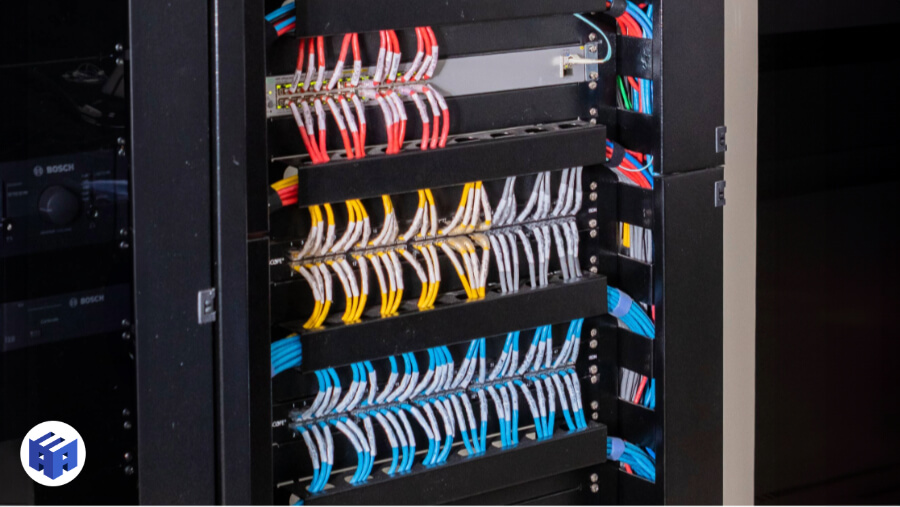
Archive: A3A Engenharia de Sistemas
Originally published in 2000, it was revised in 2007, 2012, 2013, and 2019, reflecting the need to stay current with technological evolution and the growing demands of telecommunications infrastructure.
Definitions within NBR 14565
Within its scope, NBR 14565 covers all aspects of structured cabling, providing the basis for proper implementation and operation of structured cabling systems.
Guidelines for Structured Cabling Design
NBR 14565 provides technical guidance for the planning and design of structured cabling systems, defining clear parameters for network topology, component selection, and cable distribution.
The objective is to ensure that the infrastructure is planned to support both current needs and future expansion, avoiding undersized networks or performance failures.
Standardization of Components and Connectivity
One of the main objectives of the standard is the standardization of components such as cables, connectors, patch panels, and other network elements.
The standard specifies minimum performance requirements for each component, ensuring that all elements in the system are compatible and that the network operates within the established quality and efficiency criteria.
Installation and Maintenance Guidance
NBR 14565 establishes guidance for the correct installation of cables and equipment, including labeling, organization, and cable routing, which simplify maintenance and future changes.
It defines minimum separation distances between data cables and interference sources, in addition to requirements for proper grounding, providing more stable and secure data transmission.
Documentation and Network Management
The standard emphasizes the need for detailed documentation of the entire cabling system, including network maps, cable identification, and maintenance records.
This documentation is essential for precise infrastructure management, helping with quick fault identification and enabling controlled, efficient modifications to the structured cabling system.
Advantages of Compliance with NBR 14565
Compliance with NBR 14565 provides a series of technical advantages that significantly improve network performance, maintenance, and overall management of structured cabling systems.
Optimized Network Performance
Compliance ensures that all structured cabling components operate within established parameters, resulting in a network with consistent performance and less susceptibility to interference and signal loss.
The standardization of cables, connectors, and network topology preserves transmission integrity, optimizes data transfer rates, and minimizes communication errors.
Easier Expansion and Flexibility
Networks designed according to NBR 14565 are structured to support expansion and technological upgrades without the need for extensive reconfiguration.
The standard anticipates expansion points and reserves extra capacity, allowing new demands to be met efficiently without compromising existing infrastructure performance.
Simplified Maintenance and Reduced Downtime
Compliance simplifies network maintenance by establishing labeling, organization, and cabling documentation practices. This reduces the time required to identify and correct faults, decreasing downtime and associated costs.
The standardized organization of network elements also simplifies future changes and adjustments, keeping the infrastructure orderly and functional.
Greater Safety
NBR 14565 includes specific guidelines for surge protection and proper grounding, which are essential to preserve the integrity of equipment connected to the network.
Following these guidelines reduces the risk of damage caused by electromagnetic interference and adverse events such as electrical discharges, increasing infrastructure resilience and the protection of telecommunications systems.
Efficient Documentation and Management
Complete documentation of the cabling system, as recommended by NBR 14565, is fundamental for efficient infrastructure management.
Maintaining detailed records of each component, the network map, and maintenance history makes it easier to identify issues and implement changes, ensuring precise control and mitigation of operational risks. This practice supports more proactive management aligned with engineering best practices.

Risks and Impacts of Non-Compliance
Although NBR 14565 is a technical standard and not a direct legal obligation, ignoring it is operational suicide for modern companies. Property insurers and ISO audits often require network compliance reports as a prerequisite for policies and certifications.
In addition, a network outside the standard, for example one without correct electrical separation or with improper cable tray occupancy rates, is a major cause of latency problems faced by IT teams in daily operations.
If cabling is not properly planned and installed, communication failures, signal degradation, and interruptions become frequent, compromising overall network performance and affecting all dependent devices and services.
Lack of compliance also negatively impacts maintenance and future network expansion. Without standardization, every change becomes more difficult, requiring more time and resources to ensure that new components work correctly.
This increases operational costs and puts service continuity at risk, since avoidable problems end up arising and directly affecting organizational performance.
Importance of Hiring a Specialized Company
Hiring a specialized company is fundamental to ensure that your network is designed, installed, and maintained according to the highest quality standards.
A qualified team has the technical knowledge required to follow standards and guidelines, ensuring that all critical aspects of the network are properly addressed, from component selection to best-practice installation execution.
Companies at this level have access to updated technical standards as well as appropriate tools and equipment, allowing technical execution aligned with the best practices in the sector.
Always look for companies with a broad technical portfolio that demonstrates consolidated experience across multiple projects, allowing the application of the most effective solutions for each specific context.
Audit and Compliance with NBR 14565
Do not leave your infrastructure in the dark. If your company suffers from slowness, connection failures, or needs to expand the office, the first step is a technical diagnosis based on the standard.
A3A Engenharia de Sistemas performs inspections, point certification with Fluke equipment, and complete executive designs. Turn your network into a high-performance asset.
Request a Design or Audit Quotation
Frequently Asked Questions
What is a Structured Cabling Design?
It is the technical planning of a standardized physical infrastructure system for communication networks, unifying services such as voice, data, and video in a modular and hierarchical architecture.
Who prepares a Structured Cabling Design?
A design should be prepared by engineers specialized in telecommunications, networks, or electrical systems, with the proper legal registration before CREA.
How much does a Structured Cabling Design cost?
The value is determined by the size of the area to be covered, the architectural complexity of the building, and the density of required network points.
How does Structured Cabling work?
Structured Cabling works as the basis of communication infrastructure in a building, integrating heterogeneous services into a single, standardized, and high-performance infrastructure.
Is the executive design really necessary?
Yes. The executive design is the foundation of any professional deployment. It standardizes scope, avoids waste, eliminates improvisation, and guarantees compliance with technical standards. Without it, the risk of rework, additional costs, and operational failures increases considerably.
What is the difference between an executive design and a simple installer quotation?
An installer quotation usually considers only the number of points and materials, without deep technical analysis, detailed documentation, or formal technical responsibility.
The executive design provides complete diagnosis, official documentation, normative specification, a precise bill of materials, and ART support, protecting your investment and enabling a fair comparison between proposals.
How much does an executive design represent compared with the total investment?
The executive design usually represents between 5% and 10% of the total implementation cost, depending on complexity and system size. In large projects, this percentage can be even lower, reaching around 3%, thanks to the dilution of engineering cost over the total investment value.
Does an executive design really generate savings?
Yes. In addition to avoiding rework and unnecessary purchases, the correct specification of materials and services can generate immediate savings in implementation cost, as demonstrated by real cases validated in A3A Engenharia’s technical archive.
What should be required from a structured cabling design provider?
A detailed executive design, descriptive memorial, bill of materials, executive and as-built drawings and diagrams, ART, and point test and certification reports.
Is it possible to adapt the infrastructure for future expansions?
Yes. When the project is well designed and documented, the infrastructure remains ready for expansion, upgrades, and future integrations without rework or long outages.
How can I know whether my system complies with the standards?
Request the complete technical documentation, including the executive design, reports, and ART, and require the service to be performed by qualified and experienced professionals.
If there are still doubts, request a specialized technical audit.
Normative References
“NBR 14565 – Structured Cabling for Commercial Buildings” – ABNT (Brazilian Association of Technical Standards)
“ISO/IEC 11801 – Generic Cabling for Customer Premises” – ISO/IEC (International Organization for Standardization) & International Electrotechnical Commission
“ANSI/TIA 568 – Generic Telecommunications Cabling for Customer Premises” – ANSI/TIA (American National Standards Institute) & Telecommunications Industry Association
“Which structured cabling services and respective technical responsibilities apply?” – CREA (Regional Council of Engineering and Agronomy)
“Structured Cabling Systems: the Fact File” – CommScope
Relevant Links
Structured Cabling Design: Complete Guide
eBook – Why hire a Structured Cabling Design?
Technical Standards for Structured Cabling
Network Certification for Structured Cabling Systems
Consulting for Structured Cabling Projects
Structured Cabling Installation
How to avoid common problems in Structured Cabling Systems?
Main benefits of Structured Cabling
