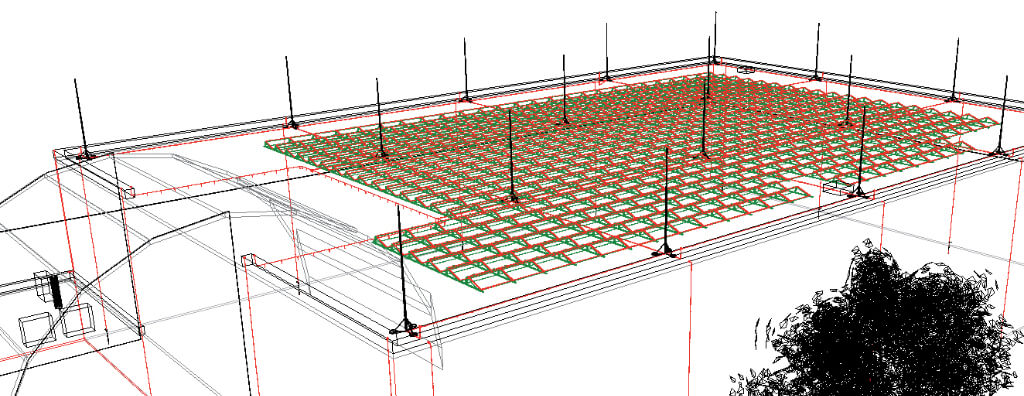
See how an LPS design is developed according to ABNT NBR 5419, including technical representation, risk analysis, air-termination, down conductors, grounding, SPDs, ART, and documentation.
Check it out!
An LPS design is the set of engineering documents and criteria that defines how a structure will be protected against the effects of lightning. It starts with risk analysis and establishes the air-termination solution, down conductors, grounding, equipotential bonding, protection of internal systems, and the documentation required for implementation, inspection, and maintenance.
The design must define whether protection measures are necessary, which protection level will be adopted, how LPS components will be positioned and sized, and how the system will be integrated with the structure, electrical installations, and internal equipment.
More than indicating the location of air terminals or conductors, the design must treat the LPS as a complete system. The solution involves coordination among architecture, structure, roofing, metallic elements, grounding, equipotential bonding, surge protective devices, cable routes, and inspection requirements.
Deliverables normally include drawings, design reports, specifications, installation and acceptance criteria, technical-responsibility records, and enough information for the system to be implemented, verified, maintained, and updated throughout the building lifecycle.
What Is an LPS Design?
An LPS design is the set of technical documents that defines the lightning-protection solution for a building. It specifies the air-termination, down-conductor, grounding, equipotential-bonding, and surge-protection measures needed to reduce risks caused by direct and indirect lightning effects.
In practice, the design guides implementation, inspection, maintenance, and system documentation. Without a design, installation tends to be based only on standardized or empirical solutions, increasing the risk of failures, incompatibilities with the structure, material waste, and lack of technical traceability.
A proper LPS design should consider building characteristics, height, geometry, roof, use and occupancy, regional lightning density, presence of people, sensitive equipment, critical services, internal electrical and electronic systems, grounding grid, equipotential bonding, the need for SPDs, down-conductor routes, inspection and maintenance points, technical documentation, and ART.
When Is an LPS Design Necessary?
An LPS design is necessary whenever technical analysis indicates relevant risk to the structure, people, internal systems, or continuity of operations. It may also be required in regularization, licensing, insurance, audits, inspections, expansions, renovations, and building-upgrade processes.
In many cases, the problem is not only the absence of an installed LPS, but having a system without design, documentation, ART, periodic inspection, or proper integration with grounding, SPDs, and equipotential bonding. When the system already exists, the assessment may involve LPS inspection and technical documentation or issuance of an LPS technical report, depending on the contracting objective.
The design is especially important in commercial buildings, industries, hospitals and clinics, schools, universities, public institutions, high-rise condominiums, logistics warehouses, data centers, technical rooms, metallic structures, environments with CFTV, access control, automation, telecommunications, and buildings with high occupancy.
Why Contract an LPS Design?
Contracting an LPS design allows the solution to be defined before implementation, using technical criteria, traceable documentation, and compatibility with applicable standards.
During the design phase, risks are evaluated, protection methods are defined, conductor routes are selected, components are sized, materials are specified, grounding points are indicated, equipotential-bonding connections are planned, and the need for surge protective devices is established.
Without this stage, problems may occur such as air terminals installed in unsuitable positions, insufficient down conductors, lack of integration with the grounding grid, lack of equipotential bonding, missing or incorrectly specified SPDs, incompatibility with roofs, metallic structures and façades, missing technical reports, absence of ART, difficulty issuing a technical report, and rejection during inspections or audits.
Need to develop or review an LPS design?
A3A Engenharia develops LPS designs with technical analysis, engineering documentation, coordination with grounding, SPDs, equipotential bonding, and the requirements of ABNT NBR 5419. If your building needs a design, upgrade, inspection, technical report, or LPS documentation, request a specialized assessment.
Contact A3A Engenharia’s technical team to understand the best path for regularizing or upgrading your building’s lightning-protection system.
How Is Risk Analysis Performed in an LPS Design?
Risk analysis is an essential stage of LPS design. It evaluates the probability and consequences of lightning striking the structure or affecting the building’s internal systems.
This analysis considers factors such as location, structure dimensions, occupancy type, lightning density, presence of people, economic value of assets, service continuity, internal electrical and electronic systems, and possible associated losses. For more detail, see the article on NBR 5419-2, risk analysis, and LPS risk management.
Based on this assessment, the need for an LPS and the applicable protection level are defined. This stage prevents both undersizing and oversizing of the solution.
In other words, risk analysis answers whether the building needs an LPS, which protection level should be adopted, which losses must be mitigated, which internal systems must be protected, which complementary measures are necessary, and which precautions must be adopted for SPDs, grounding, and equipotential bonding.
What Are the Stages of an LPS Design?
An LPS design normally involves a technical building survey, risk analysis, definition of the protection method, air-termination subsystem design, down-conductor design, grounding subsystem design, equipotential bonding, SPD specification, and technical documentation.
Technical Building Survey
At this stage, information is collected on architecture, structure, roof, height, façades, technical areas, electrical panels, existing grounding, electronic systems, and the building’s general conditions.
Existing documents may also be analyzed, such as drawings, electrical designs, single-line diagrams, previous reports, inspection reports, and photographic records.
Risk Analysis
Risk analysis defines the need for the system and the applicable protection level. It is the technical basis for justifying the protection measures adopted in the design.
Definition of the Protection Method
Based on the characteristics of the structure, the designer defines the most appropriate protection method, such as the protection-angle method, rolling sphere method, or mesh method, as applicable to the case.
Air-Termination Subsystem Design
The air-termination subsystem is responsible for intercepting lightning. It may use air terminals, rods, cables, bars, conductors, natural components of the structure, or air-termination meshes, depending on the defined technical solution. Selection of these components should consider the LPS structure and the building’s actual geometry.
Down-Conductor Design
Down conductors carry lightning current from the air-termination system to grounding. The design must define quantity, positioning, routing, clearances, fixings, connections, inspection points, and integration with the structure.
Grounding Subsystem Design
LPS grounding must allow lightning current to dissipate into the soil, reducing the risks of dangerous sparking, step voltages, touch voltages, and damage to internal systems.
The design must consider the grounding grid, rods, buried conductors, connections, inspection boxes, exothermic welds or appropriate connectors, and integration with the building equipotential-bonding system. Specification of grounding materials should consider application, durability, installation environment, and component compatibility.
Equipotential Bonding
Equipotential bonding or potential equalization reduces dangerous potential differences among exposed conductive parts, electrical systems, structures, piping, cable trays, racks, panels, busbars, and other conductive elements.
In LPS designs, it is essential to reduce the risk of internal sparking and improve integration among the LPS, grounding, electrical installations, telecommunications, and electronic systems.
SPD Specification
Surge protective devices are essential for protecting electrical and electronic systems against transient overvoltages. In the context of an LPS, the SPD must be coordinated with the electrical installation, grounding, and lightning protection zones.
The design must evaluate SPDs for the power supply, main panels, secondary panels and, where necessary, SPDs for data lines, CFTV, automation, and telecommunications, especially in buildings with sensitive electronic systems.
Technical Documentation
Technical documentation must enable implementation, inspection, verification, and maintenance of the system. It normally includes a descriptive report, drawings, construction details, bill of materials, technical specifications, diagrams, installation criteria, risk-analysis report, and LPS ART.
Relationship Among LPS, Grounding, SPDs, and Equipotential Bonding
A common mistake is to treat the LPS as an isolated system. In practice, lightning protection depends on integration among the external LPS, grounding, equipotential bonding, and surge-protection measures.
The external LPS intercepts and conducts lightning. Grounding allows current dissipation. Equipotential bonding reduces dangerous potential differences. SPDs protect electrical and electronic systems against transient overvoltages.
When these elements are not coordinated, the system may appear visually complete yet remain vulnerable to failures, equipment damage, electronic burnout, operational downtime, and safety risks. In building systems with racks, CFTV, access control, and telecommunications, integration with grounding and equipotential bonding in network infrastructure becomes a relevant part of the protection strategy.
Therefore, an LPS design must interface with the electrical design, grounding design, distribution panels, SPDs, telecommunications infrastructure, CFTV, access control, building automation, fire systems, metallic structures, equipotential-bonding busbars, maintenance documentation, and inspection.
What Should an LPS Design Include?
A well-structured LPS design should provide enough information for implementation, inspection, validation, and maintenance of the system.
Example of a minimum scope for an LPS design:
- risk-analysis report and definition of the protection level;
- drawings showing air-termination, down conductors, grounding, connections, and inspection points;
- descriptive report, calculation report, and material specifications;
- indication of equipotential bonding, SPDs, and interfaces with internal systems;
- criteria for implementation, inspection, technical acceptance, final documentation, and ART.
Main deliverables include a descriptive report, risk analysis, definition of the protection level, drawings with air terminals, meshes and conductors, down-conductor details, grounding-subsystem details, inspection points, measurement boxes, connections and joints, material specifications, bill of materials, equipotential-bonding details, SPD indication, coordination with electrical and electronic systems, installation recommendations, inspection criteria, and ART of the responsible professional.
LPS Design With ART
ART, the Technical Responsibility Record, links the service to the responsible qualified professional. In LPS designs, ART is important for formalizing technical responsibility for the design and the adopted criteria.
For the contracting party, ART contributes to document traceability, regularization processes, audits, and evidence that the work was developed by a qualified professional.
The existence of ART does not replace design quality, but it is an essential part of technical documentation for systems involving safety, assets, operational continuity, and standards compliance.
Difference Between LPS Design, Installation, Inspection, and Technical Report
An LPS design technically defines how the system should be implemented or upgraded.
Installation implements in the field what was defined in the design, using materials, routes, connections, and construction methods compatible with the technical documentation.
Inspection verifies the conditions of the existing system, assessing conservation, continuity, connections, component integrity, documentation, and compliance with applicable criteria.
An LPS technical report formally documents the assessment performed, recording the conditions found, nonconformities, measurements, evidence, recommendations, and technical conclusions. When resistance, continuity, or the condition of the grounding system must be evaluated, the engagement may also involve grounding measurement and a technical report.
These stages are complementary. An existing system may require inspection and a technical report. A new or inadequate system may require a design. A building with structural changes, renovations, expansions, or a change of use may require a technical review of the LPS.
Common Mistakes in LPS Designs and Installations
Among the most common mistakes are the absence of risk analysis, use of a standardized solution without considering the building, lack of coordination with architecture and structure, inadequate down-conductor routes, connections without inspection or maintenance, grounding without integration with the building system, lack of equipotential bonding, missing or incorrectly specified SPDs, lack of protection for data lines and electronic systems, absence of ART, lack of a technical report, missing as-built documentation, lack of periodic inspections, use of unsuitable materials, absence of inspection boxes, and failure to consider subsequent renovations and expansions.
When Should an Existing LPS Design Be Reviewed?
Review of an LPS design is recommended when there are structural changes, layout changes, building expansion, roof replacement, installation of solar panels, deployment of new electronic systems, change in building use, visible damage to the system, equipment failures, or lack of reliable technical documentation.
It is also recommended when the building has an old LPS without the original design, without ART, without risk analysis, without recent reports, or without a clear record of the installed components.
A technical review makes it possible to identify whether the system still meets the building’s conditions and remains compatible with current risks. When there are nonconformities or changes in conditions of use, the review may evolve into LPS maintenance and upgrading.
Is your LPS integrated with grounding, SPDs, and equipotential bonding?
In many buildings, a lightning-protection system exists but is not properly coordinated with grounding, electrical panels, equipotential-bonding busbars, SPDs, and internal electronic systems.
A3A Engenharia can assess the building’s technical condition and indicate whether the correct path is to develop a new design, review existing documentation, perform an inspection, issue a technical report, or propose upgrades.
Request an LPS technical assessment to verify integration among LPS, grounding, SPDs, and equipotential bonding before carrying out new installations or approving existing documentation.
LPS Design for Buildings With Sensitive Electronic Systems
Modern buildings contain increasingly connected electronic systems: IP CFTV, access control, building automation, structured networks, servers, IP telephony, alarm systems, fire detection, sound systems, Wi-Fi, IoT, and industrial equipment.
In these environments, lightning protection cannot be limited to the air terminal and down conductors. Conducted and induced surges, equipotential bonding, rack grounding, power-line protection, data-line protection, and SPD coordination must be evaluated.
This care is essential to reduce equipment burnout, lockups, loss of communication, system downtime, and intermittent failures that are difficult to diagnose.
How to Contract an LPS Design?
To contract an LPS design, the best approach is to gather basic information about the building and request an initial technical assessment.
Useful information may include the building address, architectural drawings, existing electrical designs, roof photos, electrical-panel photos, information about existing grounding, previous technical reports, history of failures or equipment burnout, information on installed electronic systems, insurer, audit, or inspection requirements, and the need for document regularization.
Based on this information, the engineering company can assess the scope, define the need for a technical visit, identify document gaps, and propose the best path for design, inspection, technical report, or upgrading.
A3A Engenharia: LPS Design, Diagnosis, and Upgrading
A3A Engenharia develops designs, diagnoses, technical reports, inspections, and technical upgrades related to LPS, grounding, SPDs, equipotential bonding, and electrical installations.
The technical approach considers the building as an integrated system, evaluating not only external lightning protection but also impacts on electrical and electronic systems, telecommunications, electronic security, automation, and operational continuity.
If your company needs to develop, review, regularize, or upgrade a lightning-protection system, rely on a specialized team to assess the scenario and indicate the most appropriate technical solution.
Technical references
[1] BRAZILIAN ASSOCIATION OF TECHNICAL STANDARDS. ABNT NBR 5419 — Protection against lightning. Consult the current series in the ABNT Catalog.
[2] INTERNATIONAL ELECTROTECHNICAL COMMISSION. IEC 62305 — Protection against lightning. Consult the official series in the IEC Webstore.
[3] FEDERAL COUNCIL OF ENGINEERING AND AGRONOMY. Technical Responsibility Record — ART. Consult the official guidance at Confea.
Frequently asked questions
It is the technical document that defines how a building will be protected against lightning, considering risk analysis, air-termination, down conductors, grounding, equipotential bonding, SPDs, technical documentation, and ART.
Not every building necessarily needs an LPS, but the need must be technically assessed through risk analysis and the conditions of the structure, occupancy, location, and internal systems.
In common language, many people use “lightning-rod design.” Technically, LPS design is more appropriate because the system includes air-termination, down conductors, grounding, equipotential bonding, SPDs, and technical documentation.
ABNT NBR 5419 is the main Brazilian normative reference for lightning protection. It provides criteria for risk analysis, physical protection of the structure, protection of internal systems, and complementary measures.
Yes. ART is important for formalizing the technical responsibility of the qualified professional responsible for the design or contracted technical service.
The design technically defines how the system should be implemented or upgraded. The technical report assesses the condition of an existing system, recording compliance, noncompliance, measurements, evidence, and recommendations.
Yes. Grounding is one of the essential LPS subsystems because it allows lightning current to dissipate. However, it must be integrated with equipotential bonding and the building’s other systems.
No. An SPD protects electrical and electronic systems against transient overvoltages, but it does not replace the external LPS. In many cases, LPS and SPDs must be designed in coordination.
Review is recommended for renovations, expansions, changes of use, installation of new electronic systems, addition of solar panels, system damage, missing documentation, or changes in the building’s risk conditions.
The design must be developed by a qualified professional with the technical competence to assess the building, apply the relevant standards, issue technical documentation, and register the corresponding professional responsibility.
Additional technical materials
- NBR 5419: LPS, risk analysis, grounding, SPDs, and technical documentation
- NBR 5419-2: risk analysis in LPS designs
- External LPS: air-termination, down conductors, and grounding
- LPS Grounding
- SPD: surge protection, NBR 5410, LPS, and grounding
- Equipotential Bonding or Potential Equalization
Additional technical materials
NBR 5419 and LPS cluster
Grounding, equipotential bonding, and SPDs
Related services and solutions
