Many facility managers still believe a Lightning Protection System (LPS) is simply a matter of mounting a rod on the rooftop, overlooking the critical requirements of NBR 5419. This is the single most common failure that leads to rejections during Fire Department inspections (AVCB) and to insurers refusing to honour claims following a lightning incident. […]
Check it out!
Many facility managers still believe a Lightning Protection System (LPS) is simply a matter of mounting a rod on the rooftop, overlooking the critical requirements of NBR 5419. This is the single most common failure that leads to rejections during Fire Department inspections (AVCB) and to insurers refusing to honour claims following a lightning incident.
Author’s Note:
Lightning protection demands both mathematical rigour and normative precision. As Technical Director of A3A Engenharia de Sistemas, I lead the engineering design and deployment management of LPS and Low-Voltage Electrical Installations across critical infrastructure sites. My practice combines exacting overvoltage protection engineering with strategic business judgment — ensuring every system delivers genuine safety and full regulatory compliance.
Electrical Engineer PMP/MBA
Massachusetts Institute of Technology / Babson College
The Importance of the Executive Design and Technical Accountability
Our benchmarking — built over nearly 30 years of work on critical infrastructure projects — consistently points to one non-negotiable premise: the effectiveness of an LPS is determined at the Executive Design stage.
Technical development must rigorously follow NBR 5419 at every stage, from the complex Risk Assessment (Part 2) through to the precise definition of material scope and system topology. Equally critical to correct sizing is ensuring that field installation maintains full fidelity to the engineering specifications. Any unvalidated deviation from the technical memorandum undermines the system’s protective integrity.
Engineering is an Exclusive Prerogative. LPS sizing is the exclusive technical prerogative of Electrical Engineers registered with the CREA, who must issue an ART (Technical Responsibility Annotation) for every project.
Attempting in-house execution or hiring unqualified labour without specialist engineering oversight transfers civil and criminal liability for any resulting incident directly to the facility or plant manager.
Understanding NBR 5419:2015 — Structure, Application and Related Standards
ABNT NBR 5419, last revised in 2015, is the mandatory standard governing Lightning Protection in Brazil. It is harmonised with IEC 62305 and constitutes the primary normative reference for LPS engineering design.
Its purpose is to define an external or structural system that provides controlled discharge paths, minimising structural damage, safeguarding human life and preventing failures in electronic systems.
Standard Structure:
- Part 1 — General Principles.
- Part 2 — Risk Management.
- Part 3 — Physical Damage to Structures and Life Hazard.
- Part 4 — Electrical and Electronic Systems (LPMS).
The Normative Ecosystem: The LPS must be engineered in compliance with NBR 5419 — Protection of Structures Against Lightning and, most importantly, NBR 5410 (Low-Voltage Electrical Installations). Additional standards serve as supporting references for specific decisions, such as material selection.
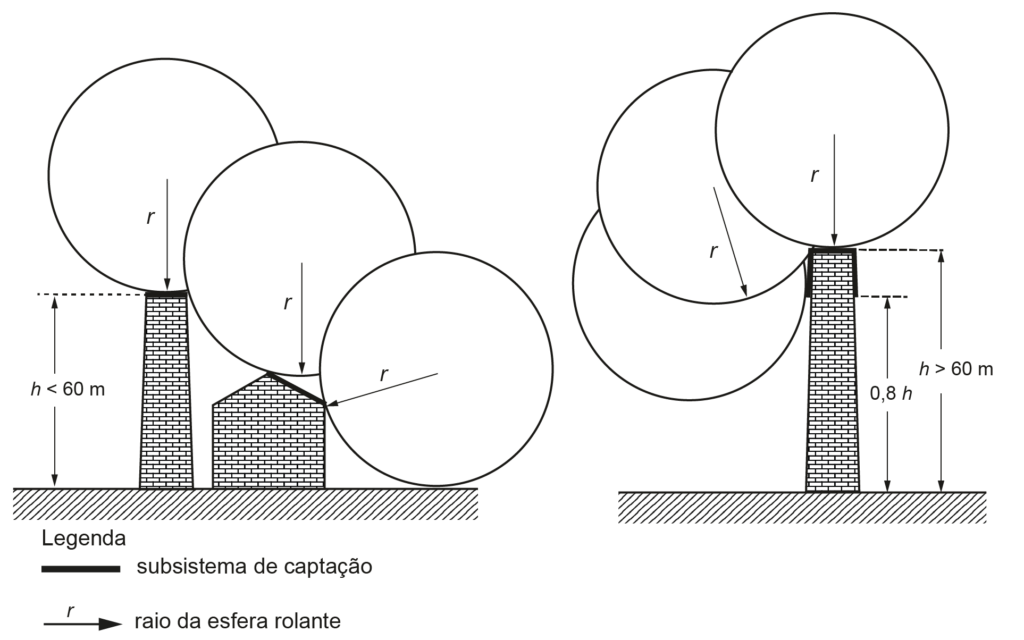
Source: ABNT NBR 5419
To ensure long-term performance and system efficiency, the responsible Engineer must specify materials that strictly comply with the following manufacturing standards:
- ABNT NBR 13571 (Grounding Rods): Only copper-clad steel rods with a High-Layer coating (minimum 254 microns) are acceptable. Commercial “thin-layer” rods tend to lose their coating during soil driving, accelerating oxidation and compromising the grounding system within a short timeframe.
- ABNT NBR 6524 (Hard-Drawn Copper Wire and Cable): Down conductors and bonding meshes must be manufactured from electrolytic copper with correct temper and stranding. Recycled or contaminated materials alter conductivity and mechanical strength, placing the entire installation at risk.
- ABNT NBR 9518 (Electrical Equipment for Explosive Atmospheres — General Requirements / Connectors): Together with NBR 5419-3 test protocols, this standard sets the performance criteria for connectors and clamps. Mechanical connections must pass both tensile and corrosion tests to ensure they will not loosen due to vibration or thermal expansion.
- Connection Reliability (Mechanical or Welded): The standard requires every connection to be electrically continuous and mechanically robust. High-pressure certified connectors (per NBR 9518/5419-3) are one valid option; for permanent, maintenance-free joints in critical grounding meshes, Exothermic Welding (molecular fusion bonding) is the preferred method due to its exceptional long-term stability.
Equipotentialization: Convergence Between NBR 5419 and NBR 5410
A serious conceptual error — still common in older installations — is the attempt to maintain separate earth systems: a “lightning ground,” an “electrical ground,” and an “electronics/instrumentation ground.” Physics and current standards are unambiguous: the grounding system must be unified.
This is precisely the point at which NBR 5419 and NBR 5410 mandatorily converge. While the LPS standard requires the dissipation of atmospheric discharge energy, the low-voltage installation standard requires that all metallic masses and protective conductors be bonded together to eliminate dangerous potential differences.
The Principle of Equipotentiality. Installation safety depends on potential equalisation. In practice, this means connecting all grounding meshes, concrete reinforcement steel, metallic pipework and the LPS to a common bonding point: the MEB (Main Equipotentialization Busbar).
Separating earth systems creates a hidden physical hazard within the installation. During a lightning discharge, the LPS mesh and the surrounding soil instantaneously rise to tens of thousands of volts, while an isolated electrical ground remains at a different potential level.
This enormous Potential Difference (PD) drives a violent surge current capable of melting cables, tripping or destroying circuit breakers, and burning sensitive electronic boards. In extreme cases, the voltage bridges air gaps inside the building, producing electric arcs and flashovers — representing an imminent fire and electrocution hazard for building occupants.
“Understand why Equipotentialization is fundamental to the safety and performance of your system — read our dedicated technical article.”
The 5 Pillars of NBR 5419 That Must Never Be Overlooked
In compliance audits, a safe LPS is validated against five foundational requirements. If any one of them fails, the entire system is compromised:
-
1. Mandatory Risk Assessment:
The non-negotiable starting point of every system, addressed in detail in Part 2 of the Standard. Without the probabilistic calculation that establishes the Lightning Protection Level (LPL), any physical installation lacks an engineering basis. -
2. Unified Grounding and Full Equipotentialization:
The mandatory convergence between NBR 5419 and NBR 5410. There is no such thing as an “isolated earth”; total integration of all bonding meshes is the only approach that eliminates dangerous potential differences. -
3. Air Termination and Protected Volumes:
The design must ensure complete protected volumes using the Rolling Sphere or Mesh Method, with no “shadow zones” that leave structural elements exposed to a direct strike. -
4. Internal LEMP Protection (Surge Protection):
Implementation of the Lightning Protection Zone (LPZ) concept with coordinated SPDs (Surge Protective Devices). Protecting the structure while neglecting electronic equipment is a critical strategic oversight. -
5. Continuous and Symmetrical Down Conductors:
The down conductor subsystem must provide low-impedance paths with proven symmetry and electrical continuity, enabling rapid and safe discharge of lightning current to earth.
Normative Compliance and Civil Liability
Full conformance with NBR 5419 is the foundation of legal security for any corporate environment — whether an office building, commercial centre or industrial complex. Non-compliance not only exposes the facility to physical hazards; it directly transfers civil and criminal liability for any incident to the responsible manager.
Passing regulatory inspections (Ministry of Labour and Fire Department) requires more than simply having a system installed. It is mandatory to maintain an up-to-date Installation Record File containing:
- LPS and Grounding Technical Report (including resistance measurements and continuity tests);
- Periodic Preventive Maintenance Log;
- Current Technical Responsibility Annotation (ART).
All documentation must be issued exclusively by a registered Electrical Engineer. Installations that are non-compliant or lack proper documentation face immediate denial of coverage under property insurance policies and interdiction during official inspections.
A3A Engenharia de Sistemas brings nearly 30 years of benchmarking on high-complexity projects to bear on these challenges, delivering the complete engineering solution — from design through to full legal documentation.
IS YOUR FACILITY PROTECTED — OR EXPOSED TO LEGAL RISK?
Ensure your operation meets full technical compliance. Talk to our LPS and EMC engineering specialists.
CONTACT OUR ENGINEERING TEAM 📲📚 Deepen Your Knowledge and Achieve Full Compliance
To ensure the complete safety of your infrastructure, our engineers recommend the following technical guides:
-
➤ LPS and Grounding Technical Report
Understand which items are assessed during inspection, why resistance measurements matter, and how to avoid penalties. -
➤ Executive LPS Engineering Design (NBR 5419)
Learn how our engineers size safe, compliant systems through rigorous risk-level calculation. -
➤ Equipotentialization and Potential Equalization
The essential technique that prevents surge damage to servers and sensitive electronic equipment. -
➤ NBR 5410: Low-Voltage Electrical Installations
The mandatory companion standard for complete electrical safety compliance in any building.
